


 4.9
4.9 4.5
4.5Axon.dev calculates that technical debt in a one-million-line codebase costs up to $1.5 million over five years, consuming roughly 27,500 developer hours. Engineers who resolve that debt save their companies hundreds of thousands of dollars, yet their resumes typically read “debugged code” or “resolved production issues” with zero financial context.
TL;DR: Debugging and troubleshooting work generates enormous business value that most resumes fail to communicate. Attaching specific metrics (hours saved, downtime reduced, cost avoided) to every debugging bullet transforms invisible maintenance work into career capital that hiring managers can actually evaluate. The DICE method (Diagnosis, Impact, Correction, Effect) gives you a repeatable structure.
Why “Debugged Code” Reads as Filler
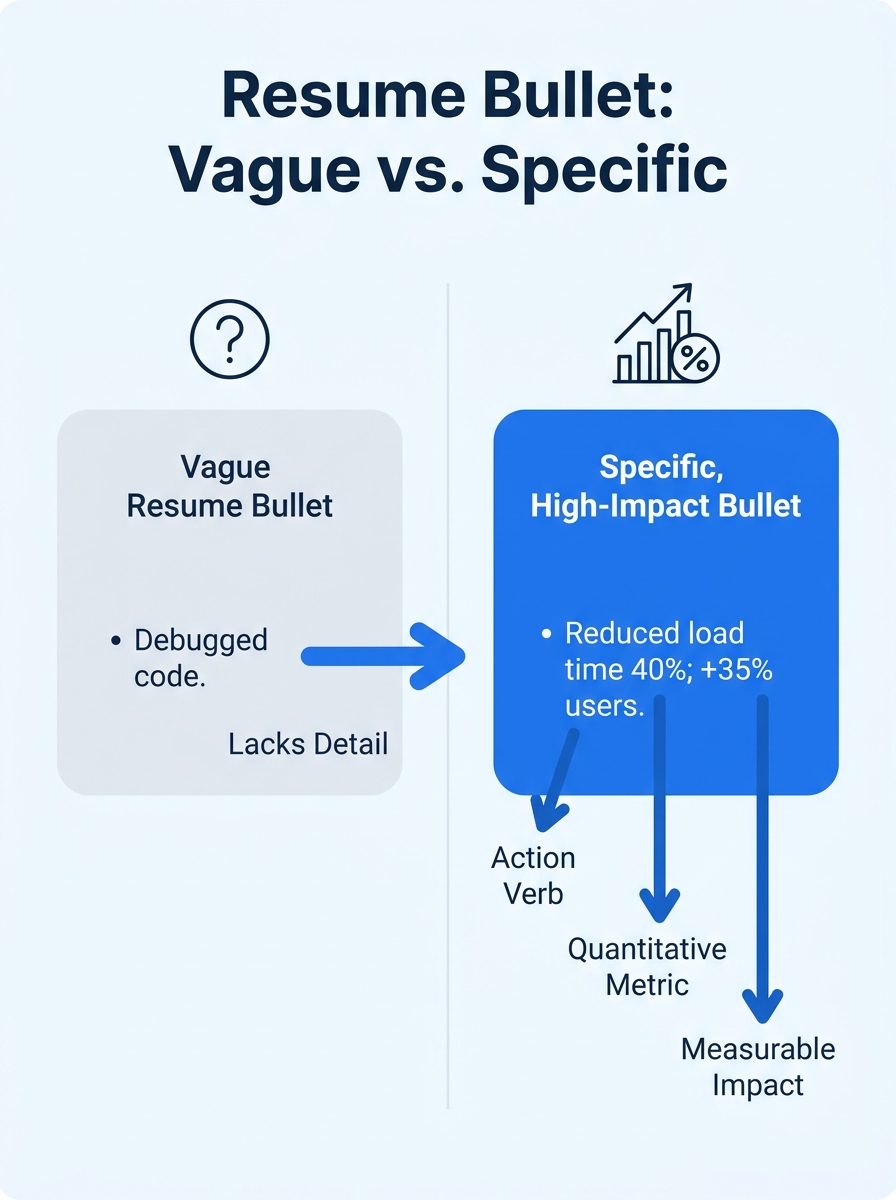
Hiring managers scan resumes in roughly 11 seconds, according to screening-process data tracked across recruiting teams. In that window, a bullet that says “Debugged application code and resolved issues” communicates almost nothing. The reader can’t tell whether you fixed a typo in a config file or saved a $200,000-per-hour production system from a cascading failure.
The problem is structural, not cosmetic. Martin Fowler, chief scientist at ThoughtWorks and author of Refactoring, has argued that “a mess is not a technical debt,” drawing a sharp line between careless code and deliberate engineering trade-offs. Your resume needs to make the same distinction. If you spent three months reducing defect density across a payment processing pipeline, the bullet point should carry the weight of that decision, not flatten it into “fixed bugs.”
Enhancv’s 2026 incident manager resume guide recommends “three to five concise bullet points showing what you owned, how you executed, and what outcomes you delivered.” That formula applies to every debugging and troubleshooting role: ownership, execution, outcome. The challenge is that most engineers default to describing only the execution step.
Metrics That Already Exist in Your Work Logs
You probably have more troubleshooting impact metrics available than you think. The data lives in tools you already use daily. Profit.co’s technical debt measurement guide identifies seven core metrics worth tracking: Technical Debt Ratio (TDR), code churn, cycle time, defect density, code duplication, maintainability index, and failed CI/CD builds. Each one translates directly into a resume number.
GetDX, a developer productivity research firm, recommends combining sprint analytics with incident tracking to identify debt-related failures. Their approach uses build and test monitoring to catch performance degradation over time. If your team tracks any of these, you’re sitting on resume gold:
- Defect density before vs. after your work (e.g., “reduced defect density from 12.3 to 4.1 per 1,000 lines of code”)
- Cycle time reduction (e.g., “cut average deployment cycle from 14 days to 6 days by resolving 3 critical dependency conflicts”)
- Failed CI/CD build rate (e.g., “decreased failed builds from 22% to 7% over two quarters”)
- Mean time to resolution (MTTR) for production incidents you handled
- Hours saved per sprint from refactoring work (one developer in a widely-cited engineering forum estimated their refactoring saved approximately 5 SWE days per month, which translates to 60 engineering days annually)
Mendix recommends that teams allocate 20–30% of development time to managing technical debt. If your role fell within that allocation, you can frame it as a defined strategic initiative, not background noise.
Tip: Check your Jira, PagerDuty, Datadog, or equivalent tool for historical incident data. Pull the date range, count of incidents, severity levels, and resolution times. These four data points alone can populate 3–5 strong debugging resume bullets.
Rewriting Debugging Bullets, Before and After
The gap between what ATS systems parse and what hiring managers actually read makes this translation work doubly important. Your bullet needs to pass keyword filters AND convince a human in seconds. Here’s what the rewrite process looks like in practice.
Before: “Debugged and optimized application code.” After: “Diagnosed memory leak in payment gateway service handling 14,000 daily transactions; implemented connection pooling fix that reduced average response time from 1,200ms to 340ms, eliminating $8,400/month in timeout-related chargebacks.”
Before: “Troubleshot production issues and resolved tickets.” After: “Resolved 47 Severity-1 production incidents across Q3–Q4, reducing mean time to resolution from 4.2 hours to 1.6 hours and saving an estimated 122 hours of cumulative team downtime.”
Before: “Reduced technical debt in legacy systems.” After: “Led 6-sprint refactoring initiative targeting 3 legacy microservices with a combined Technical Debt Ratio of 38%; reduced TDR to 11%, cutting average build time from 23 minutes to 9 minutes.”
Teal’s resume analysis database includes an example of a senior engineer who described debugging work as having “successfully debugged and optimized over 50 applications, resulting in an average of 30% performance improvement.” That 30% figure does real work on the page. Compare it to “improved application performance,” which communicates nothing quantifiable.

The DICE Method for Debugging Resume Bullets
Every production issue resolution resume bullet should follow a four-part structure. I’m calling it DICE because each element adds specificity that hiring managers can evaluate:
- D — Diagnosis: Name the root cause you identified. “Memory leak in connection handler” beats “application issue.” This shows analytical depth.
- I — Impact: Quantify the business cost of the problem before you fixed it. Revenue lost per hour of downtime, number of users affected, SLA violations incurred. Steve McConnell, author of Code Complete and CEO of Construx Software, distinguishes between intentional technical debt (strategic trade-offs) and unintentional debt (oversight). Naming the impact shows you understand which category your work addressed.
- C — Correction: Describe your technical action in 8–12 words. Enough detail to prove competence, not so much that non-technical readers lose the thread.
- E — Effect: State the measurable improvement. Percentages, dollar figures, time saved, incidents prevented.
A DICE-formatted bullet reads like this: “Diagnosed (D) cascading timeout failures across 3 microservices affecting 9,200 daily users (I); implemented circuit-breaker pattern with exponential backoff (C), reducing Severity-1 incidents from 11/month to 2/month and recovering $34,000 in monthly SLA penalties (E).”
This structure works for system engineer resume quantification at every level, from junior support roles to principal engineers. The scale of the numbers changes; the structure doesn’t.
| Resume Element | Weak Version | DICE Version | What Changed |
|---|---|---|---|
| Root cause | “Fixed bug” | “Diagnosed race condition in auth service” | Specificity of diagnosis |
| Business context | None | “Affecting 12,000 login attempts/day” | Impact quantified |
| Technical action | “Resolved issue” | “Implemented mutex locking on session handler” | Precision of correction |
| Outcome | “Improved reliability” | “Reduced auth failures from 3.2% to 0.1%” | Measurable effect |
A bullet that says “debugged application code” tells a hiring manager you showed up to work. A bullet that says “reduced auth failures from 3.2% to 0.1% across 12,000 daily login attempts” tells them you’re worth hiring.
Technical Support Roles Need Different Translation
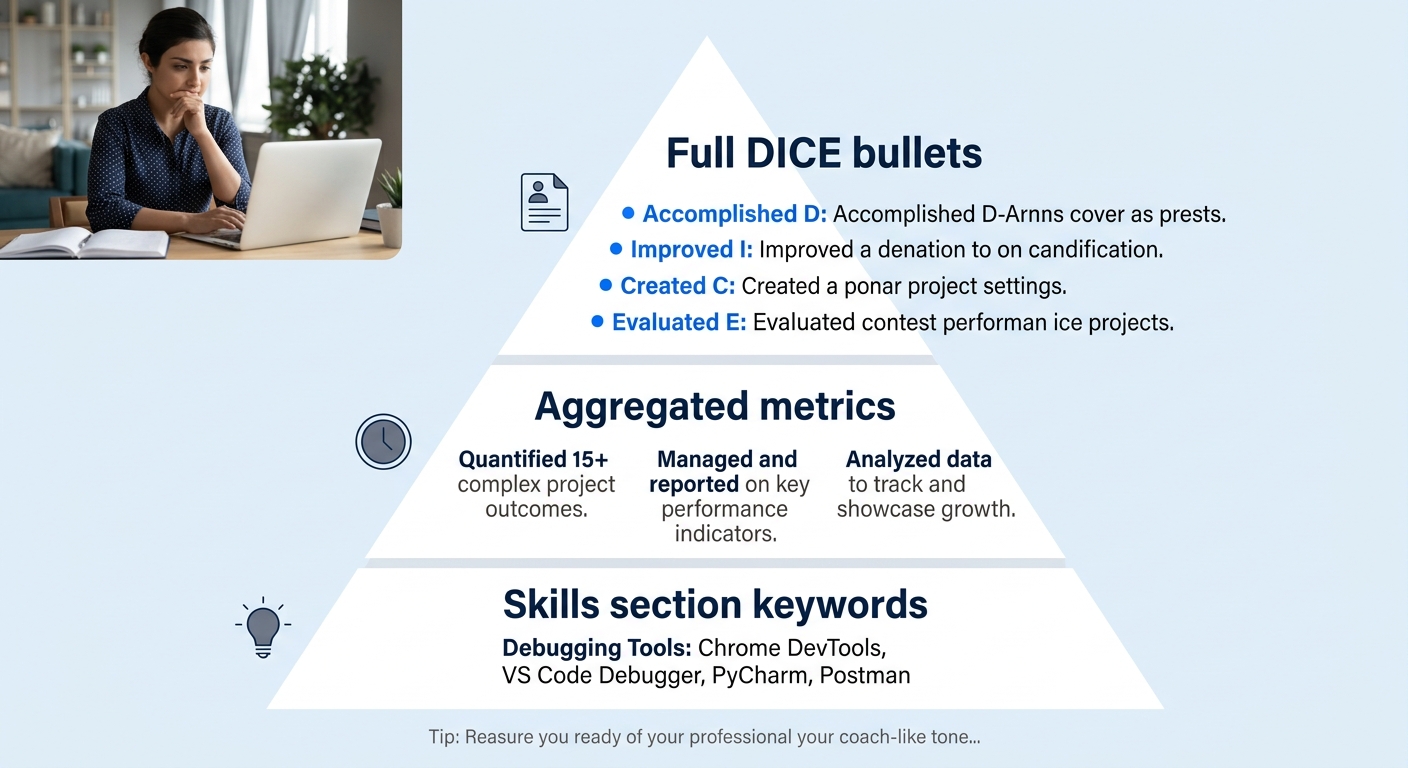
The DICE method applies to strong action verbs and direct phrasing, but technical support resume language requires some adaptation. Support engineers and IT operations staff often handle 15–30 tickets per day, making individual incident storytelling impractical. The solution is aggregation.
CVwizard’s problem-solving resume guide notes that IT professionals should use “Troubleshooting” and “Debugging” as explicit keywords on their resumes alongside specific metrics. ResumeBuilder.com’s career center advises candidates to “emphasize related capabilities, offer specific examples, tailor words to the job description, and quantify results when possible.”
For high-volume troubleshooting roles, aggregate bullets work better than individual incident stories:
- “Resolved average of 23 Tier-2 escalation tickets per week across Windows, Linux, and macOS environments, maintaining 97.4% first-contact resolution rate against 90% SLA target.”
- “Reduced recurring VPN connectivity incidents by 62% (from 34/week to 13/week) by identifying and documenting 5 root-cause configuration patterns, creating runbook entries that cut Tier-1 resolution time from 18 minutes to 6 minutes.”
Engineers repositioning after layoffs face this translation challenge acutely. If you’re rebuilding your resume after a tech industry reduction, quantified troubleshooting bullets become your strongest differentiator against candidates who describe the same work generically.
The 80/20 rule (Pareto principle) applies to your resume the same way it applies to technical debt prioritization: roughly 20% of your debugging accomplishments generated 80% of the business value. Find those top 3–4 wins and give them full DICE treatment. Everything else can be aggregated or dropped.
Where You’ll Need Help From Your AI Resume Builder
If you use a resume builder with AI suggestions, run every debugging bullet through an authenticity audit before submitting. AI tools tend to strip technical specificity in favor of generic phrasing. A builder might suggest “improved system performance through debugging efforts” when your actual accomplishment was “reduced P99 latency from 890ms to 210ms by identifying and resolving 3 N+1 query patterns in the order processing pipeline.” The generic version passes ATS filters. The specific version gets you interviews.
VisualCV’s troubleshooting skills database emphasizes “problem analysis: breaks down complex issues into manageable parts to identify root causes” as the top-ranked troubleshooting competency. That’s the diagnosis step of DICE. If your resume builder outputs bullets that skip straight to “resolved issues,” you’ve lost the analytical component that separates senior candidates from junior ones.
What the Data Doesn’t Tell Us
The $1.5 million figure for technical debt costs and the 27,500-hour equivalent come from aggregate estimates across codebases of a specific size. Your individual contribution to reducing that cost is harder to isolate. If three engineers worked on a refactoring initiative, attributing 100% of the outcome to yourself on a resume crosses into dishonesty; attributing 0% leaves you invisible.
The honest middle ground requires documentation. Track your pull requests, your incident response logs, your specific commits. When Mendix says 15–20% of each sprint should go to debt reduction, note which sprints your work fell into and what the before-and-after measurements showed. The best debugging resume bullets emerge from engineers who logged their work in real time, not from those trying to reconstruct metrics six months later.
One gap remains in all the resume guidance available: there’s no reliable data on how hiring managers weight debugging accomplishments against feature-development accomplishments. Anecdotally, engineering managers say they value reliability work highly. But until someone publishes a controlled study comparing callback rates for maintenance-focused resumes versus feature-focused resumes, we’re working from reasonable inference, not proof. If you’re quantifying infrastructure projects, the data migration resume framework offers a parallel approach for that category of invisible-but-valuable work.
What we do know, backed by every piece of resume research available, is that specificity wins. A 30% performance improvement figure on a resume outperforms “improved performance” every time. The numbers are yours. Use them.