

 4.9
4.9 4.5
4.5Employment gaps carry less stigma in 2026 hiring than they did before the pandemic, but job applicants should still address career breaks honestly and highlight transferable skills gained during time away from formal positions, according to Andy Decker, CEO of Goodwin Recruiting, in comments published June 26 by the Times Leader.
TL;DR: Recruiters now expect candidates to explain employment gaps by emphasizing volunteer work, certifications, and family responsibilities gained during breaks—approaches that have become standard as remote work and pandemic-era caregiving normalized career pauses.
Extended periods between jobs have become far more common following the COVID-19 pandemic, when many workers left positions to care for children or relatives, Decker told the Associated Press. Some candidates now list these periods on resumes as “career break” or “family responsibility,” he said.
Job applicants can expect questions about employment history lapses to surface during screenings and interviews, whether they lost positions during mass layoffs or needed to leave to care for ill loved ones. The shift toward skills-based hiring has made gaps less disqualifying than in previous labor markets, but candidates still must prepare structured explanations.
Transferable Skills Replace Perfect Timelines
Employers now focus more on demonstrable skills and results than on uninterrupted career paths, Decker said. “You have to address it honestly and directly,” he stated. “Make sure that you’ve included anything you did during that time. Did you get certifications? Did you volunteer?”
Monique Di Liberto, 57, put her career as a classically trained opera singer on pause for 17 years to raise her children while her husband built a chiropractic practice. When she reentered the workforce, Di Liberto lacked traditional 9-to-5 job experience but reviewed her activities for skills that would translate into work environments, according to the Times Leader report.
Serving as PTA president at her children’s school required managing budgets and presenting project plans to the school board, Di Liberto told the Associated Press. She also handled budgeting, software rollouts, and hiring for her husband’s business. Career coaches have recommended honest gap explanations as resume breaks lose stigma across industries.
One interviewer told Di Liberto her resume “was so different than anything I had ever seen. I needed to see the person who created this.” Di Liberto proposed a monthlong trial as an administrative assistant, saying: “I recognize that you probably are getting resumes of people who are far more qualified than me, but I would challenge that they are not as tenacious and driven as me.”
The company hired her. Over the next decade she was promoted multiple times and recruited away by other employers, eventually working up to head of client services at an artificial intelligence company. Di Liberto said she was asked about her 17-year employment lull each time she interviewed for a new position.
Volunteering and Certifications Fill Resume Whitespace
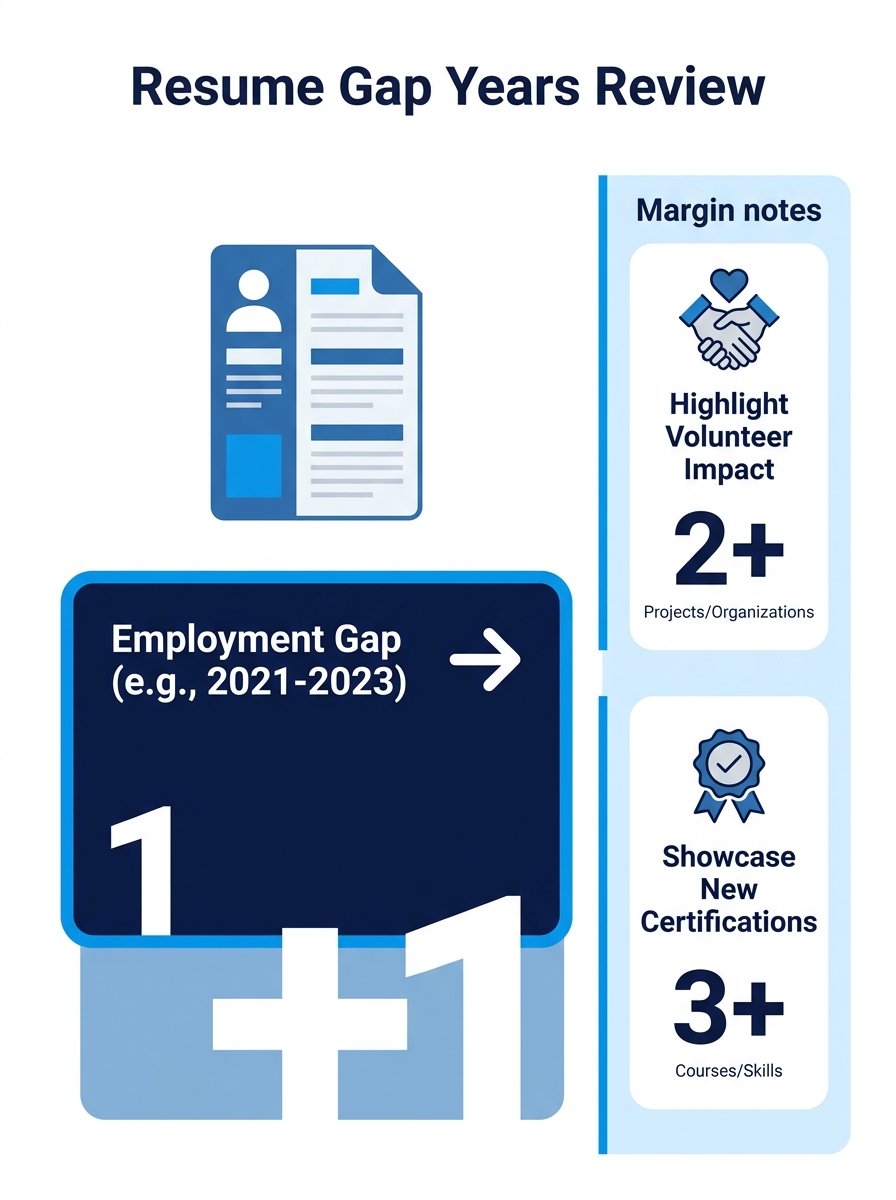
Volunteer work at nonprofit organizations offers a practical way to keep professional skills current during career breaks, Decker said. Employers view these experiences as legitimate additions to employment history when they demonstrate relevant competencies.
Laura Sandvik left a marketing job to care for her mother and later her children, then highlighted in her LinkedIn profile the soft skills she gained from those experiences. “I have no regrets about those choices. They strengthened my patience, perspective, and sense of responsibility,” Sandvik wrote in her profile, according to the Times Leader. The transferable skills translation framework provides structured methods for converting caregiving and volunteer experience into ATS-friendly resume language.
Baura Zia, 35, was laid off in 2022 shortly after returning from maternity leave. She spent the next three years raising her two children full-time. On her resume, Zia describes those years as a “parenting gap” and states that she also moved across the country during that period.
When Zia decided to find a part-time job after her son’s first birthday, she explained during interviews that her previous organization didn’t let her go over performance issues but because it lost the contract she was working on. “Having grace with yourself is really important,” Zia said. “It’s not a flaw to have a career gap. If anything, you’ve grown so much from that.”
Layoff Explanations Should Be Direct, Not Defensive
Candidates who lost jobs due to restructuring or layoffs don’t need to volunteer that information on a resume but should be honest if an interviewer asks why they left, Decker said. He suggested simple, factual responses: “I would simply say, ‘I was one of 270 people caught up in this reduction of force,’ or if you made it through a few rounds of layoffs, say, ‘Over two years we had five rounds of reductions in force, I made it through four, I was caught up in the fifth.'”
Practice responses before interviews and avoid negativity such as blaming the employer, Decker advised. “Own it, acknowledge it and move on,” he said.
Zia told the Times Leader that losing her job in 2022 “was honestly a blessing in disguise” because she spent three years raising her children full-time. During her job hunt, she sent messages to people she found online to ask about their experience working at companies where she’d applied. Many didn’t reply, but some did.
Strategy Implications
The reduced stigma around employment gaps creates opportunity for career returners, but only if they prepare structured explanations that emphasize growth during time away. Recruiters now expect candidates to frame gaps as intentional career breaks rather than unexplained absences—a shift that rewards honesty but still requires strategic presentation.
Job seekers with gaps should audit their break periods for quantifiable achievements: budgets managed through volunteer boards, certifications earned, or caregiving that developed project-management skills. The interviewer who hired Di Liberto after a 17-year pause didn’t overlook the gap—she valued the unconventional path because Di Liberto translated it into relevant competencies. The transferable skills resume trap shows why career changers fail when they rely on vague skill claims instead of concrete examples.
For layoff survivors, the practice-before-interview guidance matters more than the specific phrasing. Decker’s recommended responses work because they state facts without defensiveness—a tone that signals professional resilience rather than victimhood. Candidates who blame former employers or hedge about circumstances trigger concerns about judgment and accountability. The pattern across Di Liberto, Sandvik, and Zia: each acknowledged gaps directly, then pivoted to what they gained.