


 4.9
4.9 4.5
4.5On April 30, the New York State Senate passed a bill that would force employers to disclose whether they actually intend to hire someone for positions they advertise. The same day, a Resume Genius survey of 1,000 active U.S. job seekers found that 67% report being haunted by ghost jobs during their search. These two data points arrived within hours of each other, and together they frame a problem that has been quietly warping the job market for years: a significant share of the positions you’re tailoring your resume for may never have been real in the first place.
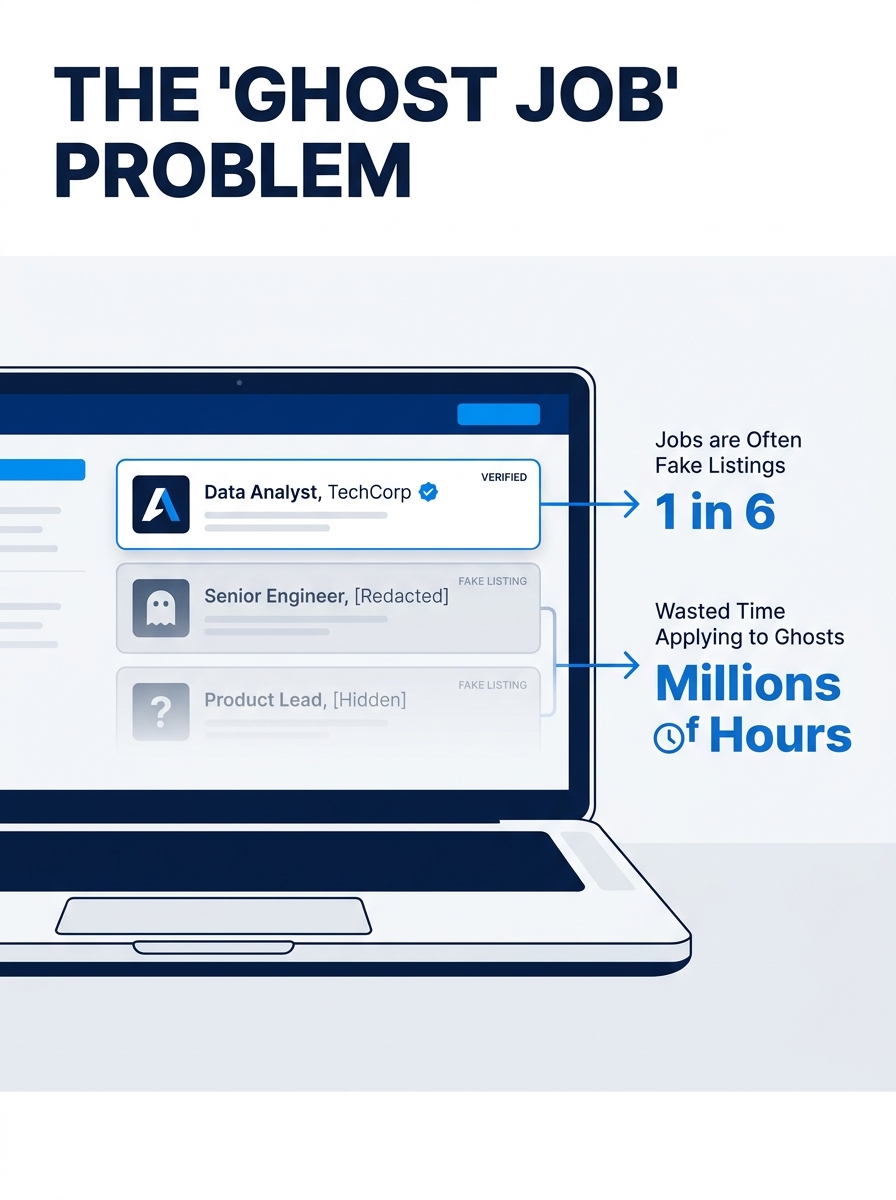
Ghost jobs are listings posted by companies with no genuine intention to fill them. Some exist to build a pipeline of candidates for hypothetical future openings. Others signal growth to investors or satisfy internal HR benchmarks. A few, as the DOJ recently alleged against Cloudera, serve to create the appearance of an open search while the outcome has already been decided. And then there’s an entirely separate category of outright scams, where fake recruiters impersonate real companies to steal money or personal data. For anyone spending 45 minutes customizing a resume per application, the question of whether anyone is reading it on the other end has become unavoidable.
The Scale Has Gotten Harder to Ignore
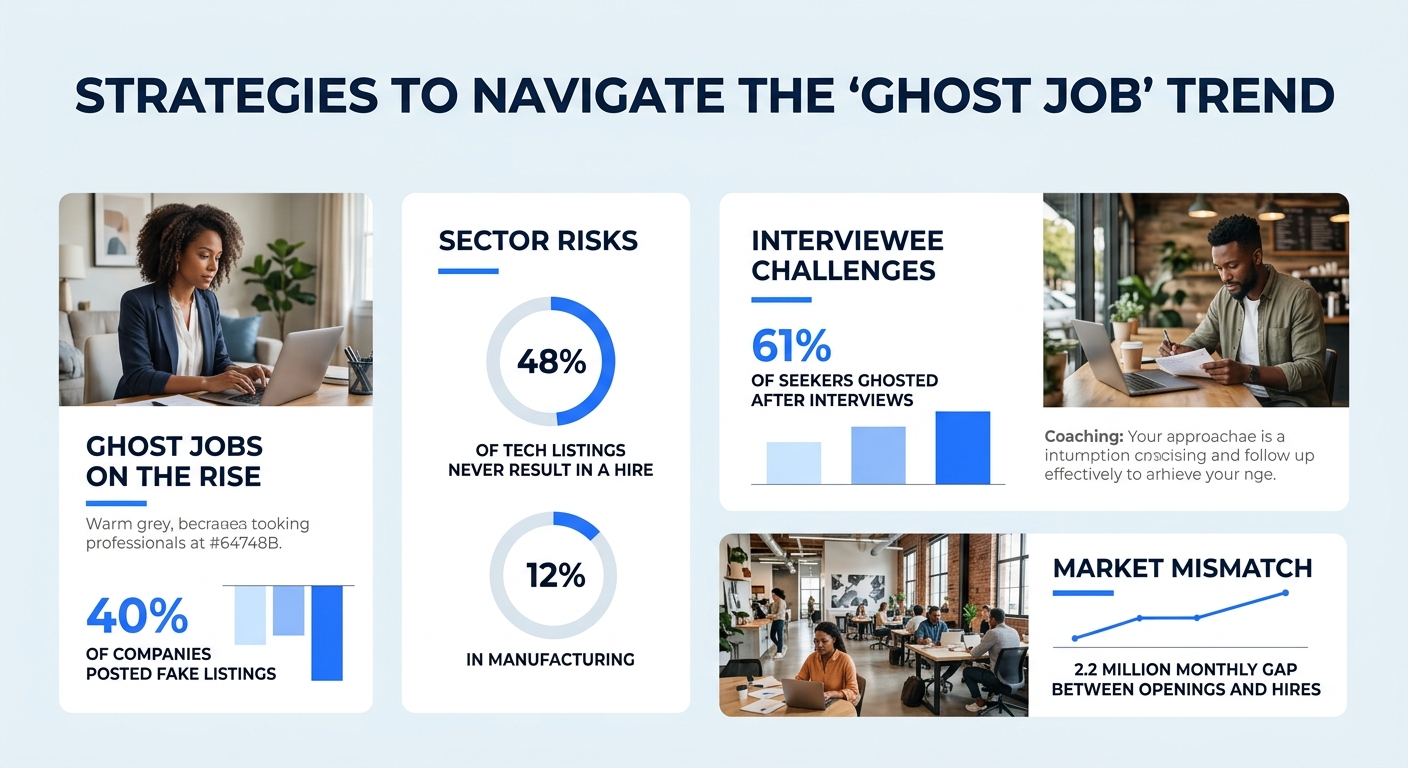
The numbers have accumulated to the point where dismissing ghost jobs as an edge case is no longer credible. According to a ResumeBuilder survey reported by CNBC, four in ten companies admitted to posting fake job listings in 2024, with three in ten maintaining at least one ghost listing at the time they were surveyed. Bureau of Labor Statistics data paints a complementary picture: since the beginning of 2024, job openings have outnumbered actual hirings by more than 2.2 million per month, a gap that ghost postings help explain. The Greenhouse 2024 State of Job Hunting report found that 61% of job seekers have been ghosted after a job interview, a nine percentage point jump since April 2024, with historically underrepresented job seekers experiencing it at even higher rates.
The distribution isn’t even across industries. Analysis suggests the technology sector carries the highest concentration, with roughly 48% of open tech listings never resulting in a hire. Manufacturing sits at roughly 12%. If you’re searching in tech, nearly half the listings you encounter may be phantoms. That’s a staggering proportion, and it means your fake job postings resume strategy needs to account for a reality where the default assumption about any listing should be skepticism, not trust.
The regulatory response is starting to catch up. Ontario’s Working for Workers Act, enforced since January 1, 2026, requires employers with 25 or more employees to disclose whether a job vacancy is real, with fines reaching CAD $100,000 for violations. New York’s Senate bill takes a similar approach. California’s AB 1251, which would mandate comparable disclosures, stalled in 2025 with no public update since. Legislation helps, but it covers only a fraction of the job market, and enforcement will take time. For now, ghost jobs detection is largely the job seeker’s responsibility.
Vetting a Listing Before You Spend an Hour on It
The most expensive thing about ghost jobs isn’t the emotional frustration. It’s the time. If you’re sending 8 to 12 tailored applications per day, which is the range that tends to balance quality and momentum according to job search communities on Reddit, and a third of those listings are ghosts, you’re losing three to four hours per week customizing materials that will never reach a human. Application effort optimization starts with a pre-application screen, a set of checks that takes five minutes but can save you the 45-minute tailoring cycle entirely.
Start with the company’s own careers page. If the role appears on a job board but not on the employer’s official site, that’s a strong signal something is off. The Social Security Administration’s Choose Work program specifically recommends this step, and it’s the single fastest filter available. Cross-reference the company on LinkedIn: look at whether employees have been added recently, whether the hiring manager or recruiter is identifiable by name, and whether the company has posted about the role on its own feed. Postings older than 30 days without updates deserve extra suspicion, particularly when paired with vague descriptions that read like they could apply to any company in the sector.
Glassdoor and similar employer review sites matter here too. The Interview Guys’ ghost job detection checklist recommends looking for patterns of complaints about bait-and-switch job postings or misleading recruitment practices before you ever submit an application. If multiple reviewers mention applying to roles that seem to vanish, you’ve found a company whose listings merit extra job search verification tactics. And for the truly diligent, a quick news search for the company’s name plus terms like “layoffs,” “hiring freeze,” or “restructuring” can reveal that the role you’re considering was posted during a period when the company was actually shrinking. A job listing that went live the same week as a 15% workforce reduction is almost certainly a ghost.
Tip: Before tailoring your resume to any listing, spend five minutes on this sequence: check the company’s own careers page, search LinkedIn for the hiring manager by name, and Google the company plus “layoffs” or “hiring freeze.” If any step raises a flag, move on.
One verification tactic that’s gaining traction is direct outreach. Messaging a recruiter or hiring manager on LinkedIn before applying accomplishes two things: it confirms the role is active, and it turns your eventual application into a warm submission rather than a cold one. Referred candidates are roughly four times more likely to receive an offer than cold applicants, so the five minutes you spend on a LinkedIn message may be worth more than the 45 minutes you’d spend rewriting your summary section. If you’re working on strengthening your LinkedIn presence for recruiter visibility, that outreach becomes even more natural.
Redirecting Your Resume Energy
Once you accept that a meaningful percentage of listings are ghosts, the rational response is to change how you distribute your effort. The spray-and-pray approach, where you send a lightly modified resume to 30 or 40 listings a day, becomes even more self-defeating in a market where a third of those listings are dead ends. You’re diluting your quality across a pool contaminated with phantoms.
The spray-and-pray approach becomes even more self-defeating in a market where a third of those listings are dead ends.
The better model invests more time per application but applies to fewer, verified opportunities. Get clear on what you’re actually looking for before you send a single application, and write it down. That clarity becomes your search compass and your first filter against ghost postings, because the vaguer your own criteria, the more easily a vague ghost listing can slip through and waste your time. When you do identify a listing that passes your verification checks, give it the full treatment: a tailored summary, keyword alignment with the job description, and measurable impact bullets that speak directly to the role’s requirements. This is where the sections that drive interview callbacks earn their keep, because when a real human is reviewing your materials, precision stands out.
There’s a secondary benefit to this approach. Hiring authenticity vetting forces you to research companies more deeply before applying, which means you’ll arrive at any interview with significantly more context than candidates who applied blind. You’ll know the company’s recent trajectory, its hiring patterns, and whether its public narrative matches its actual behavior. That preparation shows up in interviews, where storytelling drawn from genuine knowledge outperforms rehearsed credential lists every time. The ghost job problem, paradoxically, rewards the candidates who slow down.
And if you’ve been relying on AI tools to speed up your resume tailoring, this is a moment to reconsider how you’re using them. The tension between AI polish and authentic personal branding becomes sharper when your application volume drops and each submission carries more weight. A resume that reads like it was generated by the same tool everyone else is using won’t differentiate you in a smaller, curated batch of applications. Use AI for structural feedback and keyword gap analysis, but make sure the voice and specifics on the page are unmistakably yours.

The Uncomfortable Part
Legislation like New York’s Senate bill and Ontario’s Working for Workers Act represents genuine progress, but the enforcement gap remains wide. Ontario’s law has been active for four months. Whether it has materially reduced ghost postings there is unclear, because no public audit data exists yet. New York’s bill hasn’t been signed. California’s effort stalled. And these measures address only one category of ghost job: the corporate pipeline-building kind. They do nothing about outright scams, which are surging as AI makes it trivially easy to generate convincing fake postings at scale, or about the structural incentive for companies to advertise openings they aren’t seriously filling.
The deeper discomfort is that ghost jobs shift real costs onto job seekers while generating real benefits for employers. Companies accumulate resumes, project growth optics, and keep their options open, all at zero cost to themselves. The job seeker, meanwhile, spends hours tailoring materials, managing hope, and wondering why they’re not hearing back. The time you spend on application effort optimization and ghost jobs detection is time you shouldn’t need to spend. The fact that you do reflects a market design problem, not a personal strategy failure. You can find more career advice and resume guidance across the ResumeWriting.net blog, but no amount of individual optimization fully solves a systemic issue where a third of the opportunities you see aren’t real. The best you can do right now is verify before you invest, protect your time like the finite resource it is, and recognize that silence after an application often says more about the listing than it does about you.