


 4.9
4.9 4.5
4.5The universal resume advice to “quantify everything” produces its worst results in exactly the roles where people try hardest to follow it. Administrative assistants, customer service representatives, office coordinators, executive assistants, social workers, event planners, HR generalists: these professionals hear “add metrics” and respond by either inventing percentages they can’t defend in an interview or retreating to limp duty descriptions like “Responsible for managing office supplies.” Both outcomes hurt. The problem isn’t that these roles lack impact. The problem is that conventional resume wisdom was built for sales reps and project managers, and everyone else has been trying to squeeze their work into a template that was never designed for them.
This article defends a specific claim: specificity-driven resume language outperforms fabricated metrics every time, and most roles that seem unquantifiable actually contain measurable signals hiding in plain sight. You’ve been trained to look for the wrong ones.
The Fabrication Trap: Why Invented Percentages Backfire
A 2024 survey cited by Resume.io found that 34% of hiring managers discard resumes with few or no measurable results. That statistic gets repeated endlessly in career advice columns, and it has created a perverse incentive: candidates stuff their bullets with numbers they can’t verify, hoping to clear the “metrics” bar.
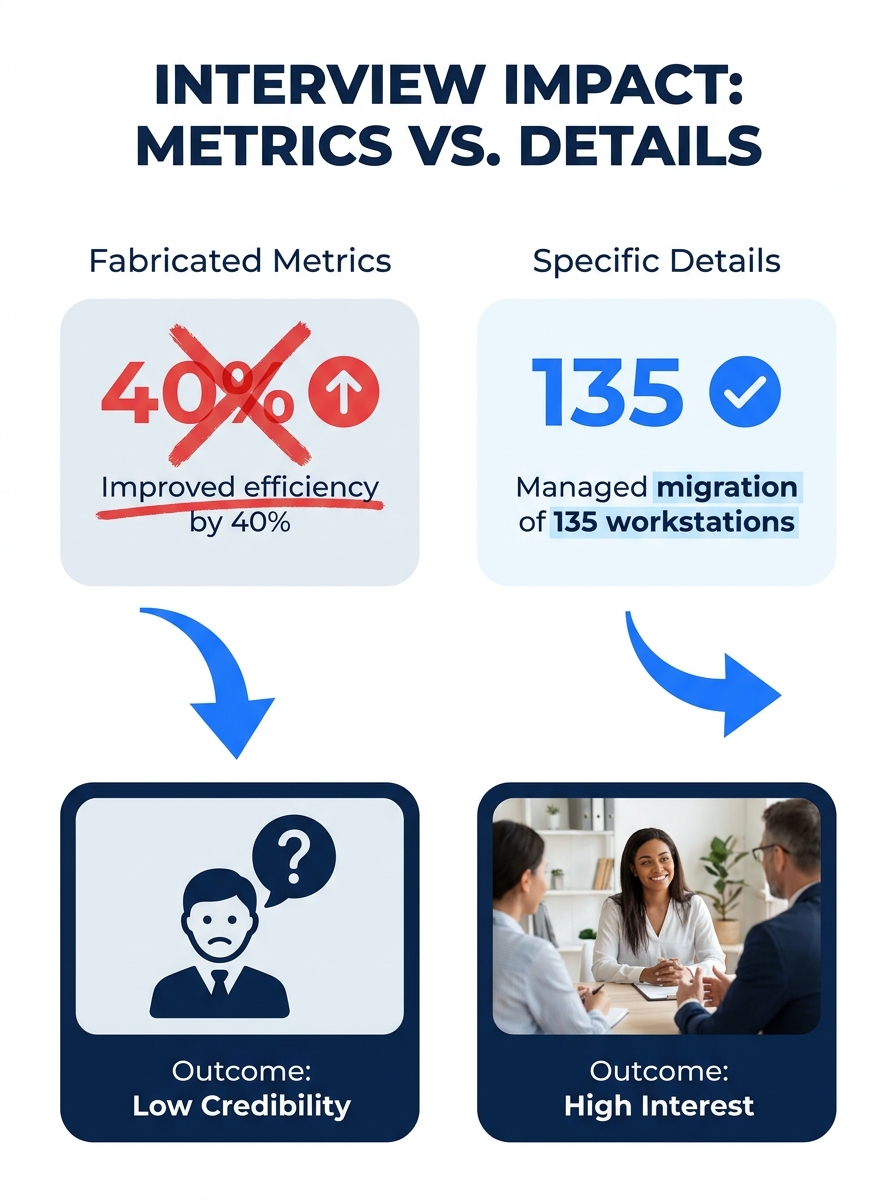
Here’s what happens next. A hiring manager reads “Improved office efficiency by 40%” on an administrative resume and asks a completely reasonable follow-up in the interview: “How did you measure that?” The candidate freezes. There was no measurement. There was no baseline. There was no tracking system. The number was invented during a late-night resume-writing session, and now it’s actively undermining the candidate’s credibility.
A thread on the Manager Tools forum captured this dynamic perfectly: a poster described completing a production application migration where nothing was measured before the project started, so there was literally nothing to compare against. The budget came in on target only because it was based on quoted prices, hardly a heroic cost-saving narrative. The honest bullet? “Facilitated a production application migration through the replacement of 135 workstations.” No percentage improvement. No dollar savings. And it works, because it’s specific and defensible.
This is the core of non-quantifiable resume impact: you don’t need a number to be concrete. You need details that a hiring manager can picture and that you can talk about confidently in a conversation.
Three Categories of Hidden Measurement
If you work in a support role, coordination role, or any position where your employer didn’t hand you a KPI dashboard, you’re sitting on more measurable material than you realize. The key is knowing which types of signals count as quantification. The XYZ formula guidance from YesWriting puts it well: when exact numbers aren’t available, use a measurable signal such as volume, frequency, rank, or before-and-after state.
Here are the three categories, with real before-and-after rewrites for each.
Volume and Scope
You may not know whether you improved anything by a specific percentage, but you almost certainly know how many people, documents, clients, events, or systems you touched. These counts are legitimate quantification.
Before: “Handled customer inquiries and resolved issues.”
After: “Resolved 15–20 customer escalations per week across three product lines, routing complex cases to engineering within a 4-hour response window.”
Before: “Managed onboarding for new employees.”
After: “Coordinated onboarding logistics for 40+ new hires across three office locations, including equipment provisioning, system access setup, and first-week scheduling.”
Notice what happened. No percentage improvement appears anywhere. The bullets read as credible because they contain specific, verifiable details, the kind you could discuss in an interview without breaking a sweat. The Muse’s guide on quantifying non-numbers roles makes the same point: think about how frequently you perform tasks, multiply that across the relevant period, and include those counts in your bullets.
If you’re already working on replacing weak resume language with stronger alternatives, volume and scope are the easiest starting points because they require zero estimation. You either handled 20 cases a week or you didn’t.
Frequency and Cadence
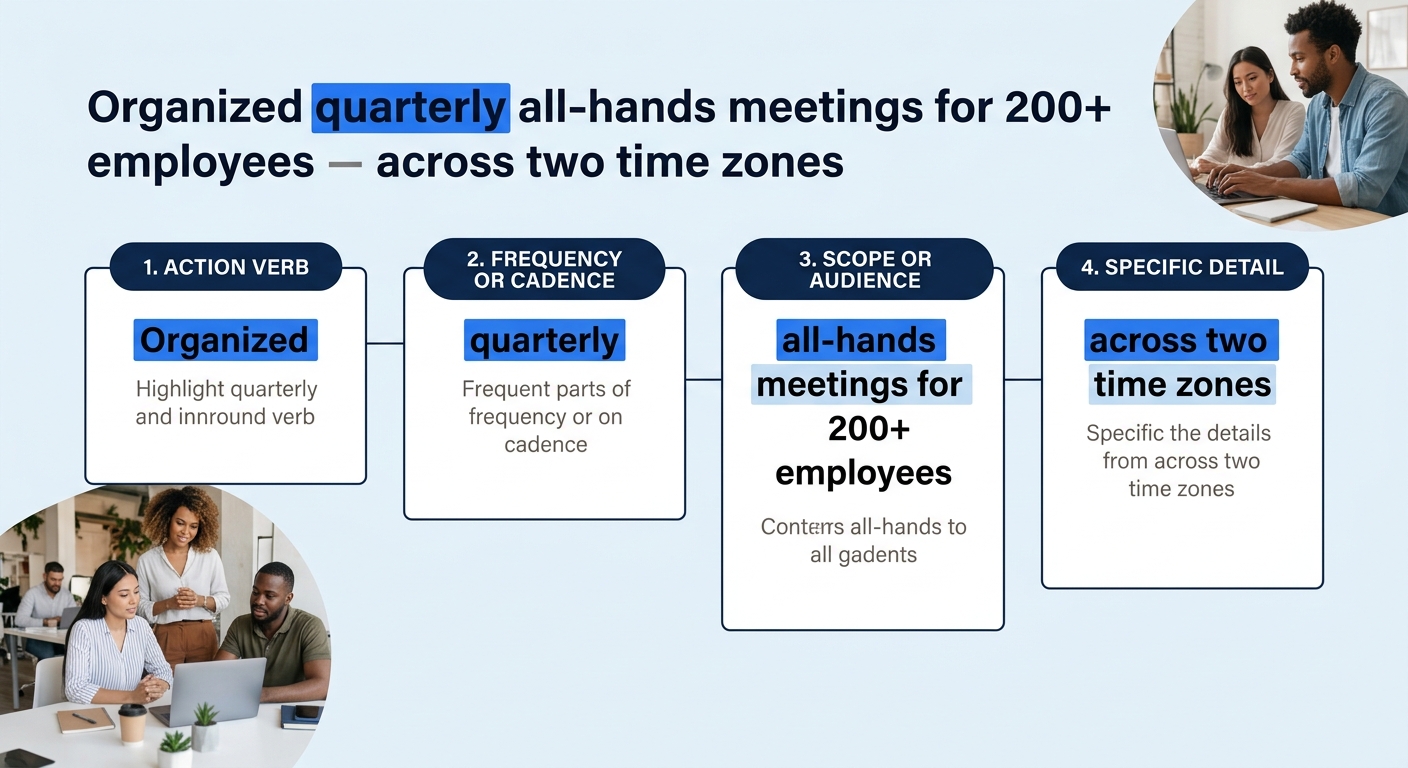
How often did you do the thing? Daily, weekly, monthly, quarterly? Frequency signals reliability and workload volume without requiring outcome metrics.
Before: “Prepared reports for management.”
After: “Compiled and distributed weekly financial reconciliation reports to a six-person leadership team, flagging discrepancies exceeding $500 for immediate review.”
Before: “Assisted with event planning.”
After: “Organized quarterly all-hands meetings for 200+ employees, coordinating catering, AV setup, and speaker logistics across two time zones.”
The second versions don’t claim to have “increased engagement by 30%” or “reduced costs by 15%.” They tell you what the candidate did, how often, for whom, and at what scale. A hiring manager reading those bullets can immediately assess whether the candidate’s workload resembles what the open role demands.
Before-and-After State Changes
This is the most powerful category for roles without formal metrics, and it’s the one most people overlook. Even if nobody measured the outcome, you can describe the state of something before you touched it and the state of it after.
Before: “Improved filing system.”
After: “Replaced a paper-based filing system spanning 10 years of client records with a searchable digital archive, reducing average document retrieval from approximately 15 minutes to under 2 minutes.”
Before: “Helped with process improvements.”
After: “Identified duplicate data entry across three departments and proposed a shared intake form adopted by all three teams, eliminating an estimated 6 hours per week of redundant work.”
You don’t need a formal measurement system to describe a before-and-after. You lived through the change. You know what it was like before and what it was like after.
The word “approximately” and the phrase “an estimated” are doing important work in those bullets. They signal honesty. They tell the reader you’re making a reasonable estimate, not citing a formal audit. The production resume quantification framework covers this estimation approach in more depth if you want a structured method for arriving at defensible approximations.
Why Qualitative Achievement Bullets Actually Outperform Weak Metrics
Here’s the part that surprises people. A qualitative achievement bullet loaded with specific context often outperforms a bullet with a number that the reader can’t contextualize.
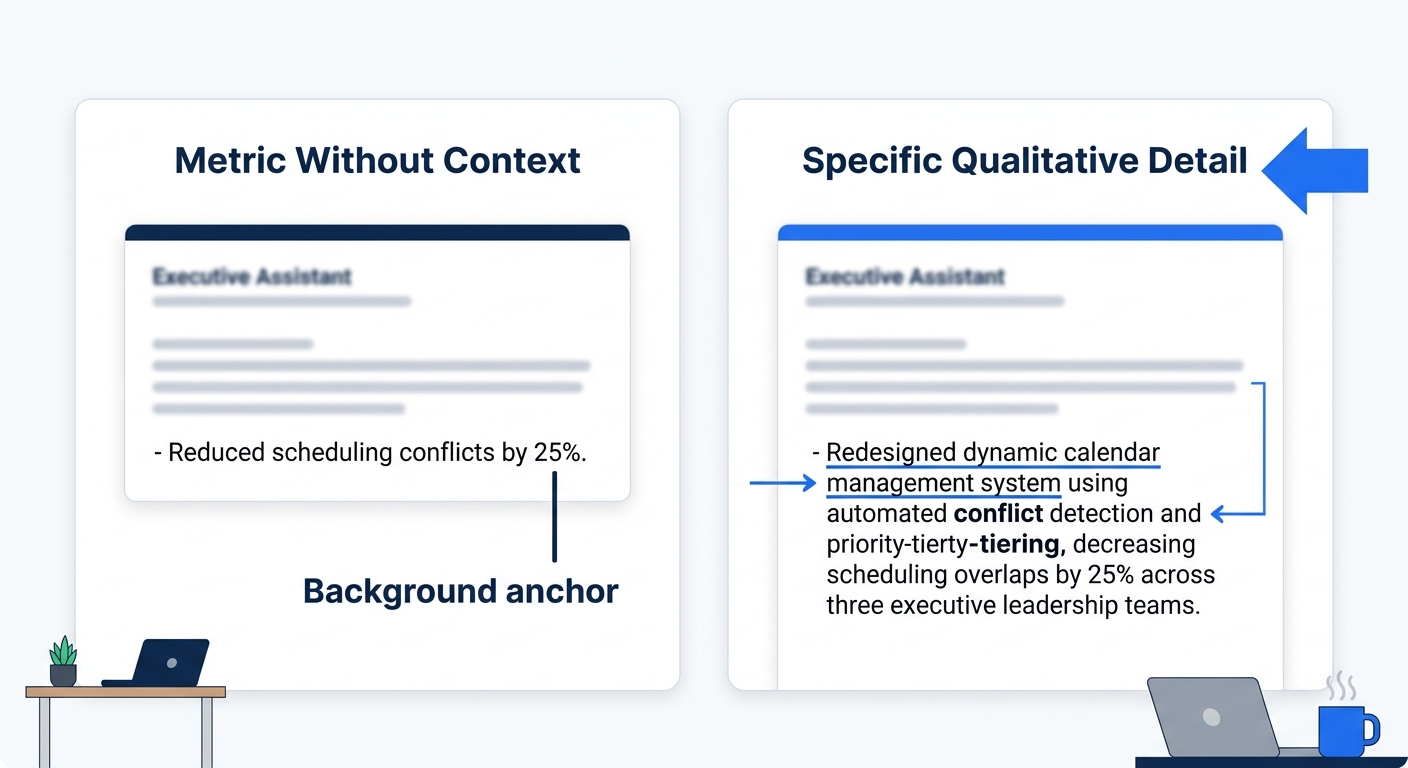
Consider these two bullets for an executive assistant role:
Bullet A: “Reduced executive scheduling conflicts by 25%.”
Bullet B: “Redesigned the CEO’s calendar management process to block preparation time before board meetings and eliminate back-to-back external commitments on Mondays, resulting in zero scheduling conflicts during Q3 and Q4.”
Bullet A has a metric. Bullet B doesn’t use a traditional percentage. And Bullet B is the stronger resume line, because it tells you what the candidate actually did, why it mattered, and what the outcome looked like in practice. The hiring manager reading Bullet B can picture the work. The hiring manager reading Bullet A wonders whether 25% means going from 20 conflicts to 15 or from 4 to 3.
Context matters more than the number itself. Jobscan’s guide to resume accomplishments confirms this: you can focus on outcomes like improvements, recognitions, or successful results without numbers, and those qualitative accomplishments carry weight when they’re specific enough to visualize.
Impact reframing without data becomes a real skill here. The technique involves connecting your work to a business outcome that your employer cared about, even if you can’t claim credit for the full result. Phrases like “contributing to,” “enabling,” and “supporting” are fine when followed by something concrete:
- “Coordinated cross-functional logistics for a product launch that generated $2.3M in first-quarter revenue.” You didn’t generate the revenue, but you were part of the machinery that did, and the specificity makes the connection credible.
- “Maintained a vendor relationship database used by the procurement team to negotiate annual contracts totaling $4M+.” You’re describing your role in a process with a measurable endpoint.
If you’ve been thinking about which resume sections tend to get overlooked by candidates, this is a good time to reconsider your bullet strategy across the entire document, not just in the experience section.
The Problem-Action-Result Framework for Support Roles
When in doubt about how to structure a bullet for a role without clear resume metrics for support roles, the Problem-Action-Result (PAR) pattern gives you a reliable scaffold.
Problem: What was broken, slow, missing, or frustrating? Action: What did you specifically do? Result: What changed, even if you can only describe it qualitatively?
Here’s how that plays out for a customer service coordinator:
- Problem: Customer complaints about response times were escalating to management weekly.
- Action: Created a triage protocol that categorized incoming tickets by urgency and routed them to specialists instead of a general queue.
- Result: Escalations to management dropped to near-zero within two months, and the protocol was adopted across all three regional support teams.
No percentage. No dollar figure. And yet the bullet communicates clear impact because you can see the before state, the intervention, and the after state. The skills-based resume approach pairs well with this framework if your job titles haven’t kept pace with the work you’ve actually been doing.
Tip: Keep a running document where you note problems you solved, processes you changed, and feedback you received. Even a sentence or two per week gives you far more to work with at resume-update time than trying to reconstruct months of work from memory. Some people call this a “wins journal,” and it’s the single best habit for building strong bullets over time.
The Advice, Reconsidered
The standard guidance to quantify your resume bullets isn’t wrong. It’s incomplete. It was designed for a subset of roles where metrics are tracked, reported, and attributed to individuals. For everyone else (and “everyone else” is the majority of the workforce), the advice needs a critical addendum: specificity is the actual goal, and numbers are one path to specificity, not the only one.
If you can count it, count it. If you can estimate it honestly, estimate it with a qualifier like “approximately” or “an estimated.” If you can’t put a number on it at all, describe the scope, the frequency, the before state, and the after state with enough detail that a reader can picture you doing the work. That kind of specificity-driven resume language is what separates a bullet that earns you an interview from one that gets skimmed over in the first ten seconds a hiring manager spends on your resume.
The professionals who struggle most with resume bullets aren’t lacking in impact. Administrative staff, coordinators, customer service teams, HR generalists, social workers, and event planners do essential, difficult work every single day. The percentage-obsessed template was never built for them. But once you stop trying to force metrics where none exist and start describing your work with honest, granular detail, the bullets practically write themselves. You already know what you did, who you did it for, how often, and what changed because of it. Put that on the page, and the numbers take care of themselves.