

 4.9
4.9 4.5
4.5Graduation dates from the 1980s, job listings that stretch back three decades, and a Hotmail email address form the trifecta that career advisors say triggers age bias in resumes faster than anything else on the page. And the frustrating part is that none of these details speak to your ability to do the work. They’re signals that give a recruiter permission to make assumptions before reading a single bullet point.
Sixty-four percent of workers over 50 report having experienced or witnessed age discrimination in the workplace, according to AARP’s workforce research, and 74% of older Americans believe their age could cost them an opportunity. Those numbers track with what certified resume writers have been saying for years: the mature worker resume needs to be modernized regularly, and the updates aren’t cosmetic. They’re structural decisions about what to keep, what to cut, and how to present the work that remains.
The good news is that every one of these fixes is straightforward. None of them require you to pretend your experience doesn’t exist. The goal of experience-heavy resume formatting is to present your career with the same polish and currency that a younger candidate brings, while letting your depth of knowledge do what it’s always done: prove you can handle the job.
Chop Your Work History to the Last 10–15 Years
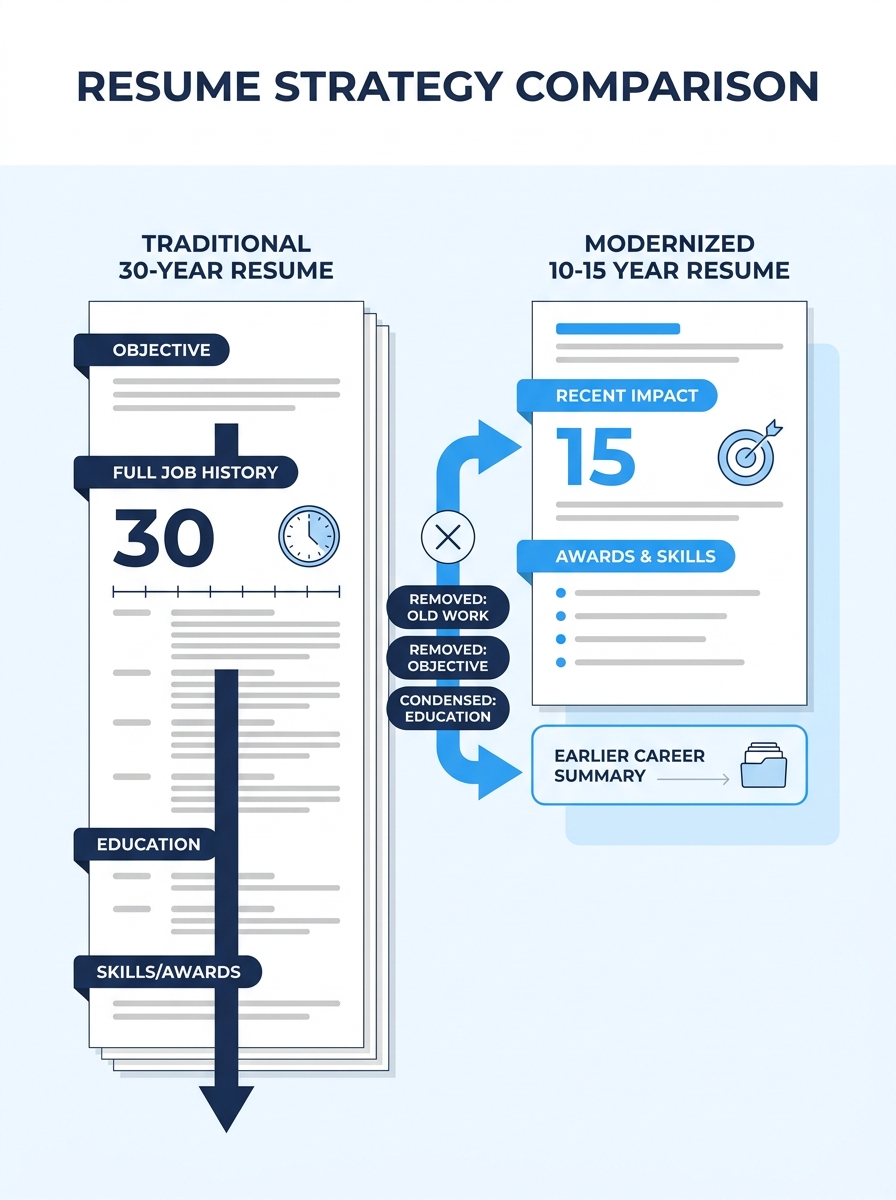
The single highest-impact change you can make is cutting your work history section down. Ancient jobs from 20 years ago have little relevance to a hiring manager evaluating your fit for a role today, as Forbes has noted in coverage of age discrimination.
This doesn’t mean erasing those years. It means repackaging them. If you held a prestigious title or worked at a well-known organization early in your career, add a brief “Earlier Career” or “Career Highlights” line at the bottom of your experience section. Something like:
Earlier Career: Managed multi-location IT infrastructure with 99.9% uptime at IBM, saving $250K annually.
One line, no dates, no lengthy bullet points. You preserve the credibility of that experience without inviting anyone to do the mental math on when you graduated.
For candidates who’ve been in the same field for decades, the chronological format still works best because it shows progression and consistency. But if you’re pivoting industries, a hybrid format that leads with skills and accomplishments can be more effective. We’ve covered how to reframe experience when job titles don’t match your value in a separate guide, and the principles there apply directly to career-changers over 50.
Formatting Signals You Didn’t Know You Were Sending
Your resume’s visual design communicates something before a single word gets read. Times New Roman, dense text blocks with narrow margins, and headers like “Work Chronology” or “Employment Record” all signal a document created in a previous era of word processing. Hiring managers notice these details, even when they can’t articulate exactly what felt “off” about a resume.
Switch to a clean sans-serif font: Calibri, Arial, or Helvetica in 10–12 point size. Use your name in 14–20 point at the top. Set margins between 0.5 and 1.0 inches, and give yourself permission to leave breathing room on the page. The instinct with an experience-heavy resume is to cram everything in, but strategic white space actually improves readability and helps your most important accomplishments stand out instead of drowning in a sea of text.
A few other formatting fixes that matter:
- Replace “Objective” with “Professional Summary.” Objective statements fell out of favor over a decade ago. A two-to-three sentence summary that highlights your specific strengths and measurable results is the modern standard. Instead of “Seeking a challenging position where I can apply my extensive experience,” try “Marketing executive who grew brand revenue from $4M to $22M across B2B and DTC channels.”
- Use a modern email address. [email protected] reads as current. An @aol.com or @yahoo.com address reads as a timestamp, fair or not.
- Keep it to two pages maximum. One page is standard for early-career candidates; two pages is perfectly acceptable when you have extensive work history. Three pages almost never helps, regardless of seniority.
- Remove “References available upon request.” This line was standard practice in the 1990s and early 2000s. Hiring managers already know they can ask for references. Including it marks the document as outdated.
Language That Gives Your Age Away
Word choices reveal as much as dates do when it comes to age bias in resumes. Certain phrases have become so closely associated with older candidates that they function as age markers even when no dates appear on the page.
Avoid describing yourself as “seasoned,” “veteran,” “mature,” or “experienced professional with 25+ years.” Each of these invites the reader to think about your age rather than your capabilities. The fix is specificity. Instead of “Seasoned operations leader with three decades of supply chain management,” try “Operations leader who reduced supply chain costs by 34% and cut delivery timelines from 14 days to 6 across three distribution centers.”
The first version tells the reader you’ve been around a long time. The second tells them what you actually accomplished. If you’re looking for more guidance on swapping passive, generic language for strong action verbs that drive interview callbacks, we’ve written extensively on that topic, and the principles are especially relevant for experienced professionals who’ve grown accustomed to a certain way of describing their work.
The phrases that feel like badges of honor on a resume—”seasoned,” “veteran,” “proven track record”—are the same phrases that career advisors identify as age-bias triggers. Replace them with results, and the experience speaks for itself.
Also watch for outdated technology references. Listing proficiency in Lotus Notes, Windows XP, or Blackberry administration tells a hiring manager exactly which decade your skills peaked in. Remove these entirely. If you still use them at your current job, they’re not resume-worthy skills in a forward-facing document.
Show Tech Fluency With a Dedicated Skills Section
One of the most persistent stereotypes facing older workers is that they’re resistant to new technology. Your resume needs to counter that assumption directly, and the skills section is where it happens.
Include a dedicated Technical Skills section that lists tools you use in your current work: Microsoft 365, Google Workspace, Slack, Zoom, CRM platforms like Salesforce or HubSpot, project management tools like Asana or Monday.com. If you’ve completed any recent certifications—a Google Analytics certification, a data visualization course, an AI for business strategy program—list them with the year of completion. A 2025 or 2026 date on a certification tells the hiring manager you’re actively investing in your own development, and it’s one of the strongest signals of career longevity packaging available to you.
Tip: If you’ve learned a new tool in the last year, add it to your resume immediately. Even something as simple as “Proficient in Canva and basic data visualization with Tableau” signals adaptability in a way that no amount of descriptive language can match.
This section doesn’t need to be long. Five to eight tools, listed cleanly, demonstrates fluency without overstating your claim. And don’t bury it at the bottom of page two. Place it in the top third of the resume, where both ATS software and human readers will find it early.
Getting Past the ATS When Your Formatting Is Stuck in 2008
Roughly 78% of companies use applicant tracking systems to filter resumes before a human ever sees them. This matters for every job seeker, but it matters especially for experienced professionals because many of the formatting habits that feel natural to long-tenured employees—tables, text boxes, graphics, multi-column layouts, decorative lines—are exactly what ATS scanners struggle to parse.
Keep your formatting simple and linear. Single-column layouts. Standard section headers (“Professional Experience,” “Education,” “Skills”). Save as PDF or .docx unless the application specifies otherwise. And tailor your resume to each job posting by matching the keywords in the job description. If the posting says “stakeholder management” and your resume says “client liaison,” you may be saying the same thing, but the ATS won’t recognize the match.
You can use AI tools to help with keyword alignment, but be thoughtful about how far you take it. We’ve explored when AI resume rewriting helps versus when it hurts, and the short version is that AI is good at matching language to a job description but tends to strip away the authentic voice that makes your resume memorable. For a mature worker resume, authenticity and specificity are your biggest advantages. Don’t let a tool sand them down into generic corporate prose.
Your LinkedIn Profile Has to Tell the Same Story
A resume doesn’t exist in isolation anymore. Hiring managers and recruiters routinely cross-reference your resume with your LinkedIn profile, and discrepancies between the two raise flags. If your resume covers 10–15 years but your LinkedIn shows your full 30-year career, the strategic trimming you did on paper becomes transparent.
That doesn’t mean you have to delete your LinkedIn history. LinkedIn allows longer narratives than a resume does. But your profile headline, summary section, and recent job entries should mirror the positioning of your resume. Use a current, professional headshot where you look engaged and approachable. Make sure your skills section is populated with the same keywords you’re targeting on your resume. And stay active on the platform—posting or commenting in your industry’s conversations signals relevance in a way that a static profile never will.
Networking still outperforms the resume alone when it comes to overcoming age-related stereotypes. When a hiring manager has already met you, or when someone inside the organization has vouched for your work, your resume becomes a confirmation of what they already believe rather than a screening mechanism that might filter you out. Your professional narrative includes your LinkedIn presence, your network, and your industry visibility. All of these need to tell a consistent, current story alongside your resume.
The Questions That Don’t Have Clean Answers Yet
Age bias in resumes exists on a spectrum, and no amount of formatting can eliminate it entirely. Some hiring managers will always make assumptions based on years of experience listed, and some ATS configurations may inadvertently disadvantage candidates whose career arcs don’t fit a narrow template. Legal protections exist under the Age Discrimination in Employment Act, but proving that a resume was screened out because of inferred age is nearly impossible for individual applicants.
What’s also unresolved is how much trimming is too much. Career advisors broadly agree on the 10–15 year guideline, but candidates with highly specialized expertise—nuclear engineers, veteran litigators, long-tenured government employees—sometimes need to show the full timeline to demonstrate qualifications that took decades to build. The tension between minimizing age signals and proving the depth of your knowledge doesn’t have a universal answer, and anyone who tells you otherwise is selling a template, not offering advice.
What we do know is that the fundamentals work: clean formatting, specific and measurable accomplishments, current technology skills, a consistent digital presence. These won’t guarantee that every recruiter sees past their assumptions, but they remove the easy excuses for screening you out. Your decades of experience are the competitive advantage. The resume’s job is to frame them so they get read that way.