
 4.9
4.9 4.5
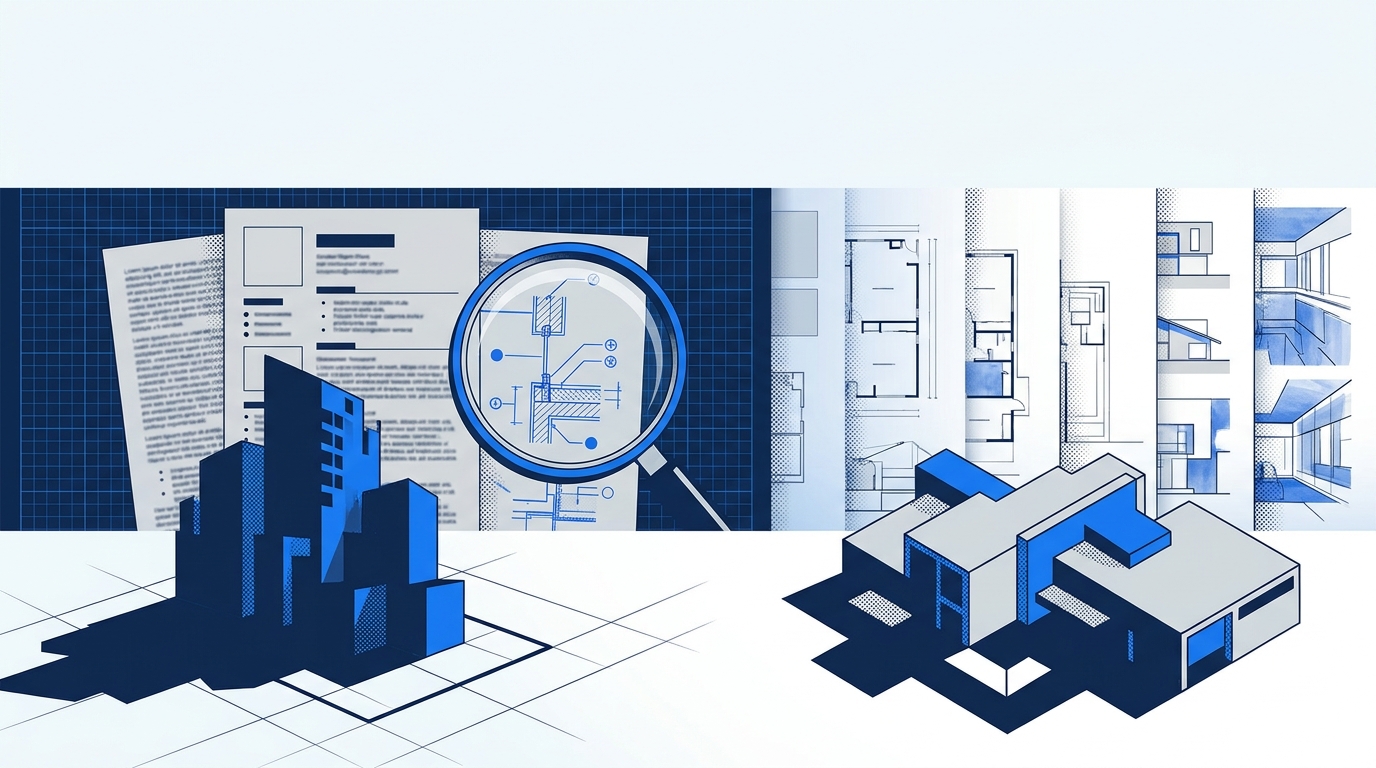
4.5The AIA’s hiring manager survey makes a blunt declaration: hiring managers in design firms prioritize the portfolio over the resume. Yet every large firm’s careers page funnels candidates through ATS keyword filters that can’t parse a rendering or read a floor plan. Three strategies exist for navigating this contradiction, and each works best for a different firm type.
TL;DR: Architects face a split hiring system where ATS software reads keywords from text resumes while human reviewers evaluate visual portfolios. The resume-first approach works for corporate firms with rigid ATS pipelines, the portfolio-forward approach wins at small studios, and a dual-document system handles firms that use both.
Why Architecture Hiring Breaks the Normal Resume Rules
Architecture sits in a category almost no other profession shares: your primary skill is visual, but the screening system is textual. According to the Architizer Journal’s young architect guide, hiring managers spend roughly 20 seconds reviewing your resume. That’s the text-based gate. But the actual hiring decision happens during the portfolio review, where managers spend 15–30 seconds per page evaluating design quality, technical range, and presentation clarity.
Bob Borson of Life of an Architect puts the tension bluntly: portfolios “are far more important than what most people outside the industry realize.” The portfolio plays the key role in landing the right sort of job. Resumes can help you get an interview, but few architects get hired on resume strength alone.
This creates the paradox. Your resume needs to pass a filter that rewards keywords like “Revit,” “BIM coordination,” “LEED AP,” and “schematic design.” Your portfolio needs to demonstrate that you actually know how to do those things at a level the text can’t convey. The question is how to weight your effort between these two documents, and the answer depends entirely on where you’re applying.
Approach One: The ATS-Optimized Resume Path
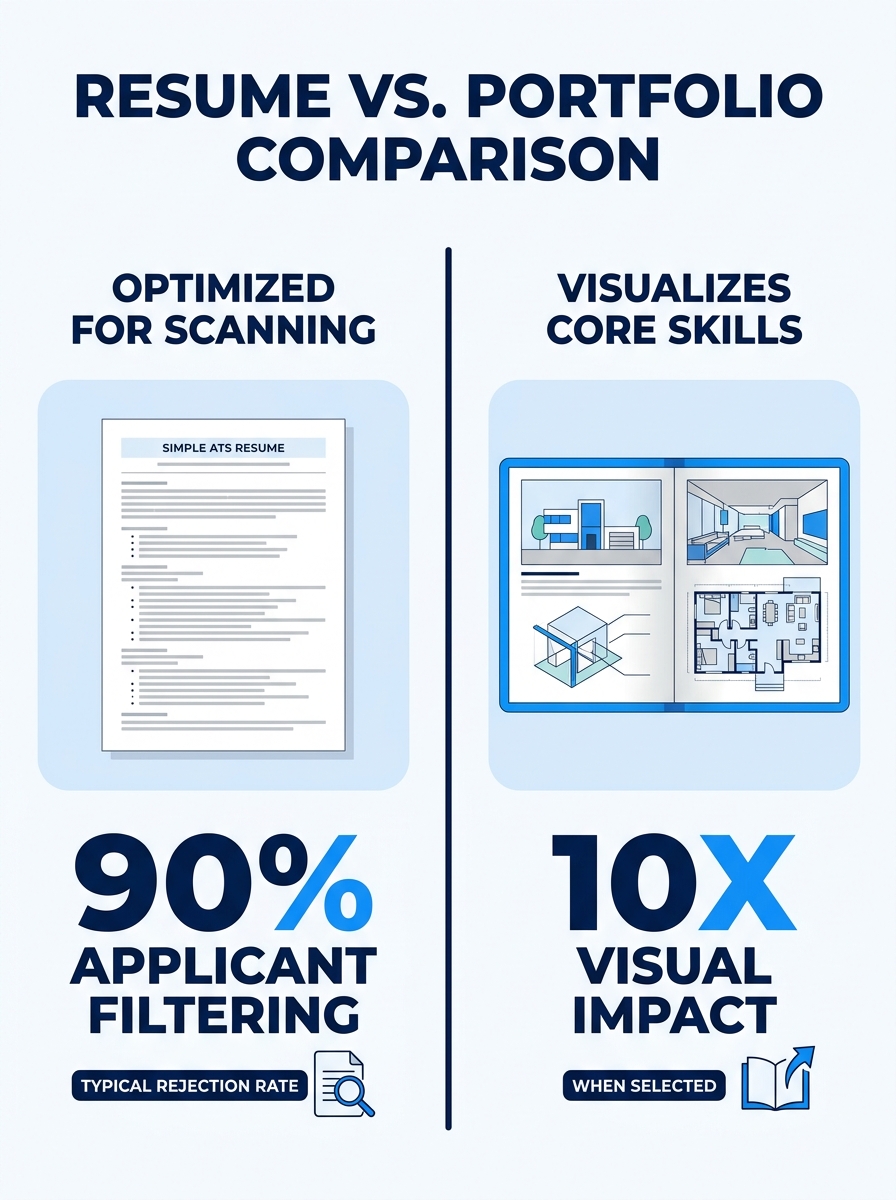
This strategy front-loads the resume as the primary application document, with the portfolio attached as a supplementary PDF or linked URL. It works best at firms with 50+ employees that use applicant tracking systems to screen hundreds of incoming applications before a human ever opens the file.
The logic is straightforward. If your application gets rejected by keyword filters, no one will ever see your portfolio. A 2026 Novatr analysis summarized the dynamic as “your resume gets you seen, but your portfolio gets you hired.” Under this approach, you pour effort into the getting-seen part first.
What this looks like in practice: a 1-page resume (for early-career architects) or 2-page resume (for those with 10+ years) built around quantified bullet points. Instead of “Designed residential projects,” you’d write “Led schematic design for 12-unit mixed-use residential building, 47,000 SF, $4.2M construction budget, achieving LEED Silver certification.” Every bullet encodes the keywords an ATS scans for while packaging them inside specific, measurable outcomes.
The gap between what ATS systems reward and what hiring managers want to read is real across every profession. In architecture, it’s amplified because the ATS literally cannot evaluate the skill that matters most: your design ability. The resume tells the system you’ve worked on relevant project types. The portfolio, linked in your header and attached as a PDF, does the actual convincing once a human opens your file.
Tradeoffs: This approach maximizes your odds of clearing automated screens at large firms. It underperforms at boutique studios (under 15 employees), where principals often review every application personally and weigh visual evidence far above keyword density. You also risk spending so much time optimizing for machines that your resume reads as generic to the humans who eventually see it. Given that recruiters now spend roughly 11 seconds on each resume before deciding to read further, a wall of optimized keywords with no personality can still land in the reject pile.
Approach Two: The Portfolio-Forward Application
Small and mid-size design firms often skip formal ATS pipelines entirely. The principal reads every email. And at these firms, the portfolio is the application.
The AIA’s hiring manager guidance is direct on this point: digital PDF files are the preferred method for showcasing creativity and project experience because they’re easy to open, review, and share without depending on a continuous internet connection. For studios under 20 people, a well-designed 10-page PDF portfolio with 3–4 curated projects carries more weight than any resume.
Under this approach, your architecture resume projects section shrinks to a single page of context: licensure status, software proficiencies (Revit, Rhino, AutoCAD, Grasshopper), education, and brief role descriptions. The portfolio does the heavy lifting. Each project spread includes your specific role on the team, the project scope and budget, key design decisions you drove, and visual evidence across multiple phases: concept sketches, development drawings, renderings, and construction documentation details.
Archinect forum discussions among hiring managers confirm they look for a portfolio that tells the story of your professional development, with consistency in presentation quality. As the Architecture Careers Guide notes, the portfolio provides a direct link to your skills because the discipline is inherently visual. You want images that demonstrate drafting, model-building, drawing, and design ability all in one package.
Your resume bullet says “Led facade design for a 22-story mixed-use tower.” Your portfolio shows that facade: the parametric studies, the mock-up photos, the construction detail, the finished building. Text makes the claim. Images prove it.
One Reddit thread among practicing architects surfaced an additional tactic for small firms: recording a video cover letter for each application. The consistent feedback from studios was that they appreciate the effort and personalization, especially where culture fit matters as much as technical skill.
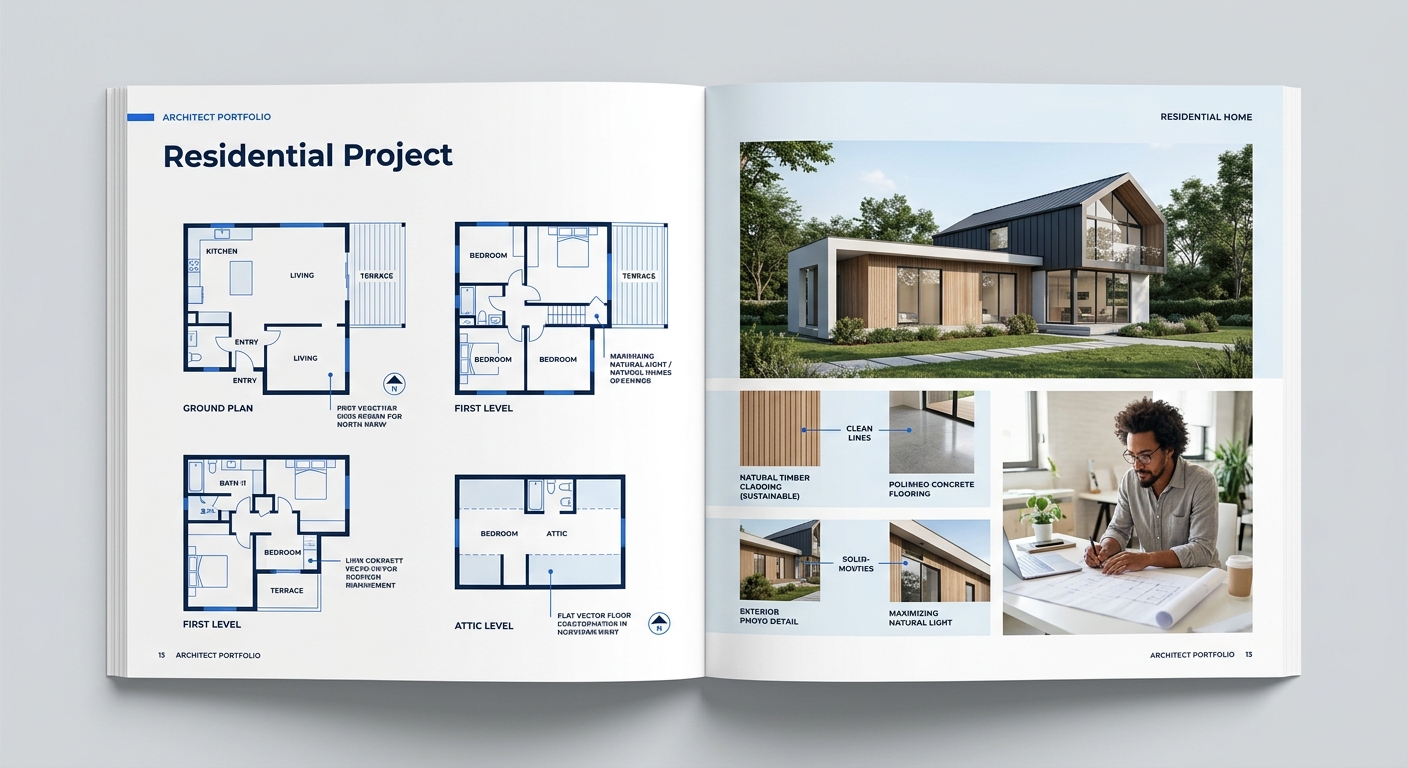
Tradeoffs: The portfolio-forward approach wins when a human reviews your application from the first second. It fails at firms that use ATS screening, because a beautifully designed PDF portfolio may not get parsed by the software at all. There’s also a practical constraint: Archinect forum contributors report that a typical architecture job search requires up to 4 resume versions and 2 separate portfolios (one design-oriented, one technically oriented), plus a website and business card. Going portfolio-forward doesn’t mean ignoring the resume. It means subordinating the resume to a supporting role.
Approach Three: The Dual-Document System
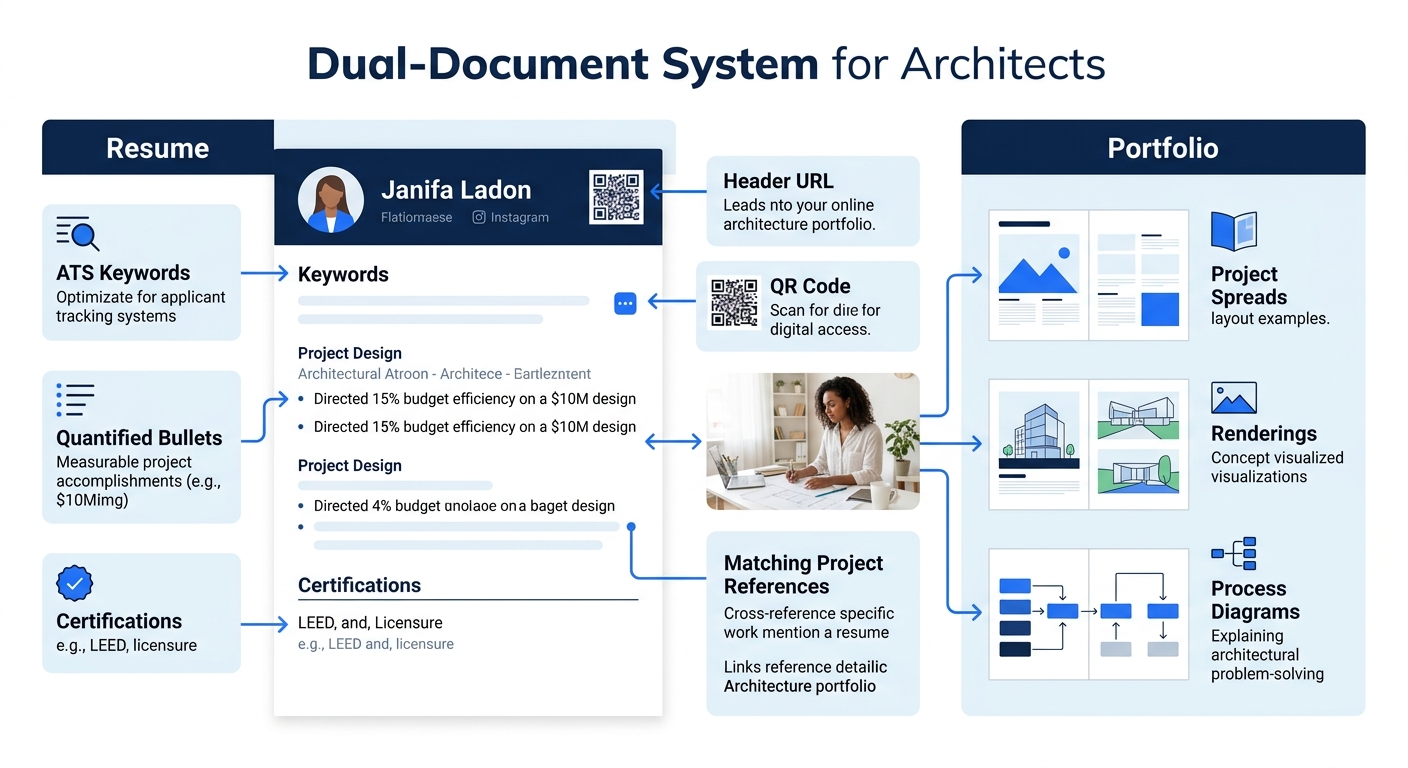
The most labor-intensive strategy treats the resume and portfolio as separate documents optimized for separate audiences, then connects them with deliberate cross-references. This is where portfolio resume integration actually pays off, because each document does what the other can’t.
The resume gets built for ATS compliance and quick human scanning. Every architecture resume projects bullet follows a consistent format: role + project type + scope metric + outcome or certification. Your visual credentials resume reference sits in the header as a portfolio URL or QR code. Teal’s architect certification guide recommends including a link to your professional portfolio showcasing projects and technical documentation, because architect hiring criteria at senior levels explicitly require demonstrable project leadership. Firms specializing in green building frequently list “LEED AP preferred” or “LEED AP required” in job postings, so matching those credentials in both documents creates reinforcement.
The portfolio gets built for design storytelling. Each project includes 2–4 pages with process images, final deliverables, and a short narrative connecting your design decisions to project constraints. Keep total page count around 10. Keep file size under 10MB. And when hiring managers inevitably search your name online, your portfolio website provides a third layer of evidence that ties everything together.
The connection between these documents matters more than either document alone. Your resume bullet claims “Coordinated curtain wall detailing across 6 consultants for a $28M civic center.” Your portfolio shows the wall section, the coordination markups, the installed result. If your resume’s executive summary already struggles to fit content into limited space, adding a coordinated portfolio layer multiplies the production work. But architects who treat their application materials as a design project in themselves tend to be the ones who land interviews at firms across the size spectrum.
Tip: If you’re applying to firms of different sizes in the same job search, the dual-document system is the only approach that covers both automated and human screening. Build one clean ATS-friendly resume and one curated 10-page portfolio PDF, then tailor each for specific applications by swapping featured projects rather than rebuilding from scratch.
Tradeoffs: The dual-document system works across firm sizes and screening methods. The cost is time. Maintaining separate, polished versions of both documents for each application round demands real effort, and you should expect to spend 3–6 hours per tailored application package compared to 1–2 hours for a resume-only submission. This approach rewards architects who already maintain an up-to-date project archive they can pull from quickly.
| ATS-Optimized Resume | Portfolio-Forward | Dual-Document System | |
|---|---|---|---|
| Best firm size | 50+ employees | Under 20 employees | Any size |
| Primary document | Resume (1–2 pages) | Portfolio (10 pages, 3–4 projects) | Both, optimized separately |
| ATS performance | High | Low (PDF may not parse) | High (resume handles ATS) |
| Design skill visibility | Low (text-only claims) | High (full visual evidence) | High (linked and cross-referenced) |
| Prep time per application | 1–2 hours | 2–4 hours | 3–6 hours |
| Primary risk | Rejected by humans as generic | Rejected by machines for lacking keywords | Burnout from ongoing maintenance |
How to Choose Between These Three
The answer depends on two variables: what size firms you’re targeting, and how many applications you’re sending per week.
If you’re applying to large corporate firms (HOK, Gensler, Perkins&Will, SOM), the ATS-optimized resume path is non-negotiable. These firms receive thousands of applications. Your keywords either match or your file disappears. Attach a portfolio link, but spend 70% of your prep time on the resume. We’ve written before about how specificity in architect portfolios trumps generic resume bullets during the human review that follows the ATS screen, so make sure that even in a resume-first strategy, you’re giving the hiring manager a clear path to your visual work.
If you’re applying to boutique design studios where the founding principal reads every email, go portfolio-forward. Your visual credentials resume is a one-page courtesy document. The portfolio is your argument. Spend 80% of your prep time on the project spreads, and keep the resume clean but minimal.
If you’re running a mixed search across firm types and sizes, the dual-document system is the only strategy that covers both screening methods. Yes, it costs more time. But architecture is a profession where presentation quality signals professional quality. A sloppy application package communicates something about your design standards whether you intend it to or not.
Whichever approach you choose, the paradox never fully resolves. The resume will always fail to capture what your best rendering communicates in a glance, and the portfolio will always fail to pass a keyword filter. The goal is to make each document excellent at its specific job, then make sure they point at each other so reviewers can follow the thread from text claim to visual evidence and back again. For more strategies that hold up under both algorithmic and human review, you’ll find plenty of additional guidance on our blog.