


 4.9
4.9 4.5
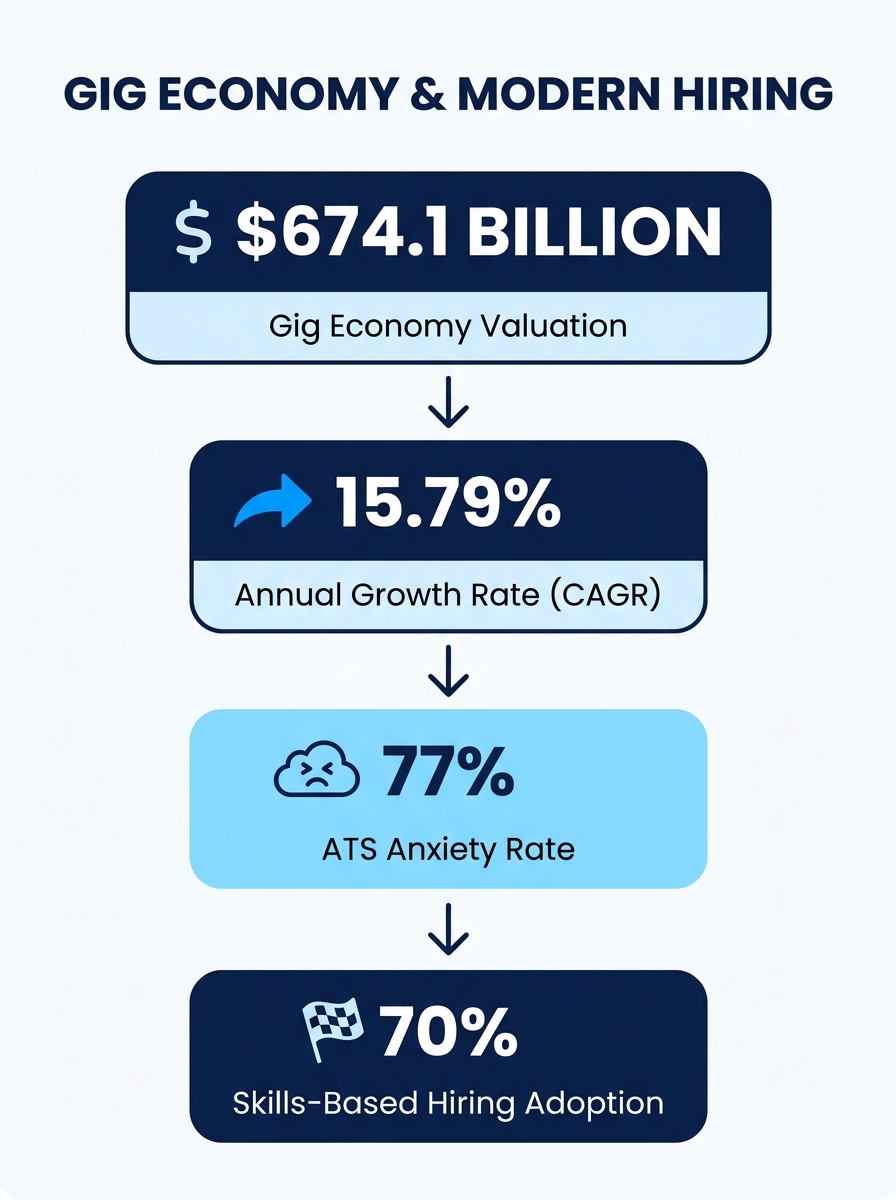
4.5The global gig economy will reach a valuation of $674.1 billion in 2026, growing at a 15.79% compound annual growth rate, according to DemandSage’s gig economy report. That growth is rewriting how hiring managers read resumes. Permanent job seekers who format their experience as a linear career ladder are getting filtered out in favor of candidates who present project-based proof of impact.
TL;DR: The contract hiring market shift has made project-scoped deliverables the default signal employers trust. If your resume reads like a chronological list of job titles and tenure dates, you’re competing at a disadvantage against candidates whose resumes emphasize outcomes and verified skills. Repositioning doesn’t require contract experience. It requires contract-style formatting.
The $674 Billion Signal Employers Are Reading
The gig economy’s 15.79% CAGR represents a structural change in how companies staff projects, evaluate talent, and define “qualified.” The U.S. holds the highest global market share for gig workers, with India, Indonesia, Australia, and Brazil closing the gap fast. When that much of the global workforce operates on contracts, the resume conventions built around permanent employment start to look like a foreign language to hiring managers who spend their days reviewing contractor deliverables.
Seventy percent of employers now use skills-based hiring as of March 2026. LinkedIn launched AI-powered skill verification features that same month, partnering with tools like Descript, Lovable, and Replit to assess actual proficiency rather than self-reported credentials. Indeed has been running a beta program since late 2025 that allows immediate virtual interviews for entry-level roles, bypassing traditional resume review entirely. The hiring pipeline is moving away from “tell me where you worked” toward “show me what you shipped.”
And the permanent job seeker’s resume, with its emphasis on tenure, titles, and company prestige, is built for the old pipeline.
Why Permanent Resumes Get Misread in a Contract-First Market
The contract hiring market shift has created an asymmetry in how resumes get evaluated. A hiring manager reviewing 50 applications for a 6-month product launch sees 30 resumes from contractors who list specific deliverables (“migrated 14 microservices to Kubernetes, reducing deployment time by 40%”) and 20 from permanent employees who list responsibilities (“managed cloud infrastructure for engineering team”). The contractor resumes answer the question the hiring manager is actually asking: can this person walk in on day one and produce a defined outcome?
This matters even when the role being filled is permanent. A survey of nearly 500 CFOs, reported this week by Insurance Business, confirms that junior roles are the ones being cut. The positions that survive tend to be scoped around projects with measurable deliverables. Companies that once hired permanent generalists now hire for specific capabilities, then evaluate retention later.
The ZipRecruiter Job Seeker Confidence Index hit 99.8 in Q1 2026, the highest level ever recorded, yet 77% of job seekers still fear their resume will be filtered out before a human sees it. That fear is justified when the resume itself doesn’t match how employers now define work. The 68% of applicants who spend less than 30 minutes customizing each application are particularly exposed. A generic permanent-employee resume sent into a skills-first pipeline reads like noise.
How Contract Workers Format Their Wins (And What You Should Steal)
Contract workers have been forced, by the nature of their employment, to develop a gig economy resume strategy for 2026 that permanent employees can adopt immediately. According to Indeed’s guide on listing contract work, the standard practice is to label each position with a modifier in the job title (e.g., “Back-end Developer; Contract”) and list work in reverse-chronological order, grouping multiple projects under the same company when applicable.
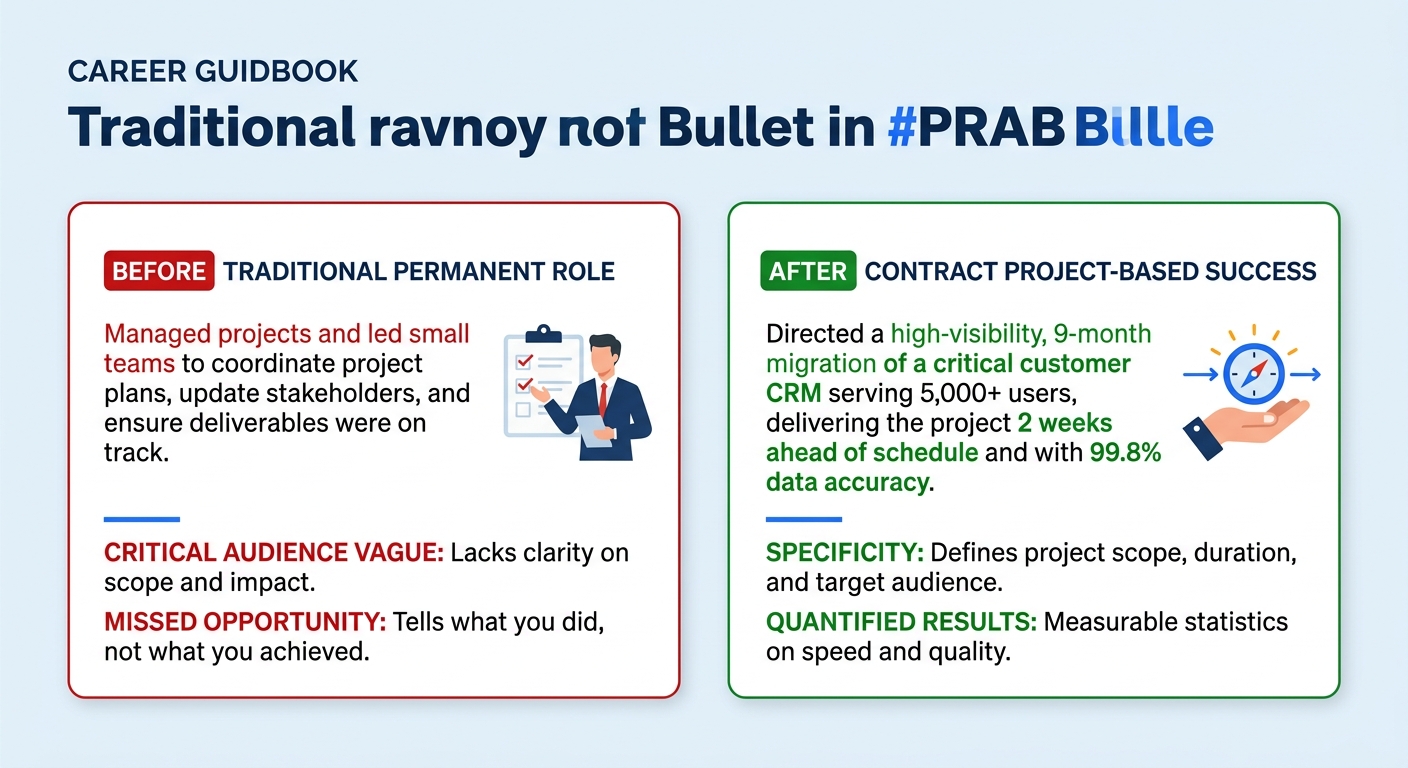
But the real advantage is the bullet structure. Contract workers write project-based resume bullets because that’s how their work is scoped: a defined start date, a defined end date, a defined deliverable, and a quantifiable result. Their bullets naturally follow the X-Y-Z format (“Accomplished X, as measured by Y, by doing Z”) because there’s no ambiguity about what the “project” was.
Permanent employees can restructure their experience the same way. Take a 3-year stint as a marketing manager and break it into the 4 or 5 discrete initiatives you led. Each initiative becomes its own bullet cluster, with its own scope, timeline, and measurable outcome. If you’ve been sharpening your resume’s action verbs, this is the logical next step: pairing those strong verbs with project-scoped context that reads like a deliverable rather than an ongoing duty.
Tip: Label internal projects the way a contractor would. Instead of “Led marketing campaigns,” write “Q3 Product Launch Campaign (12 weeks): Designed and executed multi-channel launch strategy for SaaS product, generating 2,400 qualified leads against a target of 1,800.”
The Scope-Proof-Signal Framework for Repositioning
Repositioning a permanent resume for a contract-first market requires changes at three levels, a framework I call Scope-Proof-Signal:
1. Scope each role as a series of projects. Break continuous employment into discrete engagements. A 5-year tenure becomes 5 to 8 named projects, each with a defined objective and timeline. This mirrors how contract workers present their history, and it gives hiring managers the granularity they’re scanning for. Zippia’s guidance on listing contract work recommends grouping related projects under a single employer header, which works identically for permanent employees repackaging internal initiatives.
2. Prove each project with numbers. Every project-based resume bullet needs at least one quantified outcome: revenue generated, costs reduced, users served, uptime improved, timelines shortened. The gig economy’s growth to $674.1 billion means employers are conditioned to evaluate ROI per engagement. If you can’t attach a number to a project, you either need to dig harder for the metric or acknowledge that the project may not belong on your resume at all.
3. Signal methodology fluency. Contract workers routinely name the frameworks they used (Agile, Kanban, Waterfall, Lean) because clients need to know the contractor can plug into existing workflows. Resume.io’s project management skills guide identifies methodology fluency as a top differentiator. Permanent employees should do the same: naming the project management approach, the tech stack, or the strategic framework gives hiring managers a compatibility signal they can evaluate in seconds.
This framework applies whether you’re a displaced engineer rebuilding after tech layoffs or a mid-career marketing director competing against consultants for a VP role.
What the 77% ATS Anxiety Number Actually Reveals
Why does that 77% figure persist even as hiring technology improves? Because permanent-employee resumes tend to be heavy on titles and light on the specific, searchable terms that ATS systems and AI screening tools prioritize.
Contract workers, by contrast, produce resumes dense with tool names, methodology labels, and quantified outcomes. Those are exactly the tokens that ATS parsers and AI sorting algorithms extract and score. When 92,000 tech jobs disappeared in the first five months of 2026 alone, according to Intellectia’s workforce analysis, the flood of applications made this gap worse. Hiring managers and their AI tools are drowning in volume, and the resumes that surface are the ones built around searchable, specific deliverables.
If you’re spending time checking your resume builder’s AI suggestions for authenticity, make sure the output follows contract-style specificity. A builder that generates “Managed cross-functional teams to deliver business outcomes” is producing noise. A builder that generates “Led 8-person cross-functional team through 16-week ERP migration, completing 3 weeks ahead of schedule at 12% under budget” is producing signal.
The resumes that surface in a flooded market are the ones built around searchable, specific deliverables, and that’s the format contract workers have been using for years.
Flexible Workforce Resumes Across Career Stages
The contract work resume positioning strategy looks different depending on where you are in your career. For entry-level candidates facing a shrinking pool of junior roles, internships, capstone projects, and volunteer work function as contract-equivalent experience. Resume Genius recommends creating a “Relevant Experience” section that treats each project as a standalone engagement, complete with scope, tools used, and outcomes delivered.
Mid-career professionals have the richest material to reformat. Every cross-departmental initiative, every product launch, every system migration is a project with a defined scope. The challenge is overcoming the instinct to describe your role (“responsible for overseeing…”) rather than your output (“delivered X by Y date, resulting in Z”).
Senior leaders face a subtler version of the same problem. Executive resumes tend to emphasize span of control (team size, budget authority, reporting structure) rather than project-level impact. But the hiring managers filling C-suite and VP roles in 2026 increasingly come from organizations where leadership is evaluated by portfolio of outcomes, not org-chart position. The executive summary section of a senior resume should read like a highlight reel of your highest-impact projects, not a description of your standing in a hierarchy.
| Career Stage | Key Repositioning Move | Example Bullet Format |
|---|---|---|
| Entry-level | Treat internships and class projects as contract engagements | “UX Research Intern, Acme Corp (10 weeks): Conducted 24 user interviews, identified 3 critical pain points, redesigned onboarding flow increasing completion rate by 18%” |
| Mid-career | Break each tenure into 4-8 named projects | “Q2 Data Pipeline Rebuild (14 weeks): Migrated legacy ETL processes to Airflow, reducing daily processing time from 6 hours to 45 minutes” |
| Senior/Executive | Lead with portfolio of outcomes, not span of control | “Supply Chain Digital Transformation (18 months): Directed $4.2M initiative across 3 business units, cutting fulfillment costs 22% and improving on-time delivery from 84% to 96%” |
Questions the Numbers Still Can’t Answer
The data makes a strong case for contract-style formatting, but several gaps remain. The 70% skills-based hiring figure doesn’t specify what percentage of those employers have actually updated their ATS configurations to reward project-scoped bullets over tenure-based ones. A company can claim to hire for skills while its screening software still penalizes short job stints and gaps.
The 77% ATS anxiety statistic captures fear, not verified outcomes. We don’t yet have reliable public data on how often project-formatted resumes outperform traditional ones in controlled A/B tests at scale. The gig economy’s $674.1 billion valuation measures market size, not hiring manager preference at the individual role level. And the platforms launching skill verification tools (LinkedIn, Indeed, the project-sourcing startup Vamo, which launched in February 2026) are still in early adoption phases, meaning the gap between what they promise and what employers actually use remains wide.
What we do know: the direction of movement favors specificity, project-level proof, and skill signals over tenure and title prestige. The 92,000 tech jobs lost in early 2026, the 500 CFOs shedding junior positions, the record-high job seeker confidence index all point toward a market where flexible workforce resumes carry more weight in screening than they did even 12 months ago. The permanent job seeker who reformats around deliverables and outcomes is positioning for where hiring is heading. Monitoring how quickly employers actually retool their screening systems to match these stated preferences will tell us how fast “heading there” becomes “already there.”