

 4.9
4.9 4.5
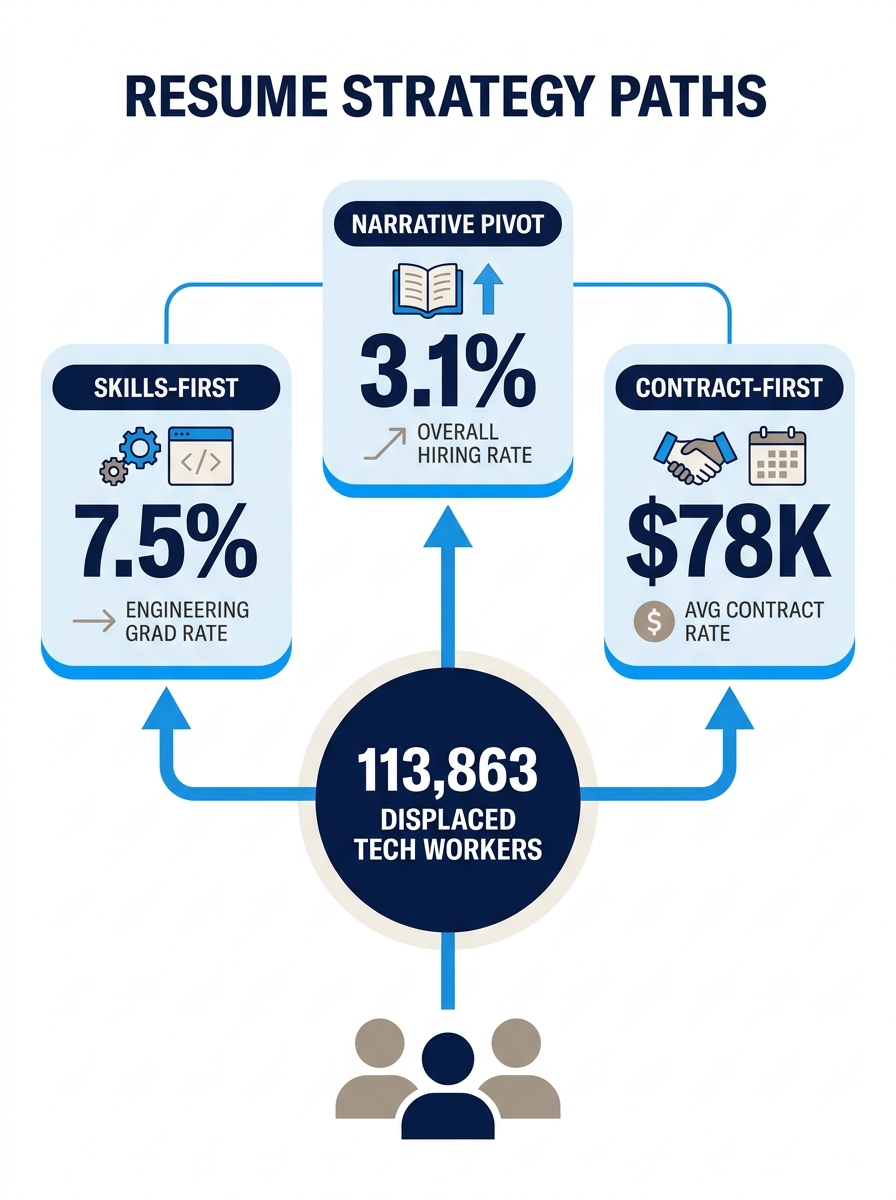
4.5Three distinct resume approaches have emerged from the displacement of 113,863 tech workers across 179 layoff events tracked so far in 2026, and career coaches are fighting over which one actually converts interviews for engineers forced into a career pivot after tech downsizing.
TL;DR: Displaced engineers choosing a post-layoff resume repositioning strategy face three viable options: a skills-first format, a narrative pivot, or a contract-first approach. Each serves a different career distance, seniority level, and target industry. The wrong pick can add months to a search where U.S. hiring rates sit at 3.1%, the lowest since April 2020.
The Three-Way Split Among Career Coaches
The scale of displacement makes the disagreement urgent. Meta plans to lay off 8,000 employees starting May 20, with additional cuts expected in the second half of 2026, according to Reuters via InformationWeek. Block eliminated 4,000 roles citing “the growing capability of AI tools.” Cloudflare reduced staff by 20%, affecting over 1,100 employees, after a 600% increase in internal AI usage. Oracle executed a single reduction of 30,000 workers. And roughly 20 to 23% of Q1 2026 tech layoffs were directly attributed to AI implementation, per data from RationalFX and Challenger, Gray & Christmas.
Coinbase CEO Brian Armstrong captured the restructuring philosophy when he described experimenting with combining multiple functions “all in one role,” as reported by InformationWeek. That language has been adopted by several other companies in their layoff communications, suggesting a coordinated corporate messaging strategy around AI displacement. The message to engineers is clear: your old title may not exist at your next company, no matter how well you performed in it.
These aren’t temporary belt-tightening moves. Companies are building flatter, AI-native teams, and many eliminated roles aren’t coming back in the same form. That changes the resume calculation entirely. Engineers can’t dust off their old resume and apply to identical positions at a different company. They need a displaced engineer career strategy that accounts for a hiring landscape where computer engineering graduates face 7.5% unemployment and computer science graduates face 6.1% unemployment, compared to the overall U.S. rate of 3.6%.
The coaches I’ve been reading and tracking have fractured into three camps, each with evidence and real failure modes.
Strategy 1: The Skills-First Resume
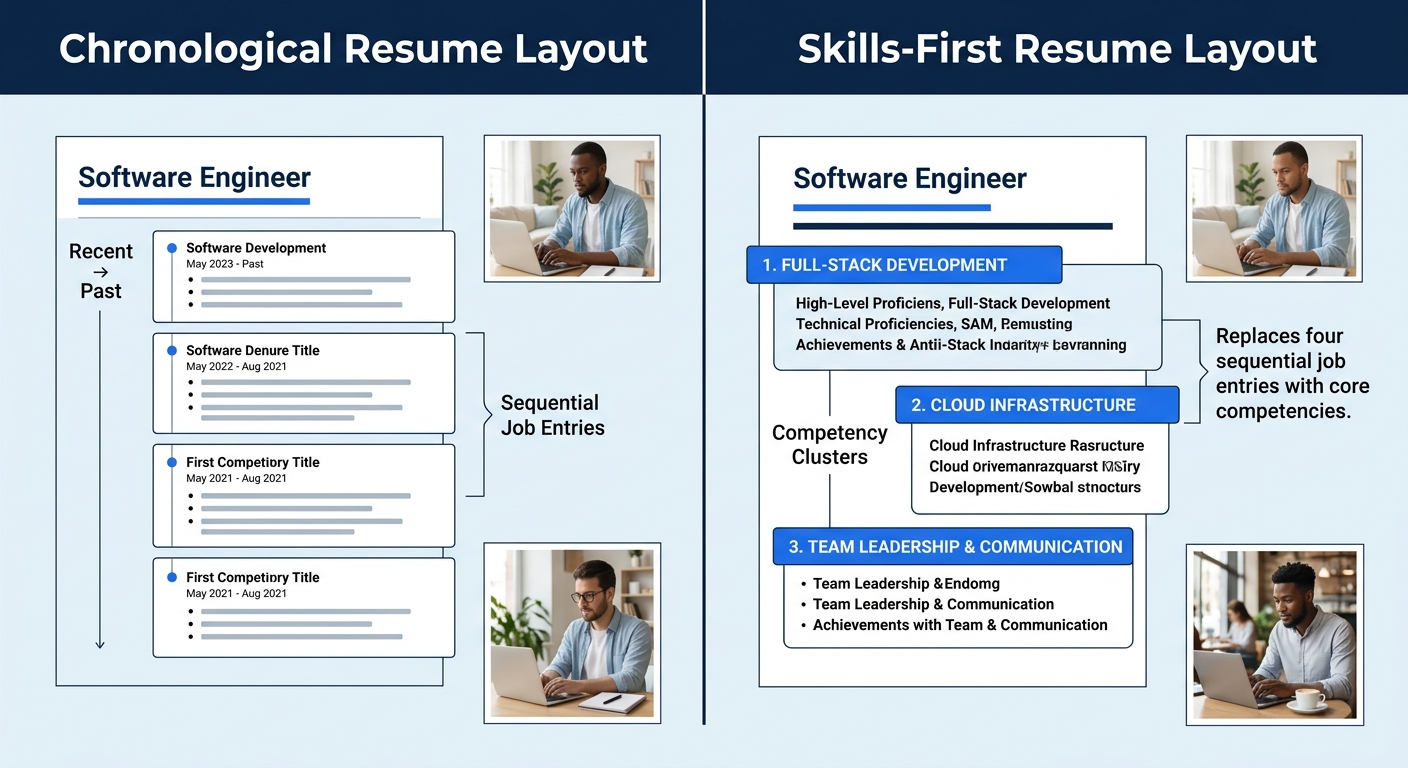
The skills-first approach strips away job titles, company prestige, and chronological work history as organizing principles. Instead, it groups your experience under competency clusters (cloud architecture, ML pipeline design, cross-functional technical leadership) and leads each section with measurable outcomes.
Why do coaches recommend this format specifically for 2026? Because when 55% of 1,000 U.S. hiring managers surveyed by Resume.org say they expect layoffs at their own companies, those managers aren’t scanning for pedigree. They’re looking for specific capabilities that fill gaps on their shrinking teams. A Harris Poll found that 70% of hiring managers are open to overqualified candidates, but only when those candidates demonstrate relevant, current skills in a format the manager can parse quickly.
The practical execution means ripping your resume apart. Dice.com’s career advice team recommends sticking to your last three to five jobs and eliminating any experience, tools, frameworks, or software programs older than 10 years. In a skills-first format, you’d go further: you’d reorganize those remaining experiences around 3 to 4 skill themes rather than listing them job by job.
Where it works: Engineers staying within tech but shifting to adjacent specialties. A Chrome platform engineer moving into browser security. A QA automation lead repositioning toward DevOps. The skill clusters let hiring managers see immediate overlap without mentally translating your previous title. If you’re exploring how to rebuild your developer resume after layoffs, the skills-first format often gets the fastest traction for lateral moves within the same industry.
Where it fails: The format confuses some ATS systems that expect reverse-chronological structure. And hiring managers at traditional companies (banks, defense contractors, healthcare systems) sometimes find the layout disorienting. You can end up optimized for one audience while invisible to another, which is exactly the kind of ATS-to-hiring-manager translation gap that sinks applications silently.
Strategy 2: The Narrative Pivot Resume
The narrative pivot resume treats your layoff and subsequent career change as an intentional, coherent story. Instead of hiding the disruption, you frame it. The career summary becomes a bridge paragraph that explicitly connects where you’ve been with where you’re heading, and every bullet point beneath it reinforces that direction.
Colorado State University’s career management guidance captures the core principle: your resume and LinkedIn should “tell a story about your strengths, your direction, and the value you bring” by being direct and connecting the dots between your experience and your goals. This is the resume narrative for lateral moves, and it works by turning what looks like a gap or a detour into evidence of adaptability.
One displaced engineer described the approach on Reddit’s r/Layoffs forum: “I actually used my experience with the layoff as a selling point. I showed that I know how to work lean, how to keep my team together during a crisis, and how to pivot fast without losing my footing.” That engineer reported receiving two third-round interview invitations before the layoff was even official and landing a new role within six weeks.
Where it works: Engineers making a genuine career pivot after tech downsizing, especially those moving into adjacent industries like fintech, healthtech, or climate tech. LinkedIn data from March 2026 showed a 34% year-over-year increase in AI/ML engineering roles, even as overall tech postings declined by 8%. If you’re targeting one of those growing pockets, the narrative pivot makes your background feel intentional rather than circumstantial. The career coaching services that specialize in post-layoff recovery generally favor this format because it gives coaches a structure to shape during sessions.
Where it fails: The narrative pivot requires strong writing. A poorly executed career summary sounds like a euphemism for “I got laid off and I’m scrambling.” The strategy also breaks down when you’re applying to 50+ jobs across multiple industries, because each narrative needs to be tailored to a specific destination. If you’re not willing to write 4 or 5 different versions of your career summary, this approach will produce generic, unconvincing results. Understanding the alignment problem between coaching advice and resume execution becomes critical here.
Strategy 3: The Contract-First Resume
The contract-first resume positions you as a fractional or project-based specialist rather than a full-time job seeker. This approach has gained traction specifically because companies restructuring toward smaller AI-native pods (Meta’s reorganization under Zuckerberg being the most visible example) still need temporary expertise to manage the transition, even while they cut permanent headcount.
Between October and November of the most recent measured period, the number of technology workers across different industries fell by 134,000, according to the Washington Post. But contract and consulting engagements haven’t declined at the same rate. Companies still need experienced engineers for migration projects, system integration, and infrastructure work. They’re reluctant to add permanent headcount, though.
The contract-first resume leads with project deliverables and outcomes rather than tenure. Each engagement gets described like a case study: problem, approach, measurable result. KORE1 reported placing a displaced cybersecurity lead in under two weeks through a contract engagement, illustrating the speed advantage this format can unlock.
Where it works: Senior engineers (10+ years) with deep specialization in areas companies can’t automate yet, including infrastructure migration, compliance architecture, and legacy system modernization. If you’ve spent time wrestling with technical debt, translating that debugging work into hiring manager language for a contract-first resume is often more natural than for a full-time application. The format also sidesteps the awkward employment gap question entirely, since contract work is expected to have gaps.
Where it fails: Engineers under five years of experience rarely have enough standalone project outcomes to fill this format convincingly. The approach also doesn’t work well if your goal is a stable, full-time position at a large company, where recruiters evaluate for long-term commitment and a resume full of 3-to-6-month engagements can trigger skepticism. We’ve covered the broader shift toward contract-first resume positioning in detail if you want the full playbook.
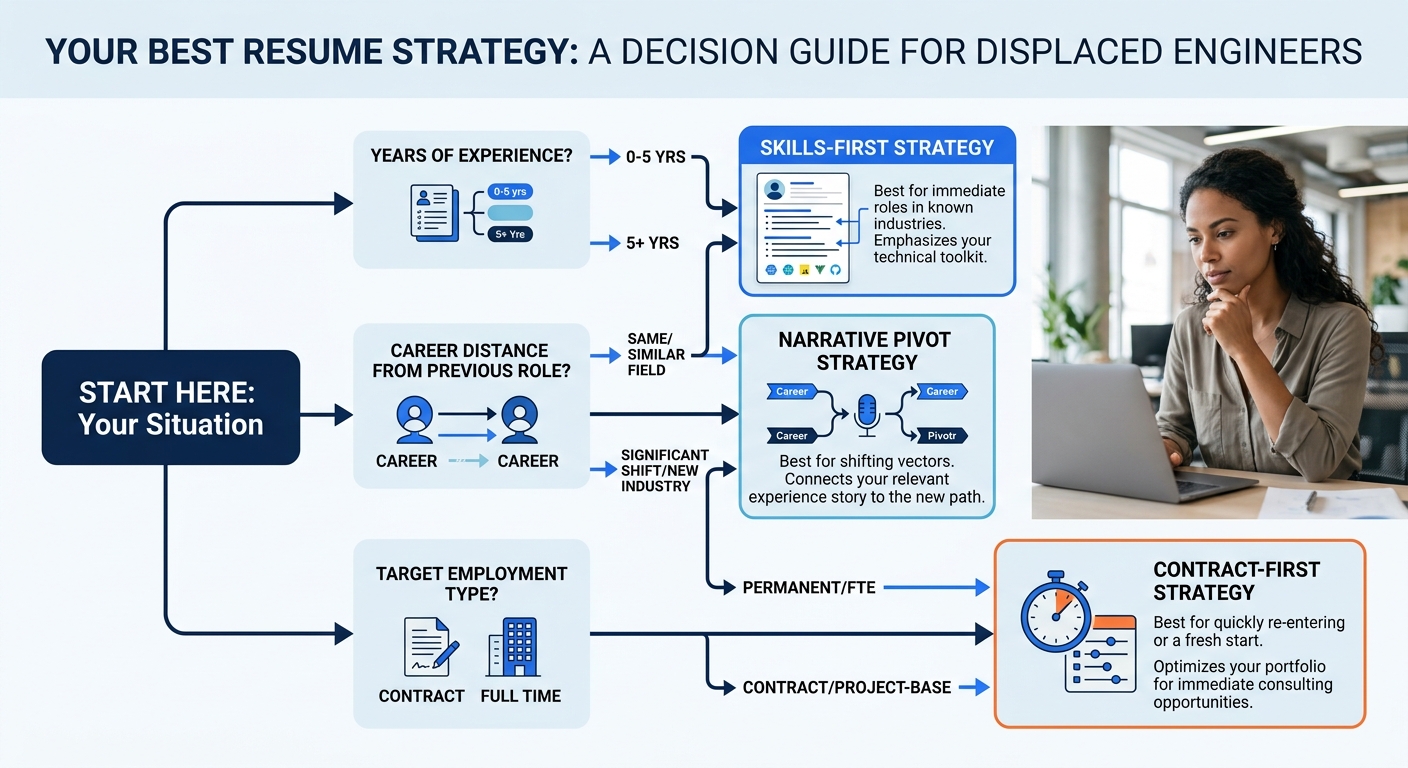
The right post-layoff resume repositioning strategy depends on how far you’re moving from your previous role, how senior you are, and whether you’re targeting full-time or contract work.
Side-by-Side Comparison
| Factor | Skills-First | Narrative Pivot | Contract-First |
|---|---|---|---|
| Best career distance | Lateral (same industry, adjacent role) | Medium to far (new industry or function) | Lateral to medium (same skills, different format) |
| Ideal seniority | Mid-level (3–8 years) | Any level | Senior (10+ years) |
| ATS compatibility | Moderate (non-chronological formats confuse some parsers) | High (maintains reverse-chronological backbone) | Moderate (project-based layout can trip parsers) |
| Time to customize per application | Low (skill clusters stay stable across similar roles) | High (each narrative needs a unique destination) | Low (project descriptions are reusable) |
| Writing difficulty | Medium | High | Medium |
| Biggest risk | Hiring managers find format unfamiliar | Poor writing makes the pivot sound desperate | Recruiters assume you won’t accept full-time roles |
How to Choose Between These Three
The honest framework comes down to three variables: career distance, seniority, and target employment type.
If you’re staying in tech and moving to an adjacent role (say, from Android platform development to embedded systems, or from Chrome engineering to browser security), the skills-first resume gets you in front of the right people fastest. Your competencies overlap with the new role, and the format makes that overlap visible immediately. Engineers from Google’s AOSP, Chrome, and Pixel teams are finding success in embedded systems, robotics, and defense tech, but only when their resumes clearly translate low-level OS or browser engine expertise into domain-relevant outcomes.
If you’re making a genuine career pivot, whether into a different industry or a fundamentally different function, the narrative pivot is the only strategy that prevents your resume from reading like a confused jumble of unrelated experience. This is the approach most professional resume writers recommend for displaced engineers targeting sectors like defense tech, climate tech, or healthcare IT, where domain framing matters as much as technical skills.
If you’re a senior engineer who wants to keep working without re-entering the full-time hiring gauntlet, the contract-first format gives you immediate credibility as a fractional specialist. With U.S. hiring rates sitting at 3.1%, the lowest since April 2020 according to BLS data, the contract path often produces income faster than a full-time search that drags into month four or five.
Tip: Some of the most successful displaced engineers are running two resumes simultaneously: a narrative pivot version for dream-job applications and a contract-first version for the “I need income within 30 days” reality. If you do this, keep a master document with all your bullet points organized by skill cluster so your two versions don’t start contradicting each other on dates, metrics, or project descriptions.
And here’s the part most coaches won’t tell you: the gap between job loss and job readiness is now the single biggest barrier to reemployment. The post-layoff resume rebuild process rewards engineers who start within days, not weeks. With 113,863 displaced tech workers competing for a shrinking pool of openings, the resume sitting on your laptop from 2023 is a liability. Pick the strategy that matches your situation, rebuild with real numbers and specific outcomes, and get moving before the next wave of Meta employees hits the same job boards you’re browsing.