


 4.9
4.9 4.5
4.5Forbes career expert Sho Dewan identified two workplace dynamics trapping mid-career professionals in stagnant positions—the “experience trap” where competence prevents advancement and the “reputation silo trap” where team-level excellence remains invisible to senior leadership—in an analysis published May 27, 2026, according to Forbes.
TL;DR: Mid-career professionals become trapped when managers view them as critical infrastructure too valuable to promote, while their expertise remains confined to their immediate team rather than visible to decision-makers across the organization.
The analysis addresses what Dewan called “one of the most frustrating places to be in a career,” citing research showing significant mid-career disengagement among professionals who have reached expert status within their teams but see no clear path to leadership roles.
The Experience Trap Creates Immobility
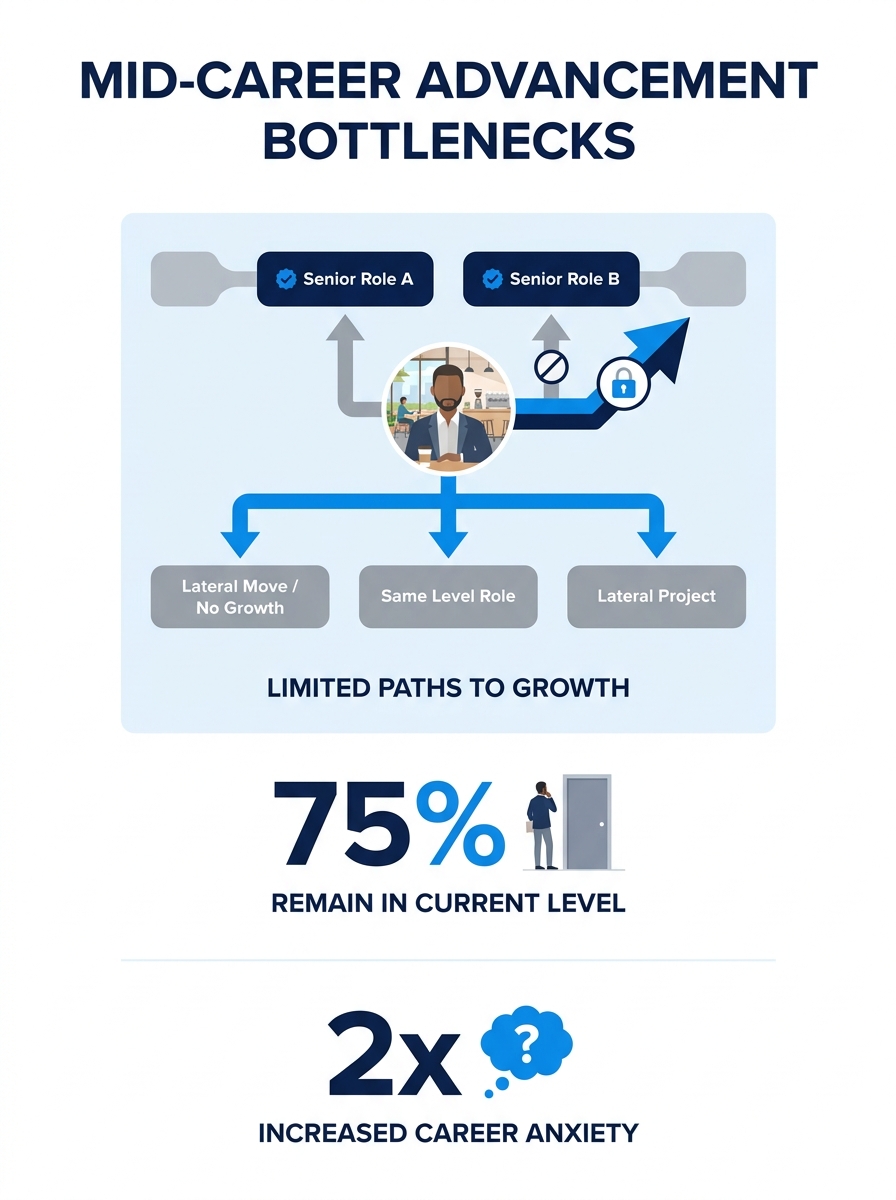
Mid-career professionals who excel in their current roles inadvertently create barriers to advancement, Dewan reported. Employees become “the go-to person for every complex problem and the keeper of all the historical knowledge,” according to the Forbes analysis, positioning them as critical infrastructure rather than promotion candidates.
“You’ve become so good at your job that your manager can’t imagine the team without you,” Dewan wrote. The dynamic transforms perceived power into a constraint: managers view these employees as too valuable to move, effectively anchoring them in place regardless of performance quality.
The analysis cited research indicating many professionals believe their current job limits career growth, though specific percentage data was not disclosed in the May 27 report.
Reputation Confinement Limits Visibility
The second barrier Dewan identified—the reputation silo trap—occurs when professional accomplishments remain confined to immediate team boundaries. Decision-makers in other departments who control senior-level roles and cross-functional opportunities never encounter these high-performers, according to the analysis.
“You could be the most talented person in your department, but if the Head of Sales has never heard of you, you’re not on their radar for that strategic new initiative,” Dewan wrote. The dynamic creates advancement ceilings unrelated to competence or output quality.
The Forbes contributor framed both traps as structural rather than performance-based obstacles, requiring strategic pivots rather than incremental skill improvement.
Cross-Functional Projects Build Escape Routes
Dewan’s first recommended strategy involves proactively seeking collaboration with departments critical to company success, rather than waiting for assignments. The analysis suggested approaching managers with language like “I want to better understand how our work impacts the sales team. Is there a small, upcoming project with them that I could contribute to?”
The cross-functional approach delivers three outcomes, according to the report: resume-building credentials, expanded professional networks, and demonstration of enterprise-level thinking beyond individual team concerns. This strategic repositioning addresses both the visibility gap and the infrastructure-anchor problem simultaneously.
The approach aligns with broader career coaching recommendations emphasizing alignment between career strategy and resume positioning as essential for interview conversion.
Mentorship Signals Leadership Readiness
The second pivot Dewan identified involves assuming leadership behaviors before formal promotion, specifically through mentoring junior colleagues or new hires. The strategy requires no formal program—offering virtual coffee meetings or task-specific guidance demonstrates what the Forbes analysis called “a key senior-level competency: the ability to develop talent.”
“By elevating others, you demonstrate a key senior-level competency,” Dewan wrote. The shift moves employee value from individual execution to team development, a distinction the analysis suggested can “quietly increase your promotion odds.”
The mentorship approach transforms how managers perceive mid-career employees, repositioning them from individual contributors to potential leaders capable of scaling impact through others.
What Happens Next
Mid-career professionals facing stagnation now have a two-part framework to diagnose whether competence itself blocks advancement. The Forbes analysis reframes the mid-career slump as a signal requiring strategic pivots rather than evidence of talent limitations, directly addressing the population of readers navigating career progression strategy after years of deepening expertise within single teams.
The identification of the experience trap and reputation silo trap provides concrete language for professionals to articulate their situation during career coaching conversations or performance reviews. Employees can now distinguish between performance problems and structural positioning problems, redirecting energy from skill-building toward network expansion and cross-functional visibility.
Dewan’s framework also creates a diagnostic for hiring managers and HR departments evaluating why high-performers stall: teams may be inadvertently creating retention through over-reliance rather than deliberately developing talent for advancement. The analysis positions the mid-career slump as a systems problem rather than an individual failure, suggesting organizational fixes beyond employee-level strategy adjustments.