
 4.9
4.9 4.5
4.5Five cover letter templates follow below, each built for a distinct job-search scenario: problem-solution, achievement-focused, entry-level, career-change, and narrative. You’ll pick the template that fits your situation, fill in the key sections using the step-by-step instructions here, and produce a finished letter in about 30 minutes.
TL;DR: Choose one of the five cover letter examples sample templates based on your experience level and situation, customize each paragraph using the fill-in-the-blank prompts provided, and verify your final draft hits the 200-to-280-word sweet spot that earns the highest callback rates.
Before You Start
You’ll need three things before touching any template:
- A specific job posting open in a separate tab. Every section of your cover letter references this posting directly. Writing a generic letter drops your callback rate from 16.4% to 12.5%, according to hiring data tracking tailored vs. untailored applications.
- Your resume, finalized. The cover letter complements your resume; it doesn’t repeat it. If your resume still needs work, start with a sample cover letter matched to your resume first.
- Two to three quantified achievements ready to reference. “Managed a team” won’t cut it. You need numbers: revenue generated, percentage improved, people trained, hours saved. Hiring managers reviewing cover letter examples sample applications scan for these proof points within the first 15 seconds.
Time required: 25-35 minutes for your first letter. Subsequent letters using the same template take 10-15 minutes.
Skill level: No prior cover letter experience needed. The entry-level template works for first-time job seekers.
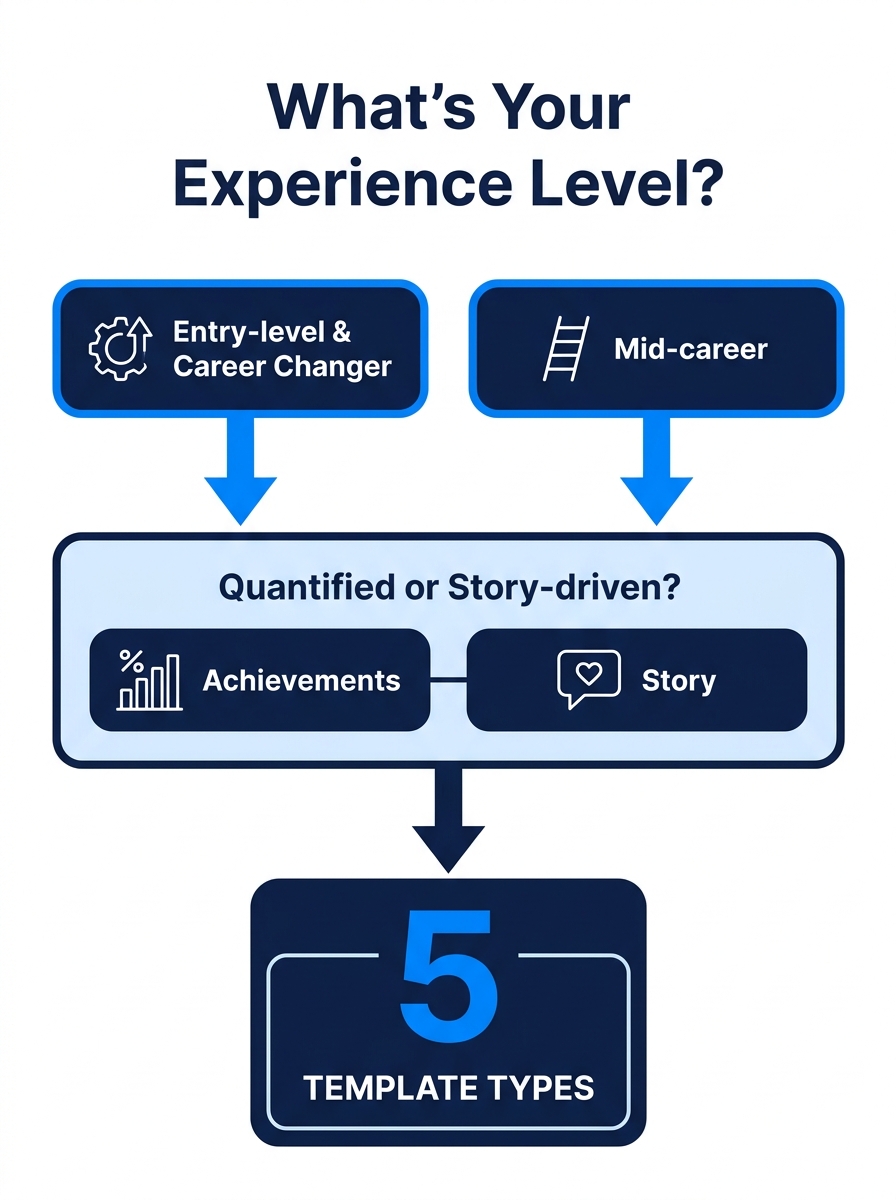
Step 1: Match Your Situation to One of Five Template Types
The single biggest mistake with cover letter examples is picking a template because it looks professional and ignoring whether its structure fits your actual circumstances. A career changer using an achievement-focused format buries the most important information (the reason for switching) below accomplishments from a field the hiring manager doesn’t care about.
Here’s how the five templates compare across the dimensions that matter:
| Template | Best For | Key Structure | Ideal Word Count | Difficulty |
|---|---|---|---|---|
| Problem-Solution | Mid-career professionals targeting a specific company pain point | Opens with company challenge, presents you as the fix | 220-260 | Medium |
| Achievement-Focused | Experienced hires with strong metrics | Leads with 2-3 quantified results | 200-250 | Easy |
| Entry-Level | Recent graduates, first-time applicants | Emphasizes transferable skills and coursework | 250-280 | Easy |
| Career-Change | Professionals switching industries | Acknowledges the pivot, reframes past work | 250-280 | Hard |
| Narrative | Creative fields, culture-fit-heavy roles | Tells a brief story connecting you to the mission | 240-280 | Medium |
You’ll know you picked the right template when you can explain in one sentence why this format highlights your strongest selling point for this specific role.
Step 2: Write a Specific Opening Hook
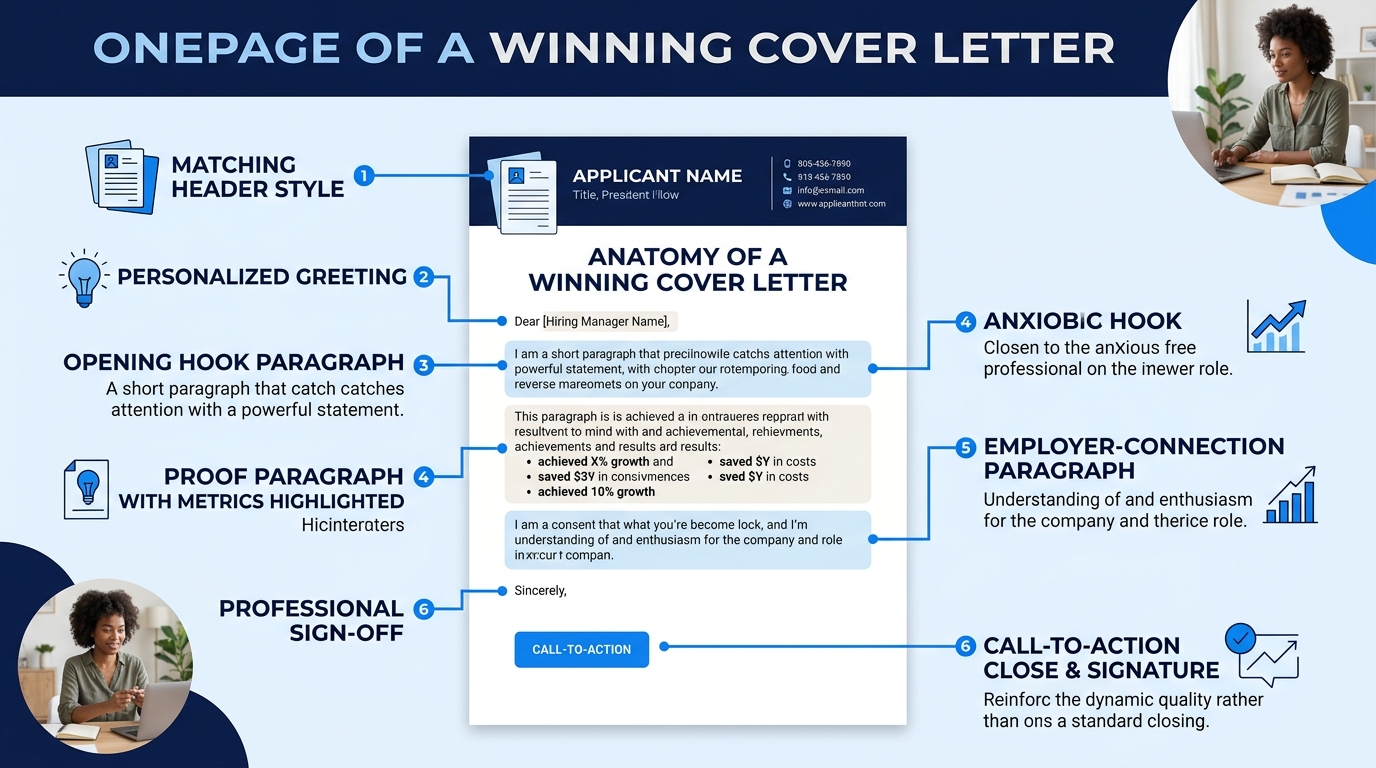
Your opening paragraph does one job: give the hiring manager a reason to read paragraph two. Data from hiring surveys shows 72% of hiring managers prioritize customization above all other cover letter qualities. A generic opener (“I am writing to express my interest in…”) signals that you copied the same letter to 40 companies.
Here’s the opening structure for each template. Fill in the bracketed sections:
Problem-Solution: “I noticed [Company Name] is [specific challenge from job posting, news article, or LinkedIn update]. At [Previous Company], I [solved a similar problem] by [specific action], resulting in [quantified outcome].”
Achievement-Focused: “In my [X years] as a [role], I [top achievement with number]. I’m applying for [Role] at [Company] because [one specific reason tied to their work].”
Entry-Level: “As a recent [degree] graduate from [University] with [relevant coursework, internship, or project], I’m applying for [Role] at [Company Name] because [specific connection to company mission or product].”
Career-Change: “My background is in [current field], and I’m pursuing [new field] because [honest, specific reason]. The [specific skill] I built while [concrete example from old career] translates directly to [requirement from job posting].”
Narrative: “When [brief, relevant personal moment, two sentences maximum], I realized [insight that connects to this company’s work]. That’s what draws me to [Role] at [Company Name].”
Verification: Read your opening paragraph out loud. If you could swap in a different company name without changing anything else, the paragraph is too generic. Rewrite it.
Tip: The University of Michigan Career Center recommends keeping cover letters short, persuasive, and never exceeding one page. Their formatting guidelines specify 10-to-12-point font (matching your resume), margins between 0.5 and 1 inch, and left-justified layout beginning no more than 2 inches from the top of the page.
Step 3: Build the Proof Paragraph with Numbers
The proof paragraph is where 83% of hiring managers decide whether your application moves forward or gets filtered out. This paragraph answers one question: what evidence do you have that you can do this job?
For all five templates, the proof paragraph follows the same three-part formula:
- Name a relevant skill from the job posting (use their exact language when possible).
- Describe a specific situation where you used that skill (one to two sentences).
- State the measurable result (a percentage, dollar figure, count, or time saved).
A data science professional on Reddit described a useful approach for structuring cover letters that works well here: the first sentence summarizes what you bring to the company, and the second flows into the specific experience you’re about to describe. This creates a clear bridge between your hook and your evidence.
Example proof paragraph (Achievement-Focused template):
“Your posting highlights the need for someone who can reduce customer churn. At Meridian Solutions, I redesigned the onboarding sequence for enterprise accounts, cutting 90-day churn from 18% to 7% and recovering an estimated $340,000 in annual recurring revenue. I also trained four junior account managers on the updated process, reducing their ramp-up time by three weeks.”
Example proof paragraph (Entry-Level template):
“During my internship at Greenway Partners, I audited 120 client records for compliance gaps, flagging 23 discrepancies that the team resolved before the Q3 review deadline. My coursework in data analysis at [University] gave me the SQL and Excel skills your posting lists as requirements.”
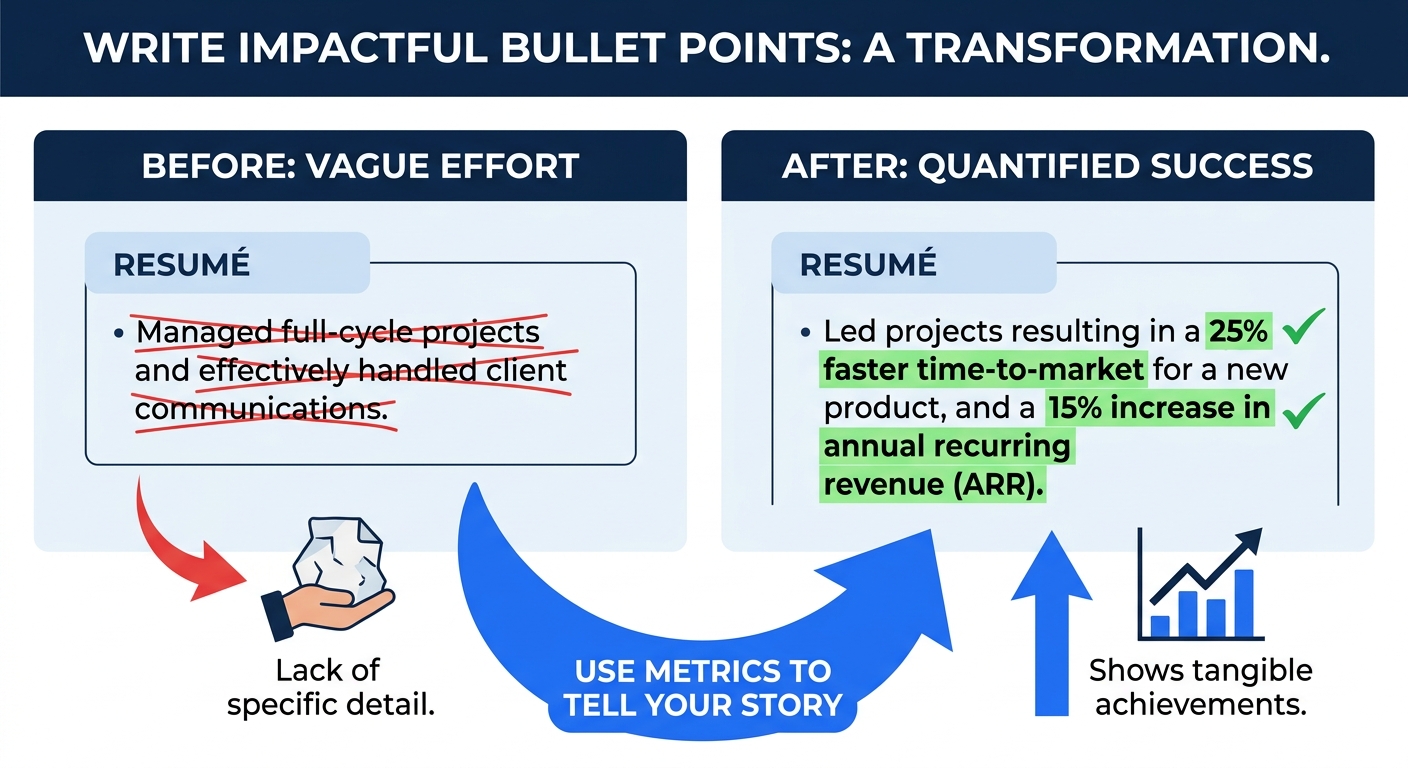
If your proof paragraph doesn’t contain at least one specific number, it reads like a job description, and the hiring manager already has the job description.
Verification: Count the numbers in your proof paragraph. You need at least one. Two is better. Zero means you’re describing responsibilities instead of results.
Step 4: Connect Your Experience to the Employer’s Problem
This paragraph is where most cover letter examples sample templates fall apart. Writers default to talking about what they want (“I would love the opportunity to grow with your team”) instead of what the employer needs.
Rewrite your third paragraph using this structure:
“[Company Name]’s [specific initiative, product, or challenge you identified from research] aligns with my experience in [relevant area]. I’m particularly drawn to [specific detail about the company, a recent product launch, a stated mission, a team structure mentioned in the posting] because [concrete connection to your background].”
If you’re addressing a career gap, this paragraph is where you handle it directly. Don’t hide the gap or hope they won’t notice. Our guide on explaining career gaps honestly walks through the exact language recruiters respond to.
Verification: Show this paragraph to someone who doesn’t know which company you’re applying to. Ask them to guess the company or industry. If they can’t, the paragraph is too vague.
Step 5: Format, Review, and Send
Formatting errors account for a surprising number of rejected applications. Candidates who reach this step with solid content sometimes undermine their own letters with sloppy presentation.
Follow these specs, drawn from Indeed’s cover letter formatting guidance and university career centers:
- Total length: 200-280 words. A survey of job seekers found 66% prefer cover letters of half a page or less, and hiring managers share that preference.
- Font: 10 to 12 point, same typeface as your resume.
- Margins: 0.5 to 1 inch on all sides.
- Line spacing: 1.0 within paragraphs, with an extra line between paragraphs.
- File format: PDF, unless the posting specifically requests Word. PDFs preserve your formatting across devices.
- File name: FirstName-LastName-CoverLetter-CompanyName.pdf.
Before you hit send, run through these three checks:
- Did you spell the hiring manager’s name correctly? (If you can’t find a name, “Dear Hiring Manager” beats “To Whom It May Concern,” which 81% of recruiters associate with generic applications.)
- Does the letter mention the company name at least twice?
- Is every achievement backed by a number?
Verification: Your final letter fits on one page with the formatting specs above. If it spills onto a second page, cut the weakest sentence from your proof paragraph first.
When Things Go Wrong
Problem: Your letter exceeds 300 words and you can’t figure out what to cut. This happens when the proof paragraph tries to cover too many achievements. Pick the single most relevant accomplishment for this specific role and cut the rest. You can reference additional results during the interview.
Problem: You can’t find specific metrics from your past work. Estimate conservatively and frame it honestly: “approximately 200 accounts” or “reduced processing time by roughly 15%.” Approximate numbers still outperform no numbers at all. If you’re looking for ways to quantify achievements on your resume and cover letter, we’ve covered strategies for pulling metrics from any role.
Problem: The job posting says “cover letter optional” and you’re not sure whether to write one. Write one. Hiring data shows candidates who submit tailored cover letters see a callback rate 53% higher than those who skip the letter entirely (16.4% vs. 10.7%). “Optional” means optional for the applicant. It’s rarely optional for the hiring manager’s impression of your effort.
Where to Go From Here
You have a finished cover letter matched to one of five proven formats, customized for a specific role and company, and formatted to the specs that hiring managers expect. The next step is repetition with variation: each new application gets the same template structure with entirely new content tailored to that posting.
If you’re applying to roles across different industries or seniority levels, you’ll find yourself switching between templates. A career changer applying to a creative agency might use the narrative format for that application and the career-change format for a more traditional corporate role. Our collection of cover letter examples for different job types shows how the same candidate can shift formats depending on the audience. And if you want additional template variations with detailed tips on tone and structure, our guide to example cover letter templates covers the nuances that separate a good letter from one that actually gets you an interview.