

 4.9
4.9 4.5
4.5Seventy-two percent of hiring managers expect a cover letter customized to the specific role, even when the posting labels one “optional,” according to a ResumeLab survey. The letters that survive that expectation follow a repeatable structure anyone can build in about 30 minutes. This guide walks you through five concrete steps with full examples at each stage.
TL;DR: The cover letters that lead to interviews open with a company-specific connection, present one or two quantified achievements in the body, and close with a direct meeting request. Follow the five steps below to build one from scratch, then verify it against the troubleshooting checklist before sending.
Before You Start
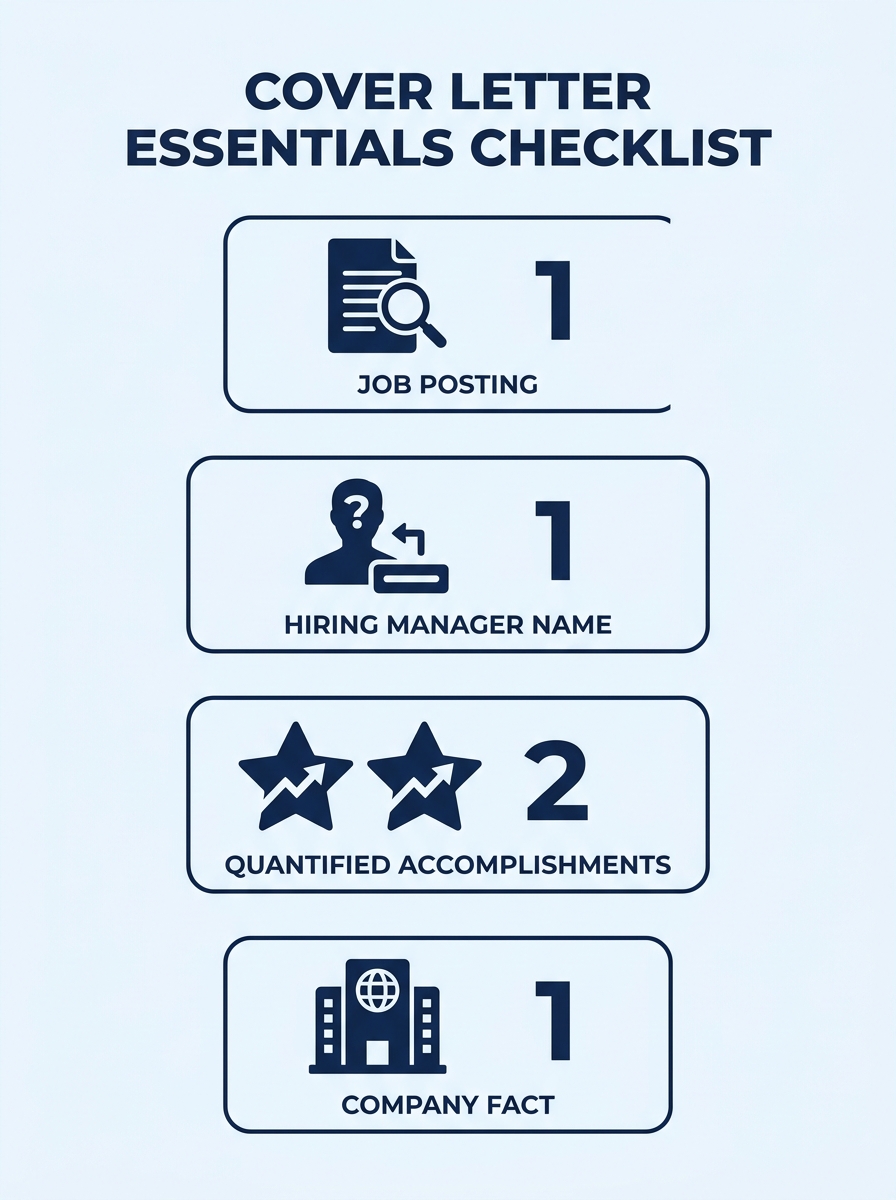
Gather these four items before you draft a single sentence. Skipping any one of them results in the kind of generic letter that 94% of hiring managers say negatively influences their decision:
- The job posting itself, copied into a document you can mark up. Highlight every skill, qualification, and responsibility mentioned. Indeed’s career team recommends reviewing keywords listed in the job description and weaving them into the body of your letter.
- The hiring manager’s name. Check LinkedIn, the company’s team page, or call the front desk. A ResumeGo study found that 59% of hiring managers believe a cover letter provides valuable insight into an applicant. Addressing that manager by name signals you’ve done basic homework that 38% of competing applicants skip entirely.
- Two quantified accomplishments from your past work that match the role’s core responsibilities. Dollar figures, percentages, and headcounts all qualify. If you haven’t mapped those out, our guide on quantified cover letter templates can help.
- One recent fact about the company. A product launch, a quarterly earnings figure, an expansion into a new market, a partnership announcement. You’ll use this in your opening paragraph.
Time required: 10 minutes for research, 15–20 minutes for writing, 5 minutes for formatting and proofreading. Total: about 30 minutes once you’ve done it a few times.
Step 1. Find the Hiring Manager and the Company’s Real Problem
Every job posting describes a gap the company needs filled. Your task in this step is to identify that gap precisely and figure out who will read your letter.
Start with the job title and department. Search LinkedIn for “[Company Name] + [Department] + manager” or “[Company Name] + [Job Title] + director.” You’re looking for the person who would supervise the role. If you find them, use their name in your salutation: “Dear Ms. Baucom” or “Dear Mr. Nakamura.” If you can’t find a name after five minutes, “Dear Hiring Manager” is acceptable. Never use “To Whom It May Concern.” Forty-five percent of hiring managers read the cover letter before the resume, so this greeting is the literal first impression.
Next, read the job posting with a pen. Circle the top three responsibilities. These are the company’s problems. A posting that says “manage cross-functional stakeholder relationships to deliver quarterly product releases” is telling you they need someone who ships products on time across messy team boundaries. That’s the problem you’ll solve in your letter.
You’ll know this step worked when: you can state the company’s core need in one sentence and you have a specific person’s name (or “Hiring Manager” as a fallback).
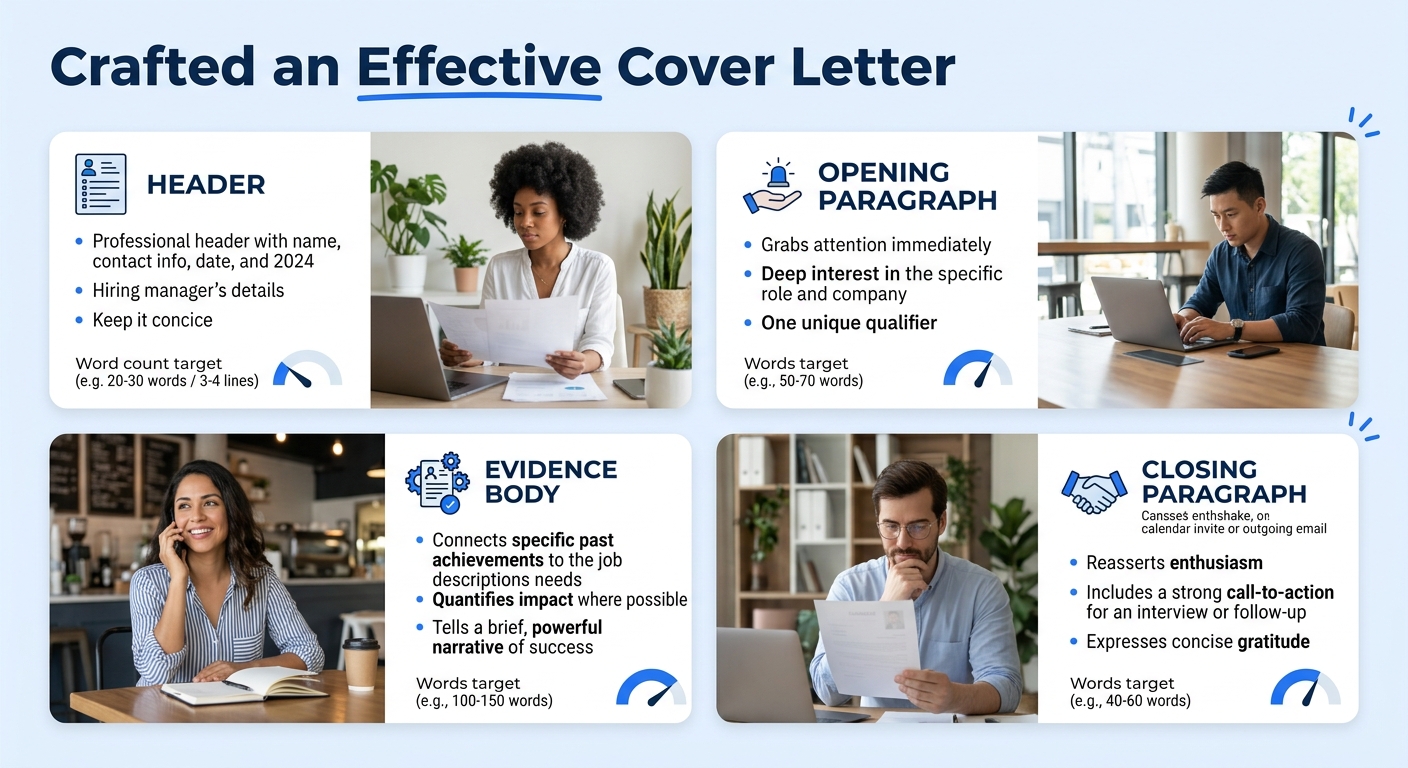
Step 2. Write the Opening Paragraph
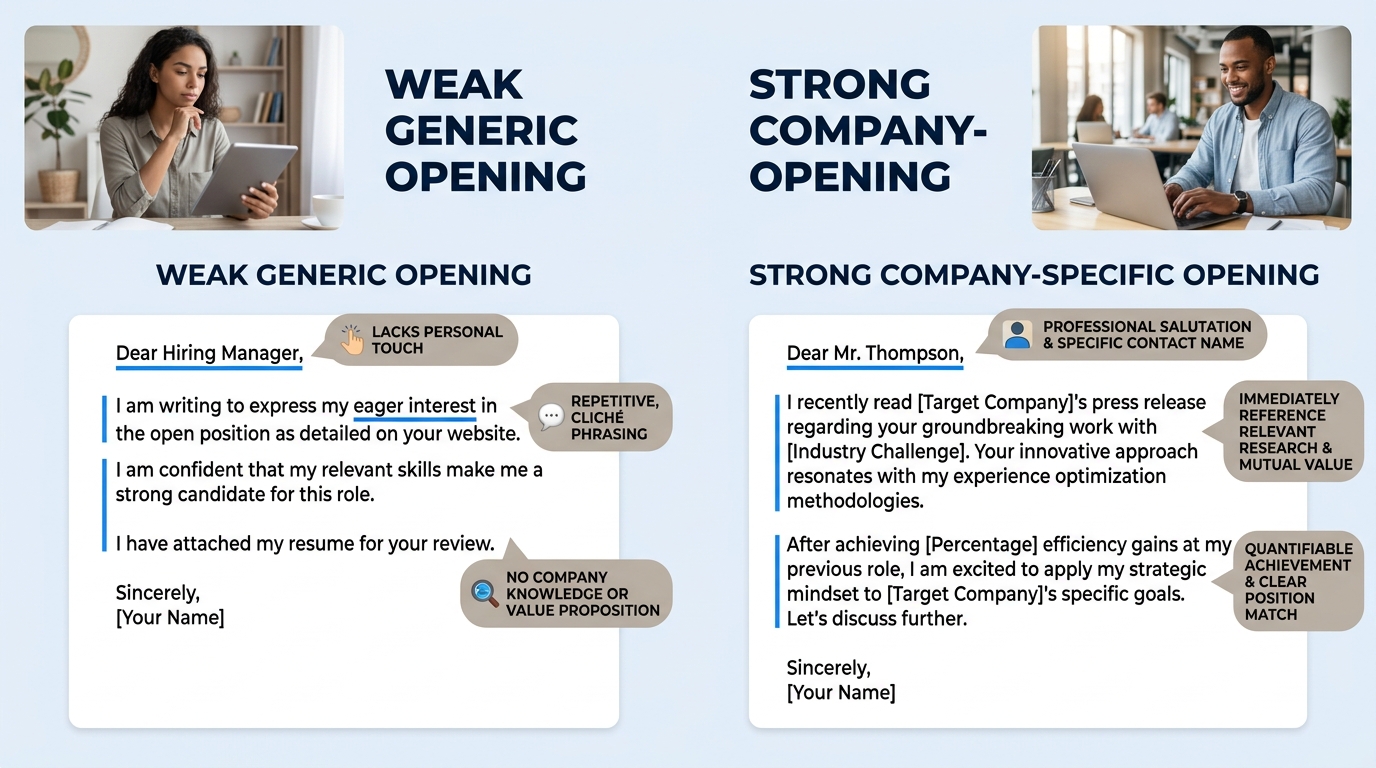
The opening paragraph has one job: give the reader a reason to keep reading. Research from Forbes contributor Goldie Chan confirms that hiring managers want to see you’ve researched the company and aren’t “just looking for a paycheck.” Your opening proves exactly that.
Here’s the formula: Name the role. Name something specific about the company. Connect it to your experience in one sentence.
Example for a marketing manager role:
I’m applying for the Marketing Manager position at Rivian. Your recent launch of the R3 and the 43% year-over-year increase in consumer pre-orders signal a brand ready to scale its direct-to-consumer messaging, and that’s where my seven years running acquisition campaigns for automotive brands fits.
Notice what’s happening: the applicant named a real product (R3), cited a specific metric (43% pre-order growth), and stated their relevant experience length (seven years). This letter could only go to Rivian. A hiring manager scanning 74% of submitted cover letters, per ResumeLab, would immediately see this one is tailored.
What to avoid: generic openers like “I am writing to express my interest in the position” add zero information. Sarah Keach Baucom, co-founder of Girl Tribe Co. and Girl Tribe Pop Up, explained in a hiring manager roundup: “If there is no cover letter, I have no idea why someone would want to work with us.” A generic opener is functionally the same as no letter at all.
You’ll know this step worked when: your opening paragraph mentions the company by name, references a specific fact about them, and states the role you’re applying for. If you could swap in a different company name without changing anything else, go back and rewrite.
Step 3. Build the Evidence Body
The body is where you prove you can solve the problem you identified in Step 1. Indeed’s hiring guidance states it directly: “Focus on one or two [achievements] and provide specific details about your success, including measurable impacts you made.”
One or two. That’s the target. Hiring managers spending 49% of their evaluation forming interview decisions based on cover letters don’t want a wall of five bullet points duplicating your resume. They want depth on the accomplishments that matter most for this role.
Pick the achievement from your prep list (Step 0) that maps closest to the company’s biggest stated need. Write it using this structure:
- The situation: one sentence naming the challenge.
- What you did: one sentence describing your specific action.
- The measurable result: one sentence with a number.
Example for a project manager role:
At my current company, a 6-month product launch was running 11 weeks behind schedule when I joined as project lead. I restructured the sprint cadence from 3-week cycles to 1-week sprints, re-scoped the MVP to 14 critical features, and facilitated daily 15-minute standups with the 8-person engineering team. We shipped 2 weeks ahead of the revised deadline, and the product generated $1.2M in revenue within the first quarter.
That paragraph contains six specific numbers. Each one gives the hiring manager a concrete picture of scope, action, and impact. If your work doesn’t involve revenue, quantify something else: satisfaction scores, error-rate reductions, time saved, users onboarded, units processed. Every job produces measurable outcomes when you look closely enough.
Tip: If you’re changing careers and your past results don’t directly map to the new role, focus on transferable skills with numbers. Reduced customer complaints by 30% in retail? That demonstrates process improvement, which works for operations roles. We’ve written more on [translating experience into a new industry’s language](/blog/career-changers-resume-industry-language).
A Reddit hiring manager explained this principle in a thread for computer science applicants: “A lot of applicants are equally qualified so we look at cover letters to see if they have expanded on their skillset or background.” Expanding doesn’t mean listing more skills. It means giving proof of impact with the skills you already claim.
You’ll know this step worked when: your body paragraph contains at least three specific numbers and directly addresses the company’s biggest stated need from the job posting.
Step 4. Write the Closing Paragraph
The closing paragraph does two things: it restates your fit in one sentence, and it makes a direct request. Sixty percent of companies require cover letters, and that figure rises to 72% for medium-sized businesses and 69% for large ones. The people reading yours are making fast decisions. Give them a clear next action.
Example:
My experience scaling acquisition campaigns for automotive brands directly matches Rivian’s need to grow direct-to-consumer channels as the R3 reaches market. I’d welcome the chance to discuss how I’d approach your Q3 launch strategy. I’m available for a conversation any day this week and can be reached at 555-012-3456 or [email protected].
Don’t close with “I look forward to hearing from you.” That sentence asks nothing and commits to nothing. Instead, name a specific topic you’d discuss in the interview and provide your availability. This shifts the tone from passive hope to professional confidence.
You’ll know this step worked when: your final paragraph includes a named topic for discussion, your contact information, and a specific statement of availability.
Step 5. Format, Proofread, Send
MIT’s career advising office sets the formatting standard: no longer than one page, font size between 10 and 12 points. Include your full name, email, phone number, and city/state at the top. Below that, add the date and the recipient’s name and title.
Here’s a quick formatting checklist:
| Element | Standard | Why It Matters |
|---|---|---|
| Length | 150–300 words body text | 66% of job seekers prefer half a page; hiring managers agree |
| Font | 10–12pt, professional serif or sans-serif | Readability on screens and in print |
| Margins | 1 inch on all sides | Clean white space signals professionalism |
| File format | PDF unless the posting specifies .docx | Preserves formatting across devices |
| File name | FirstName-LastName-CoverLetter-CompanyName.pdf | Easy to find in a cluttered inbox |
Proofread by reading the letter aloud. Your ear catches awkward phrasing your eyes skip. Then run spell-check. A single typo doesn’t usually kill an application, but two or three signal carelessness to the 1 in 4 hiring managers who consider the letter “very important” to their evaluation.
You’ll know this step worked when: your letter fits on one page, the file name includes the company name, and you’ve read every sentence aloud without stumbling.
If you could swap in a different company name without changing anything else, go back and rewrite.
Common Mistakes and How to Fix Them
Problem: Your letter restates your resume line by line. Hiring managers already have your resume. If the cover letter duplicates it, you’ve wasted their time and your space. Fix: choose only the one or two achievements most relevant to this role and add context the resume doesn’t contain, like why you chose a particular approach or what you learned from a failure that shaped your method.
Problem: You wrote a generic letter and sent it to 20 companies. Twenty percent of candidates now use AI to write cover letters, and hiring managers report growing skepticism toward polished-but-vague submissions. The 42% higher response rate that tailored letters produce over generic ones disappears the moment a reader senses the letter was mass-produced. Fix: budget an extra 10 minutes per application to customize the opening paragraph and swap in company-specific facts. If you need structural inspiration, our cover letter examples for every job type break down what “tailored” looks like across industries.
Problem: Your letter is 500+ words. The effective range is 150–300 words of body text. Anything beyond that signals an inability to edit, which is itself a professional skill employers evaluate. Fix: cut any sentence that doesn’t either name a specific achievement or connect your experience to the company’s stated need. If you’re struggling to cut, ask: “Would a hiring manager with 30 seconds care about this sentence?” If the answer is no, delete it.
Where to Go From Here
The five-step structure above produces a letter that 72% of hiring managers are actively looking for: tailored, specific, and anchored to measurable results. Once you’ve written your first one, the second takes half the time because you’ll already have your quantified achievements documented and your research process down to a rhythm.
If you’re applying across different roles or industries, the underlying structure stays the same, but your achievement examples and company research will change for each submission. Our sample cover letters for any job give you additional templates to work from. And if your resume has gaps or non-linear career moves that the cover letter needs to address, handling career gaps honestly is worth reading before your next application goes out.
The cover letter is the one part of your application where you get to speak in full sentences, make an argument, and show a hiring manager how you think. Every other document in your packet is structured data. Use this one to be a person.