
 4.9
4.9 4.5
4.5Recruitment data shows a tailored cover letter produces a 42% higher response rate from recruiters and a 30% greater chance of landing the job compared to a generic one. This guide gives you a fill-in template, section-by-section example cover letter sample text, and a 6-step process that takes about 35 minutes to produce a one-page letter matched to any role.
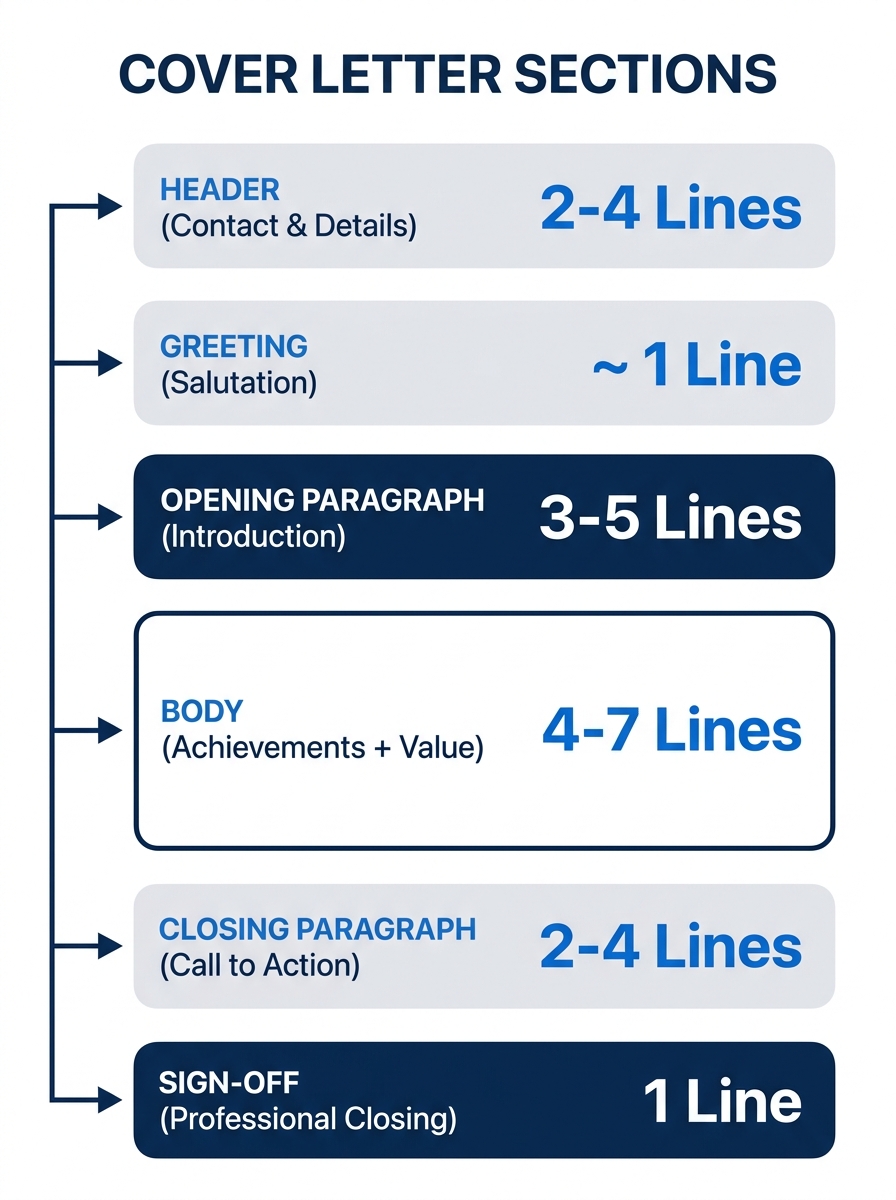
TL;DR: Build your cover letter in six sections (header, greeting, opening hook, achievement body, closing ask, sign-off), pulling keywords directly from the job posting. Back every claim with a number. The whole process takes about 35 minutes and produces a one-page letter tailored to one specific job.
Before You Start
You need four things before you open a blank document:
- The job posting, open in a separate tab. You’ll reference it in every step. Highlight the top 3-5 skills or qualifications the employer mentions most often.
- Your finalized resume. Your cover letter complements your resume, it doesn’t restate it. If your resume still needs work, review a sample cover letter structure for any job to understand how the two documents relate.
- The hiring manager’s name. Check LinkedIn, the company’s team page, or call the front desk. “Dear Hiring Manager” works as a fallback, but a named greeting signals research effort that 90% of applicants skip.
- 30-40 minutes of uninterrupted time. Rushing produces generic language that recruiters recognize within 10 seconds of scanning.
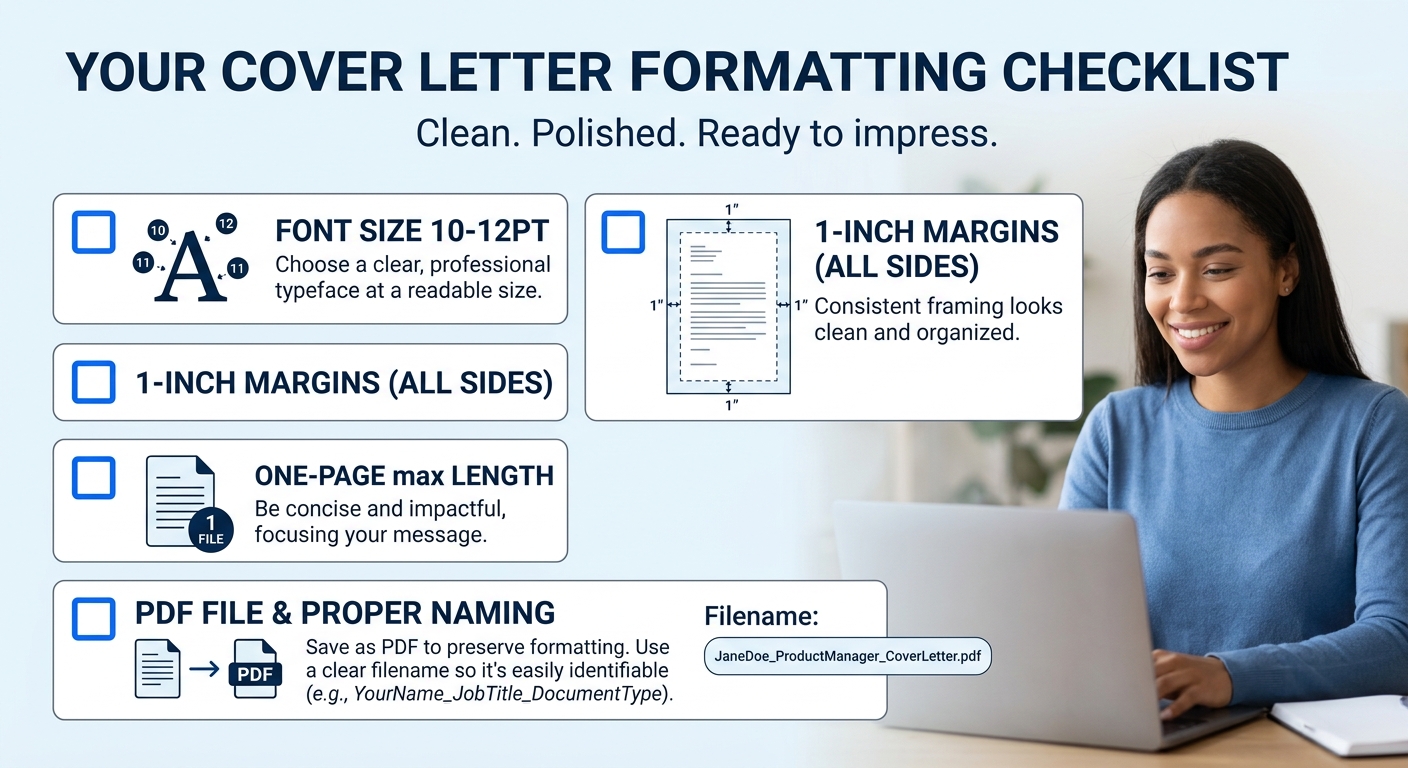
Your font size should land between 10 and 12 points, according to MIT’s Career Advising & Professional Development office, and the entire letter stays on one page. Standard 1-inch margins on all sides and a clean font like Calibri, Arial, or Garamond keep your formatting readable to both humans and applicant tracking systems.
Pull the Keywords From the Job Posting
Before you type a single word of your letter, spend 5 minutes dissecting the job posting. This step determines the language, priorities, and structure of everything that follows.
Open the posting and read it twice. On the second pass, underline every skill, qualification, and responsibility the employer mentions. Pay attention to repetition, if “cross-functional collaboration” appears in both the requirements section and the role description, the employer values it enough to say it twice. That keyword belongs in your letter.
The 42% response-rate advantage of tailored letters comes largely from this keyword alignment. ATS software scans for specific terms before a recruiter ever reads your application, and hiring managers who do read past the filter notice when your language mirrors their posting’s language.
Write down your 3-5 most prominent keywords. You’ll weave each one into a specific section of your letter. Here’s what that extraction looks like for a sample marketing coordinator posting:
- Posting says: “Manage social media calendars across 4 platforms”
- Your keyword: social media calendar management
- Posting says: “Collaborate with design team on campaign assets”
- Your keywords: cross-team collaboration, campaign assets
- Posting says: “Track and report on engagement metrics weekly”
- Your keywords: engagement metrics, weekly reporting
You’ll know this step worked when you have a short list of terms pulled directly from the employer’s own language, not your paraphrase of it.
Set Up Your Header and Address the Right Person
Your header mirrors your resume header: full name, phone number, email, LinkedIn URL (optional), and city/state. Below it, add the date and the employer’s block, company name, hiring manager’s name and title, company address.
MIT’s career advising guidance is explicit on this point: “Be sure to include your contact information and address it directly to the hiring manager, using their name.” A named greeting converts better than a generic one because it signals 10 minutes of research effort that separates you from the bulk of applicants.
If you genuinely cannot find a name after checking LinkedIn, the company website, and the department’s direct line, use “Dear [Department] Hiring Team” rather than “To Whom It May Concern.” The latter reads as outdated.
Example header:
Jordan Rivera (555) 321-4567 | [email protected] | linkedin.com/in/jordanrivera Denver, CO
July 20, 2026
Ms. Priya Kapoor Marketing Director Altitude Brands, Inc. 1400 Blake Street, Denver, CO 80202
Dear Ms. Kapoor,
You’ll know it worked when your header fits in roughly 6-8 lines, includes all contact details, and names a real person at the company.
Write an Opening That Earns the Second Paragraph
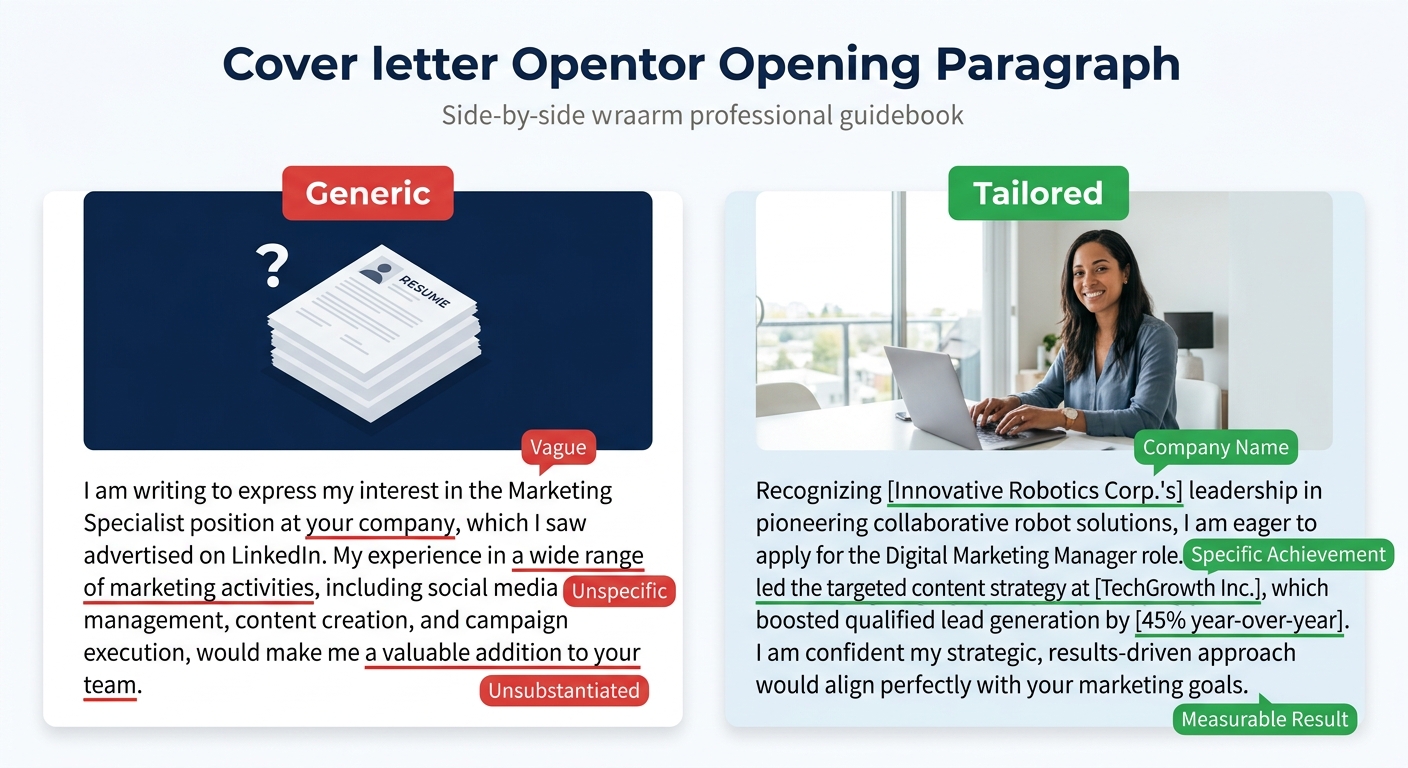
The opening paragraph is 2-3 sentences long. Its only purpose is to make the hiring manager keep reading. Name the specific role, say where you found it, and include one concrete fact about why you’re a strong match.
Here’s a weak opener versus a strong one:
Weak: “I am writing to express my interest in the Marketing Coordinator position at Altitude Brands. I believe my skills and experience make me a great candidate.”
Strong: “Your Marketing Coordinator posting on LinkedIn caught my attention because Altitude Brands’ 2025 rebrand campaign mirrors work I led at Crestline Media, where I managed social media calendars across 4 platforms and grew Instagram engagement by 35% in 6 months.”
The strong version does three things the weak one doesn’t: it references the company’s actual work, it matches a keyword from the posting (social media calendars, 4 platforms), and it attaches a measurable result (35% growth, 6-month timeframe). The University of Michigan’s Career Center advises writers to “be persuasive and show enthusiasm”, and nothing persuades a hiring manager like a relevant number tied to their stated priorities.
Fill the Body With Numbered Achievements
The body runs 1-2 paragraphs (or 1 paragraph plus 2-3 bullet points) in the center of your letter. This is where your example cover letter sample becomes distinctly yours.
Each achievement follows a formula: what you did + how much + what changed. Review your keyword list from the first step and match each keyword to a real accomplishment from your work history.
Resume Genius’s formatting guide puts it clearly: the body “should take the information you just provided about your current job and connect it to your target role,” followed by “specific achievements that demonstrate your impact.” You’re drawing a line between where you’ve been and what this employer needs done right now.
Here’s how the body plays out for the marketing coordinator example:
At Crestline Media, I managed weekly content calendars for Instagram, LinkedIn, TikTok, and Facebook, scheduling an average of 28 posts per week while maintaining a 98% on-time publish rate. I collaborated with a 3-person design team to produce campaign assets that contributed to a 22% increase in qualified leads over Q3 2025. My weekly engagement reports, covering reach, impressions, click-through rate, and follower growth, went directly to the VP of Marketing and informed a $45,000 budget reallocation toward video content.
Every keyword from the posting (social media calendars, cross-team collaboration, engagement metrics, reporting) appeared with a number attached: 28 posts per week, 98% on-time, 3-person team, 22% lead increase, $45,000 budget shift. Recruiters skim for this kind of density, and ATS systems pick up the matching terminology. Browse cover letter examples organized by job type to see how the strongest letters across industries pack 3-4 quantified results into a single body section.
Tip: If you don’t have exact numbers, estimate conservatively and say so. “Managed roughly 25 client accounts” beats “managed many client accounts” every time. Approximate figures still give the reader a sense of scale.
Each achievement follows a formula: what you did + how much + what changed.
Close With a Direct Ask
Your closing paragraph is 2-3 sentences. It restates your interest in the role, connects your top qualification to the company’s goals, and requests a specific next step.
Indeed’s cover letter formatting guide recommends a closing along the lines of “I look forward to discussing how I can contribute to your [team/department].” Adapt that structure but make it specific to the company and position.
Example closing:
I’d welcome the opportunity to discuss how my experience managing multi-platform content calendars and driving measurable engagement growth aligns with Altitude Brands’ expansion into video-first marketing. I’m available for a conversation any weekday at (555) 321-4567 or [email protected].
Sign off with “Best regards,” “Sincerely,” or “Thank you,” followed by your full name. Skip “Warmly” or “Cheers” for professional applications, they read as too casual for most hiring contexts.
You’ll know it worked when your closing names the company, references one specific contribution you’d make, and gives the reader a clear, easy way to contact you.
Format, Proof, and Send
With all six sections written, spend the final 10 minutes on formatting and proofreading. This step catches the errors that disqualify otherwise strong letters.
Formatting checklist:
- Total length: one page (MIT and Indeed both confirm this as the industry standard)
- Font: 10-12 point, consistent throughout the document
- Margins: 1 inch on all four sides
- File format: PDF, unless the posting specifically requests .docx
- File name: FirstName_LastName_CoverLetter_CompanyName.pdf
Proofreading process:
- Run your word processor’s spellcheck first, it catches the obvious mechanical errors
- Read the entire letter aloud, because your ear catches awkward phrasing that your eyes skip over
- Have one other person read it, preferably someone unfamiliar with the role, to verify clarity
Indeed’s formatting guide spells this out: “Review it aloud, use spellcheck and have a friend review it for typos and clarity. Customize: Ensure your letter is tailored to the specific company and role.” That three-layer approach, automated check, self-read, peer review, eliminates the vast majority of errors before you hit submit.
You’ll know it worked when the letter fits one page, the PDF renders cleanly on a different device, and a friend who reads it can tell you which company and role the letter targets without seeing the header.
When Things Go Wrong
Three problems account for most cover letter rejections after the content itself is solid:
The ATS rejects your file before a human sees it. This happens when you submit a .pages, .odt, or heavily designed file with text boxes and embedded graphics. The fix: save as a standard single-column PDF with no design elements that might confuse parsing software. If you want guidance on templates that reliably pass ATS filters, stick to plain layouts with standard fonts and zero columns.
Your letter reads as a reworded version of your resume. If a hiring manager holds both documents side by side and sees the same bullet points in slightly different language, the letter adds nothing to your application. The fix: your resume lists what you accomplished; your cover letter explains why those accomplishments matter to this particular employer. Pick 2-3 resume achievements and reframe them around the company’s stated needs and goals.
The opening paragraph is generic enough to fit 50 different companies. Read your first sentence and mentally swap out the company name. If the sentence still works for a competitor, you’ve written a generic opener. The fix: reference one specific, verifiable detail about the company, a recent product launch, a published initiative, a value from their about page, that applies only to them.
Warning: Don’t skip proofreading the proper nouns. A single misspelling of the company name or hiring manager’s name is one of the fastest ways to get your application discarded, regardless of how strong the rest of your letter is.
Where to Go From Here
You now have a one-page, six-section cover letter customized to a specific job posting, with quantified achievements mapped to the employer’s keywords and a named recipient at the top. The template works across industries, marketing, engineering, education, healthcare, finance, because the structure stays constant while the keywords, achievements, and company references change with each application.
For your next application, duplicate this letter and swap three elements: the company-specific references in your opening paragraph, the keyword-matched achievements in your body, and the hiring manager’s name and company details in the header. That adaptation takes about 15 minutes once you’ve built the first version. If you want to see how the same skeleton plays out across different roles and experience levels, browse additional cover letter examples with templates that apply the achievement-first body structure to fields from customer service to software development. The format you just built is the same one those examples use, the only difference is the specific numbers, keywords, and company details that fill each section.