


 4.9
4.9 4.5
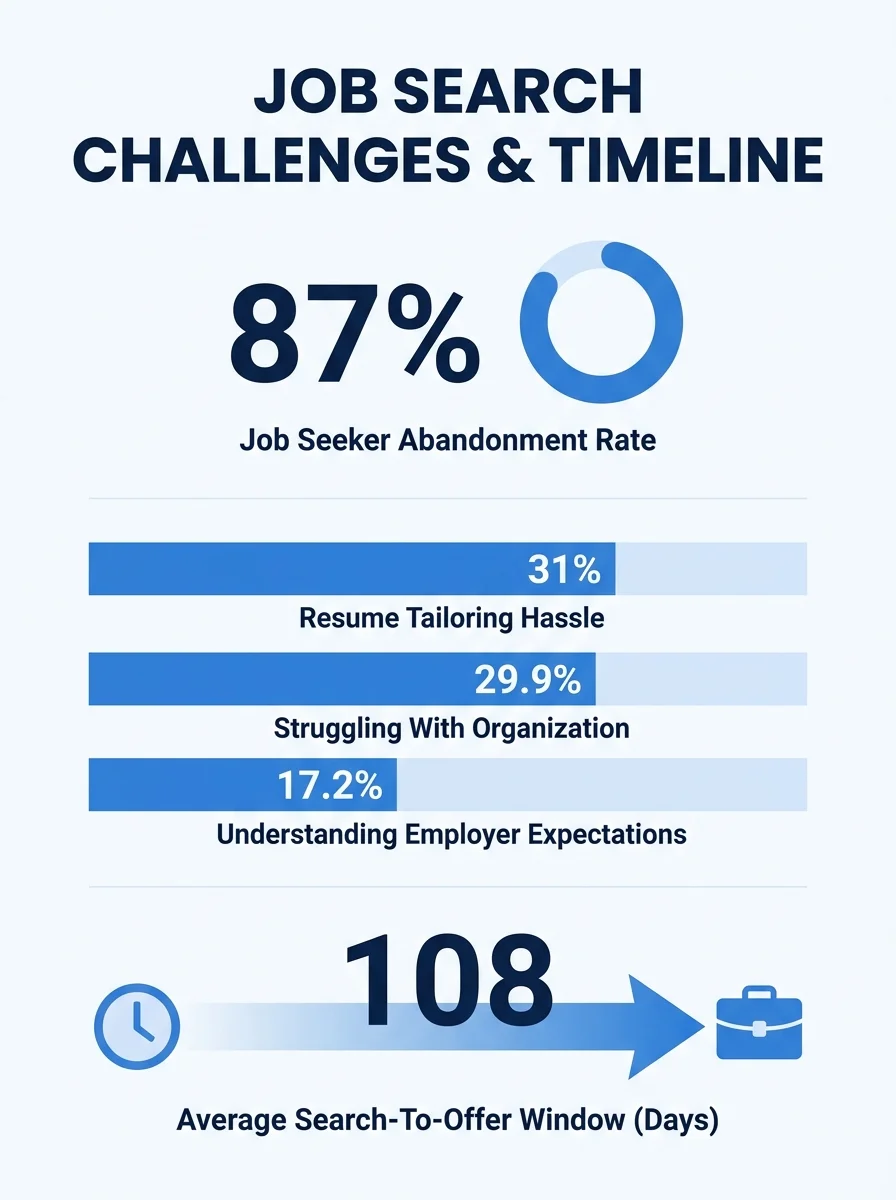
4.5Korean career platform Saramin surveyed 967 office workers and found that 87% quit writing their resumes before finishing. Three distinct AI-powered approaches are now competing to close that gap: basic resume builders, AI coaching platforms, and hybrid services that analyze hiring intent alongside candidate data.
TL;DR: Resume writing abandonment rates in 2026 sit at 87%, driven by tailoring fatigue and unclear employer expectations. AI resume builders solve speed but create a personalization gap. AI coaching services that analyze job postings and successful candidate data represent the newest category, but each approach carries real tradeoffs worth measuring before you subscribe.
The Saramin survey, published May 18, 2026, broke down the reasons: 31% of respondents cited the hassle of revising their career history for each specific job posting. Another 29.9% struggled with organizing and presenting their experience effectively. And 17.2% said they couldn’t figure out what companies actually wanted from applicants.
These numbers land at a moment when the job market is already under extreme pressure. Huntr’s Q1 2026 Job Search Trends Report, analyzing 240,000 tracked jobs and 39,000 tailored resumes, found that the average search-to-offer window has stretched to a record 108 days. Every corporate-level job posting now draws roughly 250 applicants, according to Glassdoor data compiled by Enhancv. And 60% of job applications are abandoned because they take too long to complete, per TeamStage research. The math compounds: standing out demands more effort at the exact moment when effort feels least rewarded.
Meanwhile, a survey of 1,000 executives published this week found that 99% of CEOs expect AI-driven layoffs within two years. Entry-level hiring is contracting, making career narrative differentiation critical for candidates at every level.
DIY Resume Writing: Full Control, Predictable Ceiling
The traditional approach gives you complete ownership of your career story. You draft, edit, format, and tailor each version yourself. For candidates who know how to audit their own resumes against ATS screening requirements, the results can be excellent.
But the Saramin data reveals why this path collapses at scale. When a single corporate posting attracts 250 applicants and most active job seekers target dozens of openings simultaneously, the tailoring burden grows faster than any individual can sustain. Abandonment isn’t happening at the blank page. It’s happening at version twelve, when the gap between effort invested and callbacks received becomes too wide to tolerate.
DIY also collides with a self-assessment problem. The Saramin survey found 24.8% of respondents specifically wanted help identifying key strengths and achievements buried in their own careers. Seeing your own professional value clearly is genuinely difficult, which is why many job seekers turn to career coaches or resume services as a reality check. The tradeoff with DIY is clean: you pay nothing and keep creative control, but you’re limited by your own ability to diagnose what’s missing.
One group thrives here: experienced professionals who’ve run multiple job searches, understand their industry’s hiring patterns, and write well under pressure. For first-time seekers and career changers, the dropout rate is predictably higher, and the 108-day average search window means the abandonment risk compounds over months.
AI Resume Builders: Speed That Creates New Problems
AI resume builders address the speed bottleneck directly. Tools like Rezi score resumes out of 100 across 23 key factors, recommend additional skills through AI Skills Explorer features, and deliver real-time feedback during editing. According to Prentus’s 2026 comparison of AI career tools, the 2024–2026 period saw “voice-based AI, context-aware feedback, and real-time job matching reach a quality threshold where most job seekers genuinely benefit.”
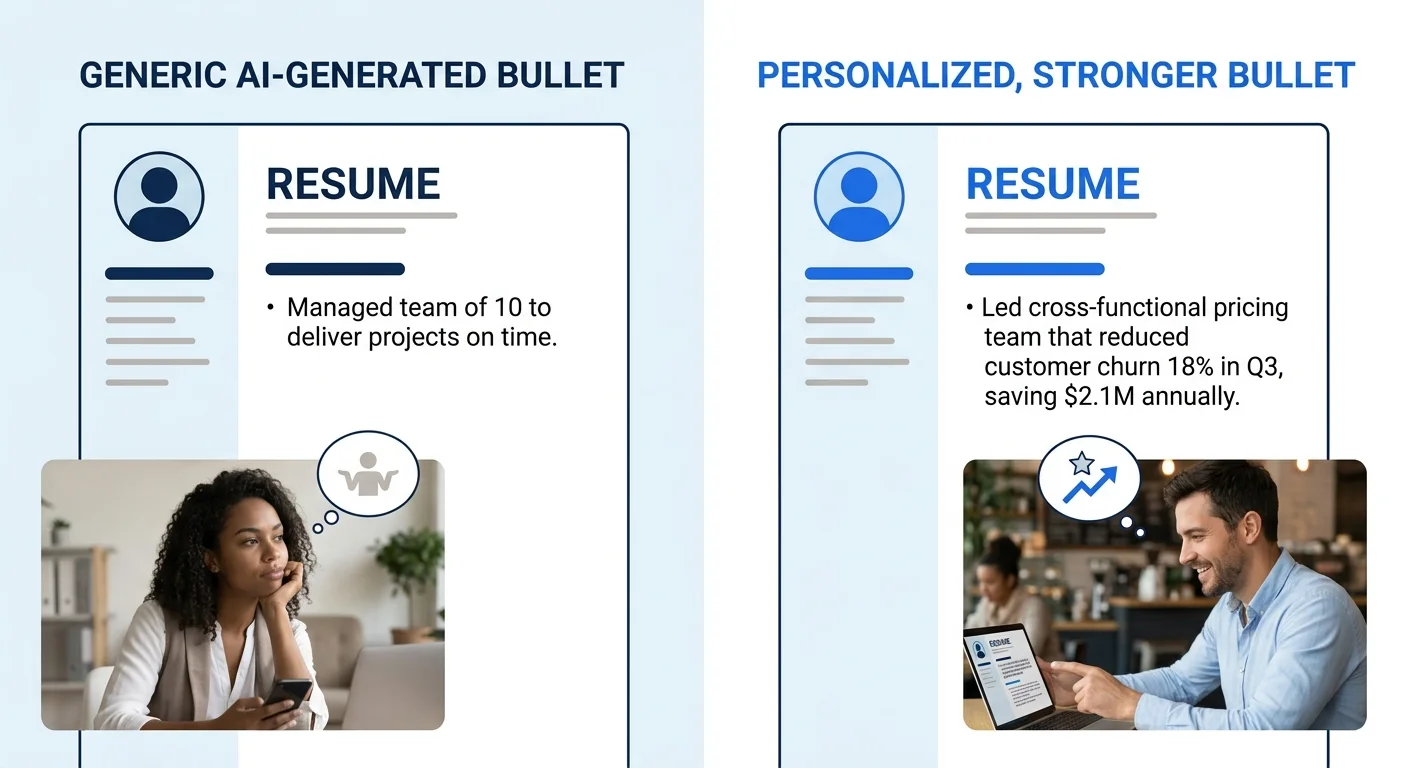
The AI tool personalization gap, however, is widening alongside adoption. Saramin’s survey found that 59% of respondents had already used AI tools for resume writing. Among those users, 52.7% said the results were “generic and hard to differentiate.” Another 38.3% weren’t confident that AI outputs actually met real hiring standards.
The employer side confirms the concern. A Robert Half survey from April 2026 found that 65% of hiring managers find AI-generated resumes challenging to evaluate, and 89% reported increased workloads from filtering generic content. Roughly half of employers now auto-dismiss resumes identified as purely AI-generated when they lack personalization.
Warning: According to Robert Half’s April 2026 data, 89% of hiring managers report increased workloads filtering generic AI content. Submitting an unedited AI-builder output is increasingly likely to hurt your chances.
This creates a frustrating loop. Candidates use builders to save time. The builders produce technically correct but interchangeable documents. Employers develop filters to catch that generic output. And the resume-builder customization trap deepens, where one-click job matching actively works against the unique value proposition each candidate needs. The Interview Guys now classify generic one-size-fits-all formats among the “obsolete” approaches, easily spotted in an era where AI generation is commonplace.
AI Coaching Services: Analyzing Hiring Intent, Not Polishing Sentences
Why does the third category exist at all? Because the first two solve different halves of the problem without connecting them.
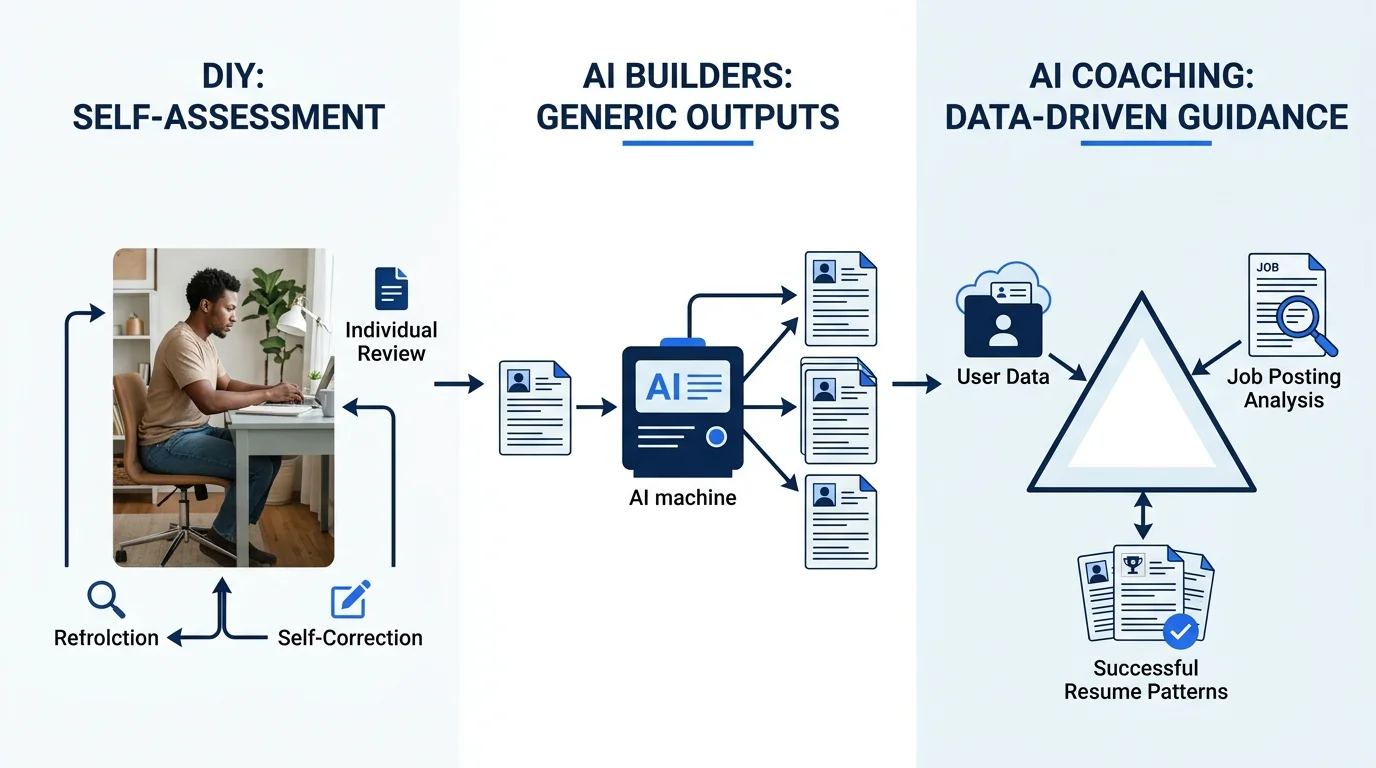
Saramin’s new AI coaching service, announced May 18, represents this emerging approach. Instead of generating text or scoring formatting, it analyzes three inputs simultaneously: the user’s career history to surface key strengths, the company’s ideal candidate profile embedded in the job posting, and data from resumes that have successfully led to offers in similar roles.
The distinction from AI resume builders is architectural. Builders work on your resume as an isolated document. AI resume coaching services work on the relationship between your document and a specific employer’s hiring intent. Saramin described the service as one that suggests “revision directions to maximize fit and differentiation,” directly addressing the career narrative differentiation that 26.3% of survey respondents wanted most. This launch complements Saramin’s AI cover letter coaching service introduced in 2025, building toward an integrated document-screening solution.
Other platforms occupy adjacent territory. CareerVillage.org’s COACH “provides instant personalized feedback at scale and curates quality career development resources wherever students are in their own career journey,” according to the platform’s description. Kickresume’s AI Career Coach scans uploaded resumes against specified target roles to identify missing skills, then delivers personalized advice with learning resources. And Apt AI focuses on career changers specifically, helping users “translate experience into a new field and craft a compelling career narrative,” per its published user testimonials.
The tradeoff is trust and transparency. As of April 2026, 84.7% of applicants don’t know whether a human or algorithm is reviewing their application. Candidates preparing resumes with AI coaching tools designed to match algorithmic hiring patterns are optimizing for a system they can’t see. If the coaching model’s understanding of “what employers want” is miscalibrated, every recommendation it produces will be off-target. And at 38.3% of users already uncertain whether AI outputs meet actual hiring standards, that trust gap remains real.
Cost is the other consideration. While open-source resume builders keep improving and DIY remains free, AI coaching services typically run $15-50 per month on subscription models. The investment makes sense for active searchers targeting specific roles over the 108-day average window. It makes less sense for passive browsers.
52.7% of workers who used AI resume tools called the results “generic and hard to differentiate,” while 24.8% specifically wanted help identifying their own key strengths and achievements.
How the Three Approaches Compare
| Feature | DIY Resume Writing | AI Resume Builders | AI Coaching Services |
|---|---|---|---|
| Speed per application | Slow (30-60 min per tailored version) | Fast (5-10 min) | Moderate (15-25 min with guided revisions) |
| Personalization depth | High (if self-aware) | Low (52.7% report generic output) | High (analyzes hiring intent + career data) |
| Cost | Free | $0-30/month | $15-50/month |
| ATS optimization | Manual, error-prone | Automated (23+ scoring factors) | Automated with strategic layering |
| Career narrative | Self-directed | Template-driven | Data-driven against successful outcomes |
| Employer perception risk | Neutral | Negative (89% of HMs filtering AI content) | Lower (outputs designed to appear human-authored) |
| Best for | Experienced professionals, strong writers | High-volume applications, keyword clearing | Career changers, targeted roles, post-layoff repositioning |
The Verdict: Matching the Approach to Your Search
No single approach dominates every scenario, and the resume writing abandonment rates in 2026 confirm that the old model of sitting down and powering through a resume document is failing nearly nine out of ten people who attempt it.
If you’re an experienced professional with strong self-editing instincts and a clear career trajectory, DIY still delivers. The abandonment risk is lower because you’ve done this before and you know what resonates with hiring managers in your field. Pair your drafts with a resume metrics framework for non-technical roles to quantify achievements, and you’ll produce something no algorithm replicates.
If you’re applying to 50+ positions and need to clear ATS filters at scale, an AI resume builder handles the mechanics. But treat its output as a rough draft. Audit every suggestion for authenticity and voice, and resist the temptation to submit one-click outputs without revision. The 65% of hiring managers already flagging AI-generated content should reshape your behavior here.
If you’re changing careers, re-entering the workforce after a layoff, or targeting roles where your experience doesn’t map obviously to the posting, AI coaching services address the strategic gap that builders miss entirely. The 108-day average search window reported by Huntr means most searches are long enough to justify a monthly subscription, and the coaching model’s focus on hiring intent analysis maps directly to the 31% of candidates whose primary obstacle is tailoring.
The question underneath all three options is the same one the Saramin survey exposed: can you articulate what makes your candidacy different from the other 249 people applying? The tools keep evolving. That underlying challenge, the hard work of honest professional self-assessment, hasn’t changed. Whichever approach you pick, the quality of your answer to that question determines whether you finish the resume or join the 87% who walk away from it.