


 4.9
4.9 4.5
4.5Production resumes carry a burden most white-collar resumes don’t: equipment lists, safety certifications like OSHA 10-hour and 30-hour cards, quality metrics, and compliance documentation. Cramming all of that onto one page forces trade-offs that cost interviews. For production workers with 5+ years of experience, two pages with measurable outcomes outperform a compressed single page.
TL;DR: The one-page resume rule hurts experienced production workers who need space for equipment proficiency, safety certifications, and production metrics. A two-page manufacturing resume format works better for candidates with 5+ years of relevant history, provided page one immediately proves fit and page two supplies supporting evidence. Early-career candidates (under 5 years) should still stick to one page.
How the One-Page Myth Took Root in Manufacturing Hiring
The one-page resume norm originated in an era when recruiters physically handled paper stacks, and a second sheet risked getting separated and lost. That practical constraint hardened into career advice gospel, repeated across job boards and college career centers without much examination of whether it applied equally to every industry.
Production roles adopted the rule without adjusting for the reality of what manufacturing hiring managers actually need to evaluate. A marketing coordinator’s resume and a CNC machinist’s resume serve fundamentally different verification purposes. The marketing coordinator demonstrates strategic thinking and campaign results. The machinist must prove specific equipment proficiency, safety training compliance, quality control track records, and sometimes regulatory certifications required by law before the candidate can set foot on a production floor.
Monster’s production resume guidance still states that a production resume “should be one page for most candidates,” advising applicants to focus on equipment operation, safety record, quality control experience, and production metrics. But that’s a lot of content categories for a single page, and the tension between those demands and the page constraint is where interviews get lost.
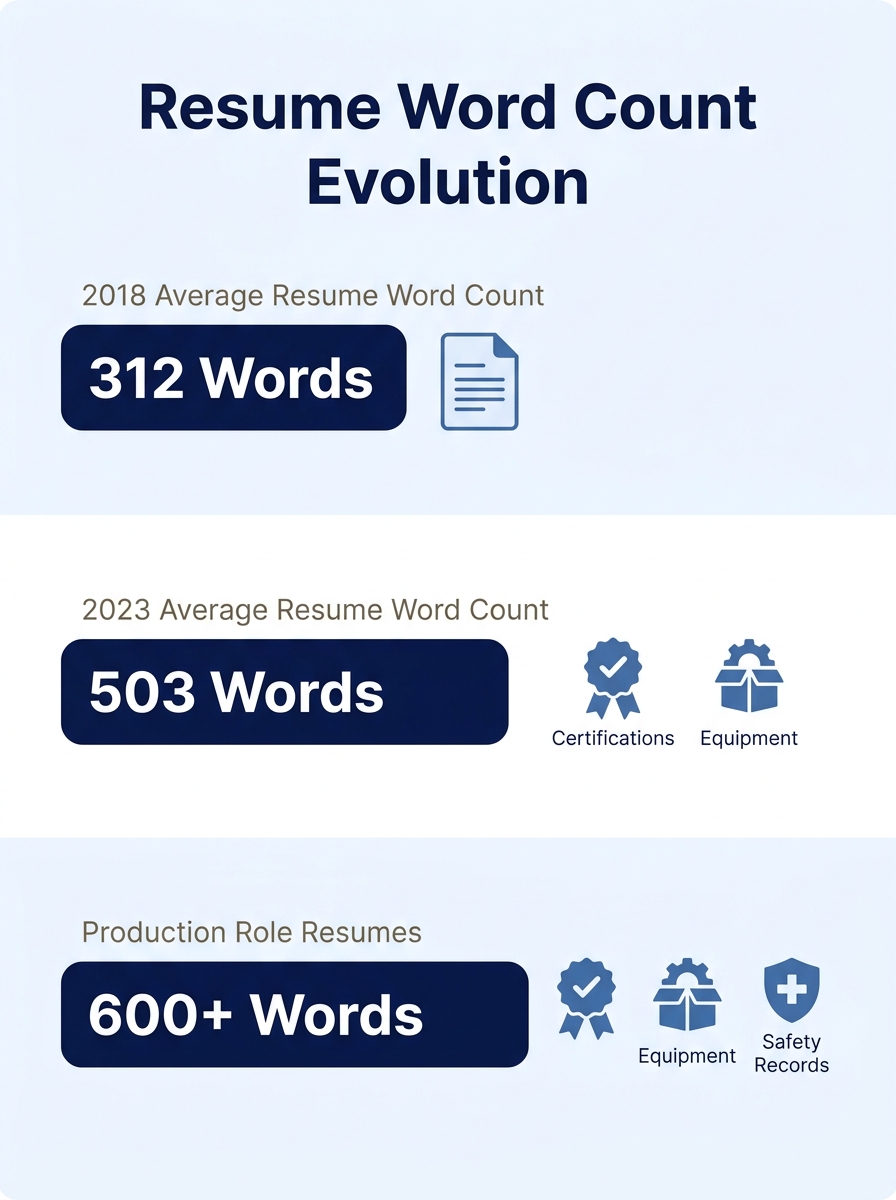
Research comparing 50,000 resumes found the average resume length rose from 312 words in 2018 to 503 words in 2023. Production resumes with equipment certifications, multiple machine types, and safety documentation routinely exceed 600 words of substantive content. The one-page rule forces candidates to cut material that hiring managers specifically look for.
What ATS Parsing Actually Does With Your Second Page
A persistent fear keeps production workers clinging to one page: the belief that applicant tracking systems reject or ignore page two. This is wrong. Modern ATS platforms parse the full document regardless of page count. They extract keywords, skills, certification names, and employment dates from every page submitted. If your OSHA 30-hour card appears on page two, the ATS indexes it the same way it would on page one.
The real gatekeeper isn’t the software. It’s the human who opens your resume after it clears the ATS filter. As we’ve covered in our breakdown of how recruiter screening decisions actually happen, hiring managers skim resumes in under 7 seconds during initial review. That speed creates a specific architectural demand: page one must immediately signal fit, because most screeners won’t reach page two unless page one earns their attention.
This is where the production resume length debate gets confused. People interpret “recruiters only look at page one” as “page two doesn’t matter.” The mechanism works differently. Page one is the filter. Page two is the closer. A hiring manager who sees relevant machine experience, safety credentials, and production throughput numbers on page one will flip to page two looking for confirmation. A hiring manager who sees vague summaries and generic skills on page one will move to the next candidate before page two gets a chance.
Understanding how production worker resume structure interacts with both automated and human screening explains why the question of resume page limits can’t be answered with a universal number.
The Content Load That Makes Production Resumes Different
Why do production resumes specifically struggle with page constraints? Because manufacturing hiring requires verification of concrete, enumerable qualifications that other industries communicate in shorter form. A production worker with 8 years of experience might legitimately need to document:
- Equipment proficiency: CNC mills, injection molding machines, hydraulic presses, conveyor systems, PLCs, packaging line equipment (each with specific models and brands)
- Safety certifications: OSHA 10-hour or 30-hour General Industry cards, forklift operator certification, lockout/tagout (LOTO) training, confined space entry certification, hazardous materials handling
- Quality systems: Six Sigma, ISO 9001, SPC (statistical process control), GMP (Good Manufacturing Practices), 5S methodology
- Production metrics: units per hour, defect rates, downtime reduction percentages, waste reduction numbers, on-time delivery rates
Resume Worded’s safety resume guidance emphasizes including certifications like OSHA’s 10-hour or 30-hour cards along with other industry qualifications. The recommendation from Enhancv’s safety manager resume guide reinforces this: use all key resume sections including summary, experience, skills, education, and certification to ensure complete presentation.
When you compress all of this into one page, something gets cut. Usually it’s the metrics. Candidates drop their 14% waste reduction achievement or their 99.2% safety compliance rate to make room for the certification list. Or they shrink fonts below 10 points and reduce margins to 0.3 inches, creating what recruiters call an “eye chart resume” that nobody wants to read.
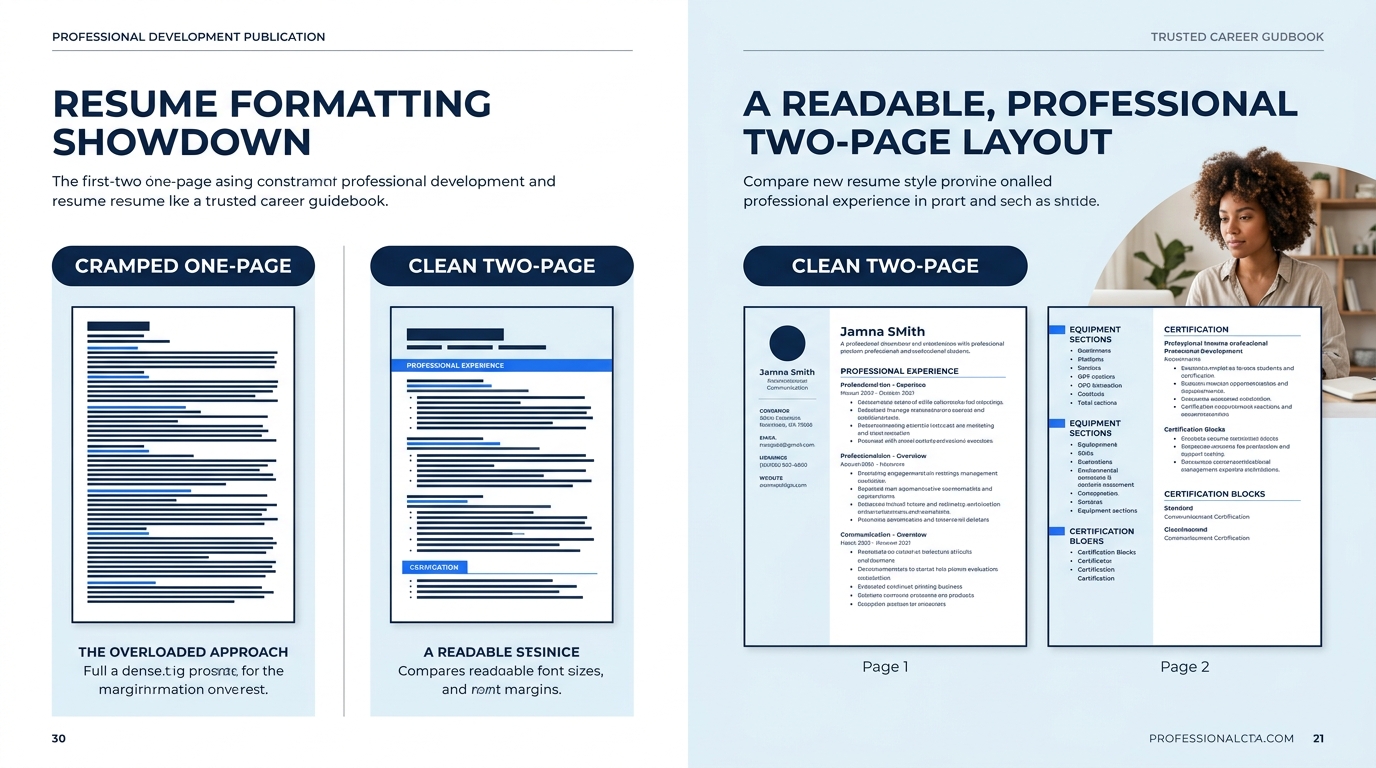
When you compress a production resume into one page, something gets cut. Usually it’s the metrics that would have gotten you the interview.
The Front-Load / Back-Fill Architecture
The mechanism that makes a two-page manufacturing resume format work is what I call the Front-Load / Back-Fill architecture. It solves the length-versus-depth dilemma by assigning each page a distinct job in the screening process.
Page one (the Front-Load) contains everything a screener needs in 7 seconds to decide you’re worth a closer look:
- Professional summary with your top 2-3 production specialties and years of experience (3-4 lines)
- Most recent role with 4-5 bullet points showing quantified outcomes
- Core safety certifications on your resume (OSHA cards, forklift cert, LOTO)
- A targeted skills section covering the specific equipment mentioned in the job posting
Page two (the Back-Fill) provides the supporting depth that converts a “maybe” into an interview invitation:
- Earlier relevant roles with 2-3 bullets each
- Complete equipment proficiency list with specific machine models
- Additional certifications and training credentials
- Quality system experience (ISO, Six Sigma, GMP)
- Relevant education or apprenticeship details
This architecture respects both the 7-second screener and the hiring manager who’s building a shortlist. TopResume’s analysis of resume length found that a two-page resume is preferred for most candidates at any experience level, which aligns with this front-load/back-fill approach: the length works because the structure is disciplined.
| Resume Element | Page One Placement | Page Two Placement |
|---|---|---|
| Professional summary | Always | Never |
| Most recent role (full detail) | Always | Never |
| Safety certifications (top 3-4) | Always | Complete list here |
| Equipment proficiency (targeted) | Top 5-6 machines | Full inventory |
| Production metrics | Best 4-5 numbers | Supporting data |
| Earlier roles | Never (unless only 2 jobs) | 2-3 bullets each |
| Quality systems (ISO, Six Sigma) | Mention in skills | Detail in experience |
| Education / apprenticeship | Only if recent | Standard placement |
The framework works because it mirrors how a hiring manager for a production supervisor or line operator role actually evaluates candidates. They want immediate confirmation of relevant experience and safety compliance, followed by depth that distinguishes you from other qualified applicants. As Beamjobs documented in their manufacturing resume examples, candidates who quantify outcomes (like using automated workflows to reduce manual work and errors by 18%) consistently outperform those who list duties without results.
If you’re working on translating your daily responsibilities into measurable impact statements, our guide to replacing vague duties with measurable outcomes on production resumes walks through the conversion process step by step.
Safety Certifications and Their Placement on the Page
Why do safety certifications on a resume deserve special attention in the production resume length discussion? Because they serve a dual function that other resume content doesn’t. A safety certification is both a qualification (proving you’re trained) and a compliance requirement (proving the employer won’t face OSHA violations by putting you on the floor). Hiring managers in manufacturing scan for these before they read your work history.
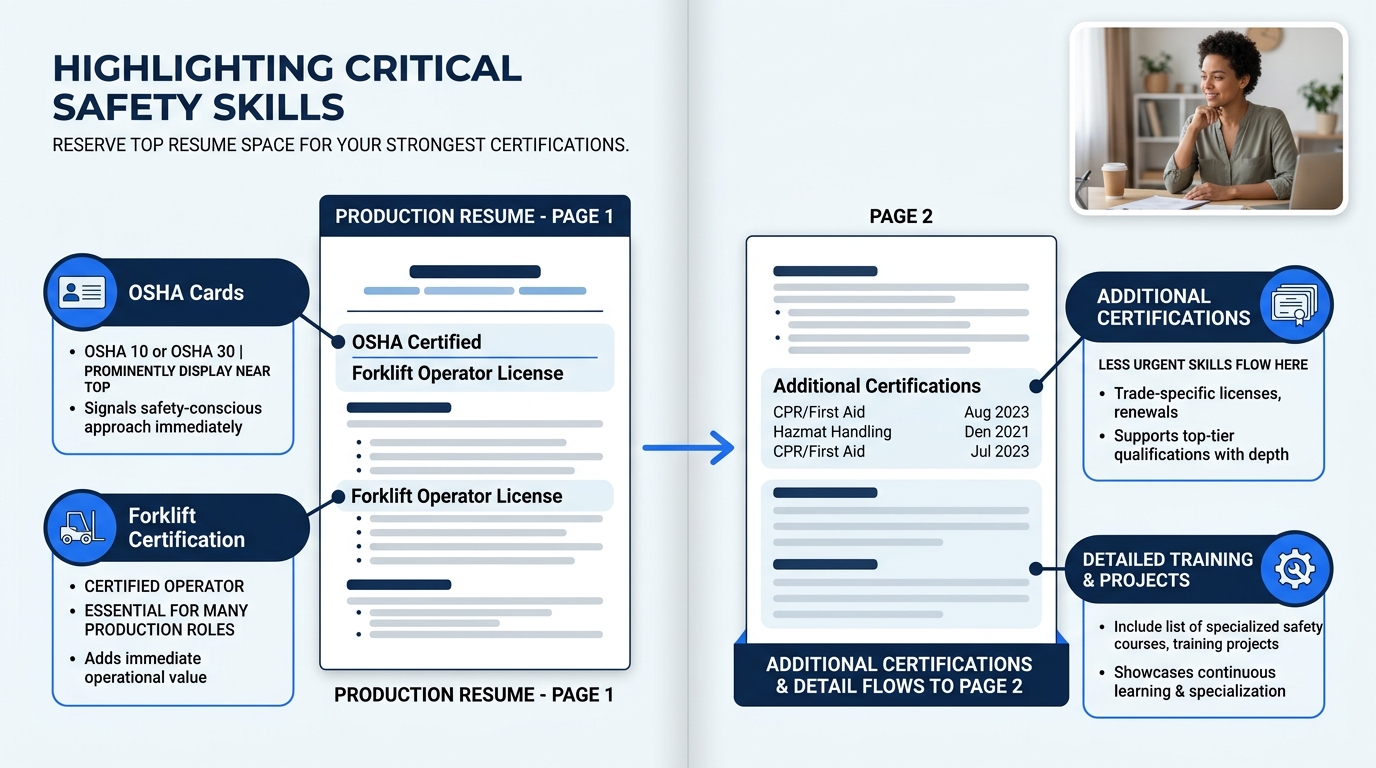
OSHA 10-hour and 30-hour General Industry cards, forklift operator certifications, and lockout/tagout training should appear on page one, either in a dedicated “Certifications” section below your summary or integrated into your skills block. These are pass/fail items for many production roles. If a screener doesn’t see them in the first 7 seconds, your resume lands in the reject pile regardless of how strong your experience section is.
Tip: List your safety certifications with their completion dates and any ID or card numbers. Manufacturing hiring managers verify these during the interview process, and including the details upfront signals that you’re prepared for that verification step.
Additional certifications like CPR/First Aid, HAZWOPER, confined space entry, or industry-specific credentials (API for petroleum, ServSafe for food production) belong on page two unless the job posting specifically calls for them. When writing for both ATS algorithms and the human reviewer, place the exact certification names from the job description on page one and supporting credentials on page two.
Where the One-Page Rule Still Holds
The Front-Load / Back-Fill architecture breaks down in specific, predictable scenarios.
Production workers with fewer than 5 years of experience should use one page. ResumeHelp’s length guidance is clear: if the job requires five or more years of experience, list at least five to six years of history. The inverse applies too. With 2-3 years of production work, a second page filled with college coursework and unrelated part-time jobs signals padding, not depth. If you’re building your first production resume from scratch, our beginner resume assembly framework covers how to fill a single page with substance instead of filler.
The one-page rule also holds when applying to staffing agencies for temporary production positions. Temp agencies process hundreds of resumes daily for shift work, and their screeners prioritize speed above all else. One page, heavy on equipment and certifications, light on narrative.
And if you’re applying to federal manufacturing positions through USAJobs, the platform enforced a strict 2-page upload limit starting in September 2025. Three pages will get blocked by the system before a human ever sees your application, which means federal production candidates face the tightest constraint and need the most disciplined editing.
The deeper issue with the production resume length debate is that it frames page count as the variable that matters. Page count is a symptom. The actual mechanism that determines whether you get interviews is information density per section: whether every line on your resume carries a specific, verifiable claim that maps to something the hiring manager needs to confirm. A bloated two-page resume filled with “Responsible for daily production tasks” performs worse than a tight one-pager. A structured two-page resume with throughput numbers, defect rates, equipment models, and dated safety certifications outperforms both. The resume metrics framework for non-technical roles applies directly here, because production work generates exactly the kind of measurable data points that separate strong resumes from weak ones.
The question was never really about page count. It was always about whether cutting your resume to one page forced you to remove the evidence that would have gotten you hired.