


 4.9
4.9 4.5
4.5A relocating candidate’s resume can’t explain why they’re moving. The cover letter can. As of April 2026, major ATS platforms index cover letter content alongside resumes, meaning that explanation directly affects whether you clear automated screening. For geographic moves, the cover letter has become the single most strategically valuable document in the application packet.
TL;DR: ATS platforms began indexing cover letter text in April 2026, giving relocation candidates a new way to boost automated match scores. Custom cover letters yield a 50% callback rate versus 20% for no letter at all, while generic letters crater to 10%. If you’re moving cities, the cover letter is the only document that turns a geographic red flag into a competitive advantage.
ATS Indexing Changed the Math on Cover Letters This Spring
Why does a document many recruiters skip reading now carry more weight than before? Because automated screening reads everything. As of April 2026, major Applicant Tracking Systems index cover letter text alongside resume data. Keywords you include in your cover letter improve your overall match score when the resume alone falls short.
This matters disproportionately for anyone navigating a geographic mobility job search. Your resume lists your current city. If you’re applying from Phoenix to a role in Chicago, the ATS sees a location mismatch. Without a cover letter stating “Relocating to Chicago in August 2026,” the system has no context for why you’re applying 1,500 miles away. With one, you’ve addressed the gap and added location-specific keywords that raise your score.
“Cover letters are still so important,” says Yulia Borysenko, staff director at Mobilunity, in a Forbes interview on hiring trends. “Looking ahead to 2026, cover letters will not disappear, but they’ll just take new forms, shorter or more conversational.”
For candidates running a relocation cover letter strategy, “shorter and more conversational” is ideal. You don’t need three paragraphs on your philosophy of work. You need two or three sentences establishing: I’m moving to your city, here’s when, and here’s why I fit this specific role. The combination of ATS indexing and human review means those sentences now do double duty, satisfying both the algorithm and the hiring manager who glances at your letter after the system flags you as a match.
A June 2026 Substack post from relocateme.substack.com documented a reader who landed a role in a new city specifically because their cover letter addressed the move upfront. The resume got them past the ATS. The letter got them the call.
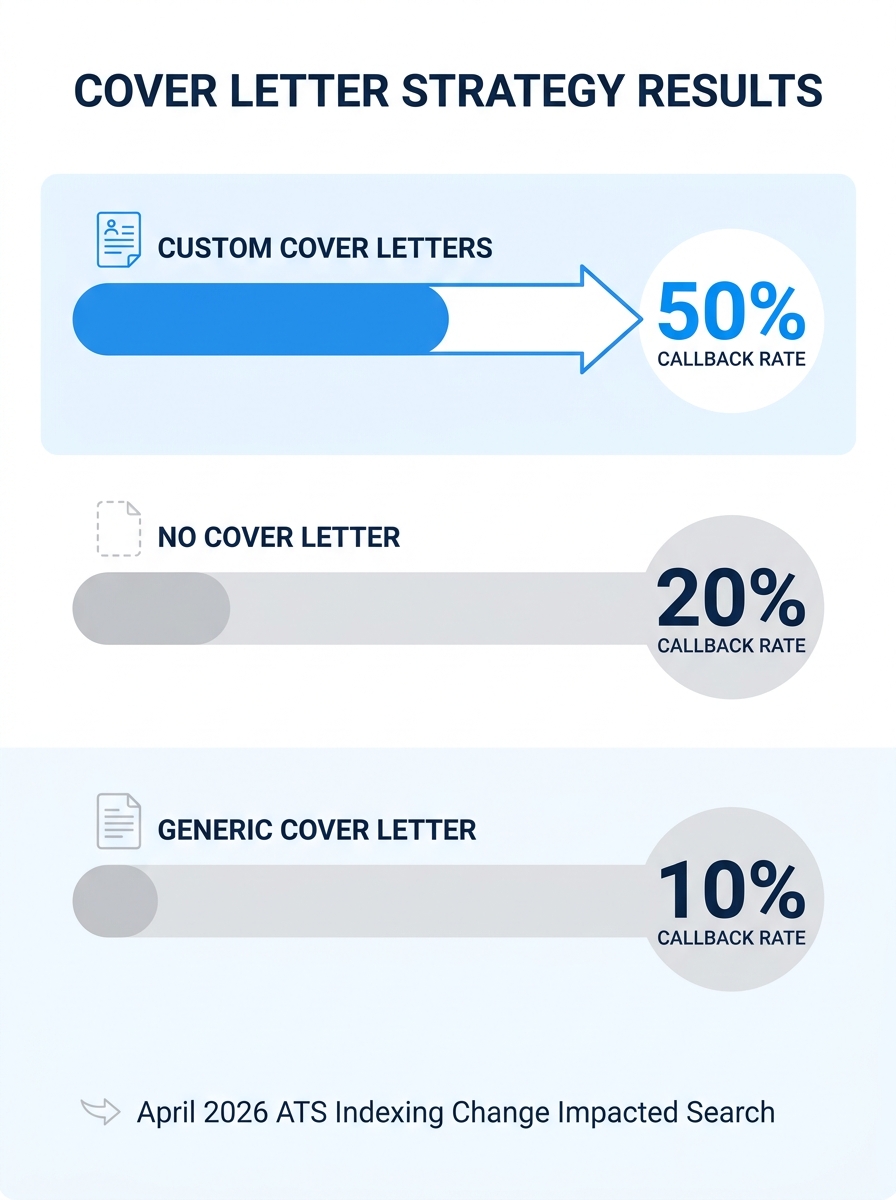
Custom Letters Dramatically Outperform, But Generic Ones Destroy Your Odds
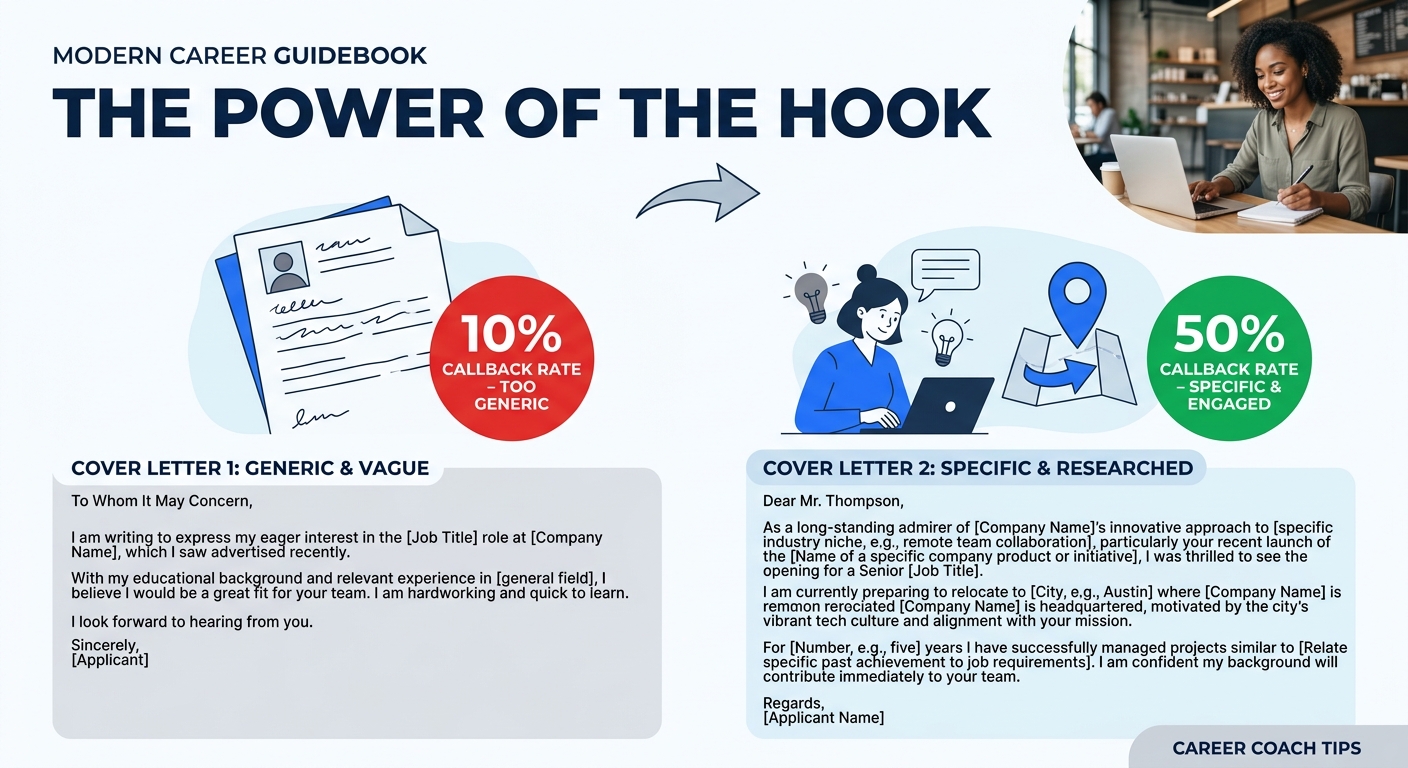
The performance gap on cover letters in 2026 should change how every relocating candidate approaches applications. A February 2026 Reddit-based callback test found that custom cover letters produced a 50% callback rate, compared to 20% for applications with no cover letter at all. Generic, untailored cover letters performed at just 10%, cutting callbacks in half compared to sending nothing.
That 10% figure is the one relocating candidates need to sit with. If you’re copying and pasting the same “I’m excited to apply for this role” letter across 40 applications, you are actively working against yourself. A hiring manager in Denver doesn’t want to read the same vague enthusiasm you sent to Portland, Austin, and Raleigh. They want to know why Denver, why their company, and why now.
The cover letter personalization playbook we’ve outlined before applies here with extra force. For relocation candidates, personalization includes city-specific context: mention the company’s local presence, reference the market they serve, or explain a personal connection to the area. “I’m relocating to Austin in March 2026 to be near family, and your Sr. PM role is exactly the kind of work I want to land in” reads as human and grounded, according to relocation cover letter templates from Cover Letter Copilot. Compare that to “I am writing to express my interest in the position listed on your website.”
Tip: Replace your street address in the cover letter header with a specific relocation statement. Resume Genius recommends language like “Relocating to Grand Rapids, Michigan on Nov. 25, 20XX.” This signals geographic intent before the reader hits your first paragraph, and it feeds a location keyword directly into any ATS that indexes the header.
The callback data also tracks with what we know about how recruiter screening decisions work in the first 30 seconds. Recruiters reviewing borderline candidates (exactly the category where out-of-town applicants land) are the ones most likely to actually read the cover letter. And if they read it and find generic filler, you’ve confirmed their hesitation instead of resolving it.
The Cover Letter Fills Four Gaps a Resume Is Structurally Unable to Address
Frontline Source Group identifies four functions a cover letter serves that a resume cannot: signal genuine interest in a specific role rather than mass application, connect prior accomplishments to the hiring company’s actual current problem, address questions the resume raises (career change, employment gap, geographic move, level change), and demonstrate written communication skill in a format the resume doesn’t allow.
Three of those four apply with particular urgency to relocation candidates. Geographic mobility triggers exactly the kind of question a resume raises but cannot answer. A hiring manager who sees a Phoenix address on a Chicago application will wonder: Is this person serious? Will they actually move? Will they need relocation assistance? Are they applying everywhere and planning to take the first offer from any city?
Your cover letter is where you preempt every one of those concerns. You state the move date. You explain the reason (family, partner’s job, personal preference, whatever is true). You specify that you’re handling relocation costs yourself, if that’s the case. And you connect your experience to what the company actually needs, rather than leaving them to guess.
“Candidates should focus primarily on transferable skills while strategically incorporating any directly relevant experience,” says Aldrich Shean in a career services guide from Empire State University. That advice carries double weight when a geographic move overlaps with a career transition, because now you’re asking a hiring manager to take two leaps of faith at once. The cover letter is where you supply the evidence that justifies both.
An Ask a Manager reader who made a full career change into youth work described the impact directly: “My supervisor has told me that without my cover letter, they never would have called me in for an interview.” When your resume alone doesn’t tell a complete story, the cover letter fills the space between what a hiring manager reads on paper and what you’d explain if you had five minutes of their time.
If you’re navigating a career pivot alongside a relocation, our breakdown of why direct job matches fail career changers covers the resume side of the equation. But the cover letter is where your relocation negotiation writing happens, where you make the argument that an out-of-state candidate with a non-obvious background deserves the same consideration as a local applicant whose experience maps cleanly to the job description. Career transition communication depends on addressing both the “why this role” and “why this city” questions in the same short document, and doing it with enough specificity that neither answer feels like an afterthought.
A hiring manager who sees a Phoenix address on a Chicago application will wonder: Is this person serious? Your cover letter is the only document that can answer before they move on.

The Claim, Revisited
The conventional wisdom that cover letters are fading works fine for local candidates applying to high-volume roles. For anyone making a geographic move in 2026, the opposite holds. The April 2026 ATS indexing shift means your letter now feeds directly into automated screening scores. The 50%-versus-10% callback gap between custom and generic letters means personalization determines whether you get a phone screen. And the structural reality that resumes cannot explain context (why you’re moving, when you’ll arrive, whether you need relocation support) means the cover letter is the only place that information lives.
Your relocation cover letter strategy reduces to three specifics: be clear about the move, be clear about why this company, and be clear about what you bring. If you’re applying through automated platforms that submit to thousands of positions, build a cover letter template with dedicated customization fields for each city and company name. A bulk-submitted generic letter will perform at half the rate of sending no letter at all, per the February 2026 callback data.
Cover letter 2026 trends point toward shorter, more direct formats. That’s good news for relocation candidates. You need a header that states where you’re moving and when, an opening paragraph connecting your experience to this role, a short middle section addressing the move, and a close. If you want the resume to carry equal weight, our guide to writing for both ATS and human readers covers the formatting and keyword strategy that makes both documents work as a pair. The cover letter gets you past the geographic red flag. The resume closes the deal on qualifications. Neither one can do the other’s job, and relocation candidates who treat the letter as optional are leaving the strongest tool in their application packet on the table.