

 4.9
4.9 4.5
4.5By the end of this article, you’ll have seven cover letter templates ready to customize, each designed for a different hiring scenario: standard professional, data-driven, career change, entry-level, referral, creative, and employment gap. The whole process takes about 30 minutes per letter.
TL;DR: Every strong cover letter shares the same bones: one page, three paragraphs, and specific achievements matched to the job posting. Pick the template that fits your scenario, fill in your details, and verify it against the ATS checklist at the end.
Before You Start
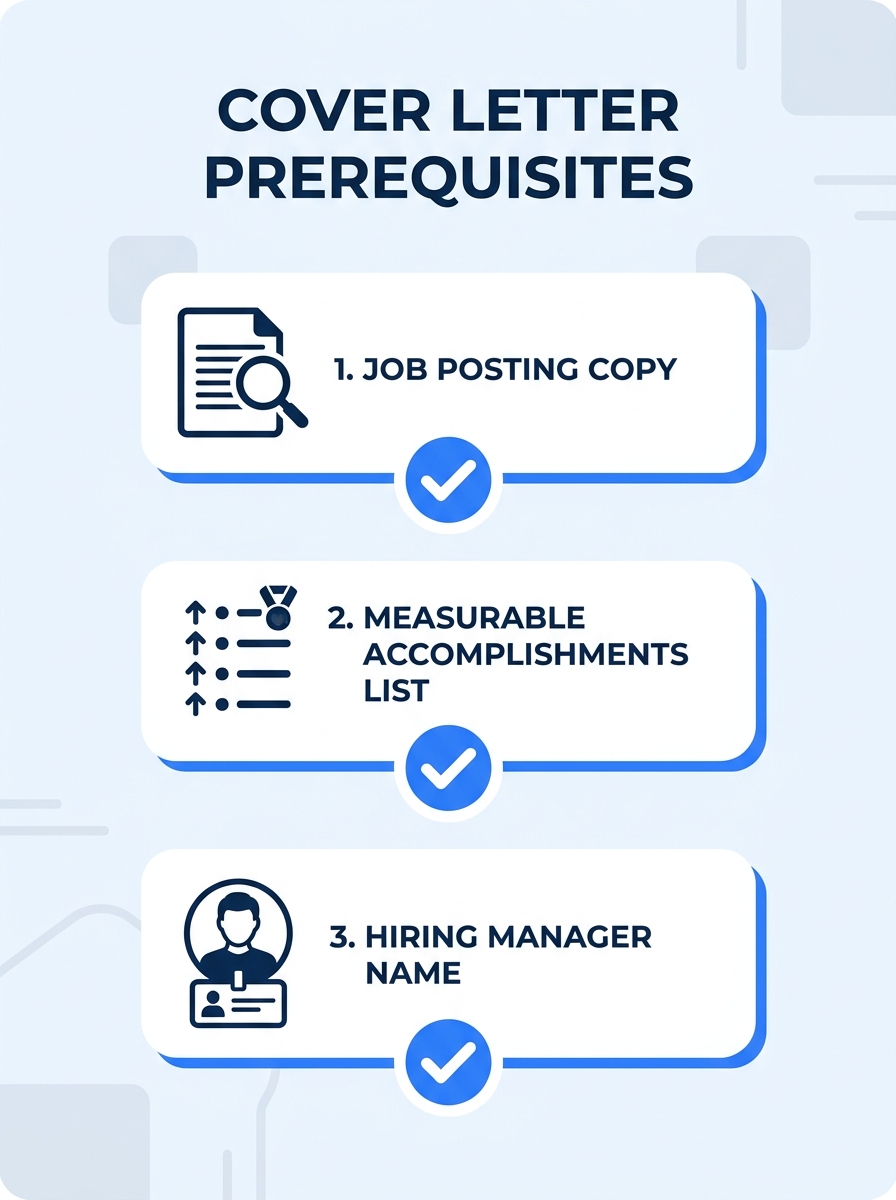
You need three things before opening any template. First, a copy of the exact job posting you’re targeting, because each template requires you to pull specific language from it. Second, three to five measurable accomplishments from your recent work, volunteer, or academic experience. The University of Michigan Career Center advises including “specific numbers, results, and accomplishments” and connecting them directly to the qualifications the employer listed.
Third, the hiring manager’s name. According to current hiring data, 26% of hiring managers say that addressing them by name significantly improves engagement with the letter. A quick LinkedIn search or a phone call to the company’s front desk usually gets you there.
Time required: 25–40 minutes for your first letter using a template, 15–20 minutes for each subsequent letter once you have the format down.
Tools: Any word processor works. Microsoft Word offers free cover letter templates if you want a pre-formatted starting point. Save your finished letter as a PDF unless the posting specifically asks for a .doc or .docx file, since ATS software can strip formatting from other file types and eliminate up to 50% of candidates before a human reviews them.
The Format Foundation All Seven Templates Share
Every template below uses the same structural bones. MIT’s career advising office specifies that a cover letter should be “no longer than one page with a font size between 10-12 points,” and you should include your contact information and address it directly to the hiring manager by name. Those aren’t suggestions. They’re the formatting rules that 41% of hiring managers enforce before they finish your first paragraph.
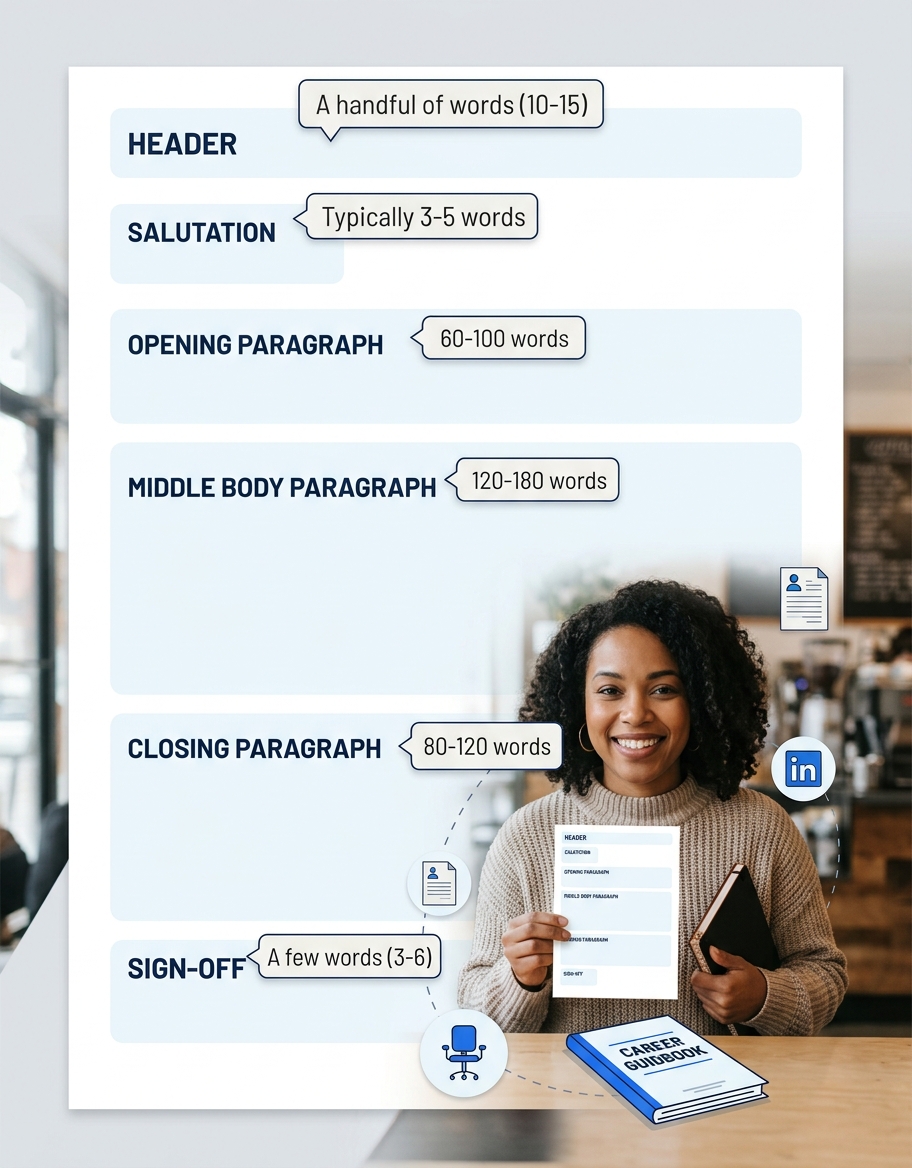
Here’s the universal skeleton:
- Header: Your name, phone number, email, LinkedIn URL (optional), city and state, date, employer’s name and title, company name, company address
- Salutation: “Dear [Hiring Manager’s Name],” (never “To Whom It May Concern”)
- Paragraph 1 (3–4 sentences): State the role you’re applying for, how you found it, and one sentence that previews your strongest qualification
- Paragraph 2 (4–6 sentences): Map two to three specific accomplishments to the job requirements, using numbers wherever possible
- Paragraph 3 (2–3 sentences): Restate your enthusiasm, reference something specific about the company, and request an interview
- Sign-off: “Sincerely,” followed by your full name
Total word count target: 250–400 words. If you’ve written about cover letter formatting before, you might recognize some of this structure from our guide on building a cover letter from a complete template. The templates below plug into this skeleton and adjust the tone, emphasis, and content for different situations.
Three Templates for Standard Applications
Template 1: Basic Professional
Best for: corporate roles, administrative positions, mid-level jobs where the posting is straightforward.
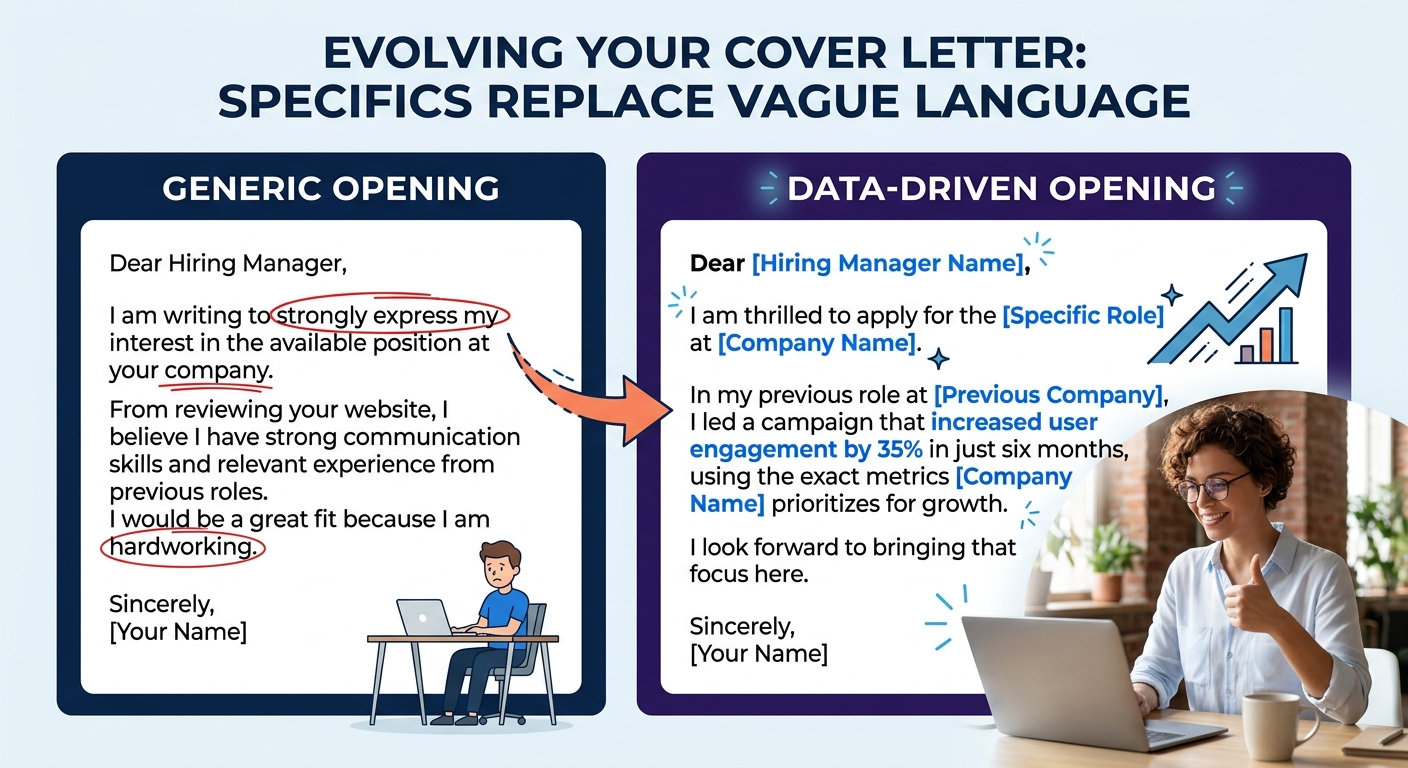
Opening paragraph: “Dear [Name], I’m writing to apply for the [Job Title] position at [Company], listed on [Source]. With [X years] of experience in [relevant field] and a track record of [one specific result], I’m confident I can contribute to your team’s goals.”
Body paragraph: Pull two accomplishments directly from your resume and rewrite them as cause-and-effect sentences. For example: “At [Previous Company], I managed a team of 12 and reduced project turnaround time by 23%, saving the department approximately $40,000 annually.” Each accomplishment should mirror a requirement from the job posting.
You’ll know it worked when: every sentence in your body paragraph connects to a specific bullet point in the job description, and you’ve included at least two numbers.
Template 2: Data-Driven
Best for: sales, marketing, analytics, finance, or any role where results are measured in percentages, revenue, or volume.
Opening paragraph: Lead with your single strongest metric. “Dear [Name], In my current role as [Title] at [Company], I increased qualified leads by 89% over 14 months, generating $2.1M in new pipeline revenue. I’d like to bring that same results-focused approach to the [Job Title] position at [Company].”
Body paragraph: Stack three metrics in descending order of impressiveness. Frame each one around the problem you solved, the action you took, and the result you delivered. Indeed’s career guidance recommends formatting cover letters to “include relevant achievements and skills that show the value you bring to the organization.”
You’ll know it worked when: a reader can scan your letter in 10 seconds and walk away with three numbers that prove your impact.
Template 3: Networking Referral
Best for: any role where someone inside the company referred you. Referred candidates have a 17% success rate compared to 7% for traditional applicants, so naming your connection immediately matters.
Opening paragraph: “Dear [Name], [Referrer’s Full Name], your [Title/Department], suggested I reach out about the [Job Title] opening. After speaking with [Referrer] about [Company]’s goals in [specific area], I believe my experience in [relevant skill] would be a strong fit.”
Body paragraph: Tie your accomplishments to whatever the referrer told you the team needs. This personal angle separates you from the hundreds of applications that arrive without any internal connection.
You’ll know it worked when: you’ve named your referrer in the first two sentences and connected their description of the team’s needs to your specific experience.
Two Templates for Career Transitions
Template 4: Career Changer
Best for: applicants moving into a new industry or function. The body paragraph does the heaviest lifting here because you need to translate old-industry experience into new-industry language. We’ve covered how career changers lose interviews by using old industry jargon on this site before, and the same principle applies to your cover letter.
Opening paragraph: “Dear [Name], My background in [current/previous field] has given me [transferable skill 1] and [transferable skill 2], both of which directly support the [Job Title] role at [Company]. I’m excited to bring these capabilities into [new industry].”
Body paragraph: Choose accomplishments that emphasize transferable skills (leadership, process improvement, client management, budget oversight) rather than industry-specific technical knowledge. Use the job posting’s exact language when describing these skills. If the posting says “cross-functional collaboration,” write about cross-functional collaboration, not “interdepartmental teamwork.”
Tip: Read the job posting out loud and circle every skill-related phrase. Then rewrite your accomplishments using those exact phrases. ATS software scans for keyword matches, and human readers respond to familiar language that mirrors their own priorities.
Template 5: Entry-Level / New Graduate
Best for: applicants with limited professional experience, including recent graduates, interns, and career starters.
Opening paragraph: “Dear [Name], As a recent graduate of [University] with a degree in [Major], I’m eager to apply for the [Job Title] role at [Company]. My coursework in [relevant subject] and my internship at [Organization] gave me hands-on experience in [specific skill].”
Body paragraph: Academic projects, volunteer leadership, internships, and part-time jobs all count. Focus on what you did, how many people or dollars were involved, and what the outcome was. “Led a four-person capstone team that developed a marketing plan for a local nonprofit, resulting in a 34% increase in donor engagement over three months” is far stronger than “Worked on a team project in my senior year.”
MIT’s CAPD recommends that you “state clearly in your opening sentence the purpose for your letter and a brief professional introduction.” For entry-level candidates, that professional introduction can include your degree, your most relevant coursework, or a standout project.
Two Templates for Special Circumstances
Template 6: Creative / Startup
Best for: design, media, content, startup, and any role where personality and cultural alignment matter as much as credentials.
Opening paragraph: Show your knowledge of the company’s product, mission, or recent work. “Dear [Name], I’ve followed [Company]’s work on [specific project or product] since [time frame], and your approach to [specific thing they do well] resonates with how I think about [relevant discipline]. I’d love to contribute to that work as your next [Job Title].”
Body paragraph: Balance accomplishments with voice. Creative roles reward writing that sounds like a real person, so let your personality come through while still hitting measurable outcomes. Mention a portfolio, personal site, or relevant project link if you have one. Browse more career advice on our blog for guidance on building a portfolio that complements your application materials.
You’ll know it worked when: the letter sounds like you wrote it, not like you filled in a template, and it still includes at least two specific, quantified results.
Template 7: Employment Gap
Best for: applicants returning to the workforce after caregiving, health issues, layoffs, or other extended breaks. The cover letter is the right place to address gaps briefly and confidently, as we’ve explored in our guide on explaining career gaps during the screening process.
Opening paragraph: “Dear [Name], I’m writing to apply for the [Job Title] position at [Company]. After a [duration] career pause for [brief, honest reason], I’ve [completed certification / freelanced / volunteered] in [relevant area] and I’m ready to bring my [X years] of prior experience in [field] back to a full-time role.”
Body paragraph: Dedicate one sentence to the gap, then move immediately into your qualifications. The gap explanation should be honest and factual, no longer than 15 words. The rest of the paragraph should function identically to Template 1: two to three accomplishments from before or during the gap, mapped to the job requirements.
Warning: Don’t over-explain the gap. One sentence is enough. Hiring managers care more about what you can do now than why you weren’t working then. Spending three sentences on your gap and one on your qualifications sends the wrong signal about where your focus is.
When Something Goes Wrong
Three problems account for most cover letter rejections, and each one is fixable.
Problem 1: The ATS rejects your file before anyone reads it. This happens when you submit a .pages file, use two-column layouts, or embed your text inside headers and footers that ATS software can’t parse. Fix: save as a single-column PDF, use standard fonts (Arial, Calibri, Times New Roman, Garamond at 10–12pt), and keep all text in the main body of the document.
Problem 2: Your letter is too generic. If you could swap in a different company name and the letter would still make sense, it’s too generic. Fix: every letter should reference the specific company at least twice in the body, mention a concrete detail about their work, and use language pulled directly from the job posting. Cover letters that demonstrate genuine knowledge of the employer’s business stand out because most applicants skip this step entirely. If you want to see how specificity changes the quality of a letter, our examples for different job types show the difference side by side.
Problem 3: You buried the lead. If your strongest qualification appears in paragraph two or three instead of the opening, you’ve lost 41% of hiring managers who make their decision based on the introduction alone. Fix: move your single most impressive, relevant accomplishment into the first paragraph and let it anchor the rest of the letter.
If you could swap in a different company name and the letter would still make sense, it’s too generic. Every letter should reference the specific company at least twice in the body.
Where to Go From Here
You now have seven templates that cover the most common cover letter scenarios, from standard applications to career pivots to employment gaps. The next step is to pick the one that fits your current situation, fill it in with your actual accomplishments and the job posting’s specific requirements, and run it through the ATS checklist above before submitting.
Once your cover letter is solid, the natural next move is making sure your resume holds up under the same scrutiny. The two documents should tell a consistent story: same job titles, same date ranges, same accomplishment language. If your resume mentions “managed a team of 12,” your cover letter shouldn’t say “oversaw a small team.” Consistency across your application materials signals attention to detail, and hiring managers notice when the numbers don’t match. For more detailed guidance on building the resume that pairs with your new cover letter, our full template and examples guide walks through that process.