


 4.9
4.9 4.5
4.5DOCX files outperformed PDFs for clean text extraction in 6 out of 8 enterprise ATS platforms in a 2026 QuickCV test, upending years of standard advice. That finding captures the resume parsing reality candidates face now: the assumptions driving your formatting choices are wrong, and the gap between what algorithms evaluate and what recruiters evaluate is wider than most guides admit.
TL;DR: ATS software and human recruiters evaluate your resume using fundamentally different criteria, but both audiences share the same document. Formatting issues cause 23% of ATS parsing failures, while recruiters spend 6 to 8 seconds on their initial scan looking for scope, results, and fit. Writing an ATS-friendly resume in 2026 means satisfying both audiences through semantic alignment and clean structure, not keyword stuffing.
The Numbers Behind the Dual-Screen Problem
Ninety-seven percent of large employers now route resumes through ATS software before any human sees them. As DISHER Talent’s screening analysis puts it, “human review puts a recruiter or hiring manager in direct control of evaluating resumes one at a time,” while automated tools “analyze, filter, and rank candidates in bulk.” These two audiences want different things from the same document.
On the algorithm side, a 2025 Enhancv study surveying 25 recruiters across 10+ ATS platforms (including Workday, iCIMS, and Greenhouse) found that formatting issues cause 23% of all ATS parsing failures. Resumes exceeding 3 pages see a 17% lower pass rate. Complex designs with tables, text boxes, or multi-column layouts account for 75% of ATS rejections.
On the human side, recruiters spend an average of 6 to 8 seconds on their initial scan. A full 47% of recruiters spend only 30 to 60 seconds total on each resume that clears the ATS filter. Hiring managers look for substance: scope, results, technical fit, career progression, and whether the candidate has actually done work similar to what’s being hired for.
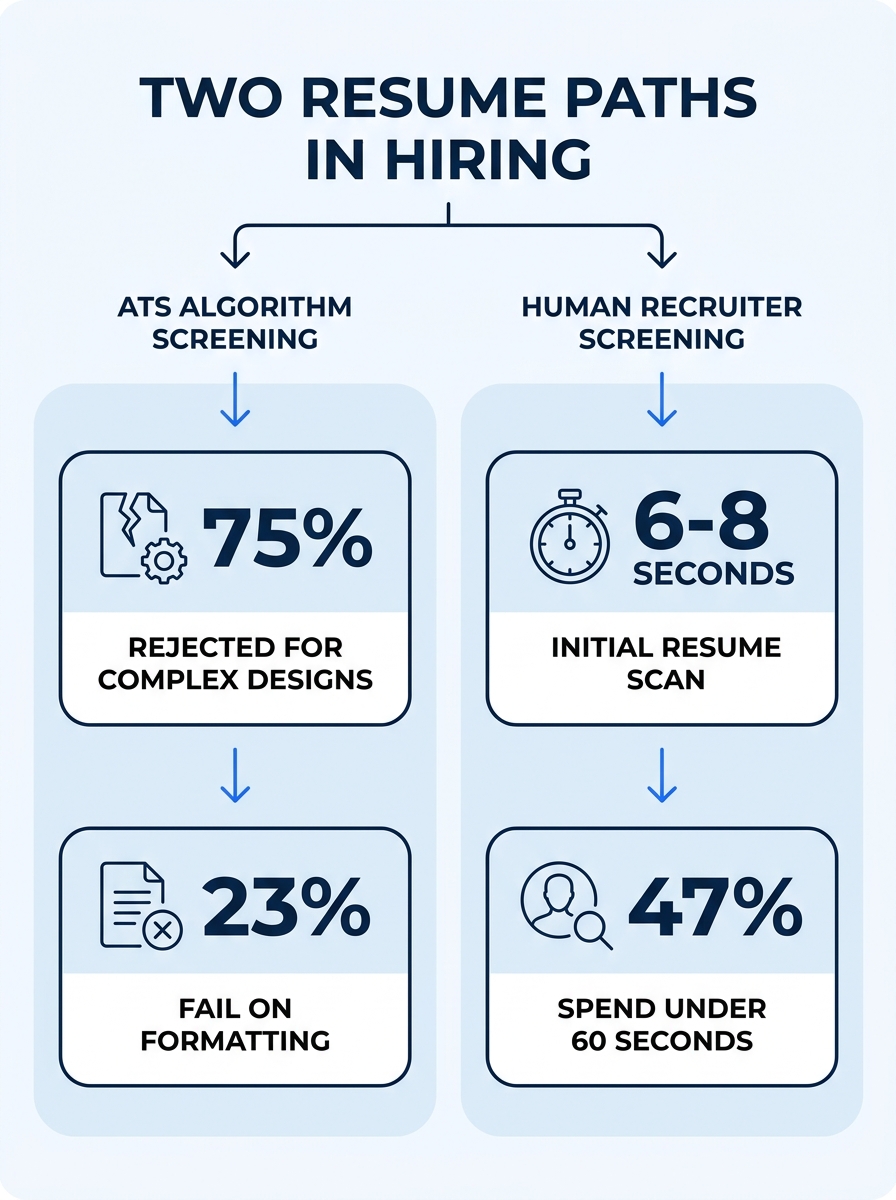
The tension between these two audiences is real. An ATS rewards structure, standard headings, and semantic keyword alignment. A recruiter rewards compelling results, readable flow, and evidence of relevant experience. Your resume has to pass both tests, in that order. If it fails parsing, no human ever sees it. If it passes parsing but reads like a keyword list, the recruiter moves on in under 8 seconds.
What Semantic Resume Optimization Actually Means
Modern ATS platforms use natural language processing and predictive analytics to assess fit, which means simple keyword matching is outdated. A machine learning model analyzing your resume doesn’t count how many times you wrote “project management.” It evaluates whether the context around your skills aligns with the job description’s intent.
Research published in the International Journal of Intelligent Information Systems confirms this shift. Machine learning algorithms now “analyze resumes and job descriptions to automate parsing, extract relevant information, and match candidates with job openings based on keyword matching, semantic analysis, and other criteria.” The key phrase is “and other criteria.” Pure keyword density no longer drives ranking.
What does drive ranking is what semantic search practitioners call “vector matching,” the practice of aligning your experience descriptions to the job posting’s underlying meaning. If a job description asks for “cross-functional stakeholder alignment,” and your resume says “coordinated between engineering, sales, and product teams to launch a Q2 feature,” the semantic match is strong even though you never used the exact phrase “stakeholder alignment.”
Keyword stuffing, by contrast, now triggers penalties. Modern parsers detect unnatural repetition and downrank resumes that read like they were written for a machine. The candidates who struggle most with semantic resume optimization are those still operating on older advice about exact-match keywords. If you’ve been reading our guide on writing for both ATS algorithms and human recruiters, this shift from keyword matching to semantic alignment is the central update for 2026.
The Parse-Scan-Read Framework
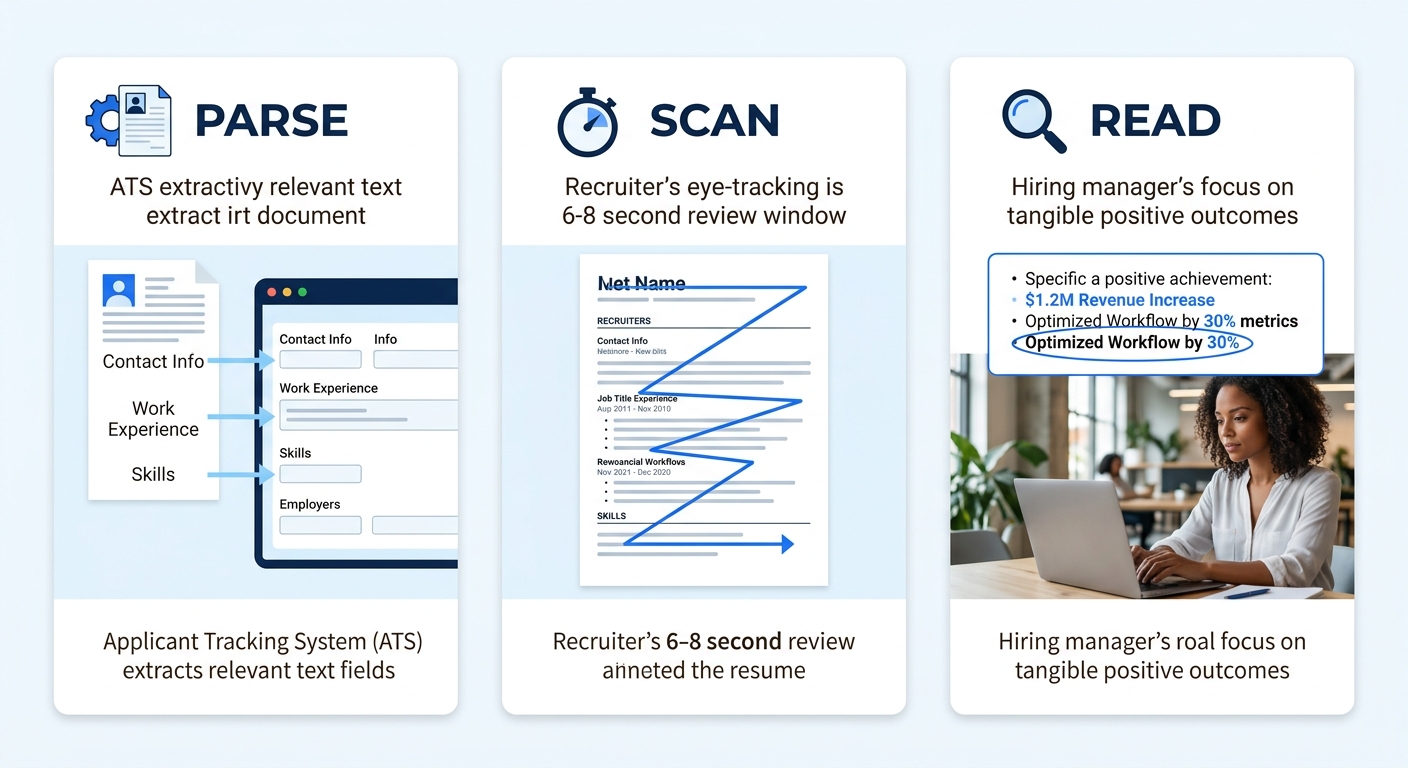
Every resume goes through three distinct evaluation stages, and each stage has different requirements. Understanding them is the clearest way to diagnose why a well-written resume isn’t generating interviews.
Stage 1: Parse. The ATS extracts text, identifies sections, and maps your information into its database fields. This is where 23% of resumes fail due to formatting. Single-column layouts with standard section headings (“Work Experience,” “Education,” “Skills”) parse cleanly. Headers, footers, text boxes, and graphics do not. The QuickCV tester who evaluated 8 ATS platforms noted that DOCX outperformed PDF in 6 of those 8 systems, explaining that “the findings apply broadly because most enterprise ATS tools share similar underlying parsing logic.”
Stage 2: Scan. A recruiter sees your parsed resume for 6 to 8 seconds. Eye-tracking research from Wonsulting shows recruiters focus on job titles, company names, dates, and the first few words of each bullet point. They don’t read long paragraphs. Short bullet points and clear section headings determine whether the recruiter moves to Stage 3 or clicks “next.” We’ve covered how visual formatting affects these scanning decisions in detail.
Stage 3: Read. The hiring manager (or sometimes a senior recruiter) reads the resume that survived Stages 1 and 2. At this stage, they’re evaluating substance: scope of responsibility, measurable results, technical fit, and career progression. A resume built entirely for ATS parsing often falls flat here because it lacks narrative coherence and sounds robotic.
A resume that passes the algorithm but reads like a keyword list still fails the 8-second recruiter scan. Both audiences share the same document but read it with completely different priorities.
The Parse-Scan-Read framework explains why so many candidates feel stuck. They optimize for one stage and unknowingly sabotage another. Fancy infographic resumes fail at Parse. Keyword-stuffed resumes fail at Scan. Beautiful prose without measurable outcomes fails at Read.
Format Decisions That Survive Both Screens
Jobscan’s ATS breakdown makes an important point: “While the software automates the sorting, humans set the criteria.” This means the human’s preferences (for clean, readable documents) and the algorithm’s requirements (for parseable structure) occasionally conflict, and the data shows where each format decision lands.
| Format Decision | ATS Performance | Recruiter Preference | Recommendation |
|---|---|---|---|
| DOCX vs PDF | DOCX wins in 6/8 platforms tested | PDF looks more polished visually | Submit DOCX unless the posting specifies PDF |
| One page vs two pages | No penalty up to 2 pages; 17% lower pass rate at 3+ pages | 51% of HR professionals prefer 2 pages for experienced candidates; 31% still insist on 1 page | Two pages for 10+ years experience; one page for under 5 years |
| Single column vs multi-column | Single column parses cleanly across all tested systems | Either works visually for the human reader | Single column always |
| Standard headings vs creative headings | Standard headings map correctly to database fields | Creative headings can slow quick scanning | Use “Work Experience,” not “Where I’ve Made an Impact” |
| Skills section placement | 60% of enterprise teams filter by skills before reviewing job history | Recruiters scan it after checking job titles | Place skills section after summary, before experience |
That 60% figure on skills-based filtering deserves attention. More than half of US enterprise hiring teams now filter candidates by specific required skills before they ever look at job history. A dedicated skills section is essential for clearing that first algorithmic gate. But it also needs to read naturally for the recruiter who encounters it seconds later, so group skills by category (“Data Analysis: SQL, Tableau, Power BI”) rather than listing 40 tools in a comma-separated wall.
Tip: If you’re unsure whether your formatting will parse correctly, upload your resume to 2 or 3 free ATS simulation tools and compare the extracted text against your original document. Any field that maps incorrectly (your job title landing in the company field, for example) signals a structural problem the recruiter will never get a chance to overlook, because your resume won’t reach them.
Writing Bullets for Human vs Algorithm Resume Screening
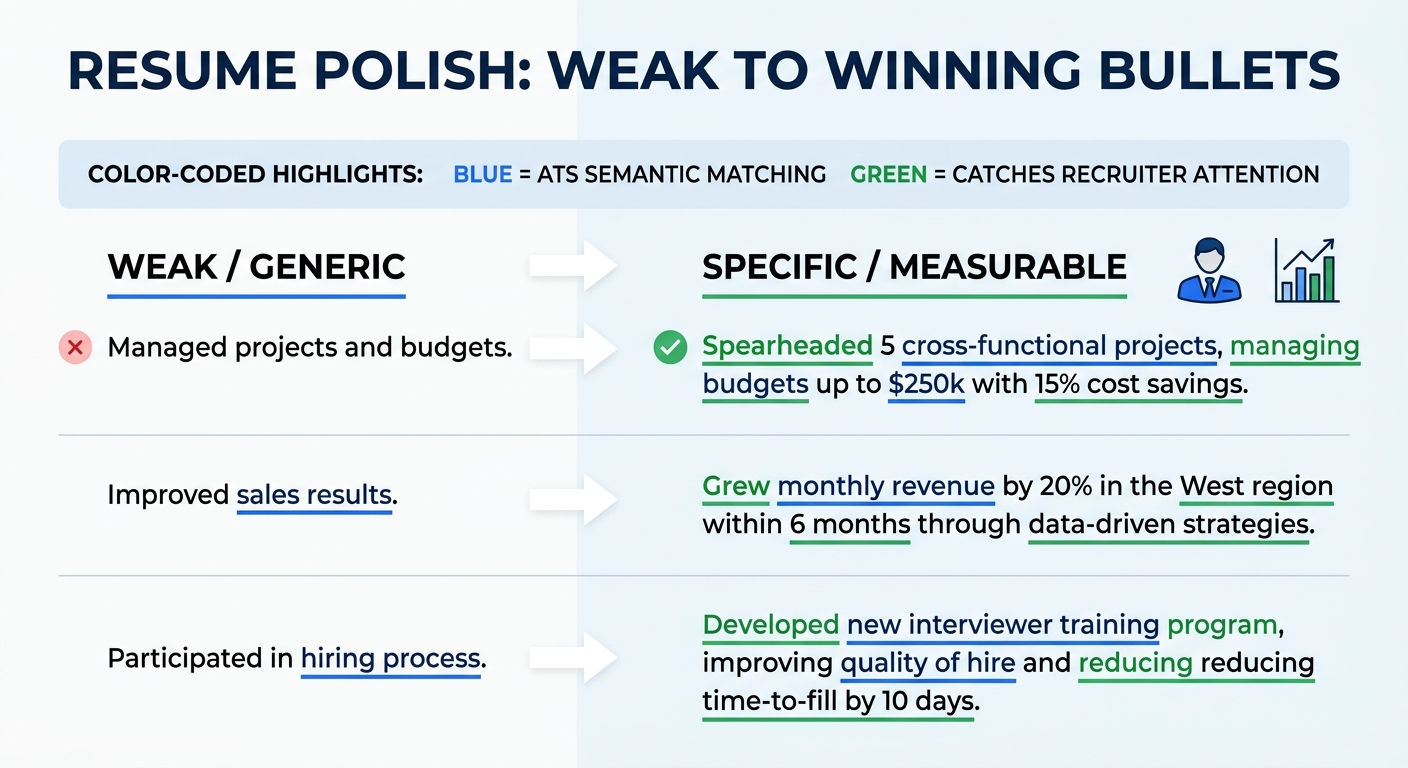
The bullet point is where human vs algorithm resume screening becomes most visible. The algorithm needs contextual anchors for semantic matching. The recruiter needs a fast, compelling reason to keep reading. Both needs converge on one formula: Action Verb + Context + Measurable Result.
Consider the difference:
Weak (fails both screens): “Responsible for managing team operations and improving processes.”
Strong (passes both): “Directed a 12-person operations team through a warehouse management system migration, reducing order fulfillment errors by 34% over 6 months.”
The strong version gives the ATS semantic anchors: “operations team,” “warehouse management system,” “migration,” “order fulfillment.” It gives the recruiter specifics: team size (12), the type of project (system migration), the result (34% error reduction), and the timeframe (6 months). That’s the kind of substance hiring managers are scanning for, including scope, results, and evidence that you’ve done the work.
For candidates who struggle with converting vague duties into quantifiable impact, the key insight is that numbers don’t have to be dramatic. A 7% improvement backed by a specific context beats a vague claim about “significant improvements” every time, both for semantic parsing and for recruiter credibility.
Your professional summary deserves the same dual-audience treatment. Think of it as a 3-sentence elevator pitch: mirror the target job title, name your key skills in natural language, and anchor one specific achievement. This summary is prime real estate for both the ATS (which often weights top-of-resume content more heavily in its ranking) and the recruiter (who reads it during the 6-to-8-second initial scan window).
And with job searches now averaging 108 days to first offer, the cost of a poorly optimized resume compounds over months. Getting the dual-audience balance right on your resume, while also strengthening the rest of your application materials with resources at ResumeWriting.net, reduces time wasted in a pipeline where your document never reached a human reader.
Questions the Numbers Still Can’t Answer
The data on ATS parsing rates, recruiter reading patterns, and semantic resume optimization tells you what to do structurally. It tells you less about the judgment calls that make each resume unique.
No dataset captures how a recruiter in biotech evaluates career gaps differently from a recruiter in financial services. The 6-to-8-second average scan time is a mean, which means some recruiters spend 3 seconds and others spend 20, depending on application volume that day, the seniority of the role, and whether your first two bullet points caught their attention.
The semantic matching algorithms, despite their advances, still operate on training data that reflects historical hiring patterns. A resume optimized purely for algorithmic fit can inadvertently mirror the same narrow candidate profiles that have always passed through. Candidates making career pivots, returning from extended breaks, or bringing non-traditional backgrounds face a structural disadvantage that formatting alone won’t overcome.
What the data does confirm is that the old binary framing of “write for the ATS or write for the human” has always been a false choice. The resume parsing reality in 2026 is that both audiences evaluate the same document, in sequence, with overlapping but distinct priorities. Clean structure, semantic alignment, specific results, and natural language serve both readers. The candidates who keep struggling are the ones still formatting for an audience of one.