


 4.9
4.9 4.5
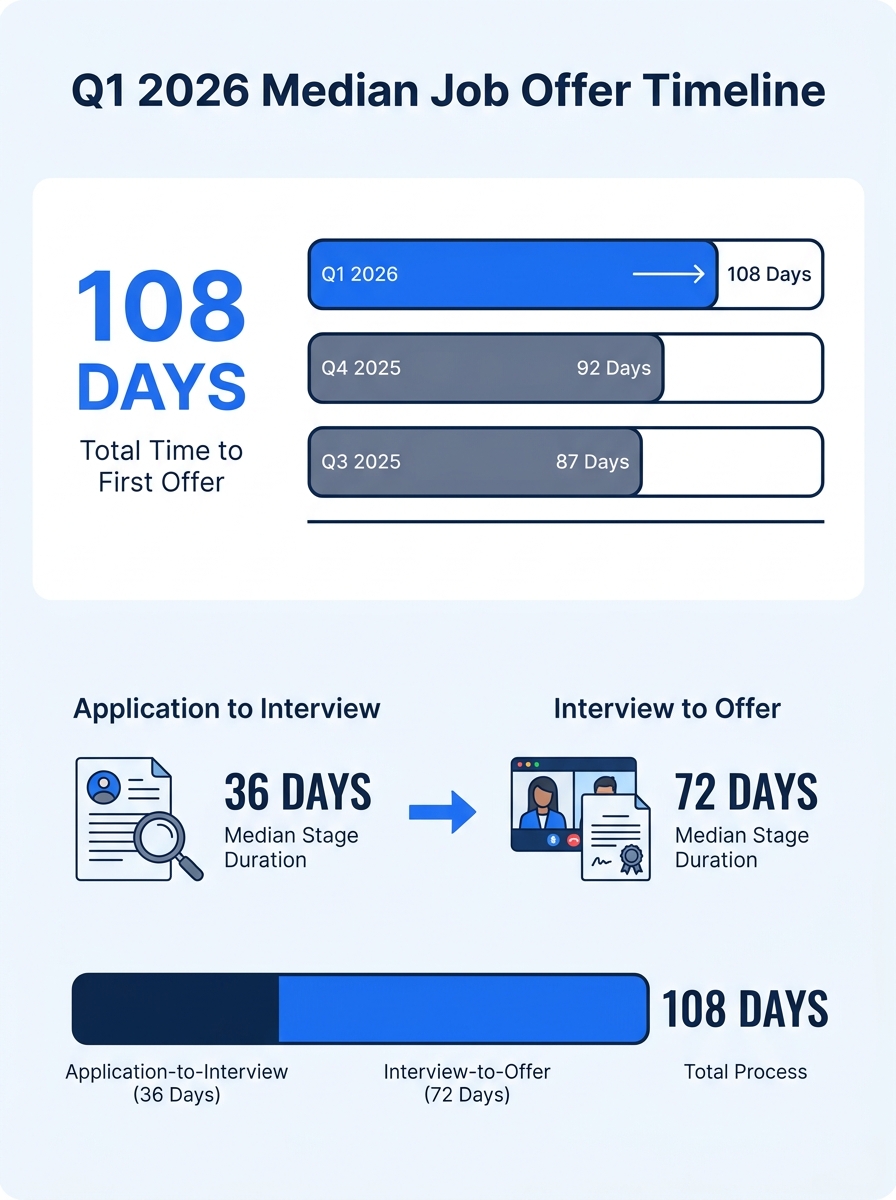
4.5Job seekers faced a record 108-day wait from first application to first offer in the first quarter of 2026, a 30% increase from the prior quarter, according to Huntr’s Q1 2026 Job Search Trends Report released June 11. The platform analyzed 240,000 tracked job applications, 39,000 tailored resumes, and survey responses from 593 active job seekers to document the slowest hiring cycle the company has measured since it began tracking quarterly trends.
TL;DR: Job searches averaged 108 days to first offer in Q1 2026, up 30% from the previous quarter, while tailored resumes delivered twice the interview rate of generic applications, according to Huntr’s analysis of 240,000 tracked applications.
The extended timeline reflects mounting friction across the entire hiring pipeline, not simply longer interview processes. Huntr’s data shows the median time from application submission to first interview response climbed to 21 days, while the application-to-offer window stretched to nearly four months. The findings arrive as 71% of surveyed job seekers reported lowering salary expectations in 2026 and nearly half said they have fewer than three months of financial runway remaining.
The Volume Versus Quality Gap
Two-thirds of successful job searches ended within 50 applications submitted, the report found. Job seekers who secured offers sent a median of 35 applications before receiving their first offer, while those still searching at the time of the survey had submitted a median of 78 applications without success.
The data contradicts high-volume application strategies that have proliferated across job search advice platforms. Huntr identified a conversion cliff: candidates who submitted more than 100 applications during Q1 2026 reported encountering ghost job postings at significantly higher rates than those who submitted fewer than 50.
Resume tailoring emerged as the single highest-impact tactic measured in the study. Resumes customized to individual job descriptions interviewed at twice the rate of untailored generic resumes, according to Huntr’s comparison of 39,000 resume versions tracked through its platform. The company defines tailored resumes as those in which the candidate modified skills, achievements, or summary sections to match specific job posting language.
Platform Performance and Ghost Job Exposure
Google Jobs delivered interview callbacks at 2.4 times the rate of LinkedIn applications, despite LinkedIn’s dominant position as the most-used job search platform among survey respondents. The report attributes the gap to Google’s job aggregation model, which surfaces listings from company career pages and third-party boards, reducing exposure to recycled or expired postings.
Ninety-three percent of job seekers reported applying to at least one suspected ghost job during Q1 2026, with 72% encountering outright scams. Only 1% of respondents said they trust online job listings completely. The mistrust aligns with candidate experiences: one in five job seekers had a written offer withdrawn before their start date during the quarter.
Among applicant tracking systems, Workday gained market share while Lever’s presence declined sharply, the report found. Remote-only positions returned the fewest interview callbacks of any work format tracked, contradicting candidate preference data showing remote roles as the most sought-after arrangement.
Resume Structure Findings
Resumes containing a dollar figure or percentage in the professional summary section interviewed at 1.46 times the rate of summaries with no quantified metrics, Huntr reported. The finding reinforces prior research on quantifiable impact statements as a differentiator in screening processes.
Two-page resumes outperformed one-page resumes for candidates with more than 10 years of experience, while one-page formats delivered higher interview rates for recent graduates and early-career professionals. The analysis challenges blanket one-page resume advice that has dominated career coaching guidance.
Advanced degrees correlated with higher interview rates: resumes listing master’s or doctoral degrees interviewed at higher rates than those showing only bachelor’s degrees. Additional professional certifications, however, showed diminishing returns beyond three listed credentials, with no measurable interview rate improvement for candidates listing four or more certifications.
Interview rates increased steadily with years of professional experience, peaking at 20-plus years, the report found. The data shows no evidence of age discrimination in initial screening, contradicting longstanding candidate concerns about experience-based filtering.
The Career Gap Penalty Window
Employment gaps between six and twelve months created the steepest interview rate penalty of any gap duration measured. Candidates with gaps shorter than six months or longer than eighteen months saw minimal interview rate impact compared to candidates with continuous employment histories.
The finding suggests hiring managers interpret recent short-term unemployment as evidence of job search difficulty, while longer gaps or very recent layoffs receive less negative inference. Huntr noted that 18% of surveyed workers reported losing a job to AI-driven workforce changes in 2026, with mid-career professionals disproportionately affected.
AI Adoption on Both Sides
Forty-four percent of job seekers said they would accept an offer from a hiring process conducted entirely by AI with no human involvement, while 42% admitted they would use AI to misrepresent information on their resume. Two-thirds of respondents believe they have been rejected by an AI screening system at some point during their search.
The mutual adoption of AI tools by both candidates and employers has created what Huntr describes as an “arms race in authenticity,” with 72% of job seekers reporting they actively hide information on resumes to avoid algorithmic or human discrimination.
The Takeaway
The 108-day search-to-offer window represents a structural shift, not seasonal variation. Job seekers optimizing for speed should prioritize tailored applications over volume, focus on direct employer postings aggregated through Google Jobs rather than relying solely on LinkedIn, and front-load quantified achievements in resume summaries. The 50-application threshold emerges as a natural quality checkpoint: candidates still searching after 50 submissions should audit their resume optimization approach and application targeting rather than simply sending more.
The six-to-twelve-month gap penalty window creates urgency for laid-off professionals to accelerate their search or consider contract work to reset the employment timeline. For candidates with 10-plus years of experience, the data supports expanding to two-page resumes that showcase depth rather than compressing achievements to meet arbitrary length limits.
Most significantly, the ghost job and offer-withdrawal rates signal systemic reliability problems in online hiring infrastructure. Candidates cannot control broken listings, but they can control application selectivity—the Q1 2026 data confirms that fewer, better-targeted applications outperform spray-and-pray volume strategies by every measured outcome.