


 4.9
4.9 4.5
4.5“Improved on-time delivery rates by 30%” and “Responsible for overseeing production schedules” can describe the same role at the same facility. Resume Worded’s 2026 production manager analysis documents why the first phrasing outperforms the second in recruiter response, and the conversion between them follows a pattern worth tracing from raw duty language to finished resume impact statements.
“Responsible for Daily Production Operations” and Its Six Identical Siblings
The resume that prompted this dissection contained seven bullet points under a single production supervisor title. Every one began with either “Responsible for” or “Assisted with.” The job spanned three years at a mid-size food packaging plant overseeing 22 line workers across two shifts, yet nothing in the bullet language distinguished this candidate from any other supervisor at any other plant in any other state.
Here’s what those seven bullets looked like in their original form:
- Responsible for daily production operations and ensuring quality standards
- Assisted with training new hires on equipment and safety protocols
- Responsible for maintaining production schedules and meeting deadlines
- Assisted with inventory management and ordering supplies
- Responsible for enforcing OSHA compliance on the production floor
- Assisted with troubleshooting equipment malfunctions
- Responsible for communicating production updates to management
As The Muse’s resume guidance states: “A duty describes what you did and an accomplishment describes how well you did it.” By that standard, all seven bullets are duties. Zero are accomplishments. And the production resume weak verbs problem here goes deeper than word choice. The structure itself communicates passivity: the candidate was present for these activities, but the bullets never indicate whether anything improved, grew, shrank, or changed because of their work.
Scale.jobs’ analysis of ATS-ranked resume action verbs found that pairing action verbs with measurable outcomes increases interview callbacks by 140%. That 140% gap separates a resume that says “Responsible for maintaining production schedules” from one that says “Reduced schedule overruns by 22% across 14 production lines by implementing a digital tracking board for shift handoffs.”
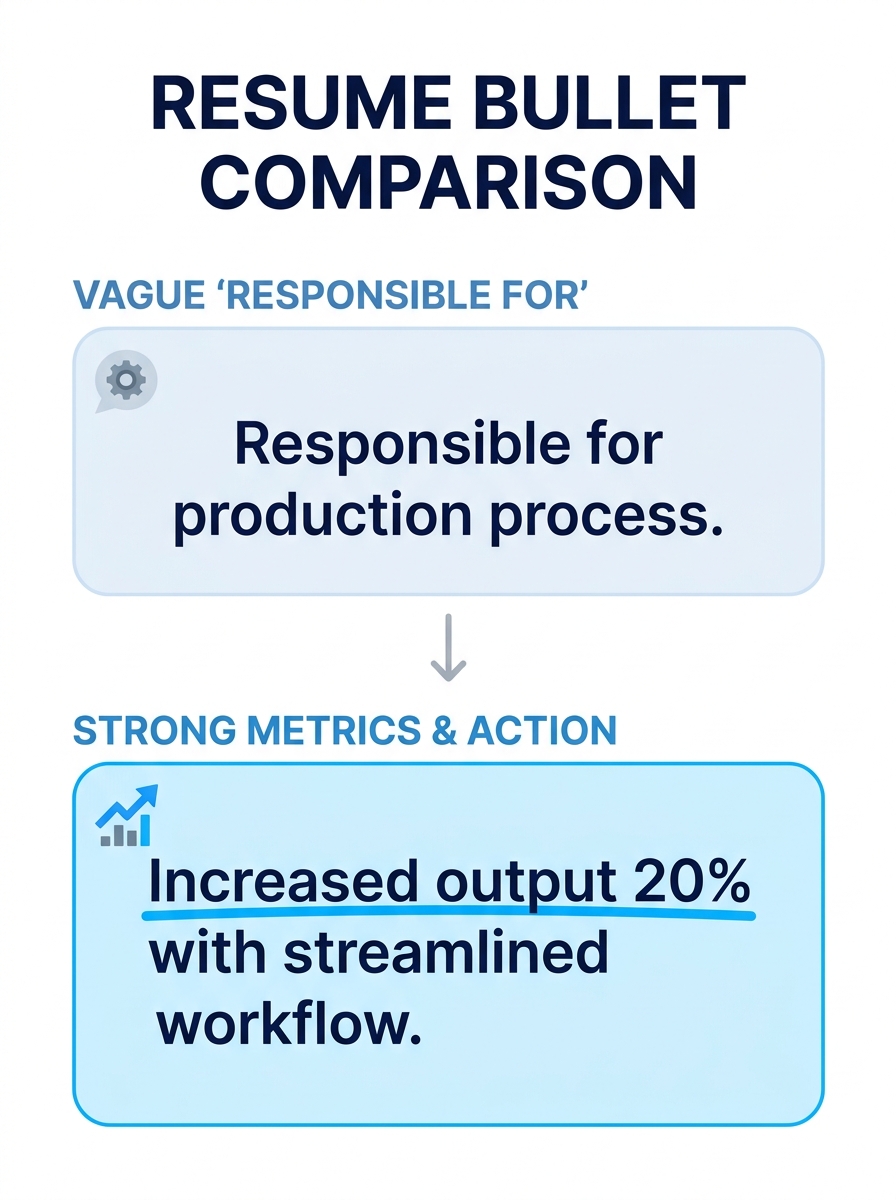
The original resume had been submitted to 30+ job postings over 11 weeks with zero callbacks. With job searches now averaging 108 days to a first offer, an 11-week silence wasn’t unusual in absolute terms, but the complete absence of any response signaled a filtering problem rather than a timing problem.
Mining the Shop Floor for Hidden Numbers
The hardest part of converting vague duties into quantifiable achievements production work isn’t the writing. It’s the memory retrieval. Production professionals track OEE, scrap rates, cycle times, and throughput every single shift, but when they sit down to write a resume, they default to describing the activity rather than the measurement they already know.
The conversion process started with a single question applied to each of the seven bullets: “What changed because you did this?” Not “What did you do?” but “What was different after you did it?”
For bullet one (“Responsible for daily production operations and ensuring quality standards”), the candidate initially drew a blank. But follow-up questions uncovered specific data points hiding in plain sight:
- The line’s defect rate when they started: 4.1%
- The defect rate after 18 months of their supervision: 2.3%
- The number of daily units produced under their watch: 8,400
- The dollar value of scrap reduction over their tenure: roughly $47,000 annually
Every one of those numbers had been tracked on a whiteboard and reported in weekly production meetings. None had made it onto the resume. As ResumeBuilder.com’s career center explains, the key is “understanding how to flesh out details for each of your job duties, so you can then take the full measure of your positive contributions.” The data existed. The translation hadn’t happened.
This pattern repeated across all seven bullets. The training bullet concealed a 40% reduction in onboarding time (from 10 days to 6). The inventory bullet hid $12,000 in annual carrying cost savings from a reorder-point adjustment. The OSHA bullet masked a 14-month streak of zero recordable incidents across both shifts.
The data existed on whiteboards and in weekly production reports. None of it had made it onto the resume.
Monster.com’s resume guidance reinforces this principle, advising candidates to “demonstrate your skills and qualities through measurable accomplishments and specific examples that illustrate your abilities” rather than relying on buzzwords or duty descriptions. The gap between what production professionals know and what they write down is the central challenge of the production resume, and we’ve covered this measurement gap in detail before.
Seven Bullets Rebuilt Around Production KPIs
With the underlying data extracted, each bullet was rewritten using a consistent structure: action verb, specific task or project, quantified outcome. This is the format that Resume Worded’s manufacturing engineer examples recommend, where using numbers and metrics to quantify achievements helps hiring managers understand impact at a glance. Here are all seven conversions, shown as action verb examples manufacturing professionals can adapt directly.
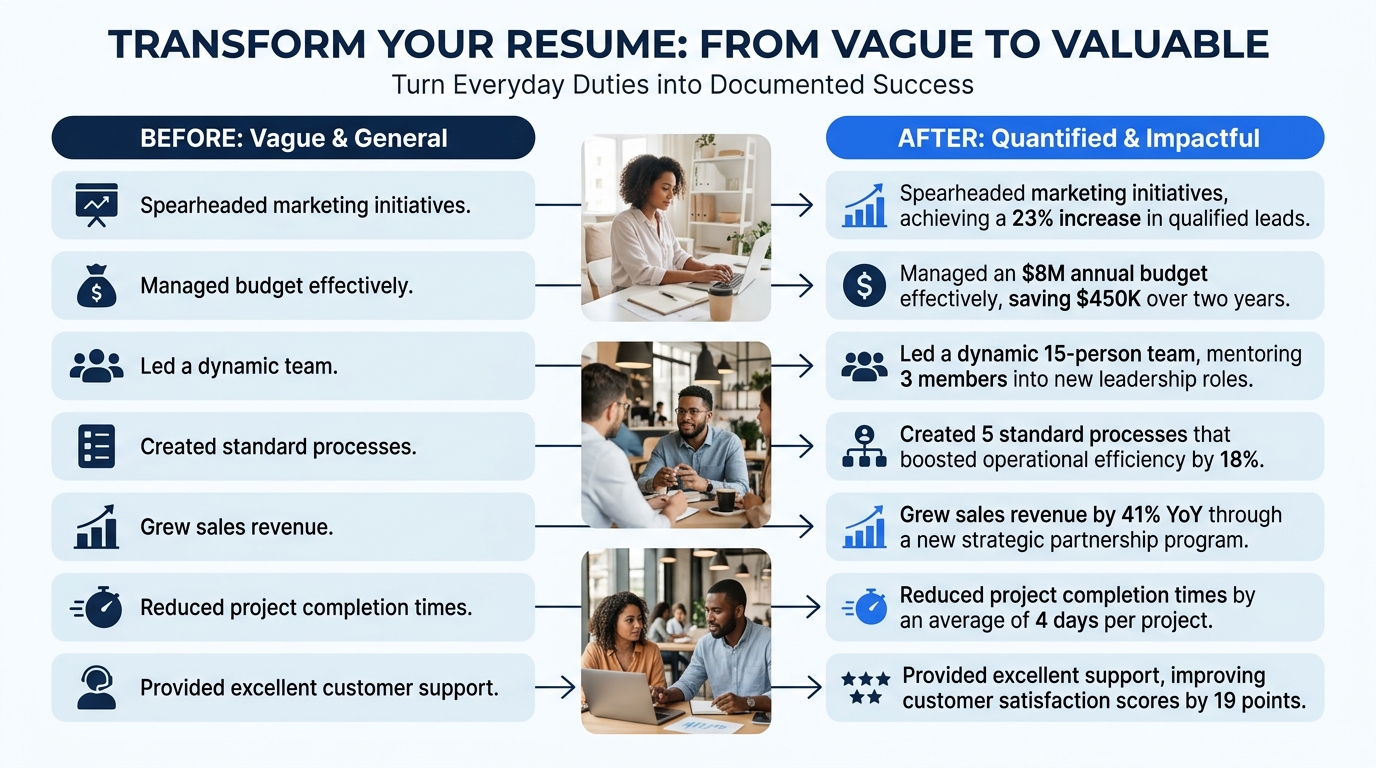
Bullet 1 — Before: Responsible for daily production operations and ensuring quality standards. After: Supervised 22 line workers across two shifts producing 8,400 units daily while reducing the defect rate from 4.1% to 2.3%, saving $47,000 in annual scrap costs.
Bullet 2 — Before: Assisted with training new hires on equipment and safety protocols. After: Designed a structured 6-day onboarding program for new line operators, cutting training time by 40% from the previous 10-day process while maintaining 100% safety compliance during ramp-up.
Bullet 3 — Before: Responsible for maintaining production schedules and meeting deadlines. After: Maintained a 96.2% on-time delivery rate across 14 product SKUs by building a digital shift-handoff tracker that reduced schedule overruns by 22%.
Bullet 4 — Before: Assisted with inventory management and ordering supplies. After: Restructured reorder points for 340 raw material SKUs, reducing carrying costs by $12,000 annually and eliminating 3 stockout incidents per quarter.
Bullet 5 — Before: Responsible for enforcing OSHA compliance on the production floor. After: Led daily safety audits across both shifts, achieving a 14-month streak of zero recordable incidents for a 22-person team in a facility handling industrial adhesives.
Bullet 6 — Before: Assisted with troubleshooting equipment malfunctions. After: Diagnosed and resolved 85% of CNC press malfunctions within 45 minutes, reducing average unplanned downtime from 3.2 hours to 1.1 hours per incident.
Bullet 7 — Before: Responsible for communicating production updates to management. After: Created a weekly KPI dashboard covering OEE, scrap rate, and labor utilization that plant management adopted as the standard reporting format across all 4 production lines.
Notice the pattern. Every rewritten bullet contains at least two numbers. The original bullets contained zero numbers combined across all seven lines. The production resume action verb audit we published earlier covers this verb-replacement process in more detail, but the critical shift here goes beyond swapping “responsible for” with “supervised” or “led.” The numbers are what make the difference between a bullet a recruiter skims and a bullet a recruiter screenshots to share with the hiring manager.
Tip: If you can’t remember exact figures, use conservative estimates. “Reduced defect rate by approximately 40%” still outperforms “Responsible for quality” in every ATS scoring model and every recruiter scan.
How ATS Algorithms Scored the Difference
Both versions of the resume were run through two ATS simulation tools to test keyword matching and content scoring against a sample production supervisor job posting.
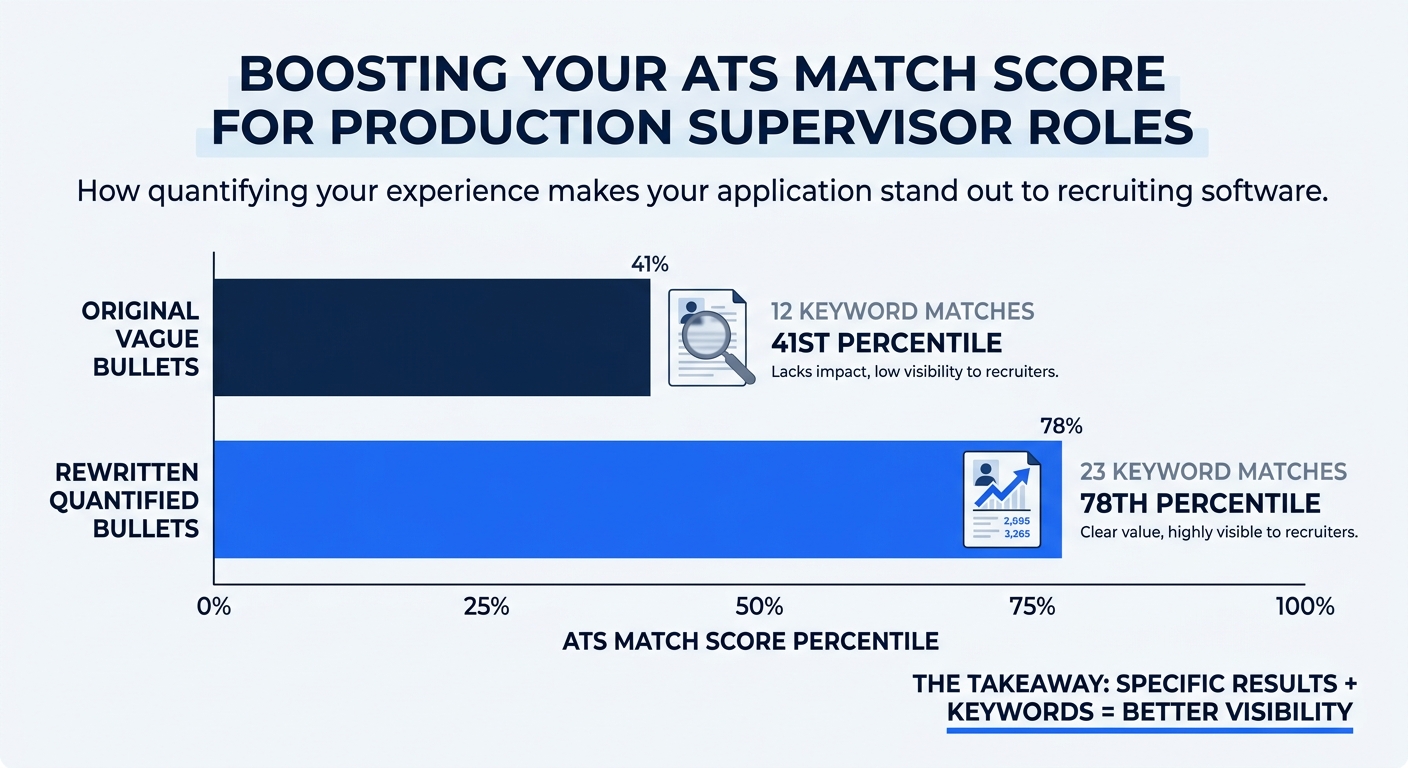
The original seven-bullet version matched on 12 keywords from the job posting, almost all of them generic terms like “production,” “quality,” “safety,” and “training.” The rewritten version matched on 23 keywords, picking up additional matches for terms like “OEE,” “scrap rate,” “on-time delivery,” “downtime reduction,” and “KPI dashboard,” all of which appeared in the job posting’s preferred qualifications section.
The score difference was significant: the original resume scored in the 41st percentile for relevance, while the rewritten version scored in the 78th percentile against the same posting. That 37-point jump came entirely from the bullet rewrites. The header, education section, and skills list remained identical. Understanding how ATS parsing and recruiter reading work together clarifies why this matters: the algorithm surfaces the resume, but the recruiter still needs to see concrete evidence of capability within those first few seconds of scanning.
The Teal career platform’s guide to quantifying resume work experience recommends categorizing each achievement as a financial, operational, performance, project, people, or marketing metric before writing the bullet. In this case, the seven rewritten bullets broke down as follows: 2 financial metrics ($47,000 scrap savings, $12,000 carrying cost reduction), 3 operational metrics (defect rate, on-time delivery, downtime), 1 people metric (22-person team safety record), and 1 project metric (KPI dashboard adoption). That spread across multiple metric categories gave the resume a richer keyword footprint than a resume focused exclusively on one type of number.
The Phone Calls After Week Twelve
The rewritten resume went out to 8 new job postings over the following two weeks. Three of those applications resulted in phone screens, a 37.5% response rate compared to 0% on the previous 30+ applications. Two of the three screeners specifically referenced bullet content during the call, with one asking about the downtime reduction figure and another asking how the KPI dashboard was built.
None of the three callbacks came from postings where the candidate had stronger qualifications than the original 30 applications. The jobs were comparable in scope and requirements. The difference was entirely in how existing experience was presented.
This conversion process took approximately 90 minutes: 45 minutes to extract the underlying data through structured questioning, and 45 minutes to rewrite and format the seven bullets. For a candidate who had already spent 11 weeks and dozens of hours applying with zero results, that 90-minute investment reversed the trajectory of the entire search. And the passive voice patterns that originally plagued this resume (with “was responsible for” appearing in multiple variations) disappeared naturally once each bullet was rebuilt around a specific action and outcome.
The conversion formula isn’t complicated: identify the KPI you influenced, find the before and after numbers, and write the bullet as verb plus context plus result. But the production floor is one of the most measurement-rich environments in any industry. The irony is that professionals who spend every shift tracking output, waste, uptime, and labor efficiency are the same people who write “Responsible for daily production operations” on their resumes and wonder why no one calls back.