


 4.9
4.9 4.5
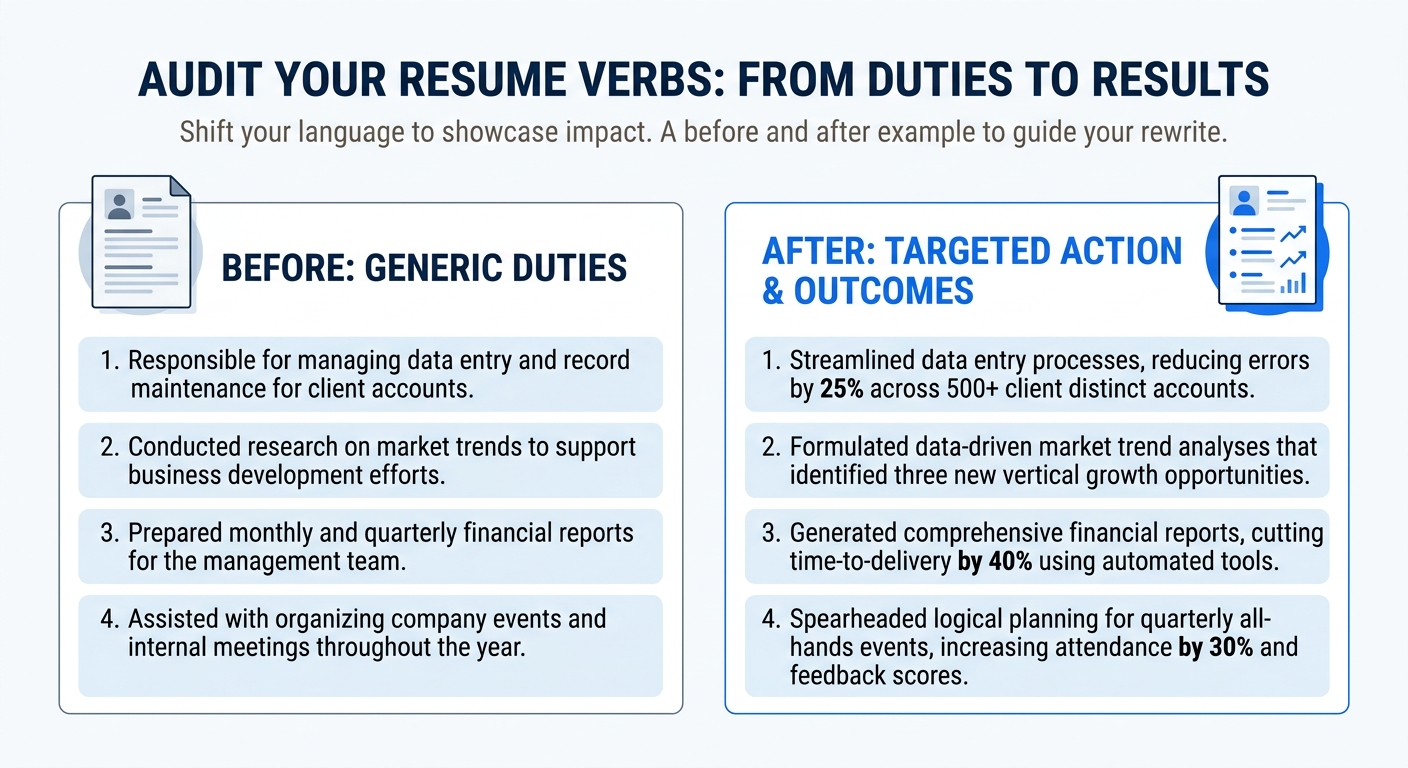
4.5Swapping “Responsible for managing client accounts” for “Grew a 40-account portfolio to $2.1M in annual recurring revenue” takes about 30 seconds per bullet point. The payoff: resumes featuring 10 or more distinct resume action verbs show a 12% higher ATS pass rate, and recruiters stay engaged 19% longer when they encounter verb-driven impact bullets.
Why “Responsible For” Costs You More Than You Think
The phrase “responsible for” sits at the top of nearly every list of resume language to eliminate, and for good reason: it describes a job’s existence, not your performance in it. As The Muse’s resume revamp guide puts it plainly, “a duty describes what you did and an accomplishment describes how well you did it.” That distinction sounds obvious, yet the majority of resumes that land in an ATS inbox still lead with duty-based phrasing. The result is a document that tells a hiring manager you held a role rather than proving you delivered in it. And the ATS reading your file before any human sees it has the same problem: it’s scanning for active, job-description-aligned keywords, not for the word “responsible.”
The data behind this is more specific than people realize. Resumes using strong, targeted action verbs hold hiring managers’ attention 19% longer than those built on generic language like “managed,” “helped,” or “assisted.” And 87% of hiring managers say they prefer targeted, impactful verbs over those defaults. These aren’t soft preferences. When a recruiter spends an average of 6-8 seconds on an initial resume scan, a 19% increase in attention translates directly into whether your bullet points register at all. The math gets worse when you factor in that job searches now average 108 days to first offer: every resume that vanishes into an ATS black hole extends that timeline by days or weeks you can’t get back.
The ATS dimension compounds the human one. Applicant tracking systems prioritize resumes containing specific, job-related action verbs that match the language in the posting, according to Scale.jobs’ analysis of ATS ranking factors. Their recommended structure is direct: Action Verb + Task or Project + Outcome or Metric. A bullet built on “Responsible for overseeing the marketing budget” contains zero active verbs, zero outcomes, and only one matchable keyword (“marketing budget”). Rebuilt as “Allocated a $350K annual marketing budget across 4 channels, reducing cost-per-lead by 22%,” it contains at least three matchable terms (“allocated,” “marketing budget,” “cost-per-lead”), a dollar figure, a percentage, and an active verb the ATS can index.
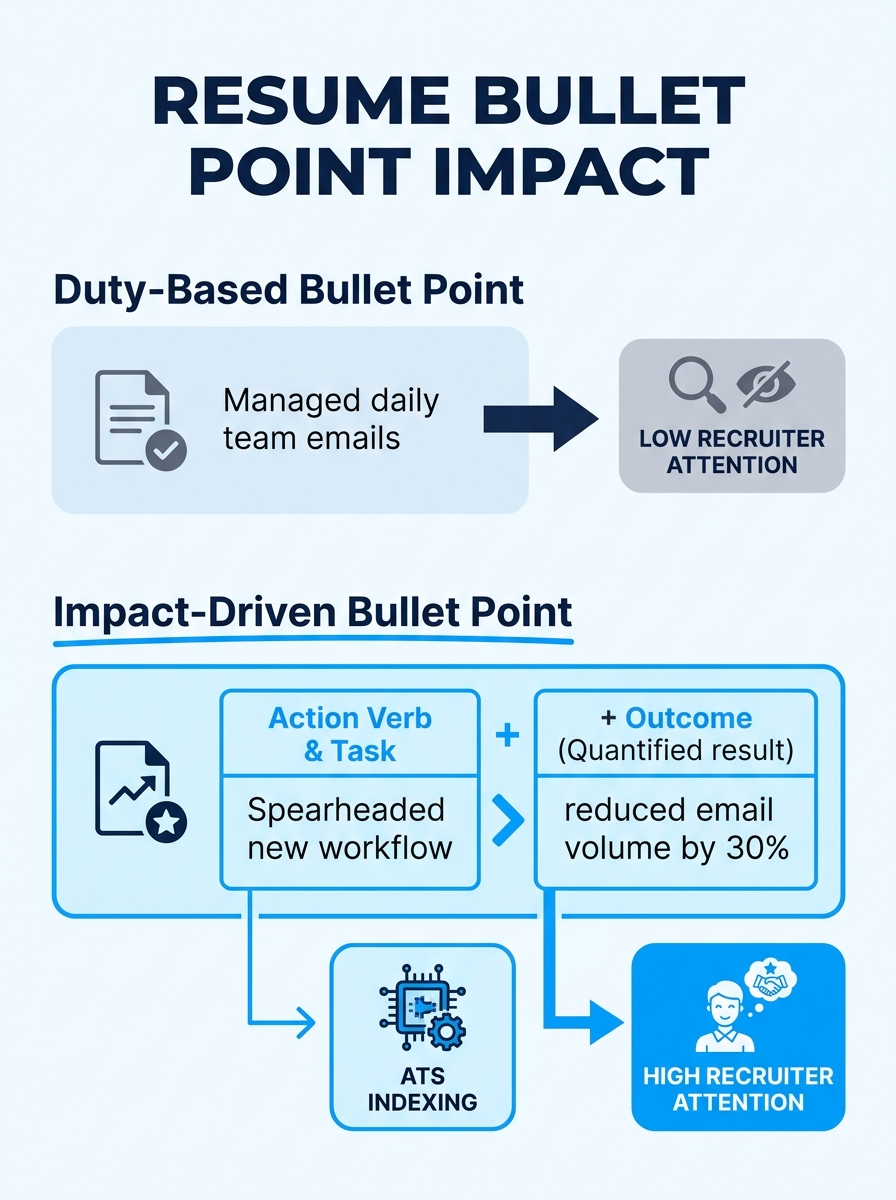
The Three-Category Verb Audit
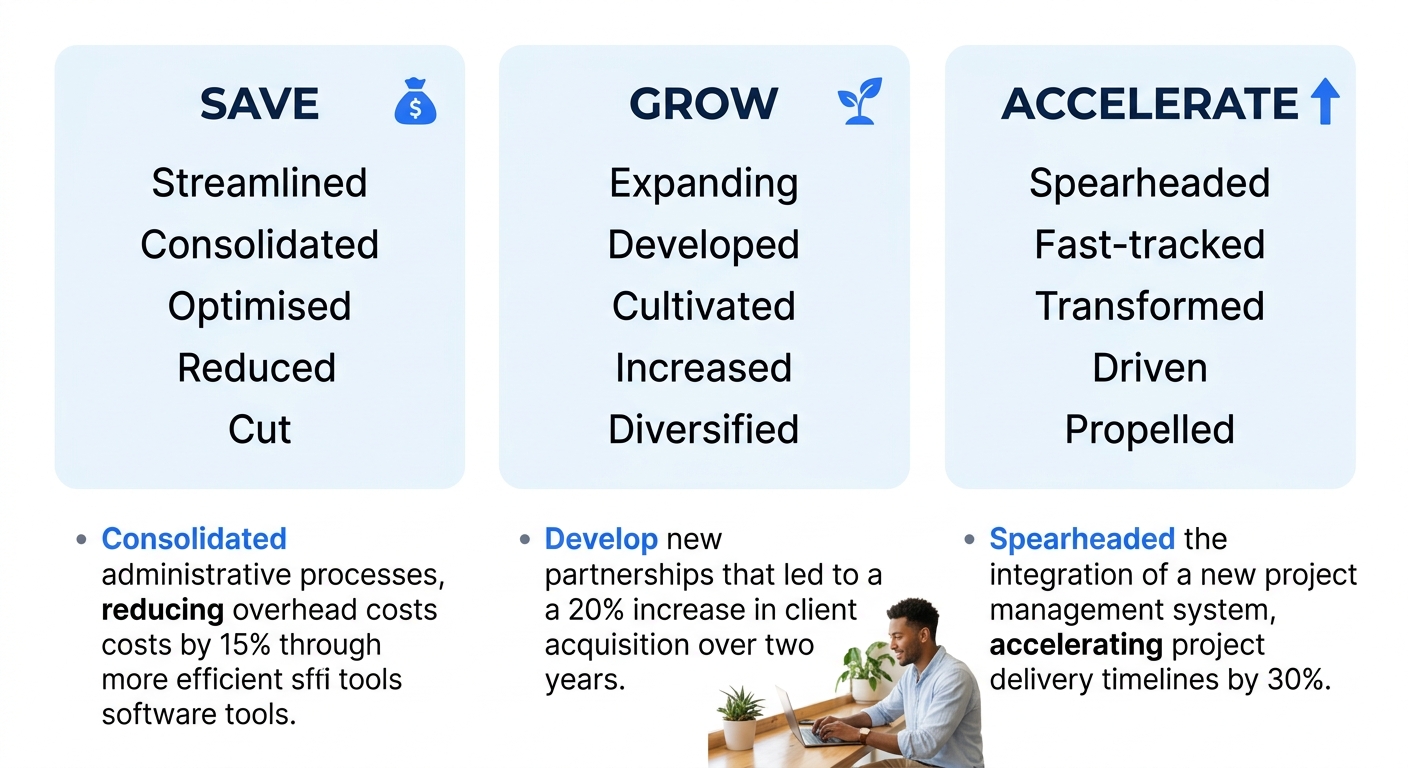
The most useful framework for a resume verb audit doesn’t organize verbs alphabetically or by intensity. It organizes them by the type of business impact they signal: saving costs, growing revenue, or accelerating efficiency. This categorization forces you to think about each bullet point in terms of what it did for the organization, and that shift in thinking produces better ATS keyword optimization almost as a side effect because job descriptions are written around those same three outcomes.
Here’s how it works in practice. Pull up your resume and read each bullet point, asking one question: did this save the company money, grow something measurable (revenue, users, market share, output), or make a process faster and less wasteful? If the answer is “none of the above,” the bullet is a duty, not an achievement. Consider a bullet like “Managed vendor relationships for the operations team.” The verb is weak, the scope is vague, and the outcome is invisible. Run it through the three categories. Did your vendor management save money? Then the verb becomes “Negotiated,” and the bullet becomes “Negotiated 3-year contracts with 12 vendors, reducing procurement costs by $180K annually.” Did it accelerate a process? Then “Consolidated vendor communications into a single platform, cutting approval cycle time from 14 days to 5.” Each version picks a category, assigns a verb that fits, and attaches a number.
The verb selection within each category matters for both ATS matching and recruiter perception. For the cost-saving category, verbs like “reduced,” “consolidated,” “eliminated,” and “negotiated” signal fiscal awareness. For growth, “generated,” “expanded,” “increased,” and “captured” carry weight. For efficiency, “redesigned,” “automated,” “accelerated,” and “restructured” tell the reader you improve systems, not just inhabit them. Coursera’s 2026 list of 150 resume action words notes that while common verbs like “led” or “oversaw” aren’t wrong, they lack the descriptive specificity that makes a bullet memorable. And from an ATS perspective, targeted verbs linked to job-description phrasing increase match rates by 12-15%, a margin that separates the “yes” pile from the “maybe we’ll look later” pile.
A duty describes what you did. An accomplishment describes how well you did it. The verb you choose determines which story your resume tells.
If you’ve already worked through converting “Responsible For” into numbers, this framework adds a layer: it tells you which numbers to look for based on the verb category each bullet belongs to. And if you’ve done a broader action verb audit on a production-focused resume, the three-category approach helps you avoid a common pitfall where every bullet sounds like it came from the same template because every verb belongs to the same impact family.
Matching Verbs to Both the Machine and the Reader
Writing impact bullet points that work requires satisfying two audiences whose priorities overlap but don’t perfectly align. The ATS wants keyword matches. The human recruiter wants proof of competence delivered in clear, scannable prose. The good news is that the same verb-swap technique handles both when you anchor it to the actual job posting.
Start with the posting itself. Read it line by line and pull every verb and noun phrase that describes what the role does. If the posting says “develop and execute go-to-market strategies,” your resume needs the verb “developed” or “executed” near language about go-to-market work. This isn’t about stuffing keywords. Jobscan’s research into ATS mechanics confirms that these systems match hard skills, soft skills, and keywords from the job listing against your resume’s text, and the match happens at the phrase level, not just the individual word level. That means “Customer Relationship Management” and “CRM” aren’t always treated identically by every ATS. Spell out the full phrase at least once, and use the acronym afterward.
The 10-verb threshold is a practical benchmark worth knowing. Resumes with at least 10 distinct action verbs across their bullet points show that 12% higher ATS pass rate, and the variety signals to human readers that you did genuinely different things in each role rather than performing the same task on repeat. Zety’s guide to 350+ action words makes this point concretely: if you’ve used “led” five times, swap four of those for verbs like “chaired,” “orchestrated,” “coordinated,” or “directed.” Each carries a slightly different connotation, and the variety prevents the repetition that 30% of U.S. employers’ AI screening chatbots and human recruiters both flag as low-effort writing.
When you pair each verb with a metric, the bullet becomes defensible rather than decorative. “Directed a 12-person sales team, increasing quarterly revenue by 30%” does three things simultaneously: it gives the ATS a leadership verb (“directed”), a team-size data point, and a revenue keyword with a percentage. For the recruiter, it answers the questions “how big was the scope?” and “what happened as a result?” in a single line. The pairing of verb and metric is the core unit of an impact bullet, and it’s the mechanism behind why writing for both ATS algorithms and human recruiters isn’t the contradiction it seems to be. When a bullet has a clear action, a defined scope, and a measurable outcome, both audiences get what they need.
One practical note on passive voice, which is the structural cousin of the duty-based bullet. Phrases like “was tasked with,” “charged with managing,” and “given responsibility for” bury the verb and put you in the passenger seat of your own career story. If you’ve been converting passive phrasing into active power statements, the verb-swap strategy is the natural next step: you’ve already eliminated the weak grammar, and now you’re choosing verbs that do real descriptive work rather than just existing in active tense.
Tip: Run a quick verb-frequency check before submitting. Open your resume in any text editor, use Ctrl+F, and search for your most-used verbs one at a time. If any verb appears more than twice across the entire document, swap at least one instance for a synonym that better fits the bullet’s impact category.
What a Verb Swap Can’t Fix
There’s an honest limitation to this strategy that most advice on the topic glosses over. The verb-swap framework works beautifully when you have real outcomes to attach to your rewritten bullets, but plenty of legitimate work doesn’t produce tidy percentages or dollar figures. Administrative roles, support functions, early-career positions, creative work, and roles in organizations that don’t track granular metrics all present the same challenge: you know you did good work, but you don’t have a “reduced costs by $180K” story to tell.
The advice industry’s answer is usually “just estimate” or “quantify something.” And to a degree, that’s right. You can count the number of people you trained, the number of reports you produced per week, the turnaround time you maintained. These are real numbers even if they aren’t revenue figures. ResumeBuilder.com’s guide to turning basic duties into achievements acknowledges that task-based roles make quantification harder, but argues the solution is fleshing out the details of each duty until the scope and quality become visible. That’s sound advice. But it doesn’t change the fact that some bullets will land at “Coordinated weekly reporting for a 6-person executive team” rather than “Increased revenue by 40%,” and pretending otherwise leads people to inflate or fabricate metrics that fall apart in interviews.
The verb swap remains valuable even without a metric. “Coordinated weekly reporting for a 6-person executive team” is demonstrably stronger than “Responsible for reports.” The active verb, the frequency, and the audience size give the bullet texture that a duty-based version lacks, and the ATS still picks up “coordinated” and “executive” as matchable terms. But I don’t want to pretend that verb choice alone closes the gap between a bullet with hard numbers and one without them. The candidates who benefit most from this strategy are those who already have outcomes buried in their experience and just need the language to surface them. For everyone else, the verb swap is a genuine improvement, an important one, and simultaneously an incomplete answer to a harder problem about how we measure and communicate the value of work that doesn’t fit neatly into a spreadsheet. That tension doesn’t resolve cleanly, and any resume advice that pretends it does is selling you a formula instead of preparing you for the reality of how recruiters actually read your document.