

 4.9
4.9 4.5
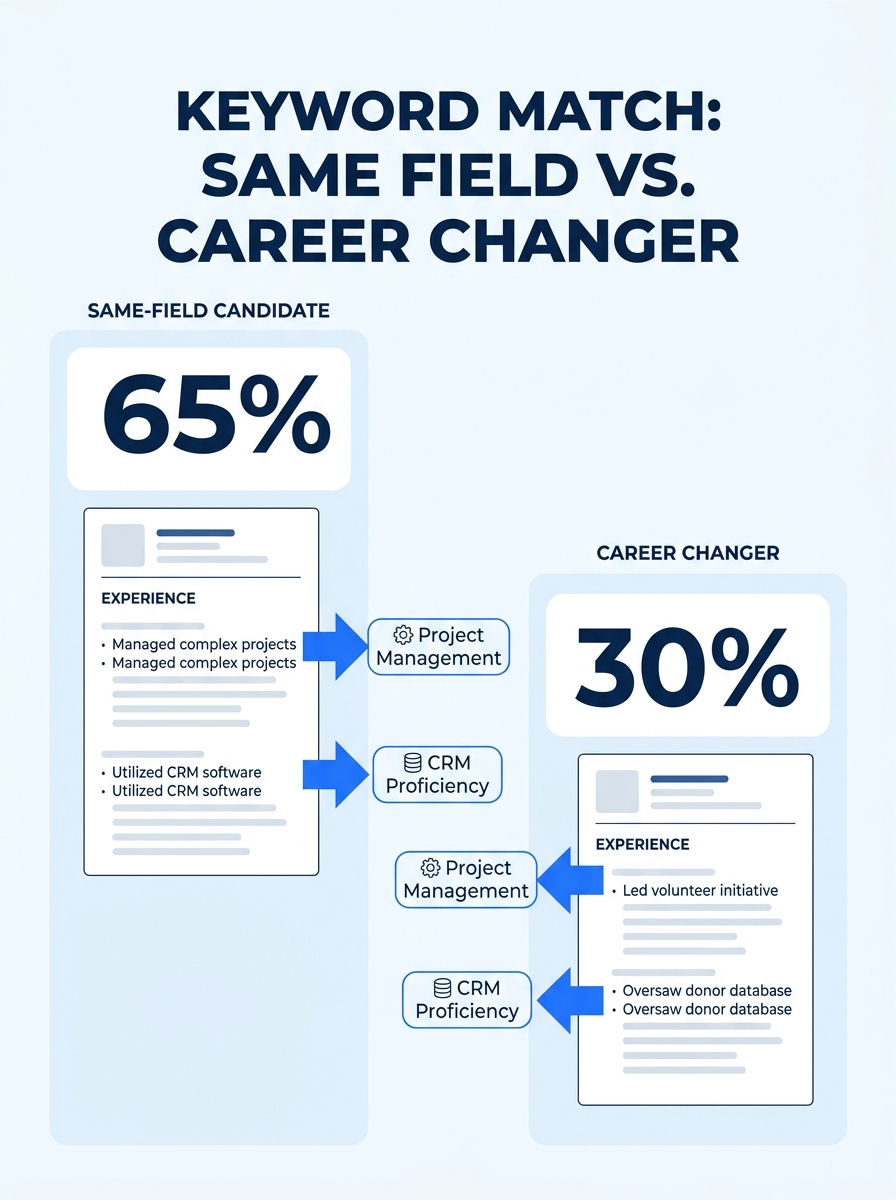
4.5Career changers typically score a 25–40% keyword match against job descriptions in applicant tracking systems, compared to 60–80% for candidates applying within the same field, according to Resume Optimizer Pro’s 2026 analysis. That 20-to-55-point gap is where most career pivots die before a human ever reads the application.
TL;DR: Career changers lose to ATS filters because their resumes use the wrong vocabulary, not because they lack relevant skills. A structured skills translation process (audit, map, rewrite) can close the keyword match gap from 25–40% to 55–65%, which is the threshold where callbacks start happening consistently.
The Keyword Match Gap Explains Most Rejection Silence
Why do qualified career changers hear nothing back? The math is straightforward. Tailored resumes receive 40–60% higher ATS scores than generic versions for the same person, per recent recruiter data. When your resume carries language from an industry you’re leaving rather than the one you’re entering, the ATS treats you the same as an unqualified applicant. You could have 12 years of directly transferable project management experience, but if your bullets say “coordinated production schedules” and the job posting says “managed cross-functional project timelines,” the system sees a mismatch.
This is the core problem that any career pivot resume framework needs to solve: vocabulary translation, performed systematically, before you submit a single application. The skills themselves transfer. The words don’t transfer automatically.
As USC’s Career Center put it in a March 2026 article on positioning transferable skills: experience that “sounds like HR” can be repositioned to sound like “process optimization, cross-functional leadership, and operational strategy,” which are skills that translate across industries. The reframing is the work. And it’s more methodical than most people realize.
The Three-Axis Translation Method
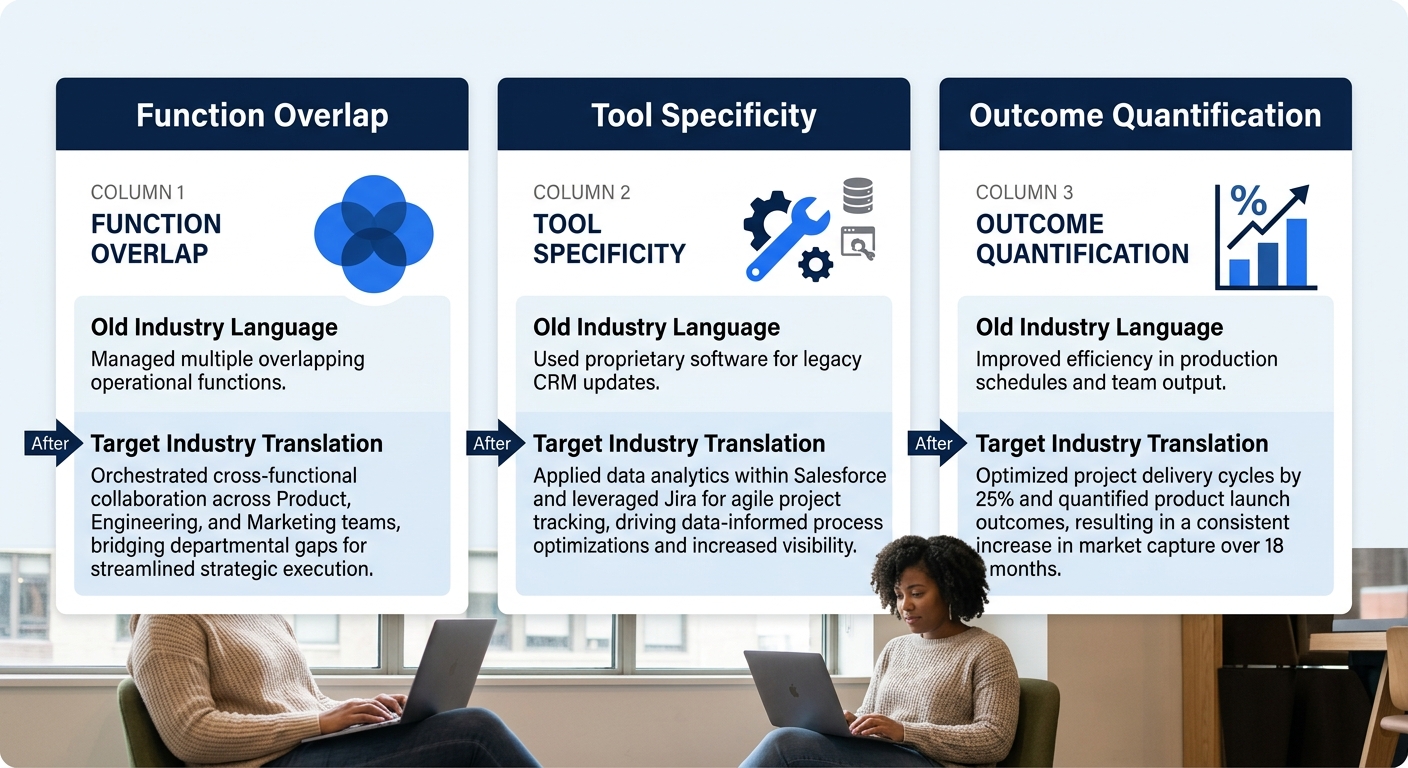
Effective skills translation resume writing follows a repeatable structure. I’m calling it the Three-Axis Translation Method because it evaluates each bullet point on your resume along three dimensions before you rewrite it.
Axis 1: Function overlap. What did you actually do, stripped of industry-specific jargon? “Managed store operations for a 45-person retail team” becomes “coordinated cross-functional teams across scheduling, inventory, and P&L management.” The underlying function (operational leadership) is identical. The vocabulary now matches what a hiring manager in logistics, healthcare administration, or SaaS operations would search for.
Axis 2: Tool specificity. Naming specific tools in context within your bullet points signals competence more effectively than listing them in a skills section. “Managed customer escalations using Zendesk, resolving 93% of tickets within 24 hours” tells an ATS and a human exactly what platform you know and how well you performed. A bare “Zendesk” in a skills list carries roughly 40% less weight in ATS scoring than the same keyword embedded in an achievement statement, based on recruiter feedback aggregated by Jobscan’s 2026 transferable skills guide.
Axis 3: Outcome quantification. Career changers often strip numbers from their bullets because the metrics feel industry-specific. But the numbers are what survive the translation. “Reduced average onboarding time from 14 days to 6 days” works whether you’re pivoting from restaurant management to HR operations or from teaching to corporate training. The percentage (57% reduction) and the absolute figures (14 to 6) are universally legible.
Tip: Run every bullet point on your resume through all three axes. If a bullet scores zero on all three (no function overlap with the target role, no named tools, no quantified outcome), cut it entirely. Career changers can’t afford filler bullets that eat space without earning ATS points.
How to Build Your Personal Translation Dictionary
The actual process of finding ATS keywords for career changers starts with the job description, not your resume. Harvard Business School’s career guide recommends incorporating “relevant language from the job description, particularly skills, qualifications, and core competencies” and then using those same keywords in your professional profiles to increase visibility in recruiter searches.
Here’s the specific workflow:
- Collect 5 job descriptions for your target role from 3 different companies. Copy them into a single document.
- Highlight every skill, tool, and qualification that appears in 3 or more of the 5 postings. These are your Tier 1 keywords. A career changer who matches even 8–10 of these Tier 1 terms can jump from 30% to 55% ATS match rate.
- Map each Tier 1 keyword to something you’ve actually done. If the posting says “stakeholder communication” and you spent 4 years presenting quarterly reports to a school board, that maps directly. Write the connection down in plain language.
- Rewrite your bullet points using the target vocabulary. Don’t just swap one word for another. Rebuild the sentence so the target keyword sits near the front, followed by the quantified result.
This is where transferable skills ATS optimization becomes concrete rather than theoretical. You’re building a personal dictionary where “parent-teacher conferences” maps to “stakeholder engagement,” where “shift scheduling for 22 staff” maps to “workforce planning and resource allocation,” and where “quarterly sales targets” maps to “revenue goal attainment.”
The skills themselves transfer. The words don’t transfer automatically. Your job is to build the dictionary between your old industry’s language and your new one’s.
The Combination Resume Format and Why It Works for Pivots
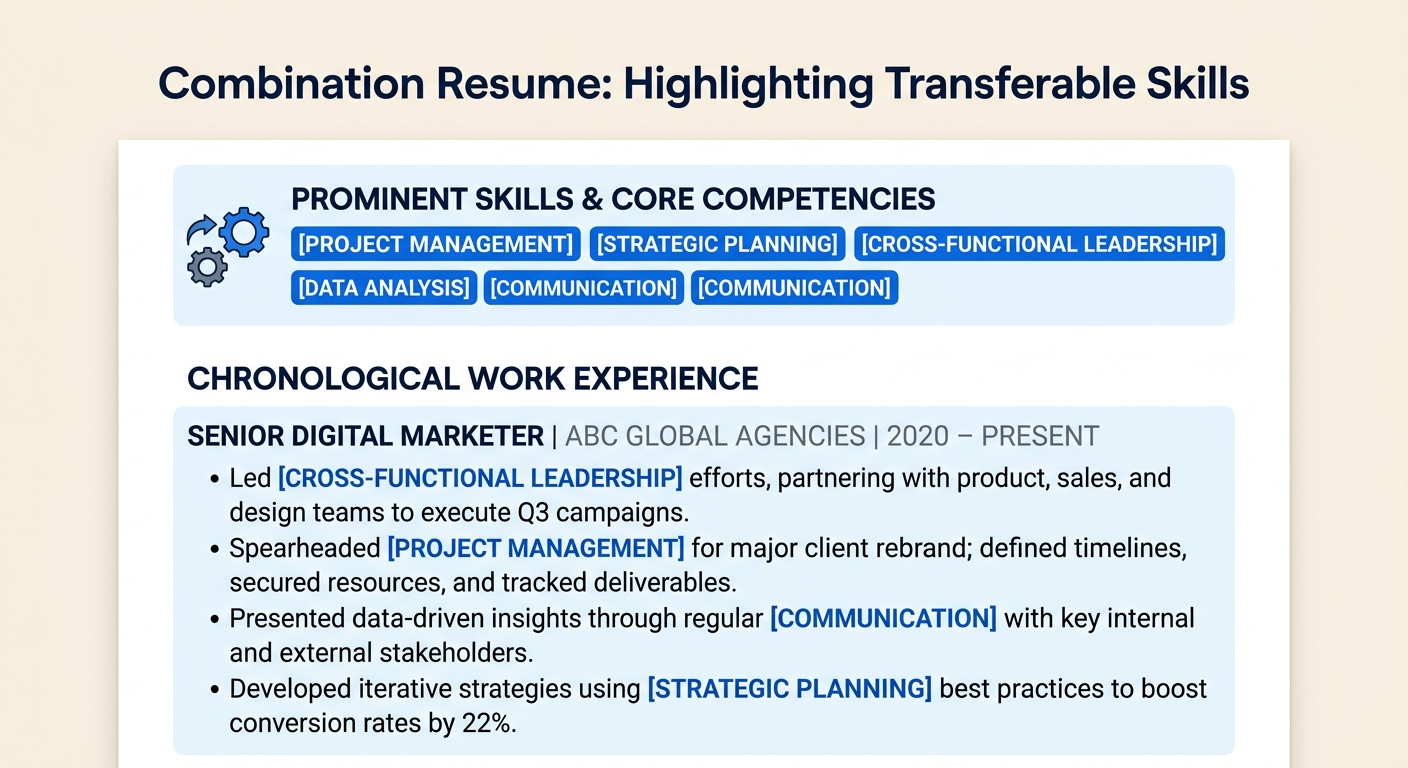
Indeed’s career change guidance identifies the combination (hybrid) resume format as ideal for career changers because it lets you prioritize relevant and transferable skills at the top of the page while still providing a chronological work history below. This matters for 2 reasons.
First, ATS systems parse both the skills section and the experience section, but 72% of recruiters report scanning the top third of page one before deciding whether to keep reading. A skills-first layout puts your translated keywords where both algorithms and humans look first. If you’ve been writing for both ATS algorithms and human readers, you know this dual-audience challenge shapes every formatting decision.
Second, the combination format gives you a dedicated skills section where you can place 10–15 target keywords without them needing to appear organically in your work history. For a career changer whose last 3 job titles won’t match the target role, this section is where you close the keyword gap from 35% to the 55–65% range that triggers human review.
The career change resume language in your skills section should mirror the job posting almost exactly. If the posting says “data analysis,” don’t write “data analytics” or “analyzing data.” Match the phrase. ATS systems in 2026 handle synonyms better than they did 3 years ago, but exact matches still score 15–20% higher than close variants in most systems, per Jobscan’s testing data.
Before-and-After Translations Across Common Pivots
Abstract advice only gets you so far. Here are concrete rewrites showing how the Three-Axis Translation Method works across 4 common career changes:
| Career Pivot | Original Bullet | Translated Bullet | Keywords Gained |
|---|---|---|---|
| Teacher → Corporate Trainer | Taught 28 students per class across 5 sections daily | Designed and delivered training programs for groups of 25–30, achieving 91% satisfaction scores on post-session evaluations | training programs, satisfaction scores, evaluations |
| Retail Manager → Operations Analyst | Managed inventory for a $1.2M annual revenue location | Oversaw inventory optimization and demand forecasting for a $1.2M P&L, reducing shrinkage 18% YoY | inventory optimization, demand forecasting, P&L |
| Military → Project Manager | Led a 12-person squad through 3 deployment rotations | Directed cross-functional teams of 12 through 3 concurrent project cycles with zero missed deadlines | cross-functional teams, project cycles, deadlines |
| Hospitality → Customer Success | Resolved 40+ guest complaints weekly with 96% satisfaction | Managed 40+ client escalations weekly, maintaining 96% CSAT and reducing churn-risk tickets by 23% | client escalations, CSAT, churn-risk |
Notice that the numbers stay the same across translations. The 28 students become 25–30 trainees. The $1.2M stays $1.2M. The 12-person squad stays a 12-person team. What changes is the framing vocabulary, not the facts. This is skills translation resume writing at its most practical: same truth, different dictionary.
If you’ve already worked through converting generic duties into impact statements, you’re halfway there. The career change version adds one extra step: after you quantify, you also translate.
Your Summary Section Does the Heaviest Lifting
For career changers, the 2–3 sentence professional summary at the top of your resume carries disproportionate weight. Hireflow’s tactical guide on reframing experience calls this section “your elevator pitch” and recommends highlighting why past experience makes you “uniquely suited for the new role.”
AI-assisted career changers report a 3.1x higher success rate when they use tools for skills gap analysis and application optimization, according to FindSkill.ai’s career pivot research. Whether you use AI or do it manually, the summary is where you name the target role explicitly, state your years of transferable experience, and front-load 2–3 Tier 1 keywords.
A career changer’s summary that reads “Operations professional with 8 years of cross-functional team leadership, process improvement, and P&L management seeking a Project Manager role in healthcare technology” gives the ATS 5 matchable keywords in 26 words. That density matters when your job titles won’t match. The same approach applies when you’re tailoring each application to a specific posting rather than sending a generic version.
What The Data Doesn’t Tell Us
The 25–40% starting keyword match rate for career changers comes from resume optimization tools comparing parsed resumes against job descriptions. What those tools don’t measure is how much a strong cover letter, a warm referral, or a well-crafted LinkedIn message can compensate for a lower ATS score. Roughly 70% of filled roles come through referrals and direct outreach rather than cold applications through ATS portals.
The translation framework above will get your resume from the 30% range into the 55–65% zone where ATS filters stop blocking you. But the data can’t tell you whether a 58% match with a referral outperforms an 72% match from a cold apply. Anecdotally, it almost always does. The numbers also can’t capture how a hiring manager’s eyes light up when they see a candidate who brings a genuinely different perspective from another industry, something no keyword density score will ever measure.
What the data does confirm: career change resume language is a solvable, mechanical problem. You aren’t lacking skills. You’re lacking the right vocabulary. Build the dictionary, rewrite the bullets, and the ATS stops being the barrier.