
 4.9
4.9 4.5
4.5Tom’s Guide published a prompt-by-prompt breakdown on June 18, 2026 showing that five specific ChatGPT prompts caught formatting errors, keyword gaps, and vague bullet points that the resume’s author — a professional writer — had missed across multiple self-editing rounds.
TL;DR: Running your resume through ChatGPT with targeted prompts catches keyword mismatches, weak quantification, ATS formatting problems, tone inconsistencies, and skill gaps that self-review almost always misses. But the prompts determine whether you get useful feedback or generic filler, and over-reliance gets 25% of AI-assisted resumes flagged by employers.
The finding landed the same week Anne Hathaway told Fortune she’d received identical ChatGPT-written thank-you notes from every candidate who interviewed for a recent role. “Nobody on that list gets that job,” Hathaway said, illustrating a growing divide between candidates who use AI as an editing partner and those who hand it the wheel entirely. According to AIQ Labs, 25% of AI-assisted resumes now get flagged by hiring teams, and the trigger isn’t AI use itself. It’s overreliance on generic, uncustomized output.
That distinction matters because the screening technology on the employer side has shifted dramatically. The leading AI resume screening tools of 2026 — HackerEarth, Eightfold AI, and TestGorilla among them — have replaced keyword filtering with semantic and skills-based matching. Your resume now gets evaluated on whether its language demonstrates genuine understanding of the role, not whether it mirrors exact phrases from the posting.
Here are the five questions a well-prompted ChatGPT review answers that you’re almost certainly skipping.
1. Does My Resume Actually Speak the Job Description’s Language?
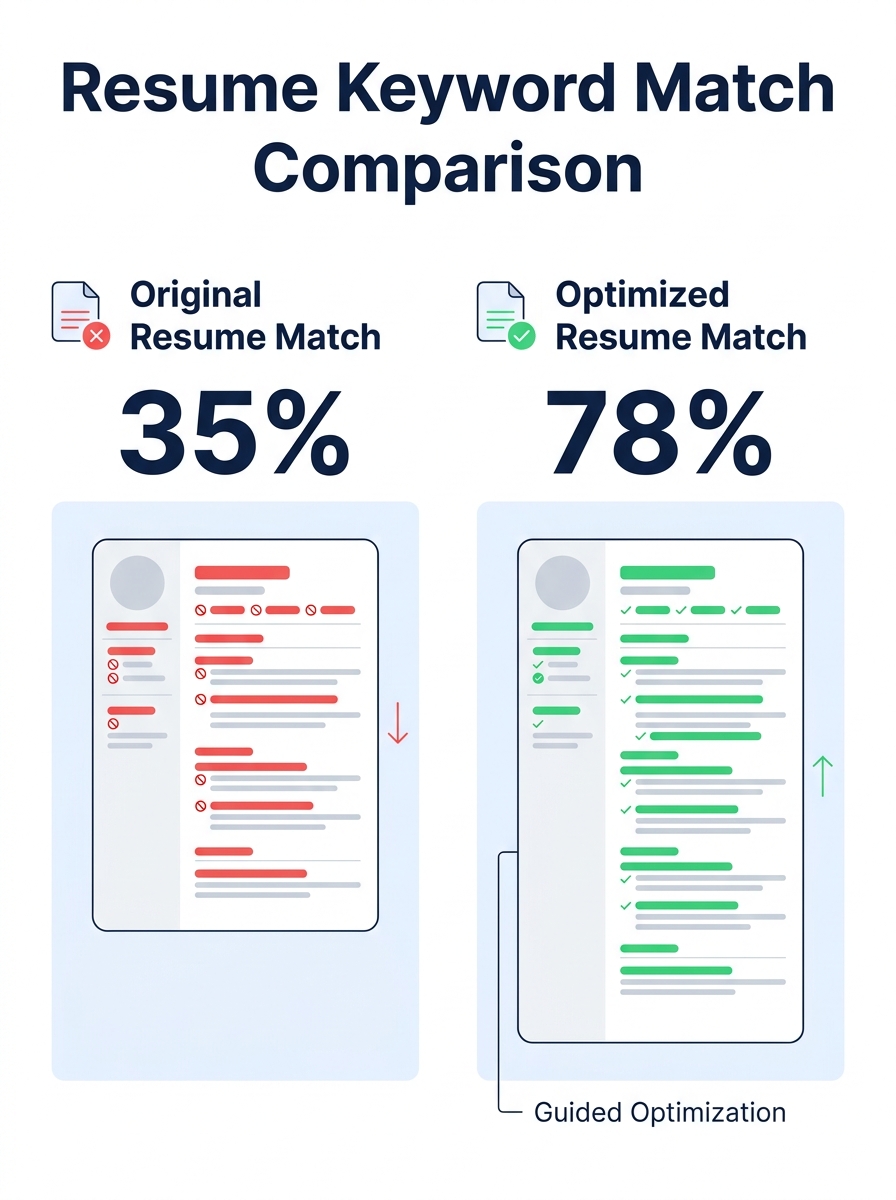
Paste a job description into ChatGPT and ask it to extract the key skills, qualifications, tools, and phrases the employer wants. According to SkillForge AI’s optimization guide, you’ll get a clean list in seconds that would take you 15 minutes to compile manually. Then ask ChatGPT to compare that list against your resume and flag every gap.
This is the highest-impact prompt you can run. Career changers score a 25–40% keyword match against job descriptions in applicant tracking systems, compared to 60–80% for same-field applicants. And even experienced professionals routinely miss terminology shifts within their own industries. If you’re writing resumes using the language from your last job instead of the language in your next job posting, ATS systems score you lower before a human ever reads the document.
The prompt structure that works: “Act as an expert recruiter. Here is the job description: [paste]. Here is my resume: [paste]. Identify every required skill, qualification, and keyword in the job description that is missing from or underrepresented in my resume.”
If you’ve been translating transferable skills into ATS-friendly language, this prompt validates whether your translations actually landed.
2. Am I Listing Duties or Proving Impact?
The second prompt asks ChatGPT to audit every bullet point for measurable outcomes. The specific framing from the Tom’s Guide breakdown: ask ChatGPT to identify which bullets describe responsibilities versus which demonstrate results with numbers attached.
Most people think they’ve quantified their work. They haven’t. Phrases like “managed a team” or “responsible for client relationships” describe what the role was, not what you accomplished in it. ChatGPT catches the pattern because it scans all 15–20 bullet points simultaneously and flags the ones that lack percentages, dollar figures, timeframes, or volume metrics.
A strong version of this prompt: “Review each bullet point on my resume. For any that describe duties without measurable outcomes, suggest a revised version that includes a specific number, percentage, or business result. Ask me clarifying questions if you need data to make the revision accurate.”
That last instruction — “ask me clarifying questions” — is the difference between getting generic rewrites and getting useful ones. Without it, ChatGPT fabricates metrics. With it, the tool prompts you to remember the 30% cost reduction you actually drove but forgot to mention.
This pairs directly with converting vague duties into quantifiable impact bullets, where the core problem is identical: you know what you did, but you default to describing the role instead of the result.
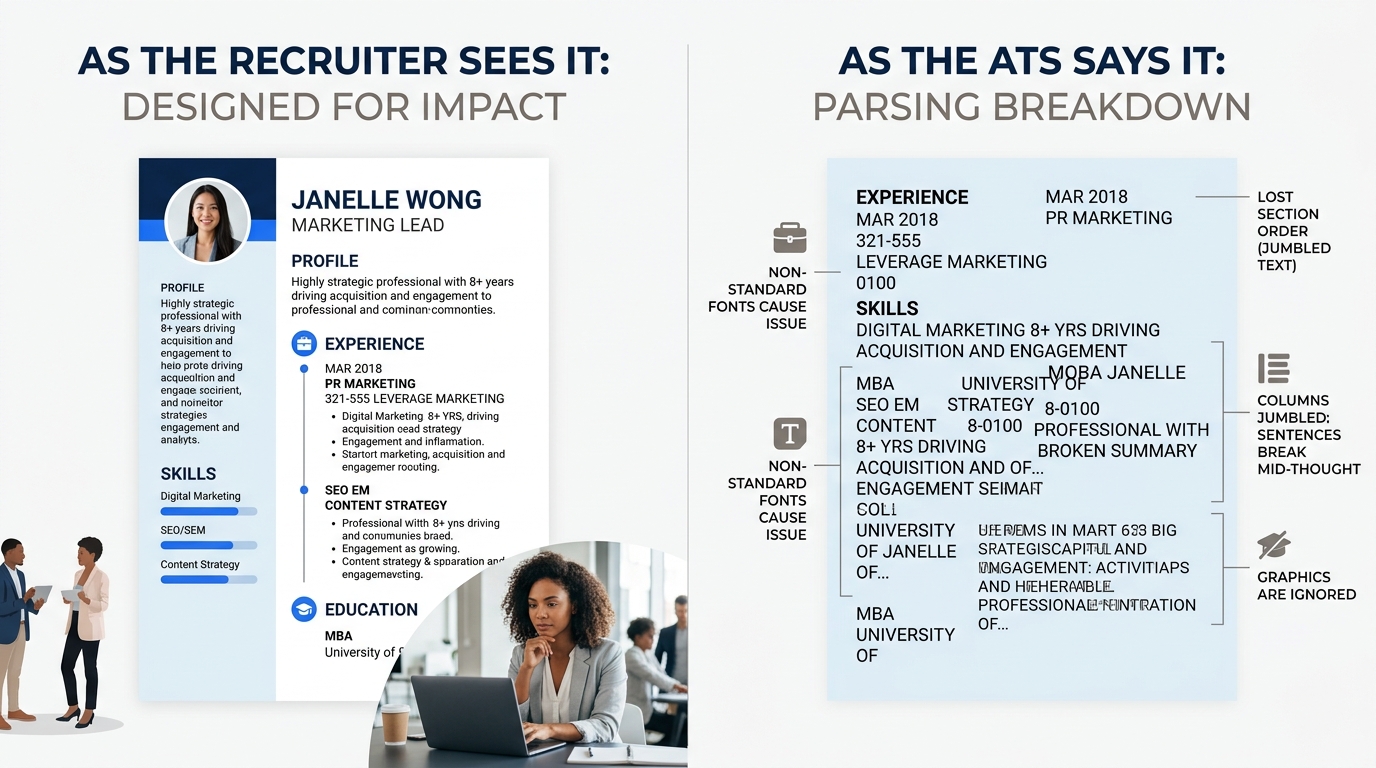
3. Will ATS Software Actually Parse My Formatting?
Indeed’s optimization guide puts it plainly: optimize your resume for AI scanners by using a compatible format, incorporating relevant keywords, and checking how it looks in plain text. The formatting piece is where most candidates lose points they never know about.
ChatGPT can audit formatting problems that are invisible in a polished Word doc or PDF. Ask it to evaluate whether your resume relies on tables, text boxes, headers/footers, multi-column layouts, or embedded images that ATS systems can’t read. The Tom’s Guide piece specifically warns against heavy graphics or multi-column layouts, recommending that you paste ChatGPT’s text output into a clean, text-based template in Google Docs or Word.
The prompt: “I’m going to paste my resume as plain text. Identify any formatting elements that would cause problems for applicant tracking systems, including inconsistent date formats, unusual section headers, or any structure that would lose information when parsed as plain text.”
With nearly 90% of employers now using AI to filter resumes, a resume that looks beautiful in PDF but gets garbled by ATS parsing effectively doesn’t exist to the people reviewing candidates. ChatGPT flags the structural problems; you still need to fix them in your document editor.
4. Does My Resume Sound Like Me or Like a Robot?
Why run a tone audit on your own resume? Because recruiters now actively look for it. Jobright’s analysis of employer detection methods found that recruiters notice when tone is identical across every section, phrasing sounds corporate and unnatural, and technical depth in conversation doesn’t match what’s written on the page. The 25% flagging rate from AIQ Labs stems directly from this pattern: candidates who let ChatGPT rewrite their entire resume end up with documents that all sound the same.
The audit prompt here works in reverse. Instead of asking ChatGPT to improve your resume, ask it to evaluate whether the voice sounds consistent and human. A version that produces honest feedback: “Read my resume and flag any phrases that sound generic, overly corporate, or like they were written by AI. Identify sections where the tone shifts noticeably or where buzzwords replace specific details.”
This is resume quality assurance at its most counterintuitive — using AI to detect AI-sounding language. But ChatGPT is genuinely good at identifying the patterns that trigger skepticism: strings of buzzwords without supporting evidence, identical sentence structures across every bullet, and superlatives that aren’t backed by data.
Warning: If ChatGPT rewrites a bullet and the new version sounds nothing like how you’d describe your work in a conversation, don’t use it. The Hathaway incident shows that hiring managers are developing a visceral reaction to AI-uniform language. Your resume needs to sound like you on your most articulate day, not like a press release.
The goal of AI resume editing prompts should be revealing blind spots, not replacing your voice. When you’re writing for both ATS algorithms and human recruiters, authenticity is the factor that separates candidates who clear the software screen from candidates who also clear the human one.
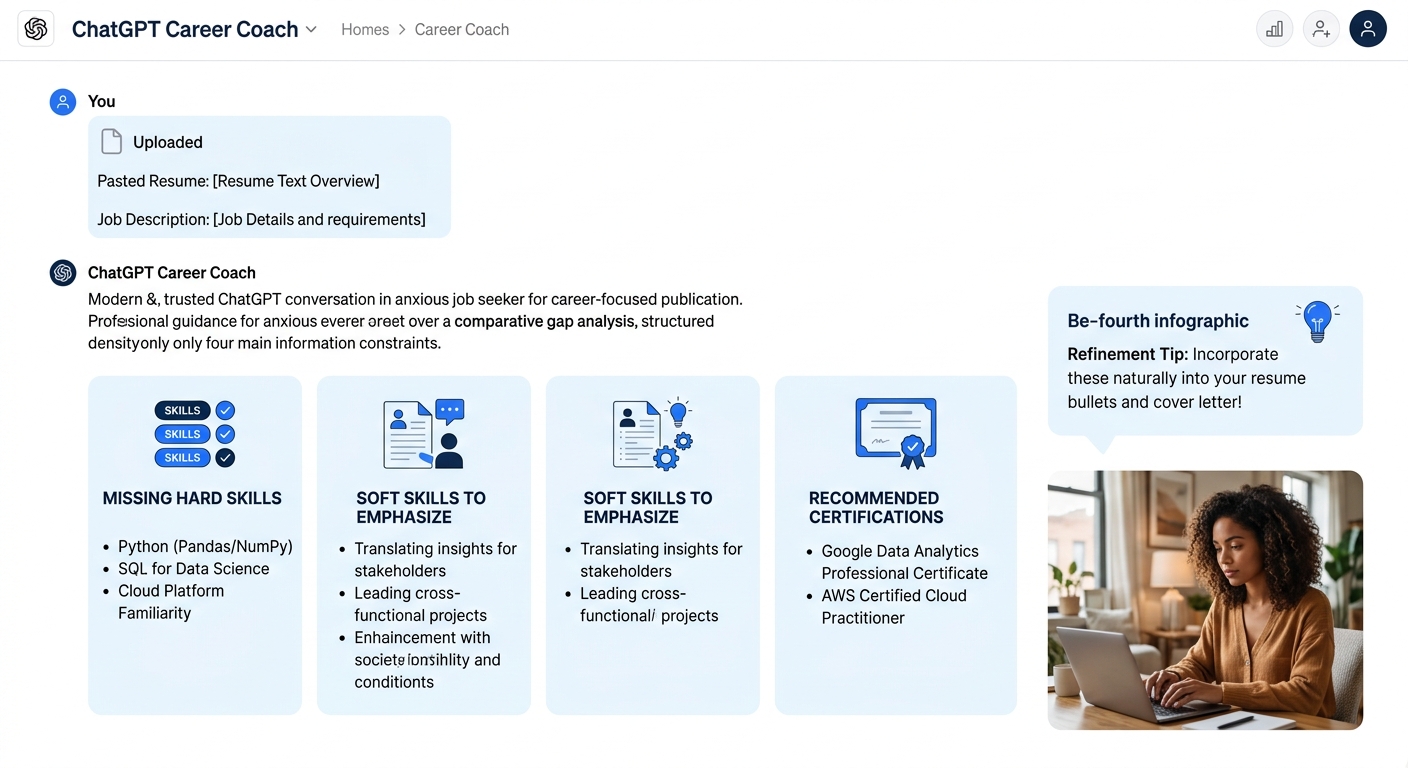
5. What Skills Am I Missing That I Don’t Know I’m Missing?
The final question goes beyond keyword matching into genuine gap analysis. The SkillSync framework, published in the International Journal of Engineering Research & Technology (IJERT), demonstrates how AI can cross-reference a resume against a job description and produce a structured list of missing competencies — then recommend specific learning resources, including tutorials of 30+ minutes for each missing skill, to close each gap.
The prompt: “Compare my resume against this job description and identify skills or qualifications the employer requires that I don’t demonstrate anywhere in my resume. For each gap, tell me whether it’s a hard skill I need to acquire, a soft skill I should better articulate, or a certification I should consider.”
This question catches the blind spot that self-review can’t: you don’t search for what you don’t know you’re missing. A project manager might not realize the posting expects familiarity with a specific methodology. A developer might overlook that the role requires experience with a framework they’ve used but never listed. ChatGPT’s value is pattern-matching across two documents faster and more thoroughly than you can.
If the gap analysis reveals significant skill deficits, that’s useful career intelligence beyond the resume itself. It feeds directly into identifying growth areas for professional development and helps you decide whether to apply now, invest in closing the gaps first, or redirect your search toward roles where your existing skills are a stronger match.
You don’t search for what you don’t know you’re missing. That’s why the skill-gap prompt catches problems that ten rounds of self-editing won’t.
The Detection Arms Race
Every one of these prompts works because it treats ChatGPT as a reviewer, not a ghostwriter. The distinction has become operationally significant this year. Willo’s research documents 11 distinct methods employers use to spot AI-generated resumes, including comparing writing style across application materials and checking whether candidates can speak to their own bullet points during interviews. The screening tools on the employer side — Eightfold AI, HackerEarth, Pesto for tech roles — are running their own AI analysis on your application. Resume mistake detection is happening on both sides of the hiring table simultaneously.
The candidates getting flagged aren’t the ones who ran a ChatGPT resume review to check keyword alignment. They’re the ones who pasted a job description and said “write me a resume for this,” then submitted whatever came back without editing a word.
With job searches now averaging 108 days to a first offer, the stakes of getting your resume right before you send it are high enough that an AI audit makes practical sense. But the audit has to start with your genuine experience and your actual voice. The five prompts above assume you’ve already written a real resume describing real accomplishments. ChatGPT’s job is to find what you missed, not to invent what you never did.
What Still Isn’t Settled
Several things remain in flux in the AI-as-resume-auditor space. The shift from keyword-based ATS filtering to semantic matching — now standard across major screening platforms — means the “right” level of keyword optimization is a moving target. Optimizing too aggressively for exact-match keywords can actually hurt your score in semantic systems that reward natural, contextual language over keyword density.
Detection technology is also evolving at a pace that makes any specific guidance about “what’s safe” perishable. ChatGPT’s own market share dipped below 50% for the first time this month according to PCMag, as candidates and employers alike spread across Gemini, Claude, and other tools. The prompt strategies that work in GPT-5.5 (which replaced GPT-5.2 on June 12) will need adjustment as models change.
The safest position remains straightforward: write your own resume, then run it through the five questions above. Fix what ChatGPT finds. Keep what sounds like you. And when you walk into the interview, be ready to talk about every single bullet point without hesitation — because the hiring manager on the other side of the table has read enough AI-generated applications to spot the difference.