

 4.9
4.9 4.5
4.5This guide produces a finished, ATS-ready cover letter in about 45 minutes. You’ll build it paragraph by paragraph using a complete cover letter sample letter, keeping within the one-page, 250–400 word range that MIT’s career advising office and most hiring managers expect.
TL;DR: Structure your cover letter in four paragraphs (hook, qualifications, company connection, close), mirror the job posting’s exact language, stay under 400 words, and customize the body for every single application.
Before You Start
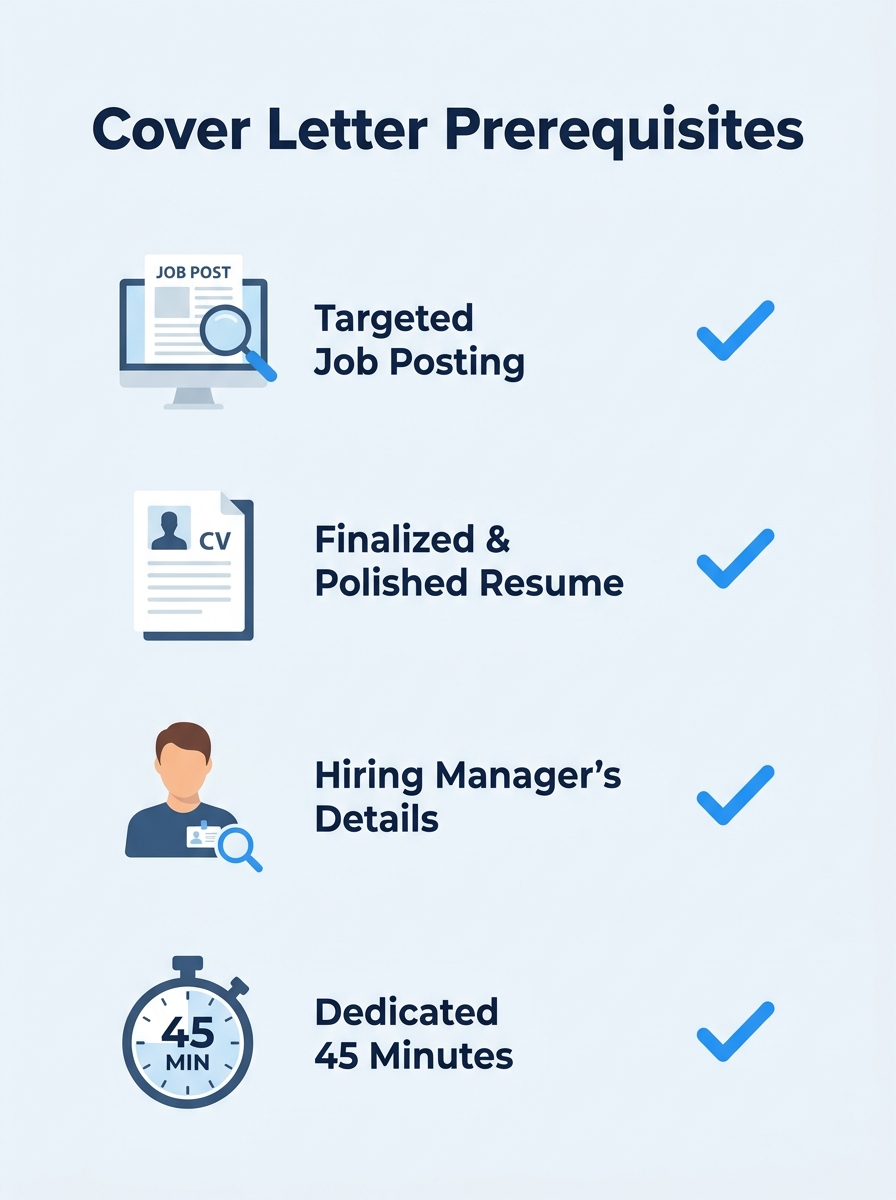
Gather these four things before you write a single word. Skipping any of them leads to a generic letter that hiring managers can spot immediately.
What you need:
- The job posting, printed or open in a separate tab. You’ll pull exact phrases from it. If the posting says “CRM,” your letter says “CRM,” not “customer database.” Mirroring the employer’s language signals that you’ve read the description carefully and helps your application clear ATS keyword filters.
- Your resume, finalized. The cover letter doesn’t repeat your resume. It adds context to two or three resume bullet points. If your resume still needs work, sort that out first. We’ve covered how to align your summary with your bullet points separately.
- The hiring manager’s name. Check the job posting, the company’s team page, or LinkedIn. “Dear Hiring Manager” works as a fallback, but a real name increases your odds of getting read. According to a ResumeLab survey, 72% of hiring managers expect a cover letter customized to the specific role, and addressing someone by name is the simplest form of customization.
- About 45 minutes of uninterrupted time. Drafting takes 20–25 minutes. Editing and tailoring takes another 15–20.
Font and formatting baseline: MIT’s Career Advising and Professional Development office specifies a font size between 10 and 12 points. Use a standard typeface (Arial, Calibri, Garamond, Times New Roman). Set margins at 1 inch on all sides. Save as PDF unless the application specifically requests a Word document.
Step 1: Set Up the Header and Salutation
The header establishes you as a professional before the hiring manager reads a single sentence. Place your full name, phone number, email, and LinkedIn URL (optional but recommended) at the top. Below that, add the date, the company name, and the hiring manager’s name and title.
Here’s the format:
Your Name Phone Number | Email Address | City, State LinkedIn URL (optional)
Date
Hiring Manager’s Name, Title Company Name Company Address
Dear [Hiring Manager’s Name],
You’ll know this step is done when: your header looks like a standard business letter and includes accurate contact information for both you and the recipient. Double-check the hiring manager’s name spelling against the job posting or LinkedIn profile. A misspelled name is one of the fastest ways to get filtered out.
Step 2: Write an Opening Paragraph That Names the Role and Your Biggest Qualification
The first paragraph of your cover letter sample letter carries the most weight. Hiring managers scanning 50+ applications per role spend about 7 seconds on an initial read. Your opener needs to answer two questions immediately: what job you’re applying for, and why you’re worth reading further.
The action: Write 2–3 sentences. Sentence one names the position and where you found it. Sentence two states your single strongest qualification, backed by a number.
Sample opening paragraph:
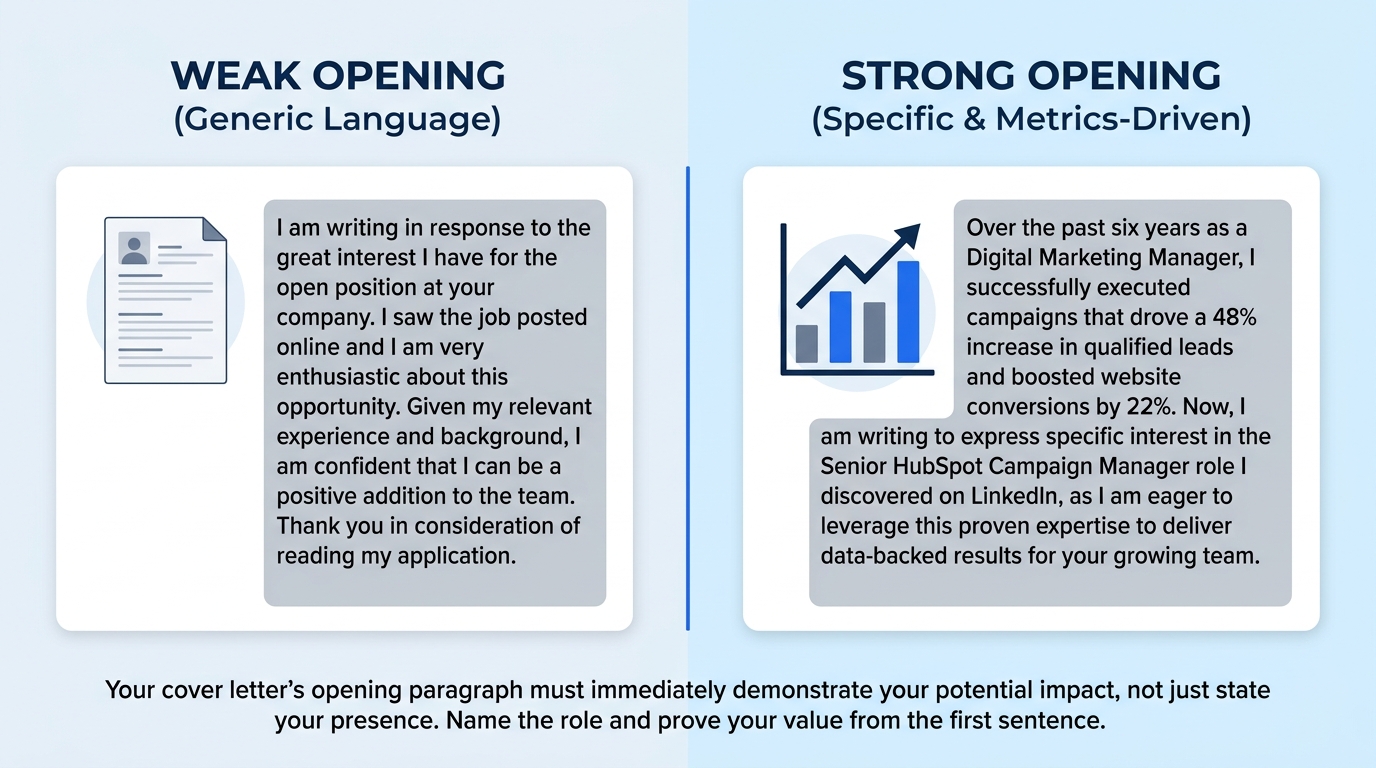
I’m applying for the Marketing Manager position posted on your careers page. Over the past four years at [Current Company], I’ve led paid acquisition campaigns that drove $2.1M in attributable revenue while reducing cost-per-lead by 34%.
Notice what this doesn’t do: it doesn’t open with “I was excited to see your posting” or “I believe I would be a great fit.” Both phrases waste your opening on feelings instead of evidence. The University of Michigan Career Center advises candidates to “describe your qualifications for the type of position you seek using specific examples from academic, work, volunteer, and/or co-curricular experiences.” Specific examples are the key phrase here.
Tip: If you’re changing careers and your biggest qualification doesn’t come from a traditional employer, pull from volunteer work, freelance projects, or academic research. The source of the achievement matters less than the result.
You’ll know it worked when: your opening paragraph contains the exact job title, one measurable achievement, and zero filler phrases.
Step 3: Build the Body with Two or Three Measurable Achievements
The body is where you prove you can do the job. Pick two or three requirements from the posting and match each one to an achievement from your background. The structure for each achievement follows a simple pattern: what you did, how you did it, and what resulted.
The action: Read the job posting’s “responsibilities” or “what you’ll do” section. Identify the top two or three items. For each one, write 1–2 sentences connecting your experience directly to that requirement.
Sample body paragraph:
Your posting emphasizes building cross-functional partnerships to accelerate product launches. At [Previous Company], I coordinated between engineering, design, and sales teams to ship a SaaS onboarding tool three weeks ahead of schedule, which increased trial-to-paid conversion by 18% in the first quarter after launch.
According to Indeed’s cover letter guidance, you should “include relevant achievements and skills that show the value you bring to the organization.” The phrase “value you bring” is doing important work. A body paragraph that says “I have five years of project management experience” states a fact. A body paragraph that says “I managed a 12-person cross-functional team that delivered a $400K project 11% under budget” demonstrates value.
If you’ve been dealing with gaps in your employment history, the body paragraph is a natural place to address them briefly. One sentence explaining what you did during the gap (freelancing, certifications, caregiving) followed by a pivot back to your qualifications handles it without drawing excessive attention.
A body paragraph that states a fact tells the hiring manager what you’ve done. A body paragraph that quantifies an outcome tells them what you’ll do for them.
You’ll know it worked when: each body paragraph maps directly to a specific job requirement and includes at least one number (percentage, dollar amount, team size, timeline).
Step 4: Show You Know the Company
This is the paragraph most candidates skip, and it’s the one that separates customized applications from mass-sent ones. Spend five minutes researching the company’s mission statement, a recent product launch, a quarterly earnings highlight, or a press mention. Then write 2–3 sentences connecting your professional values or goals to something specific about the organization.
Sample company-connection paragraph:
I’ve followed [Company Name]’s expansion into the European market over the past year, particularly your localization strategy for the DACH region. My experience managing multilingual campaigns across six markets aligns directly with the scaling challenges your team is tackling right now.
Experts consistently emphasize that demonstrating genuine interest means referencing specifics, not writing vague praise like “I admire your company culture.” Name a product, a strategy, a public statement, or a business initiative. If you can’t find anything specific after five minutes of research, that itself is worth considering before you apply.
This step pairs well with the general approach to tailoring cover letters to specific job types, where industry-specific language and priorities shift the emphasis of your letter.
Step 5: Close with a Confident Final Paragraph
The closing paragraph does three things: restates your interest, signals availability, and thanks the reader. Keep it to 2–3 sentences. The University of Central Florida’s career development office recommends candidates “restate your interest in this position and how your unique qualifications fit the position” while requesting an interview or telling the reader you’ll follow up.
Sample closing paragraph:
I’d welcome the opportunity to discuss how my campaign management experience and data-driven approach can support [Company Name]’s growth goals. I’m available for a conversation at your convenience and can be reached at [phone] or [email]. Thank you for your time.
You’ll know it worked when: your closing paragraph contains a specific reference to the role or company (not just “this position”), a concrete way to reach you, and a professional sign-off. End with “Sincerely,” “Best regards,” or “Thank you,” followed by your full name.
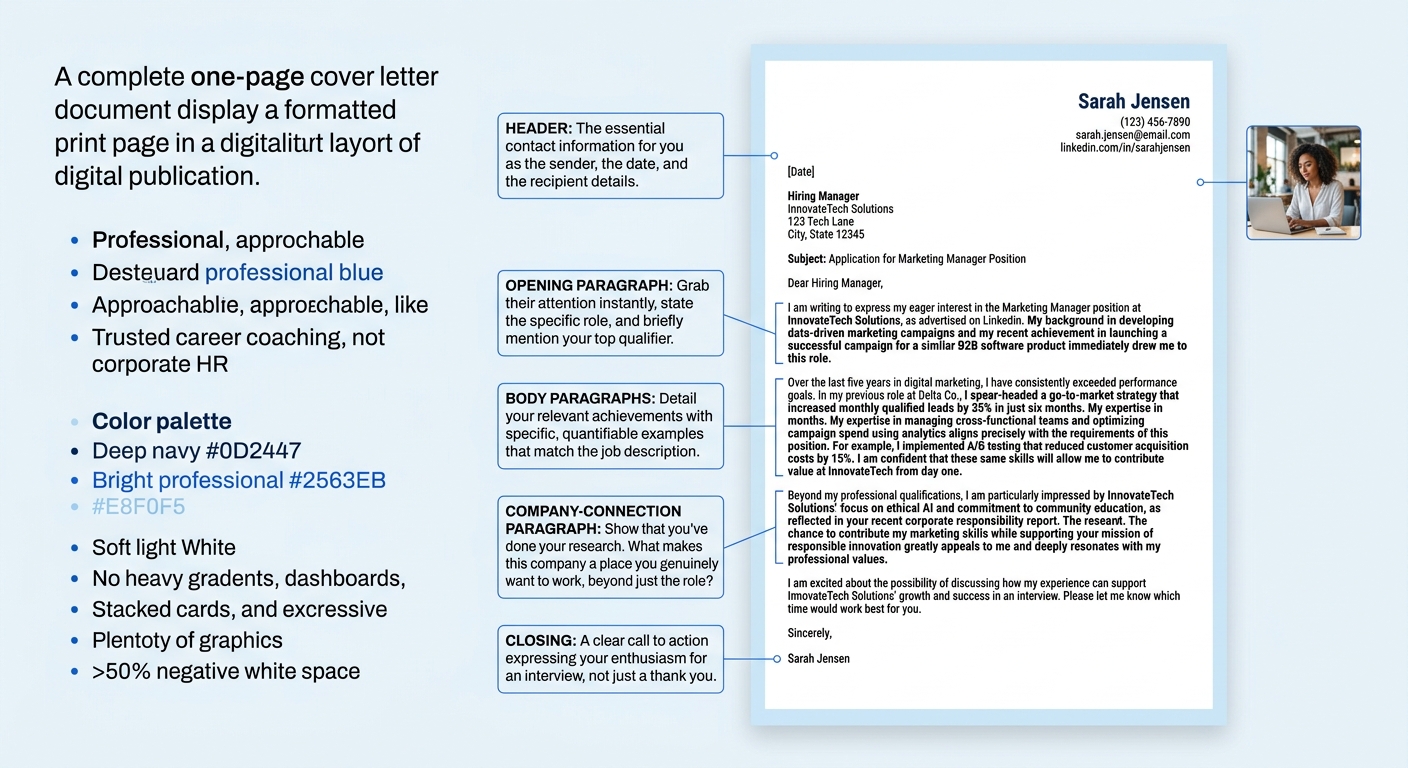
The Complete Template, Assembled
Here’s the full cover letter sample letter with placeholder text you can replace section by section. The entire letter runs 280 words, well within the 250–400 word target.
[Your Name] [Phone] | [Email] | [City, State] [LinkedIn URL]
[Date]
[Hiring Manager Name], [Title] [Company Name] [Company Address]
Dear [Hiring Manager Name],
I’m writing to apply for the [Job Title] position at [Company Name], posted on [Source]. With [X years] of experience in [relevant field], I bring a track record of [strongest measurable achievement, e.g., “increasing quarterly revenue by 22% through targeted outbound campaigns”].
Your posting highlights [Requirement 1] as a core responsibility. At [Previous Company], I [specific action] that resulted in [measurable outcome]. You also emphasize [Requirement 2]; in my role at [Company/Organization], I [specific action], which led to [measurable outcome].
I’m drawn to [Company Name]’s [specific initiative, product, or value]. My experience in [relevant area] aligns with the direction your team is taking, particularly [specific detail from your research].
I’d welcome the chance to discuss how my background in [key skill area] can contribute to [Company Name]’s goals. I’m available at [phone/email] and look forward to hearing from you. Thank you for your consideration.
Sincerely, [Your Name]
For additional cover letter sample letter formats organized by industry, we’ve compiled templates that match different job types with annotated breakdowns.
When Things Go Wrong
Three problems come up repeatedly when candidates follow a template.
Problem 1: The letter sounds robotic after you fill in the blanks. Read your draft out loud. If any sentence sounds like something you’d never say in a real conversation, rewrite it in plainer language. AI drafting tools make this worse because they default to formal, hedging phrasing. Edit aggressively until the letter sounds like you.
Problem 2: You can’t find measurable achievements for your field. Quantification doesn’t require dollar figures. Hours saved, error rates reduced, customers served per shift, training completion rates, satisfaction scores from surveys all count. If you managed a team, name the size. If you handled a caseload, name the volume.
Problem 3: Your letter exceeds one page. Cut the company-connection paragraph to two sentences. Remove any sentence that restates a resume bullet point without adding context. If you meet 60–70% of the core requirements listed in the posting, you have enough to write a strong letter without padding.
Where to Go From Here
Once your cover letter is drafted, send it to one trusted person and ask them a single question: “After reading this, can you tell me what job I’m applying for and why I’m qualified?” If they can’t answer both parts clearly, revise the opening and body paragraphs until the letter passes that test.
Build a version-controlled folder where you save each customized letter alongside the job posting it was written for. After ten applications, you’ll have a library of cover letter sample letter variations that cover most of the requirements you encounter. Adapting a letter from your library takes 15 minutes instead of 45, and the quality stays high because each one started from a proven structure.
If you’re also reworking your resume, the red flag audit for hiring blockers covers the most common mistakes that make recruiters skip applications before they ever open the cover letter.