
 4.9
4.9 4.5
4.5Interviewers form candidate impressions before hard questions begin, making the opening “Tell me about yourself” response critical for job seekers who rely on credential recitation, according to business storytelling strategist Esther K. Choy in Forbes guidance published April 25.
Two interviewer groups decide on candidates early in the session, Choy reported: experienced interviewers confident in pattern recognition and fatigued interviewers who have already conducted four or more interviews that day. Candidates who answer the common icebreaker question with education history, job titles, and geography miss an opportunity to differentiate themselves from competing applicants whose resumes contain similar credentials, according to the analysis.
Interview Response Research
The Forbes piece outlined a structured storytelling approach that replaces biographical data with character-trait demonstrations. Choy provided a comparison between two candidate responses to illustrate the contrast. Candidate A recited university name, employer, and client roster. Candidate B opened with a lakefront scene—a family preparing to jump into Lake Michigan—then described recording the moment, approaching the mother to share the video, and connecting that initiative to workplace qualities.
“That’s the kind of marketer and collaborator I am,” Candidate B stated in the example, according to the article. “I keep my eyes open to opportunities. And when I spot opportunities, I don’t wait to be asked to do something.”
The narrative approach addresses interviewer fatigue by replacing expected data with unexpected scenarios, Choy explained. Interviewers already possess resume content and LinkedIn profiles before the session begins, making credential repetition redundant rather than informative.
The IRS Framework for Interview Stories
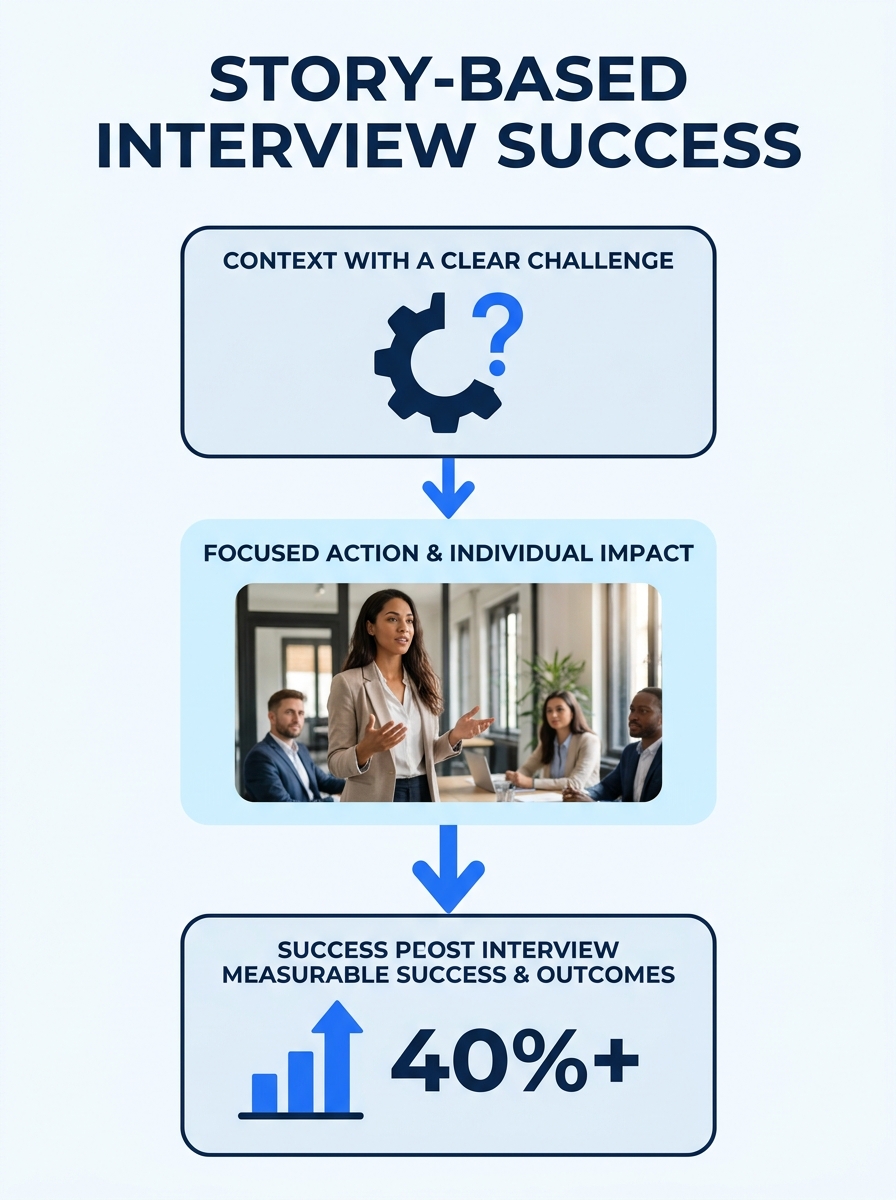
Choy introduced a three-part structure for interview storytelling: Intriguing beginning (10 percent of story duration), Riveting middle (70 percent), and Satisfying end (20 percent). The intriguing beginning requires an unexpected opening—a bold question, striking image, or unusual scenario that captures attention from fatigued or distracted interviewers, according to the framework.
The riveting middle section develops tension through selective detail inclusion, the guidance stated. Candidate B’s lakefront story omitted sunshine descriptions and child ages because those elements did not serve narrative tension. The satisfying end returns to the original question while connecting story events to workplace character traits.
Job seekers should identify two to three character qualities they want employers to recognize, then recall experiences from the past year that demonstrated those qualities, Choy advised. The most compelling experience becomes the foundation for the strategic story, according to the methodology.
The approach aligns with broader interview preparation strategies that emphasize narrative structure over chronological recitation. Candidates who master the technique gain advantage over applicants who treat the opening question as a resume summary exercise, the Forbes analysis suggested.
Strategy Implications
Interview preparation now requires story inventory in addition to achievement lists and technical skill rehearsal. Job seekers benefit from documenting recent experiences—within the past 12 months—that showcase specific character traits relevant to target roles. Those experiences become source material for brief strategic narratives that fit the 60-to-90-second window most interviewers allocate to opening questions.
The timing reality matters: candidates cannot predict whether their interviewer will be fresh and engaged or mentally depleted from back-to-back sessions. Storytelling acts as a pattern interrupt that works across both scenarios, capturing attention from experienced evaluators while re-energizing fatigued interviewers. The method also provides early evidence of communication skill and self-awareness—two qualities that separate strong candidates from credential-identical competitors.
Practicing the IRS framework before interviews reduces reliance on improvisation during high-pressure moments. Candidates who prepare two to three character-trait stories gain flexibility to match narrative choice to interviewer cues, company culture signals, or specific role requirements mentioned in pre-interview materials.