


 4.9
4.9 4.5
4.5Job description analysis works backward from what the employer wrote to what your resume should say. Treat each posting as a weighted checklist, match your experience against its priorities, then rewrite your bullets using the employer’s own phrasing. The entire resume tailoring process takes under 60 minutes once you know the sequence.
TL;DR: Reverse-engineering a job description means extracting its hidden scoring rubric, sorting requirements by priority tier, mirroring exact language in your bullets, and running a keyword match before submitting. Tailored resumes increase interview callbacks by 30–40%, and the process gets faster with each application after the first.
The six rules below aren’t theoretical. They follow the order you should actually work in, from the moment you find a posting to the moment you submit. Skip a step and the resume still reads as generic. Do them in the wrong order and you’ll waste 30 minutes rewriting sections you’ll delete anyway. The sequence matters as much as the content.
Read the posting three times and highlight it in three colors
The first read-through should happen before you open your resume file. According to Indeed’s career advice team, you should “read the description and write down or highlight any significant keywords related to skills,” looking for “words or phrases that seem unique to the job or reoccur throughout the posting.”
Three colors, three tiers. Use red for hard requirements (years of experience, certifications, named tools). Use yellow for preferred qualifications and soft skills. Use green for cultural and team signals buried in the “about us” and “you’ll love this role if” sections. A typical posting contains 12–18 distinct qualifications spread across these tiers, and your resume needs to address as many red-tier items as possible before touching yellow or green.
Why three reads? The first read gives you the surface keywords. The second reveals structural patterns, like when a skill mentioned in the requirements section also shows up in the responsibilities section (that’s a double-weighted priority). The third read catches the implicit asks. If a posting says “fast-paced environment” and “ambiguity,” they’re screening for someone who doesn’t need hand-holding. Your resume needs to reflect autonomous decision-making, not “worked under supervision.”
This step takes 10–15 minutes. Resist the urge to start editing your resume during this phase. Your only job right now is to build the scoring rubric the hiring manager already has in their head.
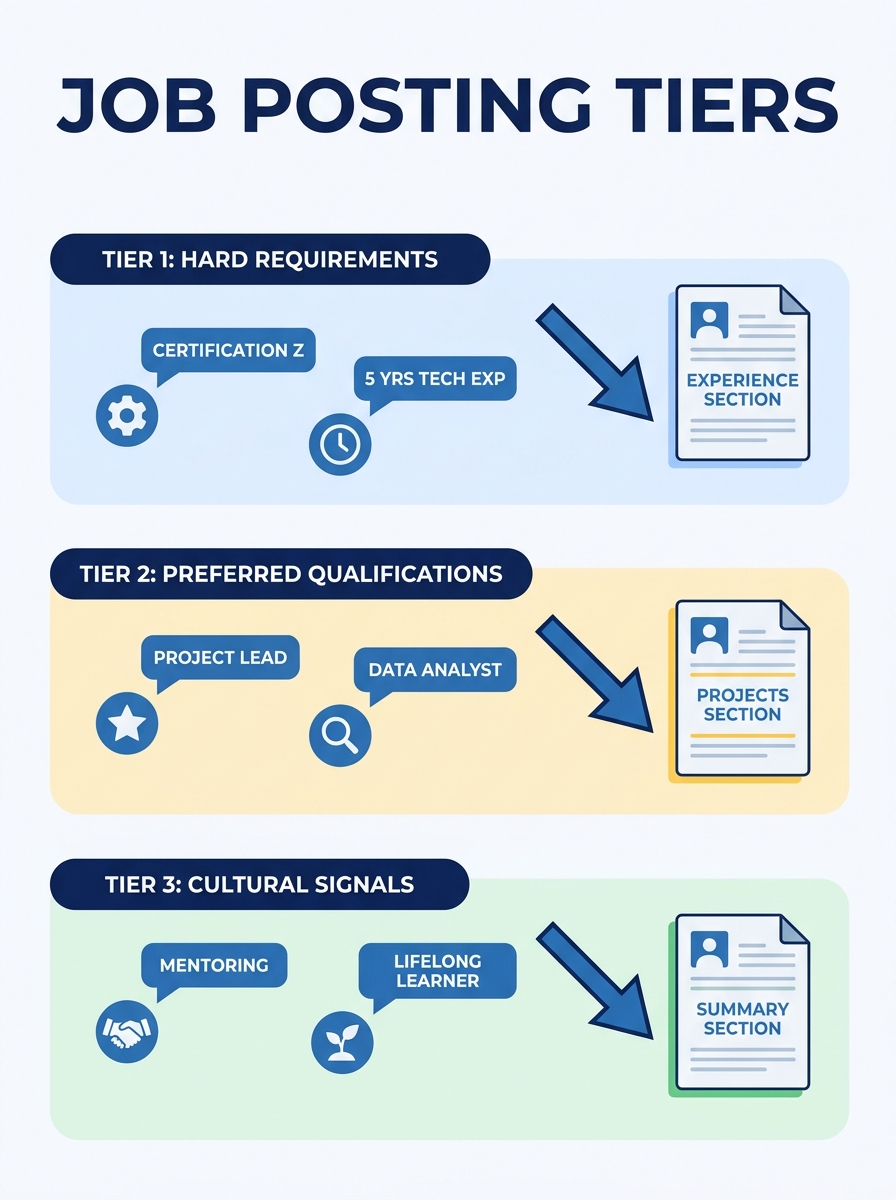
Sort requirements into weighted priorities, not a flat list
A flat keyword list treats every requirement as equally important. That’s wrong. The posting’s structure tells you exactly how the employer ranks their needs, and your keyword targeting should follow that same hierarchy.
Requirements listed first carry more weight. Skills mentioned multiple times across different sections carry more weight. Qualifications in the job title itself (like “Senior Data Analyst” or “Bilingual Customer Success Manager”) carry the most weight of all. ResumeAdapter’s 2026 ATS optimization guide defines resume optimization as “the process of formatting and structuring a resume so Applicant Tracking Systems can correctly parse, score, and rank it against a job description,” and that ranking is directly influenced by how prominently and frequently keywords appear in your document.
Here’s a practical way to sort: after your three-read highlighting session, list every red-tier requirement in a column. Next to each one, tally how many times it appears in the posting. A skill mentioned 3 times is fundamentally different from one mentioned once. Your resume should dedicate proportional space to each. If “project management” appears in the title, the summary, and two bullet-point responsibilities, it deserves a spot in your professional summary, your skills section, and at least two experience bullets. A skill mentioned once in a “nice to have” line gets one mention in your skills section and nothing more.
Tip: Career experts recommend maintaining 5–6 versions of a base resume for a serious job search, each aligned to a different role type. You’re not building from scratch every time. You’re adjusting the priority weighting for each application.
Steal the employer’s exact language for your bullet points
This is where most people get the resume customization wrong. They read “manage cross-functional stakeholder relationships” in the posting and write “worked with different teams” on their resume. The ATS scores exact and near-exact matches far higher than paraphrases, and hiring managers spending 6–7 seconds on initial review will pattern-match against the language they wrote.
If the posting says “develop and implement sales strategies,” your bullet should read “Developed and implemented regional sales strategies that increased pipeline revenue by 22%.” If it says “Python,” don’t write “programming languages.” If it says “SDLC processes,” use that exact phrase. As one Indeed hiring guide notes, you should “highlight the skills, qualifications, and experience that the employer emphasizes” and pay attention to specific keywords including “project management,” “customer service,” or any other terms the posting actually uses.
The ATS scores exact and near-exact keyword matches far higher than paraphrases, and hiring managers will pattern-match against the language they wrote.
This doesn’t mean lying. It means translating your real experience into the employer’s dialect. If you ran quarterly business reviews but the posting calls them “strategic planning sessions,” and the work was genuinely the same, use their term. If you have no experience with a required skill, don’t fake it. Leave it off and address the gap in your cover letter instead. (If you need a system for writing those cover letters efficiently, the cover letter personalization playbook walks through a reusable framework.)
One warning about verb choice: the posting’s verbs reveal what level of ownership they expect. “Lead” and “drive” signal management-level accountability. “Support” and “assist” signal individual-contributor roles. Match the verb tier to the role level, and make sure your action verbs carry the right energy for the seniority you’re targeting.
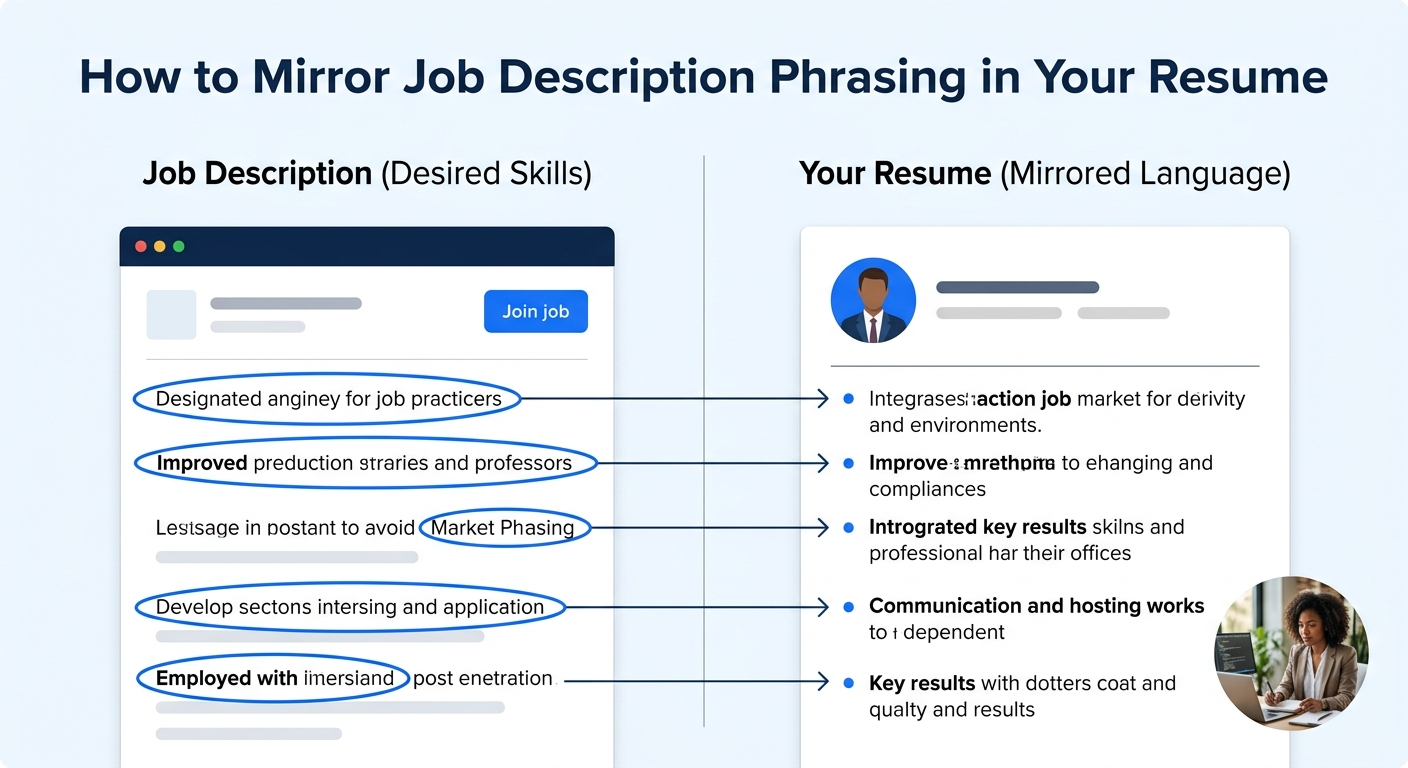
Rewrite your professional summary last, not first
This rule contradicts most resume advice, which says to start at the top. But your summary should function as a thesis statement for everything below it, and you can’t write a thesis until you know what arguments (bullets) you’re making.
After you’ve rewritten your experience bullets to mirror the posting’s language, your skills section to reflect its priority weighting, and your achievements to quantify impact with real metrics, you’ll know exactly which 3–4 themes dominate your tailored resume. Your summary then distills those themes into 2–3 sentences.
A strong tailored summary names the job’s top priority, states your relevant credential, and previews a measurable result. For a posting that leads with “5+ years of B2B SaaS sales experience,” your summary might open with: “B2B SaaS sales leader with 7 years driving enterprise pipeline growth, including a $4.2M ARR portfolio built through consultative selling and cross-functional account strategy.” Every noun in that sentence came from the posting. Every number came from your actual track record.
Writing the summary last typically saves 10–15 minutes per application because you’re not rewriting it three times as you discover what the resume needs to emphasize.
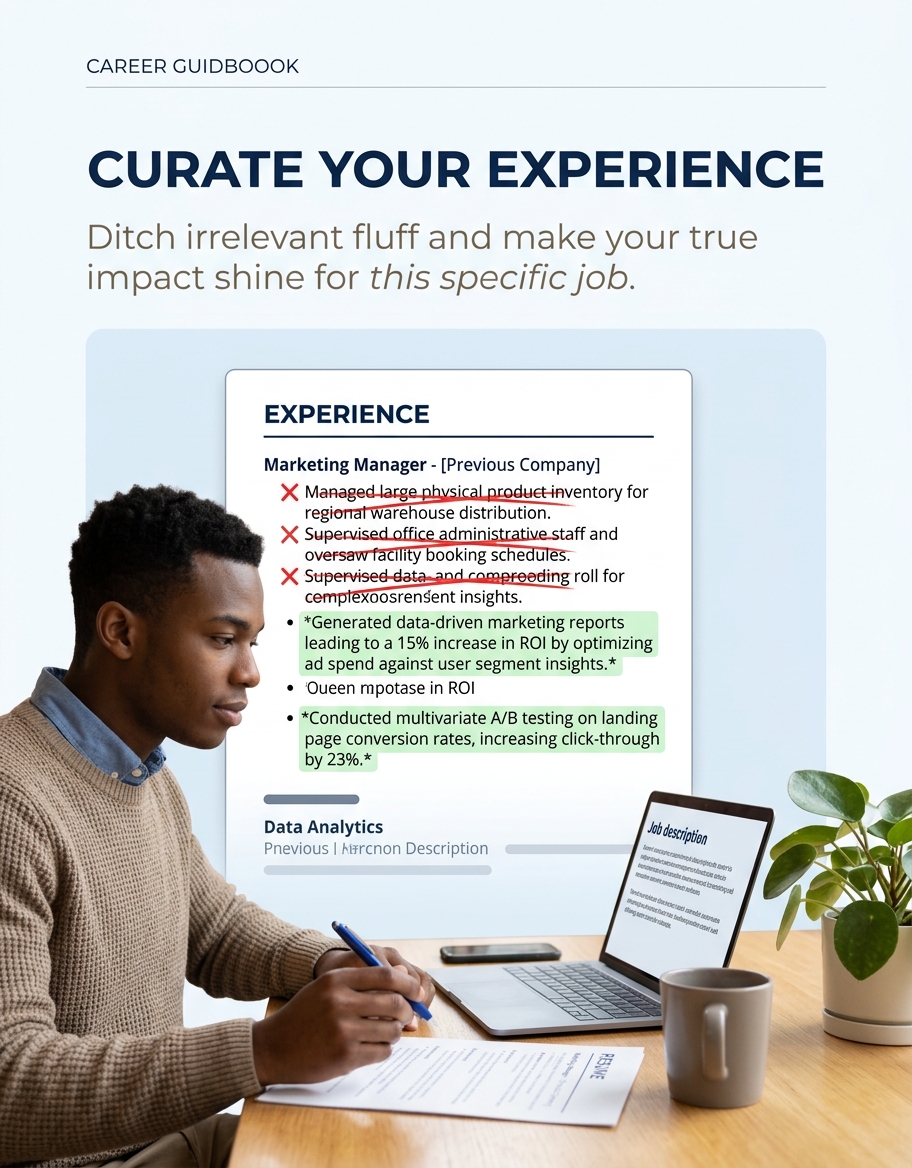
Cut anything that doesn’t answer a requirement in the posting
The hardest part of resume customization is deletion. Your 2019 volunteer coordination role, your bartending experience from college, your Advanced Excel certification when the posting asks for SQL proficiency — if it doesn’t address a red or yellow-tier requirement you identified in step one, it should go.
Candidates who tailor their resumes and LinkedIn profiles are 71% more likely to land interviews compared to those submitting generic applications. That lift comes specifically from relevance density: the ratio of relevant content to total content on the page. Every irrelevant bullet dilutes your match score in the ATS and wastes seconds of the recruiter’s attention span.
This is particularly challenging for career changers or people with 15+ years of experience. If that’s you, keep your resume to two pages maximum and make sure at least 80% of your bullets connect to a specific requirement in the posting. The remaining 20% can showcase transferable skills or unusual achievements that round out the picture. If you want to verify your resume format passes modern ATS screening, run a format check before you worry about content cuts.
Run a keyword match score before you hit submit
Your application strategy should include a final quality gate: a keyword comparison between your finished resume and the original posting. Jobscan’s resume scanner “compares your resume to the job description and provides a match score, along with recommendations to improve formatting and keyword optimization.” Resume Worded offers a similar free scan that identifies which specific keywords your resume is missing.
Target a match score of 70% or higher. Below 60%, most ATS platforms will rank you too low for a human reviewer to see your application. Between 60% and 70%, you’ll land in the middle of the pile. Above 75%, you’re in the top tier for keyword alignment.
This step takes 5 minutes. Paste your resume text into the scanner, paste the job description, and read the gap report. If you’re missing a critical keyword you genuinely have experience with, add it. If the scanner flags a keyword you don’t have experience with, leave it out. Integrity matters more than a perfect score, and interviewers will test you on anything you claim.
Warning: AI-powered resume tailoring tools can paste in the job description and rewrite your resume automatically, but [auditing those AI suggestions for authenticity](/blog/resume-builder-ai-audit-authenticity) is critical. A 2026 ResumeAdapter analysis found that ATS optimization covers three layers — formatting, keyword matching, and content alignment — and automated tools frequently nail the first two while producing generic, unverifiable content for the third.
When These Rules Contradict Each Other
The mirroring rule (use the employer’s exact language) sometimes conflicts with the cutting rule (remove anything irrelevant). You might have extensive experience with a skill the posting mentions once in passing. Do you mirror the language and expand on that experience, or do you cut it because it’s low-priority? The answer depends on your overall match density. If you already address 80%+ of the red-tier requirements, expanding on a yellow-tier skill adds texture without diluting focus. If you’re below 70% on core requirements, every bullet needs to pull weight on the highest-priority items.
The “summary last” rule breaks down when you’re applying to a role where your fit is immediately obvious. If you’ve held the exact same title at a direct competitor, your summary writes itself before anything else, and you should start there.
And the three-color highlighting system loses value for postings shorter than 150 words, which are common for contract and freelance roles. Short postings require you to do more inference work, reading the company’s website, other recent postings from the same team, and LinkedIn profiles of people currently in the role. The rubric exists. It’s distributed across other sources rather than spelled out in one document.
The one rule that never bends: your resume must speak the employer’s language, not yours. Your internal vocabulary for what you do each day is meaningless if it doesn’t match the terms the hiring team typed into their ATS filters. Job description analysis is, at its core, a translation exercise. The source language is always the posting.