
 4.9
4.9 4.5
4.5Indeed.com’s template library, MIT’s career advising guide, and the University of Michigan Career Center all recommend the same four-paragraph cover letter structure. This tutorial walks you through building one from scratch in under 30 minutes, producing a finished cover letter sample example you can copy, customize, and submit today.
TL;DR: Every effective cover letter follows four paragraphs: opener stating the role and your fit, two body paragraphs connecting achievements to the job description, and a closing paragraph with a direct ask. The template below gives you the exact skeleton with fill-in prompts, formatted for ATS compatibility.
Before You Start
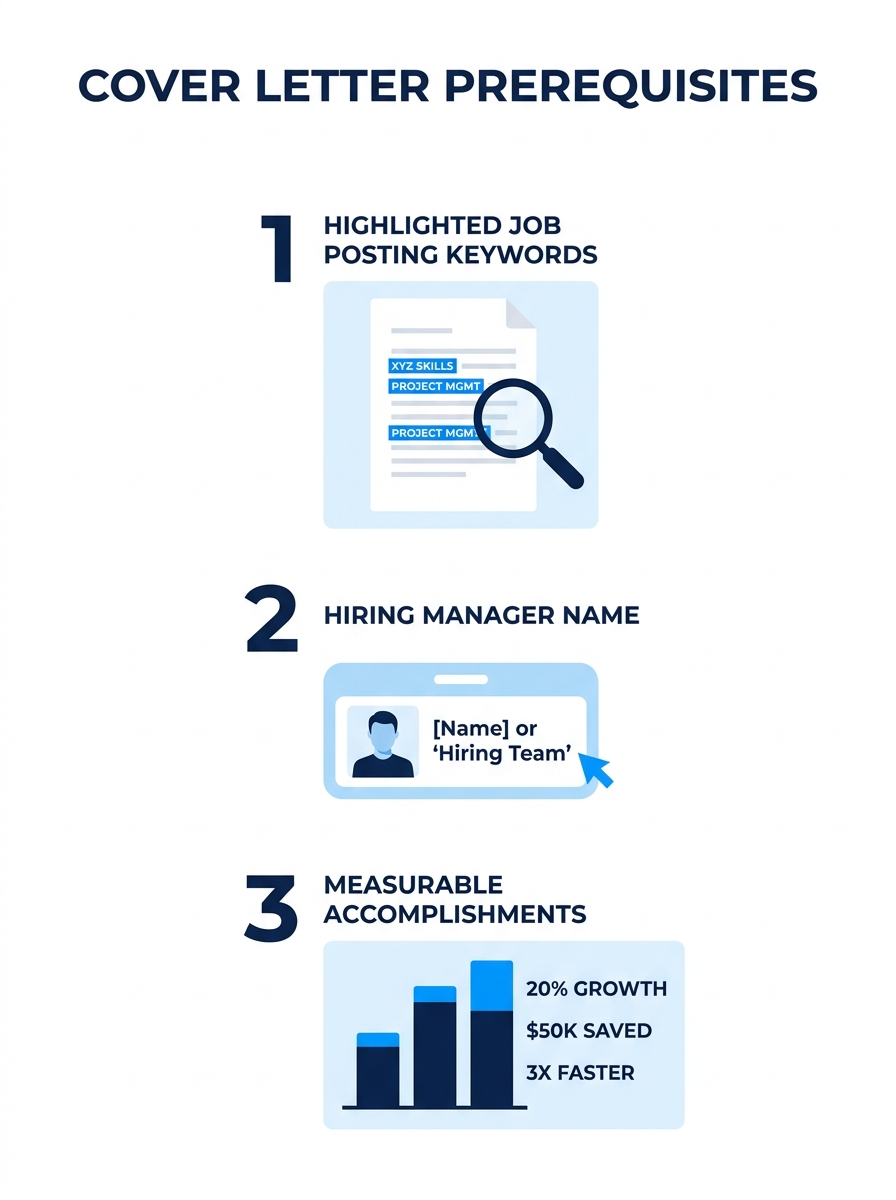
You’ll need three things before writing a single word. Skipping any of them leads to a generic letter that reads like a form submission.
The job posting, printed or open in a separate tab. You’re going to pull specific phrases from it. MIT’s career advising team instructs applicants to include the role’s reference number or code if one exists, so that “human resources is able to accurately track your application.” Highlight 4-6 skill keywords and the job title exactly as written.
The name of the hiring manager. Address your letter to a specific person whenever possible. If the posting doesn’t list one, check the company’s LinkedIn page or team directory. When you can’t find a name, “Dear Hiring Manager” works, according to MIT’s cover letter guidance.
Two or three measurable accomplishments from your work history. These are the backbone of your body paragraphs. Think revenue figures, percentage improvements, project counts, team sizes. A letter without specific numbers reads the same as every other applicant’s.
Tip: Time budget: 10 minutes on research and prep, 15 minutes writing, 5 minutes formatting and proofreading. Thirty minutes total for a strong first draft.
Step 1: Build the Header Block
Goal: Create a professional contact section that ATS software can parse without errors.
Place your full name, phone number, email address, city and state (full street address is optional), and LinkedIn URL at the top of the document. Below your contact info, add the date and the employer’s information: hiring manager’s name, their title, company name, and company address.
The University of Michigan Career Center specifies that cover letter layout should be “left justified, beginning no more than 2 inches from the top.” Use a standard font like Arial, Calibri, or Times New Roman at 10.5-12 point size. Set margins between 0.5 and 1 inch on all sides.
Verification: Your header should contain exactly 7 elements: your name, phone, email, location, date, employer contact info, and salutation line. If you’re missing any, add it before moving on. Many applicants forget the date, which signals carelessness to a hiring manager scanning 200+ letters for a single role.
Here’s what the header looks like filled in:
Jane Rodriguez (555) 412-8830 | [email protected] | Austin, TX | linkedin.com/in/janerodriguez
July 29, 2026
Michael Chen, Director of Marketing Apex Digital Solutions 4200 Commerce Drive, Suite 310 Austin, TX 78701
Dear Mr. Chen,
Step 2: Write the Opening Paragraph (3-4 Sentences)
Goal: Tell the reader which job you’re applying for, how you found it, and one sentence about why you’re a strong fit.
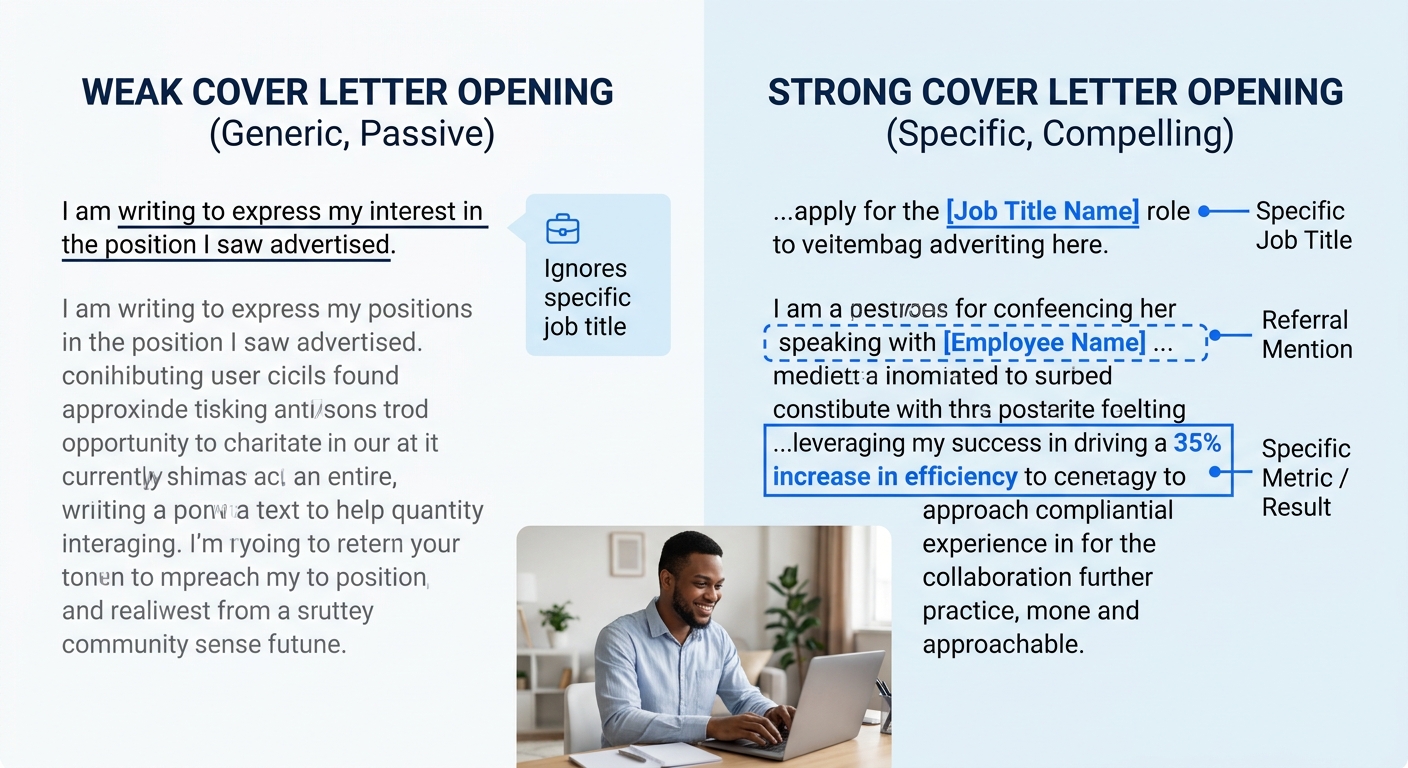
MIT’s career advising department puts it directly: “State clearly in your opening sentence the purpose for your letter and a brief professional introduction.” Don’t bury the job title in sentence three. Lead with it.
Your opening paragraph should run 40-60 words. Name the exact position, mention where you saw the listing, and deliver one claim about your relevant experience. If someone referred you, say so here. Lia Economos, Lead Recruiter at Replicate, has noted that roles often receive thousands of applications and that reaching out directly to hiring managers after applying can prompt interview prioritization. A referral name in your opener gives you that same advantage on paper.
Verification: Read your opening paragraph aloud. Can a stranger identify the job title, your profession, and one reason you belong in the role? If any of those three are missing, revise.
Filled-in example:
I’m writing to apply for the Marketing Manager position listed on your careers page (Ref: MKT-2026-041). With 6 years of experience leading B2B content strategy at SaaS companies, including a 34% increase in qualified leads at my current role, I’m confident I can contribute to Apex Digital Solutions’ growth targets.
Step 3: Build the Body Paragraphs (2 Paragraphs, 4-6 Sentences Each)
Goal: Connect your specific achievements to the employer’s stated needs using keywords from the job posting.
The University of Michigan Career Center advises applicants to “describe your qualifications for the type of position you seek using specific examples from academic, work, volunteer, and/or co-curricular experiences.” This is where those 2-3 measurable accomplishments you prepped come in.
Body Paragraph 1 should match your strongest achievement to the job posting’s top requirement. If the posting emphasizes “cross-functional collaboration,” open this paragraph with a sentence about leading a cross-functional project. Include the metric: team size, timeline, result. For email cover letters specifically, the current best practice is keeping the entire letter to 150-250 words, so you may compress these two body paragraphs into 2-3 concise achievement bullets instead of full prose. Either format works, but don’t mix them in the same letter.
Body Paragraph 2 addresses a second requirement from the posting and demonstrates a different skill set. If paragraph one was about results, make paragraph two about process or leadership. Vary the evidence so the hiring manager sees range.
Verification: Underline every keyword in your body paragraphs. Cross-reference with the highlighted phrases from the job posting. You should match at least 4-6 keywords. If your body paragraphs could be sent to a different company without changes, they’re too generic. The whole point of a cover letter sample example is that it gives you structure while forcing specific details into every section.
If you’ve already worked through our cover letter templates for different scenarios, you’ll recognize this two-paragraph body structure as the standard across all 7 variations. The skeleton stays the same; the achievements swap out.
Filled-in example:
At TechForward Inc., I managed a 5-person content team that produced 120+ assets per quarter across blog, email, and paid channels. When leadership set a goal of increasing marketing-qualified leads by 20% year-over-year, we restructured our content calendar around bottom-funnel keywords and launched a gated resource library. Within 8 months, MQLs rose 34%, and our cost per lead dropped from $47 to $29.
I also led the integration of our CRM and marketing automation platforms during a company-wide tech stack migration, coordinating with engineering, sales, and customer success teams over a 14-week timeline. The project finished 2 weeks ahead of schedule and reduced manual data entry by 60%, freeing the sales team to focus on pipeline conversations.
Step 4: Write the Closing Paragraph (2-3 Sentences)
Goal: Restate your interest, ask for the interview, and thank the reader.
The UCF career center’s cover letter guide instructs applicants to “restate your interest in this position and how your unique qualifications fit” and then “request an interview or tell the reader that you will contact him/her soon.” Do both in 2-3 sentences. Don’t introduce new accomplishments here. Close the loop.
Your closing should include a specific call to action. “I’d welcome the opportunity to discuss how my experience with B2B content strategy aligns with your Q3 goals” is stronger than “I look forward to hearing from you.” The first version gives the reader a reason to pick up the phone.
Verification: Does your closing paragraph contain (a) a restatement of interest, (b) a specific ask for an interview or conversation, and (c) a thank-you? If any piece is missing, add it. Then sign off with “Sincerely” or “Best regards” followed by your full name.
Filled-in example:
I’m excited about the opportunity to bring my content strategy and cross-functional leadership experience to Apex Digital Solutions. I’d welcome a conversation about how my work at TechForward could translate to your team’s 2026 growth objectives. Thank you for your time and consideration.
Sincerely, Jane Rodriguez
A cover letter without specific numbers reads the same as every other applicant’s. The structure is the skeleton; your metrics are the muscle.
Step 5: Format and Submit
Goal: Ensure your finished letter passes ATS filters and displays correctly on any device.
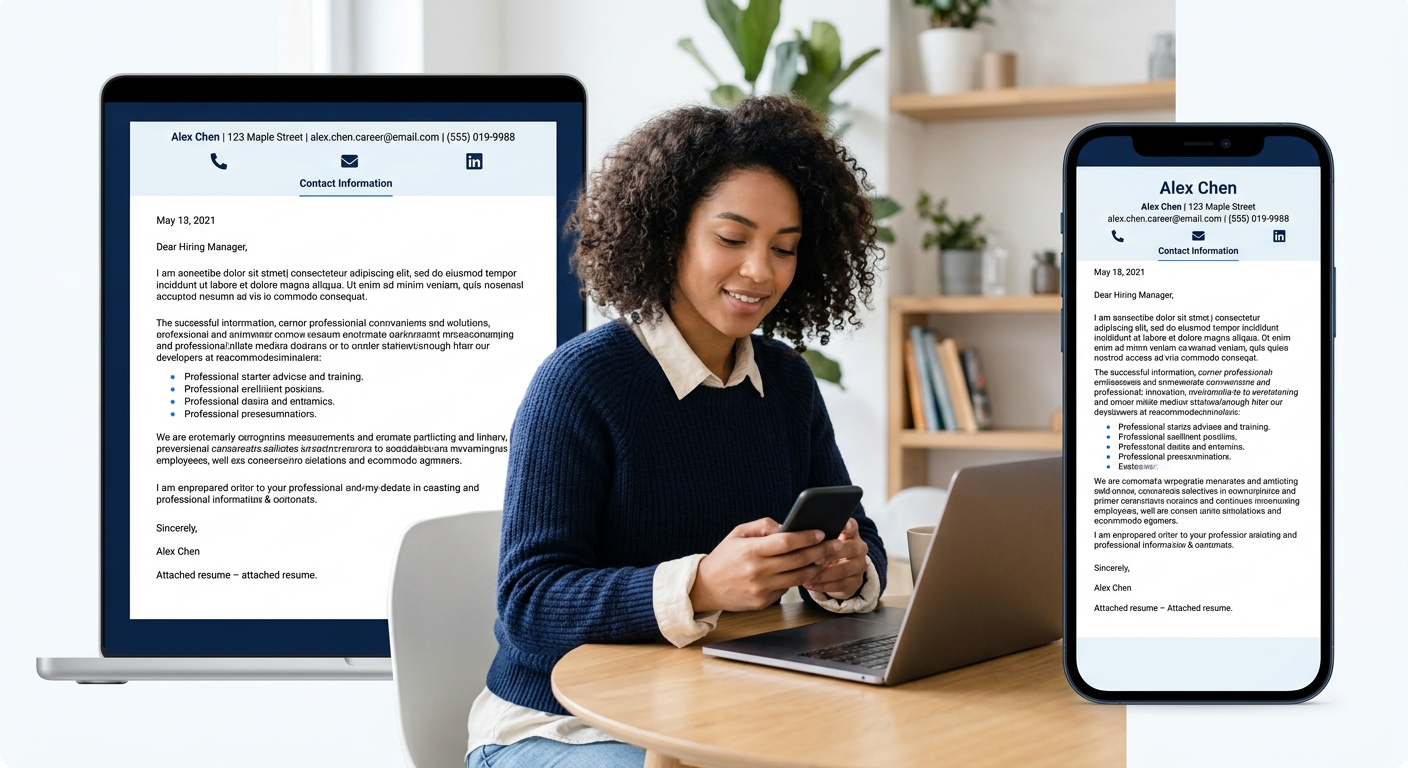
Indeed’s formatting guide confirms that many companies use applicant tracking systems to filter applications, and that “a simple, clean format with standard headings helps ensure your letter is parsed correctly and reaches a human.” Follow these formatting rules:
- Length: One page maximum. Indeed recommends keeping your cover letter to one page. MIT’s guide targets 250-400 words for the full document.
- File type: Save as PDF unless the posting specifically requests .docx. PDF preserves your formatting across systems. If you need a .docx starting point, Microsoft Word’s free cover letter templates offer dozens of ATS-compatible layouts.
- File name: FirstName-LastName-CoverLetter.pdf. Recruiters download hundreds of files; generic names get lost.
- Email submission: When the application asks you to email directly, paste the letter body into the email itself and attach the PDF as a backup. Use a subject line that names the role and one key strength, such as “Marketing Manager Application, 6 Years B2B Content Strategy, Jane Rodriguez.”
- Spacing: Single-spaced within paragraphs, one blank line between paragraphs. No extra spacing after the header.
Verification: Open your PDF on your phone. If the text overflows, wraps oddly, or extends to a second page, adjust font size (minimum 10.5 pt) or margins. Send a test email to yourself and confirm the formatting holds.
If you want to see how the same structure flexes across different job types, we’ve published cover letter examples organized by scenario and a complete sample letter walkthrough with line-by-line annotations.
When Formatting Breaks
Three problems show up repeatedly, and all three are fixable in under 5 minutes.
Problem 1: The letter spills onto a second page. This usually happens because of oversized margins or a header that takes up too much vertical space. Reduce top and bottom margins to 0.5 inches. Cut your body paragraphs to 4 sentences each. If you’re still over, remove your mailing address from the header (city and state are sufficient for most applications).
Problem 2: ATS strips your formatting and the letter reads as a jumbled wall of text. Avoid tables, text boxes, columns, and headers/footers in your document. ATS software parses top-to-bottom, left-to-right. Anything positioned outside that flow gets scrambled or dropped entirely. Stick to plain paragraph formatting. If you’ve been optimizing your resume for ATS, apply the same principles here.
Problem 3: You don’t know what to write because the job posting is vague. When a posting lists broad requirements like “strong communication skills” or “team player,” look at the company’s recent press releases, blog posts, or annual report for specific projects and initiatives. Reference those directly in your body paragraphs. This demonstrates research effort and creates the specificity that a vague posting lacks.
Warning: Don’t rely on AI tools to write the entire letter for you. Experts advise that candidates must personally revise AI-generated content to reflect their true voice and specific metrics. Hiring managers can spot templated language, and a letter that sounds like everyone else’s defeats the purpose.
Where to Go From Here
The four-paragraph structure you just built works for any industry, any experience level, and any submission format. Once you’ve written your first version, the second letter takes half the time because the skeleton stays constant. Only the achievements, keywords, and company details change.
Your next move is to build 3-4 variations of the body paragraphs, each emphasizing a different skill cluster from your background. When a new posting goes live, you select the variation that matches the job’s top 2 requirements, swap in the company name and role title, and submit within 24 hours. That speed matters when roles attract thousands of applicants and recruiters begin screening within the first 48 hours of posting.
If you’re also reworking your resume alongside these letters, our guide on how career changers can update their resume language pairs well with this template, especially for the body paragraph keywords. And if salary negotiation is already on your radar, the advice from career coaches on anchoring to market rates will help you prepare for what comes after the interview.