


 4.9
4.9 4.5
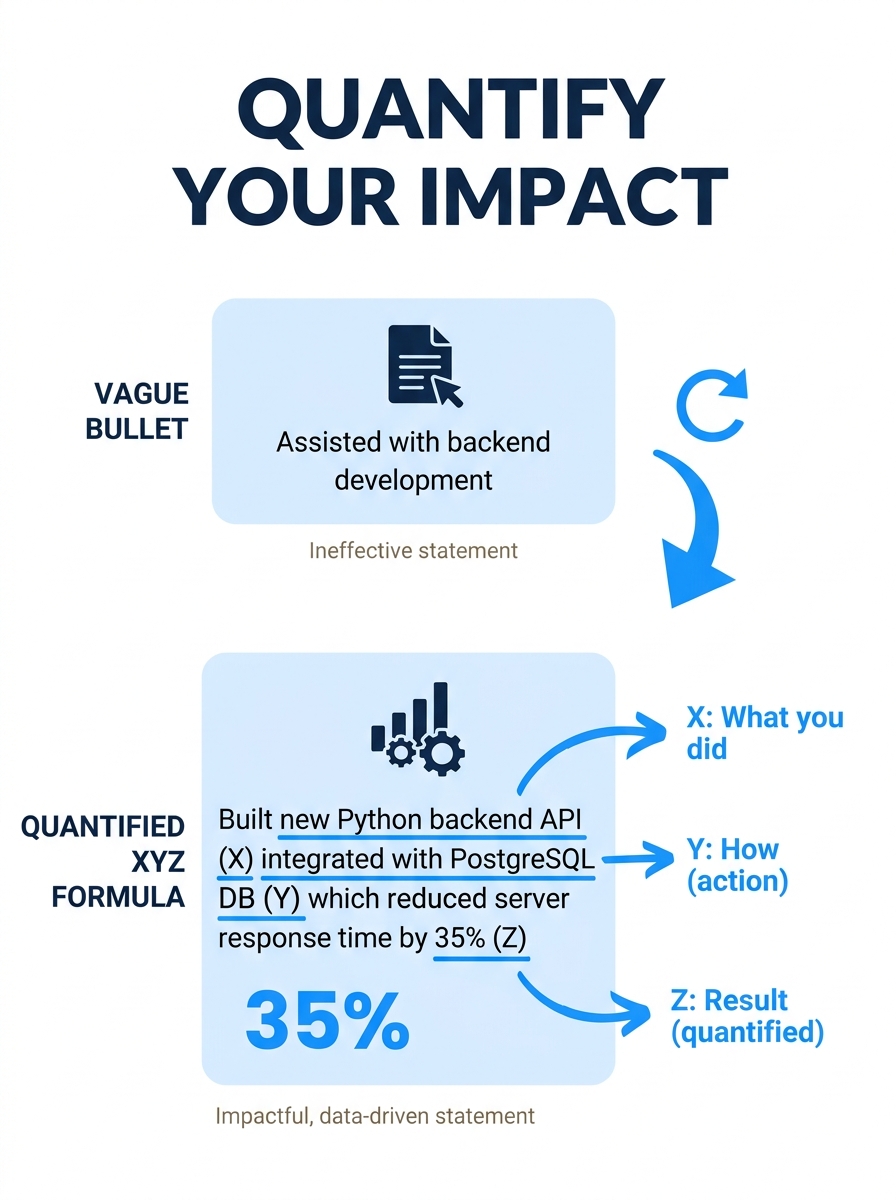
4.5The XYZ formula (Accomplished X, measured by Y, by doing Z) transforms vague entry-level developer resume bullets like “Assisted with backend development” into programmer resume impact statements that recruiters can evaluate in seconds, and it works even when your internship projects didn’t track formal metrics.
TL;DR: Entry-level developers can quantify almost any contribution by counting features shipped, tests written, endpoints built, tickets resolved, or users affected. The XYZ formula gives structure to these numbers. You don’t need access to company dashboards to produce credible, specific bullets.
Why “Assisted With” Kills Your Resume Before Anyone Reads It
Bullets starting with “assisted with” or “helped with” strip away your individual contribution and hand credit to the team. ResumeStudio’s 2026 junior developer resume guide recommends including at least two metrics per role, citing features shipped, tests written, users, performance improvements, or team size as quantifiable metrics junior developers already have access to. When nearly 90% of employers now use AI to filter resumes (a figure confirmed by career coaches tracking ATS adoption), a bullet that says “Assisted with API development” contains zero extractable achievement data for the parser to score.
The problem compounds at the entry level. Senior engineers can point to revenue impact, system uptime percentages, or cost reductions measured in six figures. Junior developers and interns rarely have access to those dashboards. A Workplace Stack Exchange thread on quantifying software engineering contributions captured the frustration directly: contributors noted that most resume advice assumes you measured your achievements, but many developers “didn’t measure many of my achievements” and work at companies that “don’t track any metrics.”
That gap between advice and reality is where most entry-level developer resumes stall. The fix requires knowing which numbers you already generated without realizing it.
The XYZ Formula Applied to Internship Projects
Google’s internal resume guidance popularized the XYZ structure: Accomplished [X] as measured by [Y], by doing [Z]. For entry-level candidates, the formula works with smaller numbers than you’d expect. A bullet reading “Built 12 REST API endpoints serving 3 user-facing features across a 10-week internship” carries more weight than “Assisted with API development for the product team,” even though both describe the same work.
ResumeBuilder.com’s 2026 software engineer resume examples highlight academic projects with quantifiable achievements like “3 million app downloads and a 30% boost in user satisfaction” as proof that even pre-professional work can carry real numbers. You don’t need millions, though. ResumeWorded’s action verb examples show bullets like “Resolved 90% of Level 2 technical support tickets without escalation” and “Introduced design optimizations slashing costs by 85%.” The pattern is consistent: a specific percentage or count, tied to a concrete action, with the scope defined.
The formula works for internship projects resume bullets because it forces you to answer three questions. What did you build or do? How much of it? What changed as a result? Even when the “result” is modest (4 teammates used your internal tool, page load dropped from 3.2 seconds to 1.8 seconds, you wrote 47 unit tests covering 82% of a module), the specificity signals competence that vague participation language never will.
Tip: Count everything during your internship or first role: commits, pull requests merged, endpoints built, bugs closed, tests written, pages or screens delivered, sprint stories completed. These raw counts become your resume metrics later, and they’re impossible to reconstruct after you leave.
Five Categories of Numbers You Already Have
Entry-level developers struggle with quantification when the numbers are sitting in their Git history because nobody taught them which categories to look for. Here are the five that apply to virtually every junior developer role or internship.
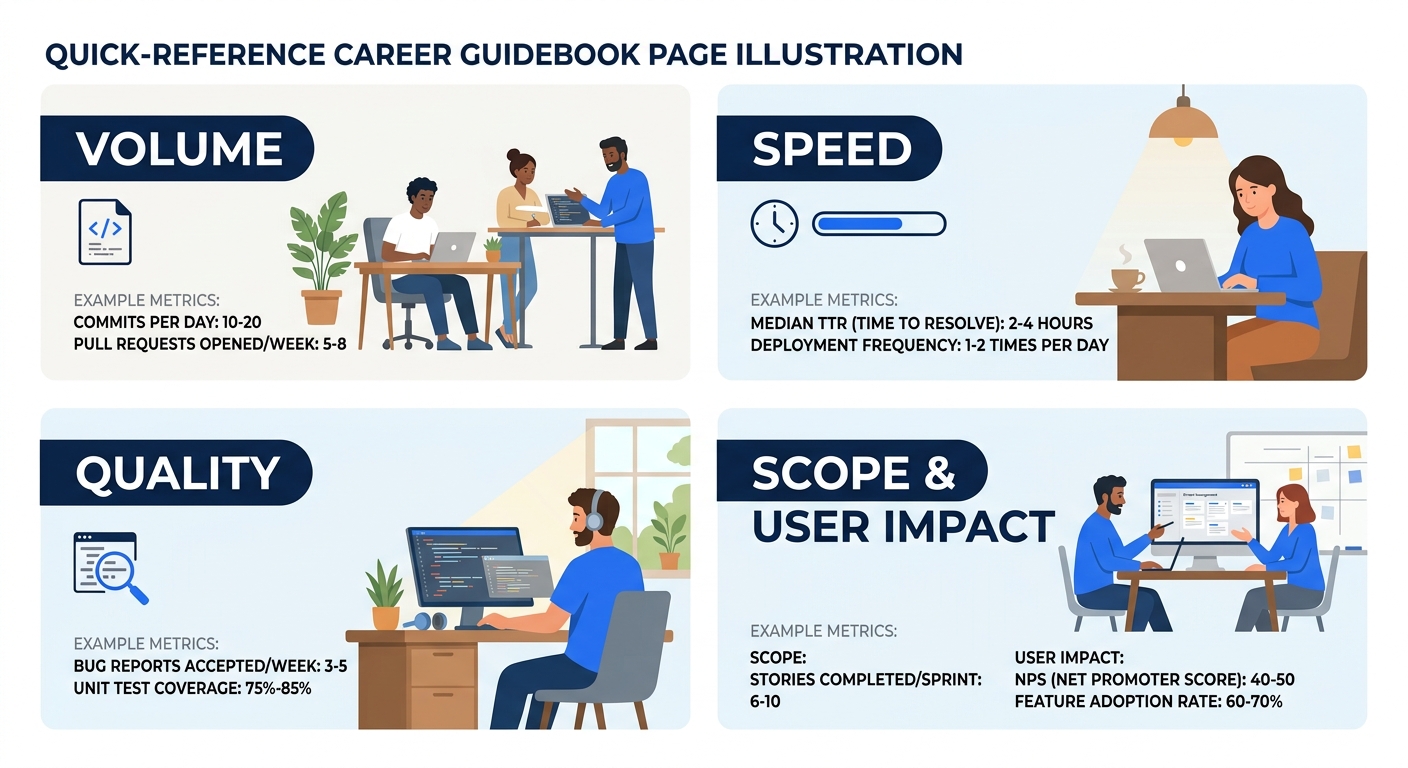
Volume metrics
Count the things you produced. Pull requests merged (e.g., 45 PRs across 12 weeks). Features or screens shipped (8 user-facing features). Test cases written (120 unit tests). Documentation pages created (15 internal wiki pages). These are the easiest numbers to find because Git, Jira, and project boards track them automatically.
Speed and efficiency metrics
Measure how your work affected timelines. Reduced build time from 14 minutes to 6 minutes. Cut average code review turnaround from 48 hours to 18 hours. Delivered the authentication module 2 weeks ahead of the sprint deadline. Even small efficiency gains read well when framed with before-and-after numbers.
Quality metrics
Track error reduction and code health. Wrote tests that caught 23 bugs before production. Reduced lint warnings in the codebase from 340 to 12. Achieved 92% code coverage on a new service module. Quality numbers work especially well for programmer resume impact statements because they show discipline, not output volume.
Scope and scale metrics
Define the boundaries of what you touched. Worked across 3 microservices. Supported an application used by 2,400 internal users. Contributed to a codebase with 150,000 lines of production code. These numbers give the hiring manager a sense of the environment’s complexity without requiring you to claim personal credit for the whole system.
User or stakeholder impact metrics
Connect your work to people. The feature you built was used by 500 beta testers. Your documentation was referenced by 8 onboarding engineers. Your bug fix resolved a ticket that had been open for 6 months and affected 1,200 users. Even indirect impact counts when the number is specific.
Before-and-After Rewrites for Common Junior Developer Bullets
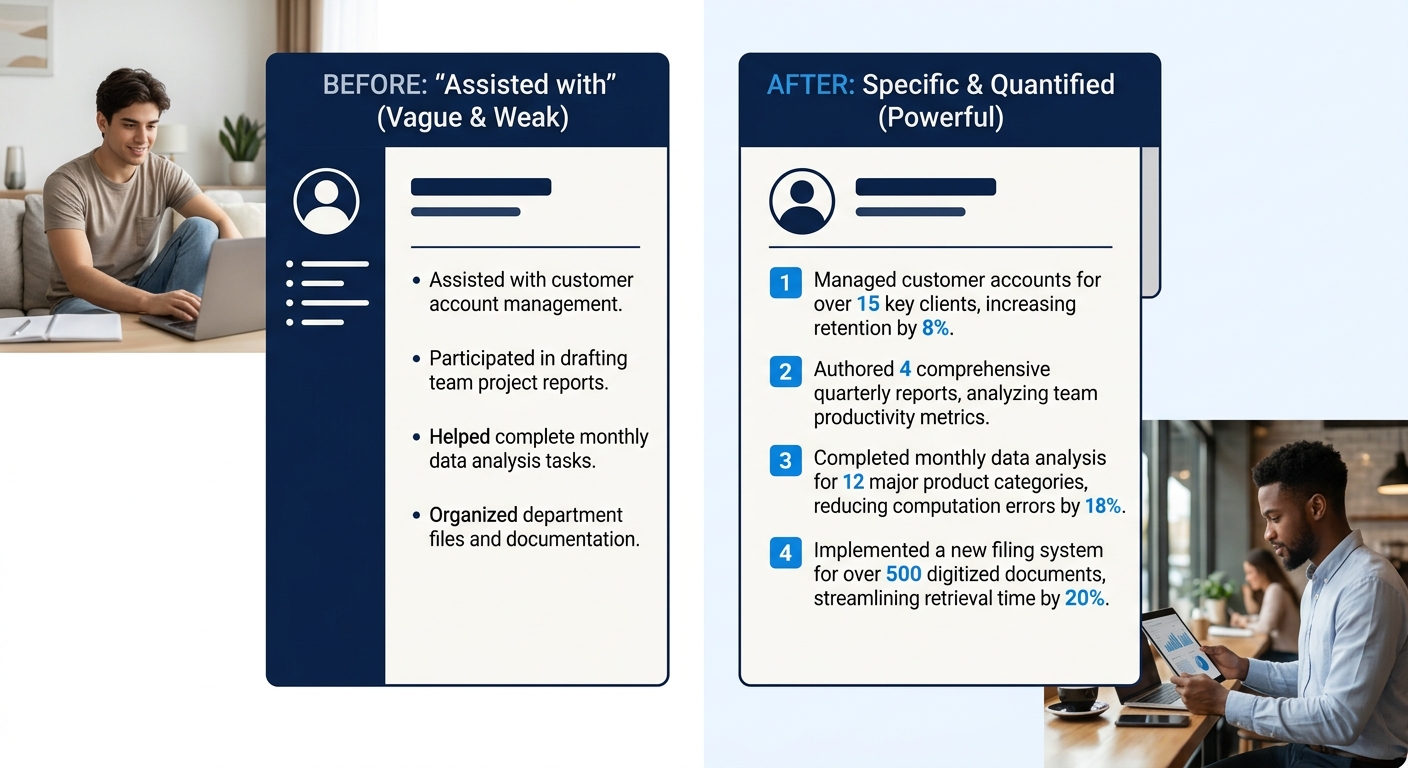
The gap between a weak bullet and a strong one is often 10 minutes of reflection, not a different job history. Here are four common entry-level bullets rewritten using the XYZ approach.
| Before (Vague) | After (Quantified) | What Changed |
|---|---|---|
| Assisted with frontend development | Built 6 React components rendering data for 3 dashboard views used by 400+ daily active users | Added volume (6 components, 3 views), scale (400+ users) |
| Helped debug application issues | Resolved 34 bug tickets across 2 sprint cycles, reducing open P2 defects by 60% | Added count (34 tickets), timeframe (2 sprints), result (60% reduction) |
| Participated in code reviews | Reviewed 28 pull requests over 10 weeks, flagging 15 security vulnerabilities before merge | Added volume (28 PRs), timeframe (10 weeks), quality impact (15 vulnerabilities) |
| Worked on database optimization | Refactored 4 SQL queries reducing average response time from 2.3s to 0.4s across the reporting module | Added count (4 queries), before/after speed (2.3s to 0.4s), scope (reporting module) |
Each rewrite follows the same principle: replace the passive verb (“assisted,” “helped,” “participated,” “worked on”) with an active one (“built,” “resolved,” “reviewed,” “refactored”), then attach 2 to 3 specific numbers. As ResumeLab’s 2026 programmer resume guide puts it, “Don’t just list programmer skills. Add numbers to your programming resume like percentages or dollar figures.”
If you’re working on converting vague duties into quantified impact statements, this same translation process applies to mid-level roles too. The scale of the numbers changes, but the structure doesn’t.
When You Genuinely Don’t Have Numbers
Some internships and academic projects produce work that’s hard to count. You paired with a senior developer for 8 weeks. You shadowed the DevOps team. You attended architecture reviews. These experiences matter, but they resist the XYZ formula.
The honest approach is to quantify what you can and describe the rest with precise language. “Paired with a senior engineer on 3 production deployments, learning CI/CD pipeline configuration for a 12-service architecture” is better than “Assisted with deployments.” You haven’t fabricated a metric. You’ve added specificity (3 deployments, 12 services) that gives the reader something concrete to hold onto.
A thread on r/ExperiencedDevs addressed this directly: “Quantifiable data is nice-to-have, but no recruiter expects every bullet to have a percentage.” The consensus among hiring managers in that discussion was that 2 to 3 quantified bullets per role hit the target, with remaining bullets using precise technical language and scope indicators instead of vague participation verbs.
The goal of quantification is making your actual experience readable in the 6 to 7 seconds a recruiter spends scanning your resume.
And if you’re wondering whether AI tools can help you identify these hidden metrics, consider how ChatGPT audits can surface patterns in your bullets you might miss on your own. The tool is good at prompting “how many?” and “how often?” when you feed it your raw bullet points. Just be careful about keeping your authentic voice when you polish those results.
Handling the Authenticity Concern
Quantifying your entry-level developer resume raises a fair worry: will hiring managers think you’re inflating your contributions? The line between quantification and exaggeration is real, and crossing it backfires in technical interviews when someone asks you to walk through the project you described.
Two guardrails keep you on the right side. First, use verifiable numbers. If you say you merged 45 pull requests, your GitHub contribution graph should support that claim. If you say you reduced response time by 80%, you should be able to explain the before-and-after measurement during a technical interview. Second, scope your contribution honestly. “Contributed to a team that shipped a feature used by 50,000 users” is different from “Shipped a feature used by 50,000 users.” Both are quantified, but only the first accurately represents a junior developer’s role within a larger team.
This balance applies to every number on your resume. The quantified bullet should be something you can defend for 5 minutes in conversation, with details about how you measured it and what your specific role was. If you can’t, scale the claim back until you can.
What Still Hasn’t Been Settled
Entry-level resume quantification still has unresolved tensions. The 2026 hiring market, where job searches now stretch past 108 days on average, puts more pressure on every bullet point to perform. But the industry hasn’t settled on whether junior candidates are better served by 2 heavily quantified bullets per role or by 4 to 5 moderately specific ones. Different hiring managers weight these differently, and ATS systems parse them with varying sophistication.
The rise of AI-generated resumes adds another layer. When 53% of job seekers use generative AI to write or edit their resumes, the quantified bullet has become both more common and more suspect. Hiring managers are developing sharper instincts for numbers that feel manufactured versus numbers that feel lived-in. The difference usually comes down to specificity of scope: “Improved performance by 40%” reads as generic, while “Reduced PostgreSQL query latency on the /orders endpoint from 2.3s to 0.4s by adding composite indexes” reads as real, because nobody fabricates that level of detail.
Your quantified bullets need to pass both the ATS extraction test and the human plausibility test. The XYZ formula gives you the structure. Your actual work, counted carefully and scoped honestly, gives you the content. And the gap between “assisted with” and a number that matters is usually smaller than it looks. It starts with going back through your Git log, your Jira board, or even your Slack messages and simply counting what you already did.