


 4.9
4.9 4.5
4.5USAJOBS enforced a strict two-page resume cap for Title 5 positions starting September 27, 2025, and the policy demolished the single most persistent myth about federal applications: that they need to be long. For years, career advisors told corporate professionals switching to government work that their sleek one-page resumes would need to balloon into five-, seven-, or even ten-page documents packed with GS grade levels, supervisor phone numbers, and weekly hour counts. That era is over, but the confusion it left behind isn’t. Corporate professionals now face a different problem: how to convert private-sector experience into a federal resume format that satisfies both automated screening tools and the human reviewers behind them, all within a space constraint that feels simultaneously familiar and foreign.
The irony is thick. Private-sector professionals spent years learning to condense. Federal applicants spent years learning to expand. Now both sides are converging on roughly the same page count, yet the documents themselves remain fundamentally different animals. A corporate resume sells your trajectory. A federal resume proves your eligibility. Understanding that distinction is the entire foundation of any workable USAJOBS application strategy.
Why the Federal Resume Still Isn’t a Corporate Resume
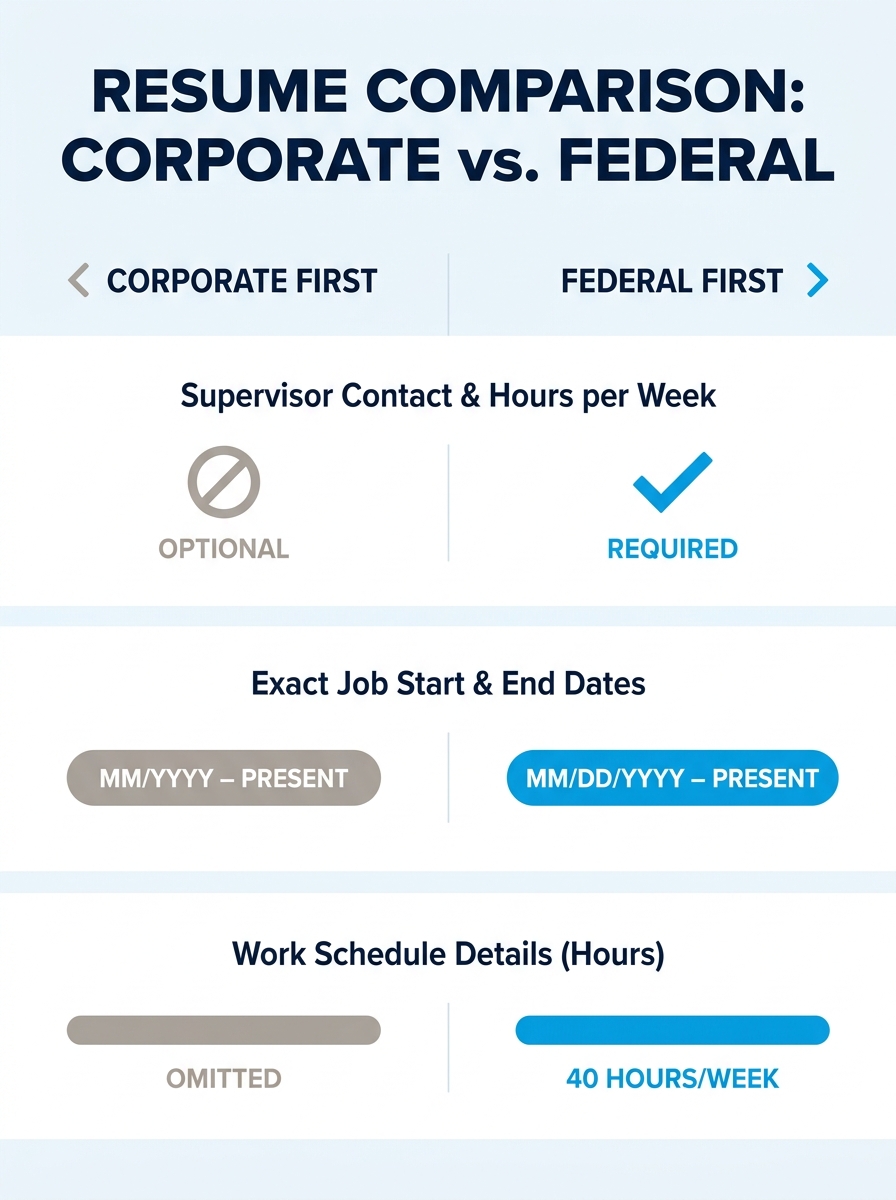
Even with the two-page limit, the federal resume format demands information that would look bizarre on a private-sector document. Each position you list needs to include your employer’s full address, your supervisor’s name and phone number (with a note about whether they may be contacted), your exact start and end dates formatted as month and year, and your average hours worked per week. These fields exist because federal HR specialists use them to calculate whether you meet time-in-grade requirements and whether your specialized experience adds up to the minimum qualifying months. Miss any of these fields, and your application may be screened out before anyone reads a single accomplishment bullet.
This is where corporate professionals typically make their first mistake. They treat these required fields as optional filler, burying them in small text or omitting them to save space for impressive achievements. The achievements matter, absolutely, but an HR specialist at the Office of Personnel Management doesn’t have discretion to waive missing required information. Your resume gets flagged as incomplete and moves to the rejection pile. The government job tailoring process starts with compliance, and compliance means including every structural element the announcement demands.
The other structural difference involves Knowledge, Skills, and Abilities statements. Federal job announcements contain specific KSA language drawn from the Duties, Qualifications, and Knowledge/Skills/Abilities sections of each posting. Your resume needs to reflect those terms with precision that borders on mirroring. If the announcement says “experience developing and implementing enterprise-level information management policies,” your resume should contain that phrase, adapted to describe your actual work but using the same core terminology. Paraphrasing into corporate synonyms (“managed large-scale data governance initiatives”) may describe the same work, but it can cost you points in automated pre-screening systems that match on proximity to the announcement’s exact language.
For anyone who’s worked through the process of matching resume language to job descriptions using keyword analysis, this concept will feel familiar. The federal version of keyword alignment is stricter, though, because the scoring rubric is often tied directly to the announcement’s wording.
Converting Corporate Accomplishments Into Federal Evidence
The biggest mental shift for corporate professionals is moving from impact storytelling to evidence documentation. Your private-sector resume might say “Drove 40% revenue growth across APAC markets by restructuring the partner channel.” That’s a strong bullet in the corporate world. In a federal application, an HR specialist reading that sentence can’t easily map it to the qualifying criteria in the announcement. What was your role, specifically? What was the context? What concrete actions did you take, and what measurable result followed?
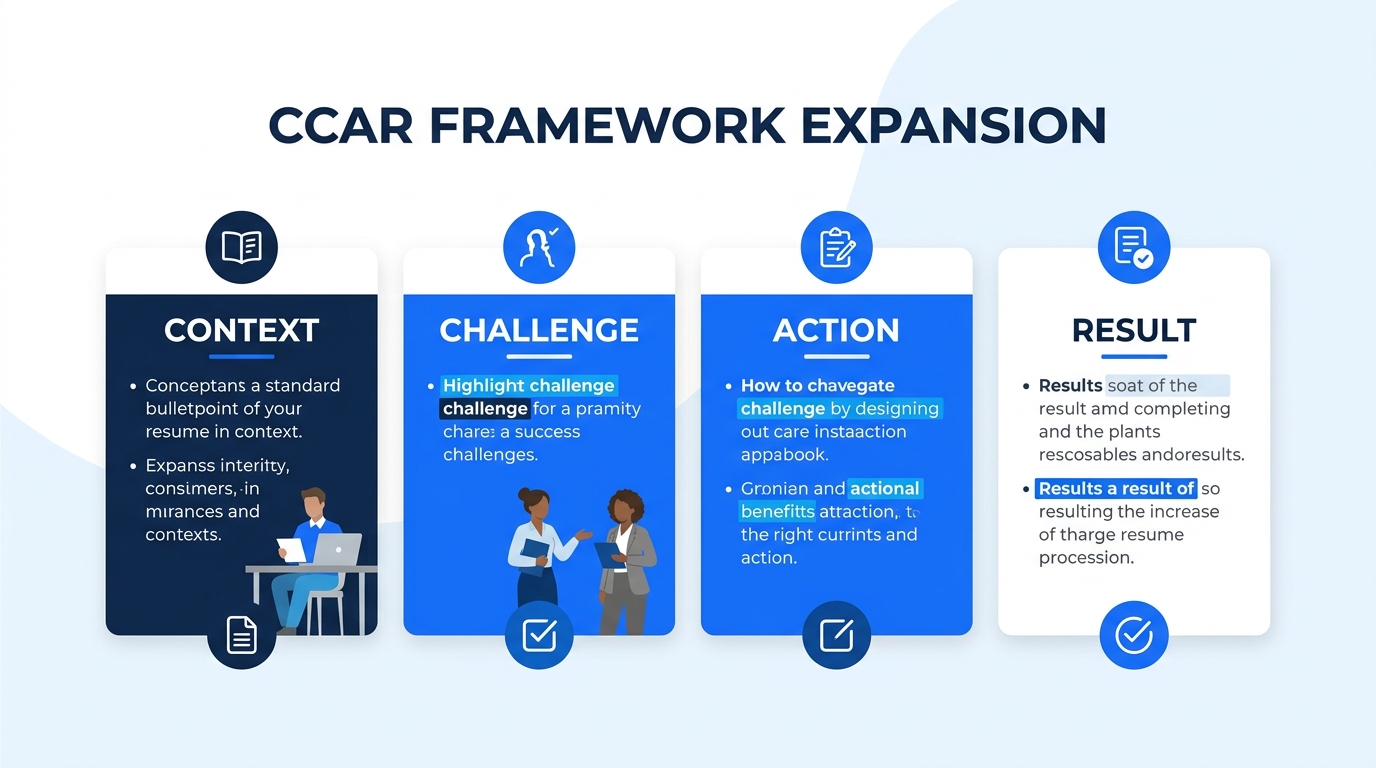
This is where the CCAR framework becomes essential. CCAR stands for Context, Challenge, Action, Result, and it gives your accomplishments the structural rigor federal reviewers expect. Take that same APAC revenue bullet and rebuild it: “Served as Regional Director overseeing a 15-member business development team (Context). Inherited a partner channel with 23% annual attrition and declining contract renewals (Challenge). Redesigned the partner onboarding process, implemented quarterly performance reviews, and negotiated revised commission structures with 40+ channel partners (Action). Increased regional revenue by 40% over 18 months while reducing partner attrition to 8% (Result).” That version is longer, yes, and space is tight with only two pages. But it gives the reviewer exactly what they need to determine whether your experience qualifies.
A corporate resume sells your trajectory. A federal resume proves your eligibility. Understanding that distinction is the entire foundation of any workable USAJOBS application strategy.
The challenge of fitting detailed CCAR bullets into a two-page document is real, and there’s no way around the tension. You’ll likely need to limit yourself to three or four strong bullets per position rather than the six or seven you might include on a corporate resume. Choose the bullets that map most directly to the announcement’s qualifying criteria and cut the rest, no matter how impressive they are. If you managed a $3.4 million annual budget with zero audit findings over four years, that’s a powerful bullet for a position requiring financial oversight experience. If the position is focused on IT project management and the budget line is tangential, drop it.
Quantification matters in federal resumes just as much as in corporate ones, and if you’ve struggled with writing resume bullets when your role didn’t produce clean metrics, the same principles apply here. Federal HR specialists value specifics: team sizes, dollar amounts, percentages, timelines, system counts, geographic scope. Even soft-skill claims benefit from grounding. “Improved cross-departmental communication” becomes “Established weekly coordination meetings between four division leads, reducing project handoff errors by an estimated 25% over six months.”
The skill translation challenge runs in both directions, incidentally. Professionals moving from government to the private sector face the same vocabulary mismatch, as research from SHRM has documented. GS levels, series numbers, and federal jargon mean nothing to a corporate hiring manager, just as corporate titles like “VP of Growth” can be opaque to a federal classifier. The data migration resume skill translation framework we’ve covered before addresses some of these cross-industry translation problems, and the principles carry over to federal conversions with minor adjustments.
Formatting Decisions That Determine Whether Your Resume Gets Read
With two pages and a 5 MB file size limit, every formatting choice carries weight. USAJOBS recommends uploading resumes as PDFs to preserve layout, and this is genuinely good advice because the alternative (building your resume inside the USAJOBS Resume Builder) strips out all formatting and produces a plain-text document that’s harder to scan visually. A clean PDF with 0.5-inch margins, 10-point body text in a readable sans-serif font like Calibri or Arial, and 14-point headings gives you the most usable space while remaining comfortable for reviewers who may be reading dozens of applications in a sitting.
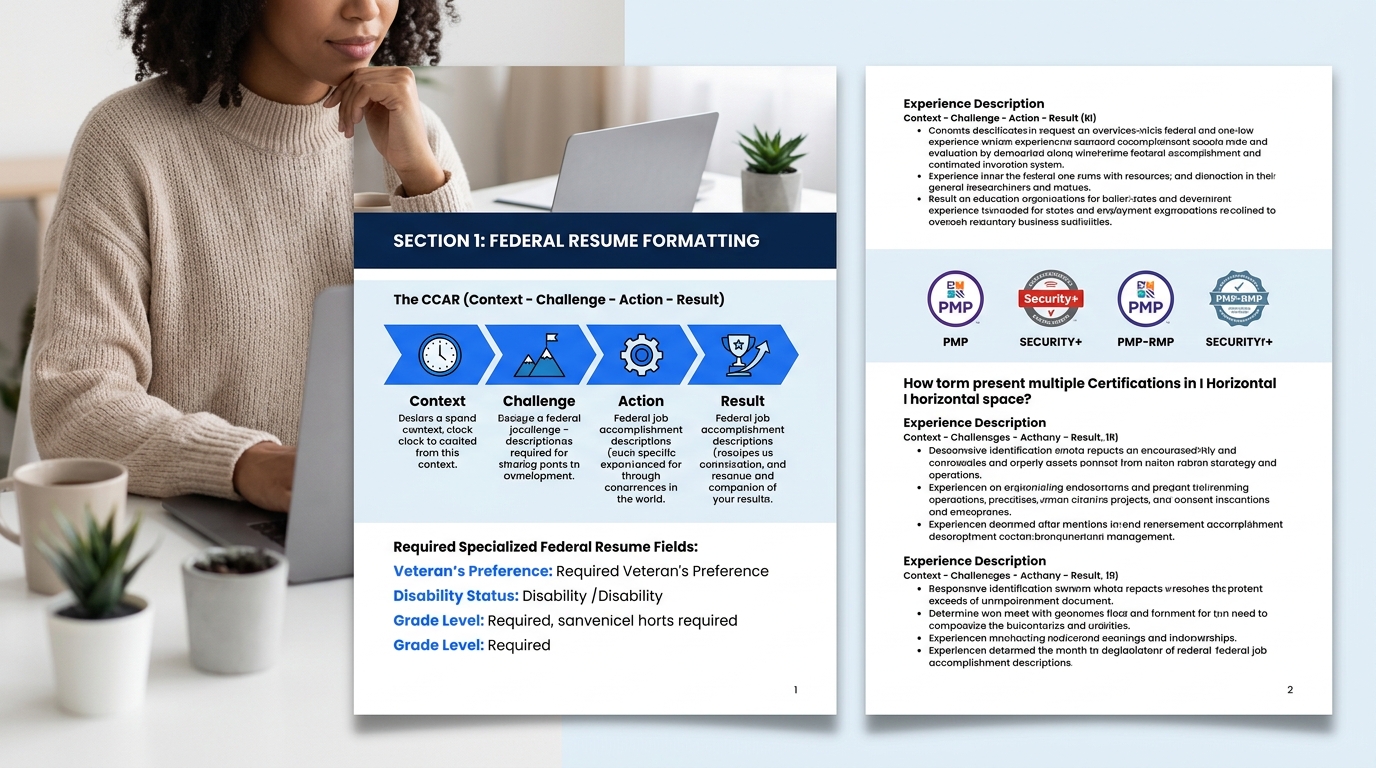
Certifications and clearances should be listed horizontally rather than stacked vertically to conserve space. “PMP | Certified ScrumMaster | Lean Six Sigma Green Belt | Secret Clearance” on a single line saves you three lines compared to a vertical list, and those three lines might be exactly what you need for one more CCAR bullet. Similarly, the old federal resume convention of including salary history and weekly hours for every position has been relaxed under the new guidelines. Unless the announcement specifically asks for this information or you’re documenting part-time status, you can reclaim that space.
The 2026 addition of four 200-word essay questions within the USAJOBS questionnaire for GS-05 and above positions has actually reduced some of the pressure on the resume itself. These essays function as tiebreakers among qualified candidates, and they give you room to provide the narrative context that your two-page resume can’t accommodate. Think of them as the federal equivalent of a cover letter, but structured around specific prompts. Your resume proves you’re qualified; your essays argue that you’re the best fit among qualified candidates.
One practical note on the application process itself: USAJOBS lets you save up to five different resumes in your profile. This is a feature worth using aggressively for resume customization for federal positions across different career tracks. If you’re applying to both IT Project Manager (GS-2210) and Management Analyst (GS-0343) positions, you need two distinct resumes with different KSA emphasis, different lead bullets, and potentially different professional summaries. The announcement language differs, the qualifying criteria differ, and your resume needs to differ accordingly. The process of reframing your experience when job titles don’t align with your target role applies directly here, since federal job series classifications rarely map neatly onto corporate org charts.
Tip: Before writing a single word of your federal resume, read the “How to Apply” section of the specific job announcement you’re targeting. Each agency can have unique requirements beyond the USAJOBS defaults, and missing an agency-specific instruction is one of the most common reasons applications are marked ineligible.
The timeline expectation is another area where corporate professionals stumble. Federal hiring has historically averaged around 101 days from posting to offer. That’s not a sign that your application fell into a void. Agencies go through eligibility determination, qualification rating, certificate issuance, interviews, reference checks, and sometimes security clearance processing before they extend an offer. Applying to federal positions requires patience that the private sector rarely demands, and you should plan to have multiple applications moving through the pipeline simultaneously rather than waiting on any single one.
The Uncomfortable Middle Ground
The convergence of federal and corporate resume expectations should, in theory, make the transition easier. A two-page federal resume looks a lot more like what corporate professionals are used to producing. But the reality on the ground is messier than the policy suggests. Federal HR specialists are still adjusting to evaluating shorter documents. Applicants accustomed to the old format are still circulating advice about writing eight-page resumes. And the AI pre-screening tools deployed in 2026, which reward exact phraseological matches with announcement language, create an uncomfortable tension with the advice to write authentic, natural-sounding documents. You’re essentially being asked to mirror bureaucratic phrasing while also demonstrating clear, compelling communication skills.
There’s also an equity dimension that deserves honest acknowledgment. The National Governors Association has documented how skills-based hiring policies in the public sector can increase accessibility for candidates with non-traditional backgrounds. The two-page mandate theoretically levels the playing field between career federal employees who knew the old system’s tricks and private-sector newcomers. But the requirement to mirror announcement language with near-exact precision tilts the process back toward candidates who understand federal hiring’s unwritten rules. If you’ve read guidance on how ATS and AI screening tools evaluate resumes in the private sector, you know that keyword optimization is already a fraught exercise. The federal version amplifies that tension because the scoring criteria are less transparent and the feedback loop is slower.
The honest advice, then, is this: treat each federal application as a research project, not a document production task. Read the full announcement at least twice. Identify every KSA phrase in the Duties and Qualifications sections. Map your corporate experience onto those phrases using the CCAR framework. Format ruthlessly to fit two pages. And then accept that you may do all of this correctly and still wait three months to hear back, because the system is designed for thoroughness, not speed. For more guidance on navigating these kinds of complex career transitions, browse our career guides for additional frameworks and examples. The federal application process rewards precision and patience in roughly equal measure, and the professionals who succeed tend to be the ones who treat both as non-negotiable.