

 4.9
4.9 4.5
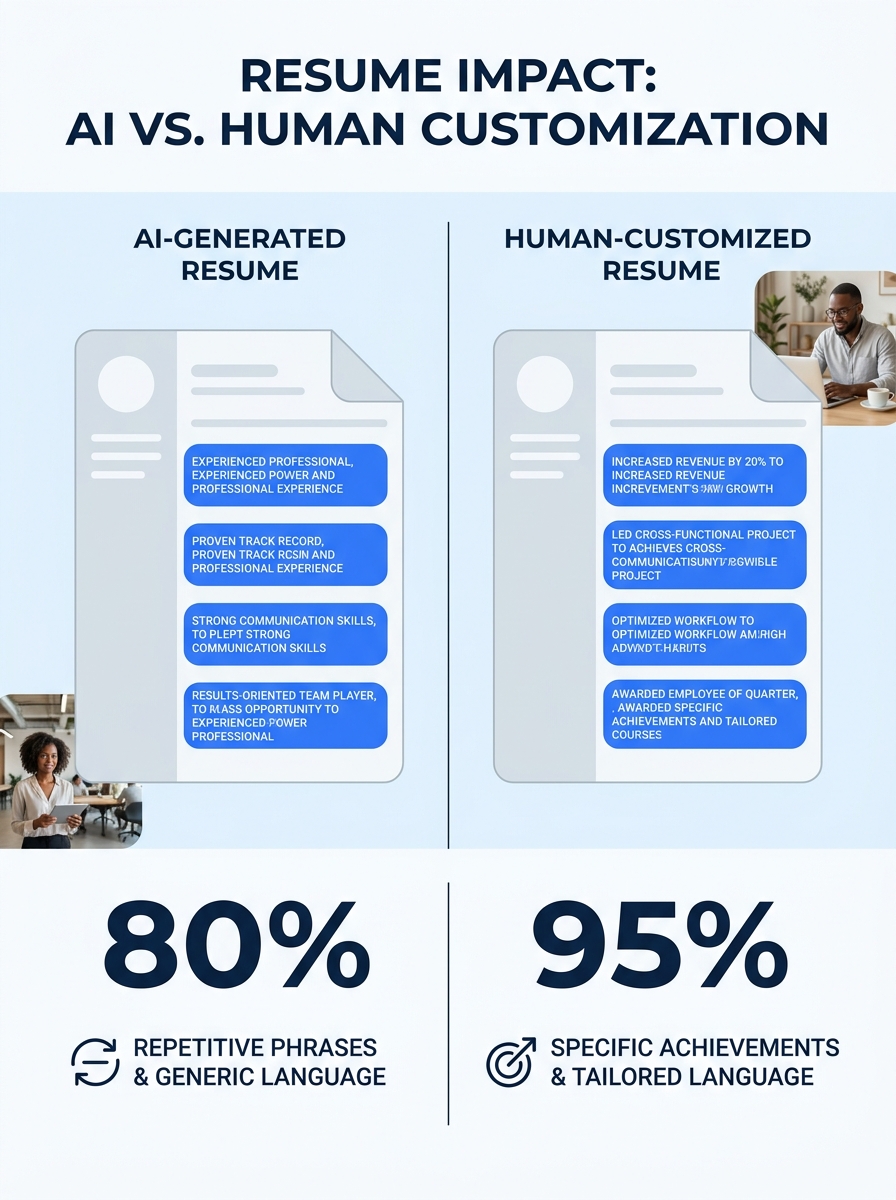
4.5Seventy-seven percent of hiring managers believe many resumes now appear AI-generated, according to a Resume Genius survey of 1,000 U.S. hiring managers conducted in 2026, with 80% reporting they can identify AI-written applications through unnatural phrasing, repetitive language, and vague descriptions, Forbes reported August 11.
TL;DR: A 2026 survey found 77% of hiring managers believe many resumes appear AI-generated, prompting employers to shift emphasis toward work samples, portfolios, and skills demonstrations over traditional resume formatting.
The findings reflect what career researchers describe as “resume inflation,” a labor-market phenomenon where AI tools allow candidates to generate polished, keyword-optimized documents within minutes, making traditional resumes less effective as differentiation tools. The shift mirrors broader changes in recruitment practices, with organizations increasingly requiring proof of skills through work samples, simulations, and portfolio materials alongside standard application documents.
Bryan Robinson, a Forbes career contributor and author of workplace research, published the analysis documenting how AI accessibility has altered the resume’s function in hiring processes. Nearly 80% of surveyed managers said candidates should disclose AI use in application materials.
Detection Methods and Employer Responses
Hiring managers identified three primary indicators of AI-generated resumes in the Resume Genius survey: unnatural phrasing or tone ranked first, followed by repetitive or generic language, and vague or inflated job descriptions. The data showed managers have developed systematic approaches to spotting automated content during initial screening stages.
Employers reported increased skepticism toward resumes featuring what Robinson characterized as “career equivalent of grade inflation,” where ordinary responsibilities become “cross-functional strategic initiatives” and basic spreadsheet experience transforms into “advanced data analytics.” The pattern creates challenges for applicants who have legitimately performed complex work but whose descriptions now match templated AI output.
The survey did not measure false-positive rates—instances where hiring managers incorrectly flagged human-written resumes as AI-generated—leaving open questions about whether detection accuracy affects qualified candidates.
AI Integration Across Recruiting Functions
SHRM’s 2025 Talent Trends research found 51% of organizations using AI for HR-related activities employ the technology in recruiting operations. Among those organizations, 44% use AI to review or screen resumes, while 32% automate candidate searches, the professional association reported.
LinkedIn’s 2026 recruiting research identified skills-first hiring and quality-of-hire metrics as major priorities, with AI systems helping employers identify candidate skills and administer assessments. The platform’s data indicated movement away from credential-based screening toward competency demonstration.
The dual adoption—candidates using AI to create resumes and employers using AI to screen them—has created what Robinson termed an “arms race” in application processes. Organizations now layer additional evaluation methods, including interview preparation assessments, work trials, and project-based screening, into hiring funnels previously dominated by resume review.
Resume Format Testing Shows Human-Written Versions Outperform Generic AI Output
Kickresume conducted a 2026 experiment submitting 200 resumes, primarily for customer service and sales roles, testing four variations: human-written one-column, human-written two-column, generic AI-generated, and AI-generated resumes customized to specific job descriptions. Human-written one-column resumes generated the highest callback rates, while AI-generated resumes without human editing produced the weakest results.
“AI can save job seekers a lot of time when creating a first draft, but simply sending that draft unchanged isn’t enough,” Peter Duris, CEO of Kickresume, said in a statement to Forbes. The company’s findings showed that adding relevant experience, achievements, and language matching job descriptions made resumes “much more specific to the role” and gave employers clearer reasons to invite candidates to interviews.
The experiment controlled for applicant qualifications and targeted similar positions across submissions, isolating resume format and authorship as variables. Duris noted that resumes tailored to individual job postings consistently outperformed generic versions regardless of whether AI or humans produced the initial draft.
Recommended Adaptations From Career Researchers
Robinson’s analysis outlined six strategies for candidates navigating the shift, framed around replacing “polish” with verifiable proof of capabilities. The recommendations centered on specificity: replacing adjectives such as “innovative” or “results-driven” with measurable outcomes, problem descriptions, and quantified results.
The Forbes article recommended candidates build micro-portfolios containing three to five work samples relevant to target positions—project summaries, process improvements, training plans, or case studies. For candidates lacking direct work samples, the analysis suggested creating samples based on public business problems, clearly labeled as self-initiated projects.
Additional strategies included optimizing LinkedIn profiles beyond resume duplication, requesting video testimonials from colleagues or clients, publishing brief articles or posts demonstrating subject expertise, and treating resumes as “tables of contents” pointing to fuller proof ecosystems. Robinson emphasized that employers now seek evidence of judgment, clear communication, and problem-solving ability that scripted AI-generated documents cannot demonstrate.
The shift affects job seekers across experience levels, from recent graduates building initial portfolios to mid-career professionals adapting long-established application approaches. Career coaching services report increased client requests for portfolio development and skills demonstration strategies alongside traditional resume review.
Context and Outlook
The convergence of widespread AI tool access and employer saturation with similar-sounding applications marks a structural change in how candidates must approach job searches. For job seekers, the immediate implication is that resume quality alone no longer functions as a competitive advantage when AI can generate professional-looking documents at scale. The data suggests investment in tangible work samples, specific achievement documentation, and skills demonstration through projects or portfolios yields better differentiation than resume formatting or keyword optimization.
The shift favors candidates who can document specific outcomes and maintain proof of work across career stages. Job seekers without existing portfolios face pressure to create relevant work samples, even for non-creative roles, while those with measurable achievements gain relative advantage by making results verifiable rather than merely claimed. The Resume Genius survey’s finding that nearly 80% of managers expect AI disclosure also introduces transparency as a new application norm, requiring candidates to balance AI assistance with authentic voice and specific detail.
Organizations moving toward skills-based assessment and work simulations likely accelerates the trend, particularly as career coaching services adjust guidance to emphasize proof-of-work portfolios over document polish. The August 2026 findings suggest the resume’s function has already shifted from gatekeeper to baseline requirement, with hiring decisions increasingly determined by materials that demonstrate rather than describe candidate capabilities.