


 4.9
4.9 4.5
4.5Leadership advisor Angela C. Hill published a five-practice framework for career reimagination on September 22, 2026, through Forbes Coaches Council, positioning the approach as a response to artificial intelligence anxiety and what she characterized as a “low-hire, low-fire” labor market, according to the Forbes article.
TL;DR: Dr. Angela C. Hill, founder of Created2Catapult and ICF-PCC certified executive coach, outlined five practices for mid-career professionals to explore career capital beyond traditional advancement paths before external pressures force pivots.
Framework Context
Hill, who holds an ICF-PCC certification and founded Created2Catapult, framed the practices as “reimagination before reinvention.” The distinction centers on examining existing career capital—expertise, relationships, credibility, and pattern recognition accumulated over 15 to 30 years—rather than starting from scratch in a new field.
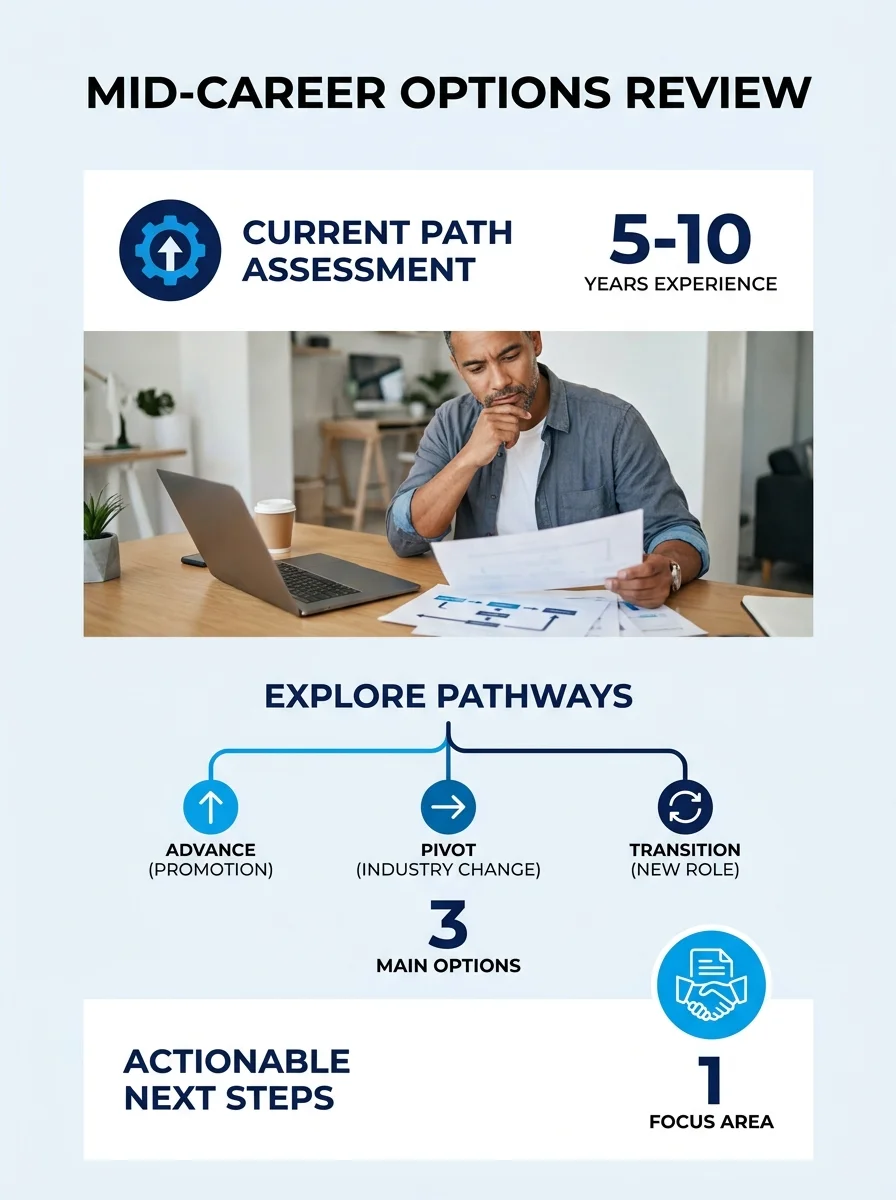
The framework targets professionals who remain engaged in current roles but question whether advancement structures built 10 or 20 years ago still align with current priorities. Hill wrote that reimagination “may be most expansive when curiosity, rather than crisis, is driving the conversation.”
Five-Practice Structure
The published framework opens with an inventory practice: professionals list problems they solve and capabilities that transfer across roles, setting aside job titles. Hill instructed readers to “write down what comes to mind without evaluating it.”
The second practice asks professionals to identify their top three optimization priorities from a list including compensation, flexibility, stability, autonomy, learning, influence, purpose, time, leadership scope, and capacity for non-work priorities. Hill questioned whether current career decisions reflect present values or “an older definition of success.”
Practice three challenges the sentence completion “At this point in my career, the logical next step is…” Hill listed fractional leadership, consulting, advisory work, teaching, coaching, board service, and entrepreneurship as alternatives to traditional advancement.
The fourth practice recommends small experiments—conversations with professionals who structure work differently, teaching underutilized capabilities, or asking colleagues “Where else do you think my experience could create value?” Hill wrote that experiments “generate information that reflection alone cannot.”
The final practice directs professionals to sketch three futures: one extending the current trajectory, one reconfiguring existing career capital into different structures, and one unconstrained by conventional paths. For each scenario, Hill asked readers to assess what they gain, what they give up, whether it supports optimization priorities, and what conditions would make it viable.
Labor Market Data
Hill cited an August 2026 Pew Research Center study showing 71% of U.S. adults believe artificial intelligence will eliminate jobs over the next 20 years, an increase from 64% in 2024. The article referenced ongoing debate about workplace flexibility and remote-work policies as additional sources of career uncertainty.
The “low-hire, low-fire” characterization Hill used describes a labor market where employers maintain existing headcount but reduce both new hiring and layoffs. Hill positioned the five practices as a proactive response to this environment rather than reactive crisis management.
Professionals building careers over multiple decades face a changed backdrop for career coaching services and advancement planning. Hill’s framework addresses mid-career workers who accumulated substantial expertise before recent labor market shifts altered conventional progression assumptions.
Implementation Timeline
Hill recommended professionals allocate uninterrupted time to work through all five practices rather than treating them as isolated exercises. The framework does not require immediate career moves; Hill wrote that the purpose “isn’t necessarily to find your next move” but to “learn about your possibilities before you need to choose among them.”
The article did not specify a timeline for completing the practices or define success metrics. Hill emphasized that some professionals may confirm their current path after completing the exercises. The framework treats staying in a current role as an equally valid outcome if it aligns with reassessed priorities.
Career guidance published earlier this year emphasized lifelong learning and digital fluency as job market transformation accelerates. Hill’s practices add a structured reflection component to that guidance, asking professionals to assess accumulated capital before external disruption forces rapid decisions.
Why This Matters Now
Mid-career professionals face a compounding challenge: they built expertise in a labor market with clear advancement ladders, but now navigate an environment where AI anxiety, hiring freezes, and structural changes to work have made traditional next steps less predictable. The September 22 Forbes article arrives as 71% of workers anticipate AI-driven job losses—a sentiment that grew 7 percentage points in two years.
Hill’s framework offers an alternative to the binary choice between staying put and full reinvention. By treating career capital as reconfigurable rather than fixed to a single trajectory, the five practices create space for professionals to explore options—fractional roles, advisory work, portfolio careers—that didn’t exist when they entered the workforce. The “reimagine before you have to” framing shifts career planning from crisis response to strategic choice, particularly for workers who remain satisfied in current roles but recognize the landscape has changed beneath them.
For job seekers and career changers reading this site, Hill’s practices translate abstract “rethink your career” advice into concrete steps: inventory transferable skills, clarify current priorities, challenge assumptions about what comes next, run small experiments, and map multiple futures. The framework acknowledges that professionals in their forties, fifties, and beyond carry substantial value even as the structures that once channeled that value—corporate ladders, linear progressions, full-time roles—lose their monopoly on career architecture.