
 4.9
4.9 4.5
4.5LinkedIn deployed its first AI agent for recruiters in October 2024, enabling hiring managers at firms including AMD, Canva, Siemens, and Zurich Insurance to describe open roles in conversational language and receive filtered candidate lists with AI-generated summaries, according to a September 4 playbook published by Value Your Network that outlines how job seekers must now structure profiles to surface in semantic searches rather than keyword-only queries.
TL;DR: LinkedIn’s Hiring Assistant, deployed October 2024, allows recruiters to search profiles using natural-language descriptions, requiring job seekers to fill detailed experience fields with action verbs, tools, and deliverables rather than relying on keyword repetition.
The shift affects how LinkedIn’s 1.3 billion members optimize profiles for visibility. The platform’s semantic search now parses work experience, location, education, skills, summaries, certifications, volunteer work, publications, and patents to match candidates to recruiter queries, the guide notes. Profiles that leave fields blank or use vague descriptions become difficult for AI agents to categorize, even when polished for human readers.
Detailed Experience Fields Replace Keyword Density
LinkedIn warns that keyword stuffing harms visibility under the new system, the playbook reports. Repeating the same phrase fifteen times across a profile reduces credibility without improving search performance. Instead, the platform’s AI agents respond to semantic clusters—groups of related terms that establish context around a specialty.
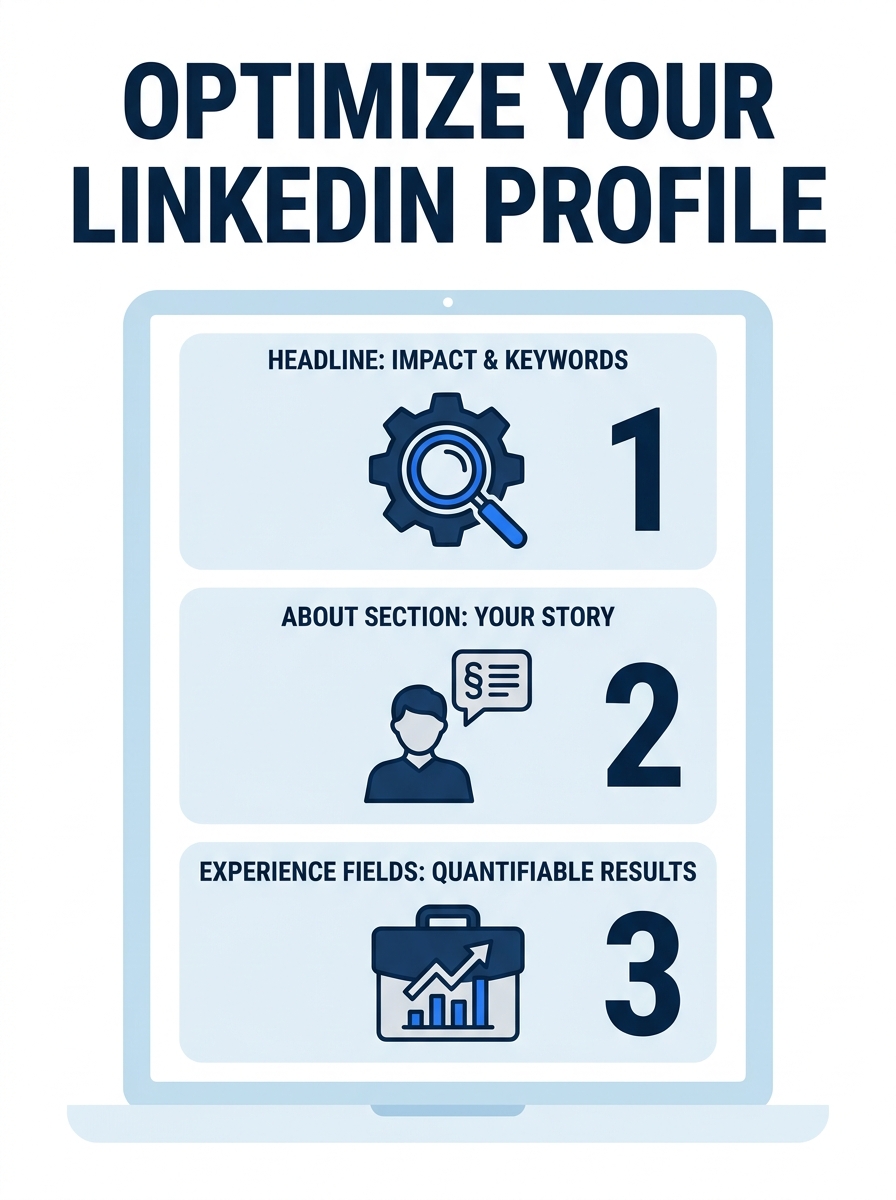
The guide recommends job seekers list five search terms spanning profession, industry, target audience, location, and format, then distribute those terms naturally across title, about section, experience entries, skills, and published content. Each experience entry should include action verbs, tools used, and specific deliverables rather than generic responsibilities. For example, “LinkedIn newsletters, Sales Navigator prospecting, social ads, pipeline reporting” signals clearer expertise to AI agents than “managed marketing campaigns.”
Professional titles should answer what the person does, for whom, and what differentiates them, according to the playbook. Titles like “Founder | Speaker | Advisor | Mentor” lack the specificity that helps AI match profiles to queries such as “B2B SaaS social selling consultant in France,” the guide states. The about section should run 8 to 12 structured lines starting with a value proposition, then listing niches, formats, target audiences, and results with evidence such as anonymized case studies or campaign metrics.
AI Citation Study Shows Moderate Engagement Sufficient
A Semrush study published in 2026 analyzed 325,000 prompts and 89,000 LinkedIn URLs cited by ChatGPT Search, Google AI Mode, and Perplexity, placing LinkedIn as the second-most-cited domain in the dataset behind Reddit, the playbook reports. LinkedIn posts most frequently cited by AI systems had moderate engagement—typically 15 to 25 reactions—debunking the assumption that viral reach drives AI visibility.
Approximately 75% of authors cited in the Semrush study had published at least five posts over a four-week period, and nearly half had more than 2,000 followers, according to the guide. The findings suggest consistent posting on specialized topics outperforms sporadic viral content for AI citation. The playbook recommends publishing two to four pieces of content weekly within consistent editorial categories, noting that accounts switching topics every three days send mixed signals to semantic systems.
LinkedIn’s relevance algorithms consider searcher activity, matching profiles, patterns from similar searches, and search history when ranking results, the platform disclosed. The guide contrasts this with pre-2024 optimization focused on headline keyword density and connection count.
Profile Structure Affects Both Human and AI Recruiter Views
LinkedIn Recruiter now generates AI summaries on profile cards when users describe hiring needs in natural language, the guide notes. This changes the weight of each profile section. A sparse about section or experience entries lacking industry-specific vocabulary reduce match likelihood even when a candidate possesses relevant skills, because the AI agent cannot parse qualifications from incomplete data.
The playbook advises removing overly vague skills like “communication” if they overshadow core expertise areas, since skill endorsements factor into semantic matching. Certifications, publications, and volunteer work populate the data fields available to AI recruitment agents, making previously optional sections now material to search visibility.
For LinkedIn job seekers building profiles from scratch, the guide’s method prioritizes evidence over claims: linking skills to verifiable results, listing tools and platforms used, and providing deliverable types rather than abstract competencies. This approach mirrors career coaching services that emphasize quantified achievements in resumes, now applied to LinkedIn’s semantic search environment.
What This Means for Job Seekers
Recruiters using LinkedIn Hiring Assistant no longer manually filter candidate lists by scanning headlines for exact keyword matches. The AI agent interprets natural-language hiring descriptions and surfaces profiles based on semantic context drawn from multiple fields. Job seekers who treat LinkedIn profile optimization as a one-time headline edit will increasingly miss recruiter searches, while those who populate experience entries with action verbs, tools, deliverables, and results position themselves for AI-agent queries.
The shift also reduces the value of inflated connection counts or generic engagement tactics. A job seeker LinkedIn profile that publishes specialized content twice weekly for a month with 20 reactions per post may earn more AI citations than an account chasing viral posts outside its niche. Consistency and clarity now outweigh reach when AI systems decide which profiles to recommend.
Practically, this means treating the about section and experience fields as seriously as a resume’s professional summary and work history. Leaving fields blank or filling them with aspirational language (“passionate about innovation”) removes data points the AI agent needs to match profiles to recruiter queries. Job seekers should audit profiles for specificity, fill all available sections with concrete details, and publish regular content within two to three defined editorial pillars rather than posting sporadically across unrelated topics.