

 4.9
4.9 4.5
4.5Meta cut 8,000 positions on April 22. Oracle followed with an estimated 30,000. Microsoft offered voluntary exits to roughly 8,750 employees, and PayPal added another 4,760 on May 9. The running total for 2026, according to Layoffs.fyi data reported this week, has now crossed 92,000 tech workers in five months, with April alone accounting for more than 45,000 cuts. That’s the worst single month for tech employment in two years.
And yet Alphabet, Microsoft, Meta, and Amazon are projected to spend nearly $700 billion combined on AI infrastructure this year. The money isn’t leaving tech. It’s moving to different rooms inside the same building. The question for every affected developer is which room to walk toward, and how to rewrite your resume so the people in that room want to open the door.
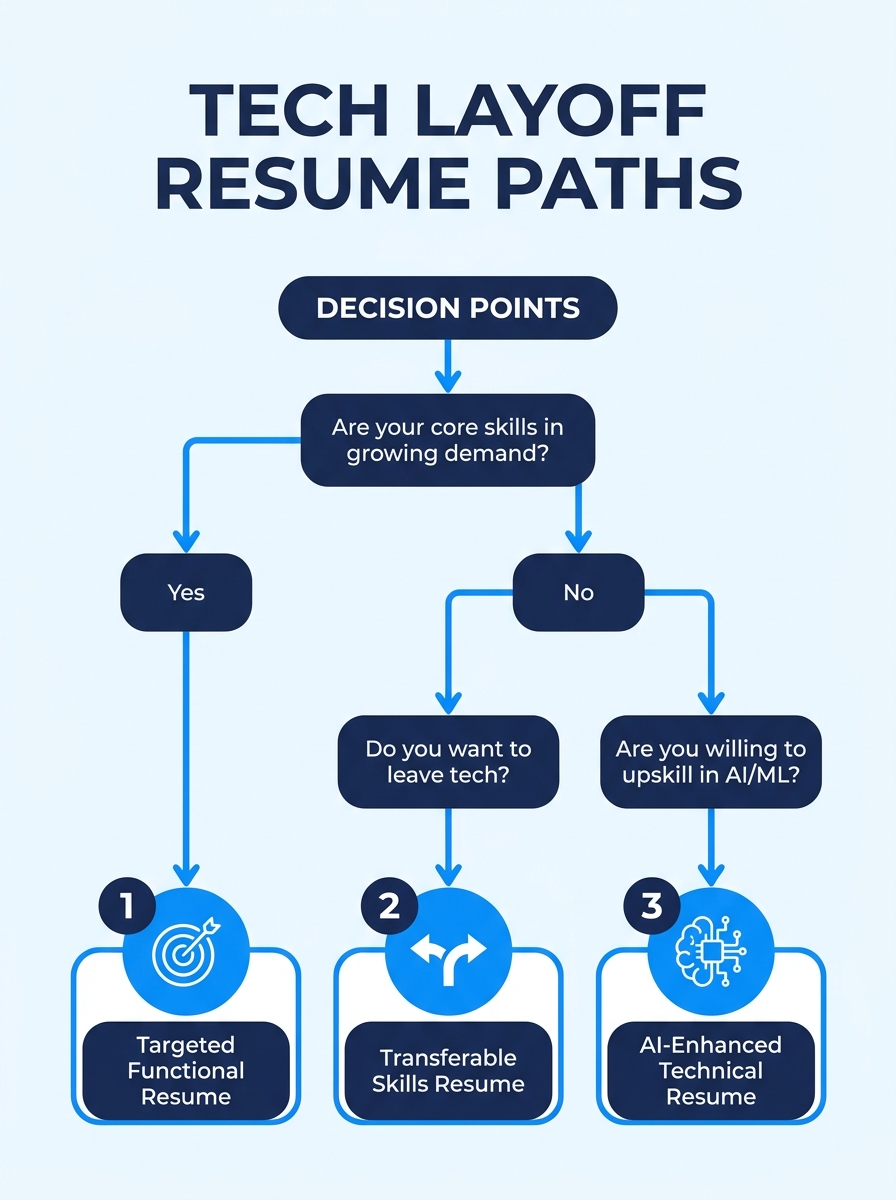
Three distinct strategies have emerged for developers navigating this reshuffling. Each one demands a fundamentally different resume architecture, different keywords, and a different story about who you are. Picking the wrong one wastes months. So let’s lay them side by side.
Strategy One: Reposition Within Tech by Reframing What You Already Do
This is the default path for most laid-off developers, and it makes sense when your core skills still map to roles that companies are actively hiring for. The trick is understanding that “actively hiring” has shifted dramatically. Traditional SWE roles at big tech companies are contracting. Infrastructure, platform engineering, security, and MLOps roles are expanding.
The resume work here is surgical. You’re not changing your career story. You’re changing which parts of your career story get the spotlight.
What the resume rewrite looks like
Take your existing bullet points and audit them for proximity to the skills companies are spending money on right now. If you spent two years building internal tooling, that experience translates directly to platform engineering. If you worked on data pipelines, you’re closer to an ML engineering role than you think. The gap between “built ETL pipelines in Airflow” and “designed feature pipelines for ML model training” might be one project’s worth of reframing.
Concrete example: a backend engineer who got laid off from a payments company might currently have a bullet that reads “Maintained microservices handling 2M daily transactions.” The repositioned version targets infrastructure roles: “Designed and operated distributed microservices architecture processing 2M+ daily transactions at 99.97% uptime, including automated scaling policies and incident response runbooks.” Same experience, different emphasis, different hiring manager’s attention.
The key to this approach is converting vague accomplishments into measurable outcomes that align with where hiring budgets are actually flowing. Don’t describe your old job. Describe the version of your old job that the market wants to buy.
The tradeoffs
Speed is the big advantage here. You can execute this strategy in a weekend if you know which roles to target. You don’t need new certifications, new portfolio projects, or a new LinkedIn headline that makes your former colleagues do a double-take.
The downside: you’re competing with every other laid-off developer who’s making the same lateral move. When Oracle drops 30,000 people and half of them target the same cloud infrastructure roles, the applicant pool gets brutal fast. Competitive resume differentiation becomes the whole game. Your bullets need to be sharper, your metrics more specific, and your tech stack descriptions more current than everyone else running the same play.
A Resume.org survey of 1,000 U.S. hiring managers found that 55% expect continued layoffs this year, with 44% pointing to AI as the top driver. That means the roles you’re repositioning toward today might face their own contraction in twelve months. This strategy works best for developers whose skills genuinely overlap with durable demand areas like security, infrastructure, and data engineering.
Strategy Two: Pivot to an Adjacent Industry That Pays for Tech Skills
Broadstaff CEO Carrie Charles has been publicly encouraging laid-off tech workers to consider data center operations, calling it a “white-collar trade job” with strong demand and genuine job security. She’s onto something, but data centers are only one example. Healthcare tech, fintech compliance, defense contracting, and energy grid modernization are all absorbing developers who can speak both technical and domain language.
Forbes reported that laid-off tech workers are landing six-figure roles in fields like biotech, clean energy, and supply chain logistics. The common thread isn’t a specific technology. It’s the ability to walk into an industry that’s ten years behind Silicon Valley’s tooling and apply modern engineering practices to legacy problems.
What the resume rewrite looks like
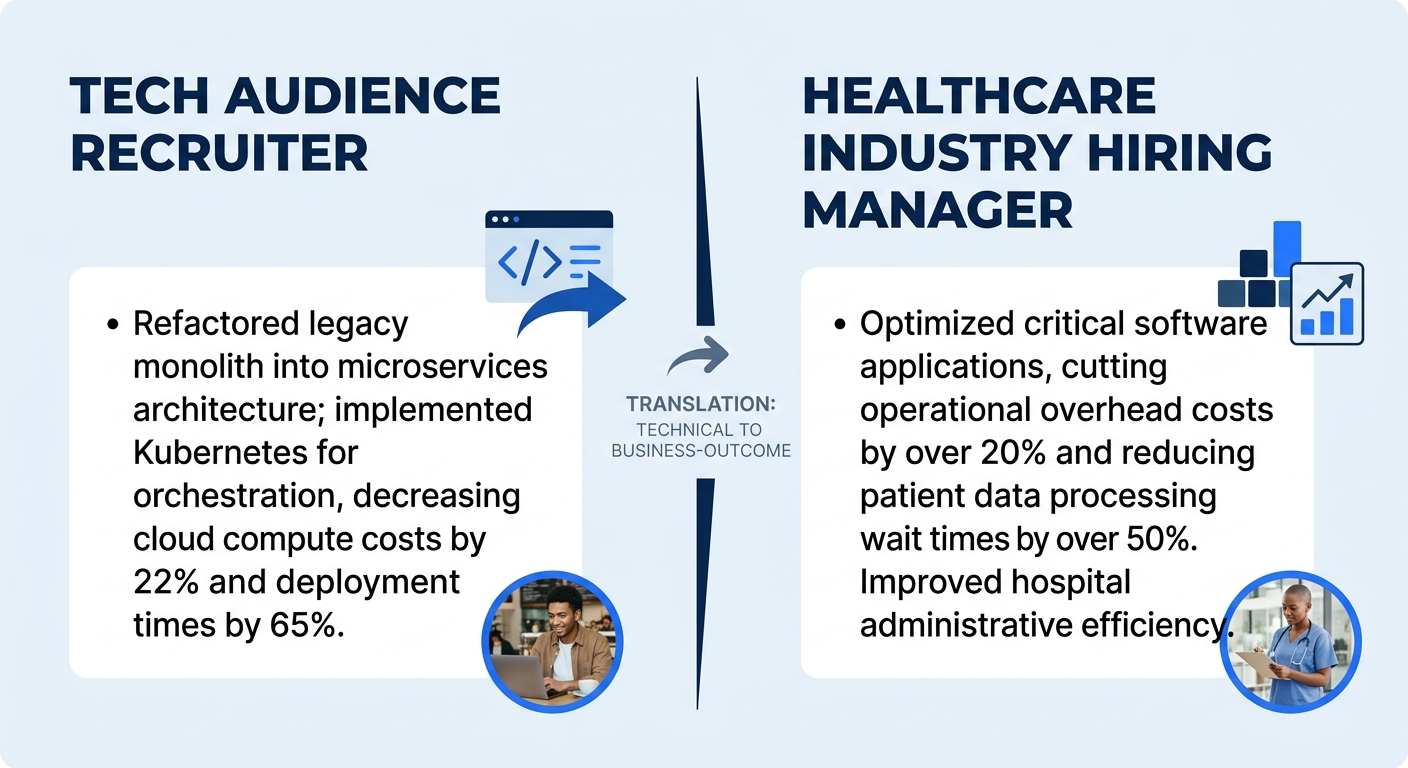
This is where career pivot positioning gets difficult, because you’re essentially asking a hiring manager in healthcare or energy to trust that your Google/Meta/Amazon experience translates to their world. The resume needs to do heavy translation work.
Strip out jargon that only makes sense inside a tech company. Replace “improved developer velocity by 30% through CI/CD pipeline optimization” with “reduced software release cycles from monthly to weekly by automating testing and deployment processes.” The second version communicates the same achievement to someone who’s never heard the phrase “CI/CD.”
Build a skills section that bridges both worlds. If you’re targeting healthcare, add HIPAA compliance awareness, HL7/FHIR data standards, or EHR integration experience even if your exposure was limited. If you’re targeting financial services, SOC 2 compliance, regulatory reporting automation, and audit trail design become prime real estate on your resume.
You’ll also want to address the elephant in the room: why you’re leaving tech. We’ve covered how displaced tech workers are reshaping their career narratives, and the short version is that your resume’s professional summary needs to frame this as a deliberate choice, not a consolation prize. “Senior engineer transitioning to healthcare technology after six years building scalable data platforms” reads as intentional. A resume that looks identical to your old tech resume but is now being submitted to hospital IT departments reads as desperate.
The tradeoffs
The upside here is reduced competition. When you apply for a senior developer role at a regional health system, you’re not competing against 500 other ex-FAANG engineers. You might be one of ten applicants who can actually build the thing they need built.
The downside is salary compression, at least initially. Adjacent industries often pay 15-30% less than pure tech roles at equivalent seniority. You’re also learning a new domain, which means your first six months will feel slower and more frustrating than you expect. And your resume needs more work upfront. You can’t just swap out a company name and resubmit. Every bullet needs to be reconsidered through the lens of your target industry.
When you apply for a senior developer role at a regional health system, you’re not competing against 500 other ex-FAANG engineers. You might be one of ten applicants who can actually build the thing they need built.
This strategy works best for developers who are genuinely tired of the layoff cycle and want to trade peak compensation for greater stability. It also works well for people whose skills are more general-purpose (full-stack web development, database administration, systems administration) rather than narrowly specialized.
Strategy Three: Go AI-Native and Rebuild Your Resume Around Machine Learning Fluency
The same companies cutting 92,000 traditional roles are simultaneously pouring hundreds of billions into AI. That spending creates new positions, and those positions need people who can bridge the gap between general software engineering and applied machine learning.
This strategy means rewriting your resume to signal AI fluency, whether you already have it or you’re building it right now. The World Economic Forum has noted that access to AI-capable talent is rapidly becoming a competitive advantage for businesses, which means companies are willing to pay a premium for engineers who can demonstrate real AI competence.
What the resume rewrite looks like
The mistake most developers make here is listing AI tools they’ve casually used. Adding “familiar with ChatGPT” to your skills section does nothing. Hiring managers at companies investing in AI want to see that you’ve built something with ML frameworks, fine-tuned a model, deployed an inference endpoint, or designed a retrieval-augmented generation pipeline.
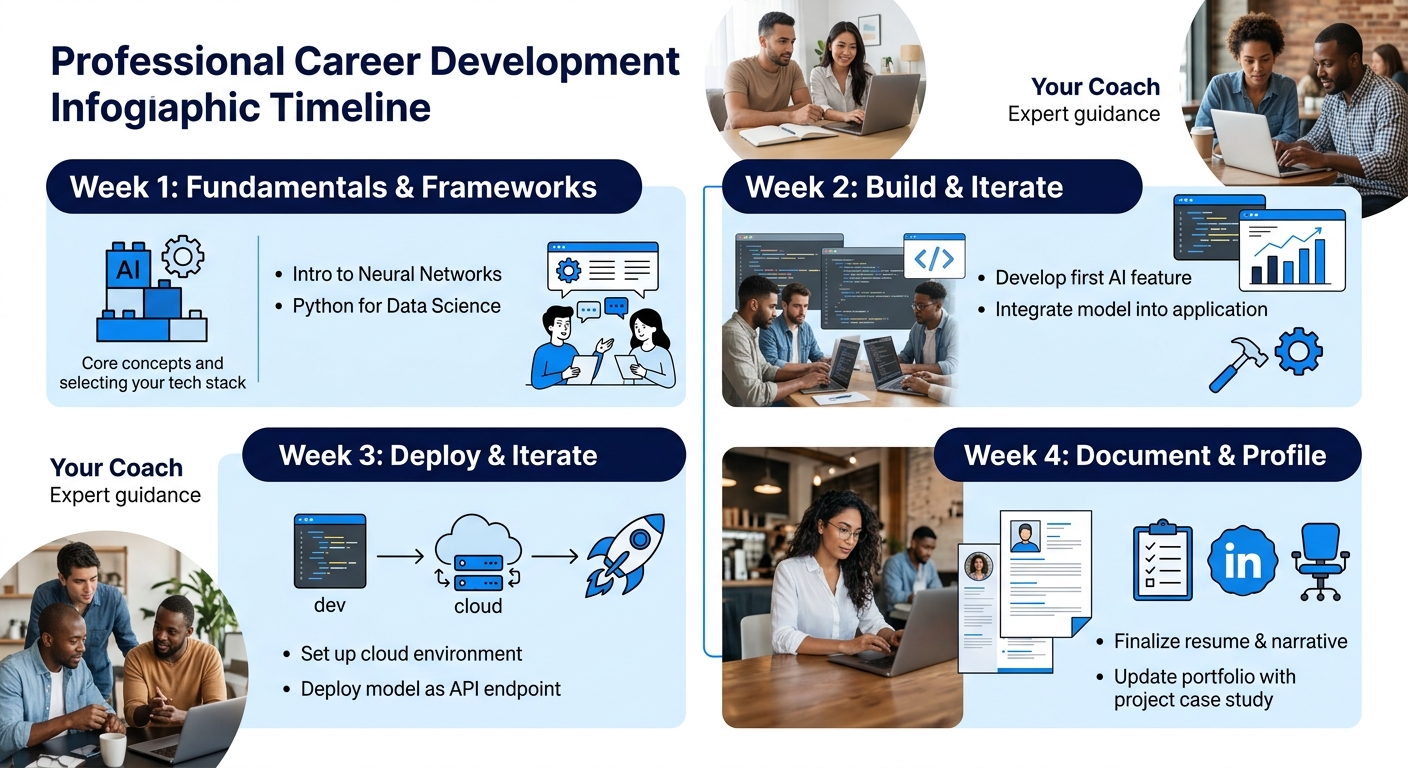
If you don’t have that experience yet, you need to build it before you rewrite your resume. Take two to four weeks, build a real project, deploy it somewhere, and then write the bullet point. “Designed and deployed a document classification pipeline using fine-tuned BERT models, reducing manual review time by 65% for a 10,000-document corpus” is a bullet that gets you interviews. “Experience with AI/ML tools” gets you filtered out.
Your resume’s structure should reflect this shift. Mapping upskilling into resume bullet points requires more than adding a “Certifications” line at the bottom. Create a dedicated “Projects” or “Applied AI” section that sits above your work history if your professional experience doesn’t include ML work. Companies like Intel and TSMC have launched apprenticeship programs specifically designed to develop AI skills, and completing programs like these gives you concrete entries for this section.
Tip: If you’re adding AI skills to your resume, make sure the rest of your application is consistent. Your LinkedIn headline, GitHub profile, and cover letter should all reflect the same AI-forward positioning. Hiring managers who see “ML Engineer” on your resume and “Backend Developer” on your LinkedIn will question which one is real.
The tradeoffs
The upside is significant: AI-focused roles are paying 20-40% premiums over equivalent non-AI engineering positions, and the demand curve still points upward. You’re positioning yourself on the side of the spending trend rather than against it, which is the strongest form of AI-driven job market resilience you can build into a resume.
The downside is the learning curve and the credibility gap. If your entire career has been building CRUD apps and REST APIs, a hiring manager will scrutinize your ML claims more carefully than they’d scrutinize a candidate with even one year of genuine ML experience. You need to bridge that gap with visible proof: open-source contributions, deployed projects, published technical writing, or certifications from recognized programs. The Freshworks layoffs earlier this year exposed exactly this kind of resume-to-hiring mismatch, where candidates’ stated skills didn’t hold up under technical evaluation.
There’s also a timing risk. If you spend three months upskilling and rebuilding your resume, you’re burning runway. Developers with limited savings or expiring severance benefits might not have that luxury.
How to Choose Between These Three
The honest answer is that your choice depends on three variables: how much financial runway you have, how transferable your existing skills are, and how much you actually want to stay in traditional tech.
If you have less than three months of savings, go with Strategy One. Reposition within tech. It’s the fastest path to a paycheck because you’re working with skills you already have and a resume that needs editing rather than rebuilding. Focus your energy on making your bullet points ruthlessly specific, targeting roles in growing areas of the tech stack, and applying at high volume. Speed matters more than perfect positioning when rent is due.
If you have three to six months of runway and your skills are general-purpose, Strategy Two deserves serious consideration. The adjacent-industry pivot takes longer to execute, but you’re entering markets with less competition and more gratitude for your skillset. Healthcare, energy, and logistics companies are genuinely struggling to hire competent engineers. Your tech pedigree is a differentiator in those rooms, not a commodity.
If you have six-plus months of runway and genuine interest in AI/ML, Strategy Three offers the highest long-term upside. But you need to be honest about whether you’re willing to build real projects and develop real competence, or whether you’re hoping that adding “AI” to your resume keywords will do the work for you. Hiring managers at companies spending billions on AI infrastructure can tell the difference in about ninety seconds.
Many developers will actually combine elements from two strategies. You might reposition within tech (Strategy One) for your immediate job search while building AI skills in the background (Strategy Three) to strengthen your position for the next move. That’s a reasonable approach, as long as your resume tells one clear story at a time. Trying to signal “experienced infrastructure engineer” and “aspiring ML engineer” in the same document creates confusion, and confused hiring managers move to the next applicant.
The 92,000 layoffs in 2026 aren’t a blip. The structural shift toward AI-driven efficiency and away from large-headcount engineering teams is real, and it’s accelerating. Your tech layoffs 2026 resume strategy should reflect that reality. Pick the path that matches your actual situation, commit to the resume architecture it demands, and get your application materials in front of the right people before everyone else running the same playbook catches up.