

 4.9
4.9 4.5
4.5Recruiters now expect job seekers to address employment gaps directly in interviews rather than obscuring them on resumes, according to guidance published July 3 by Goodwin Recruiting CEO Andy Decker in The Boston Globe. The shift reflects broader acceptance of career breaks while maintaining employer demand for honest explanations.
TL;DR: Employment gaps have become more common and less stigmatized since the COVID-19 pandemic, but hiring managers still require candidates to address them honestly during interviews and highlight any skills gained during the break.
Decker’s firm, a candidate recruitment and placement company, has observed the normalization of career interruptions across multiple industries. Extended periods between jobs became far more common during the pandemic as workers left positions to care for children or relatives, and remote work reduced stigma around non-linear career paths, Decker told the Globe. Some job seekers now label these periods on resumes as “career break” or “family responsibility,” he said.
The guidance arrives as employment gap stigma continues to fade but interview questions about work history lapses remain standard across screening processes. Job seekers who lost positions during mass layoffs or left to care for ill relatives can expect recruiters to probe the timeline, Decker said.
Direct Honest Acknowledgment Required
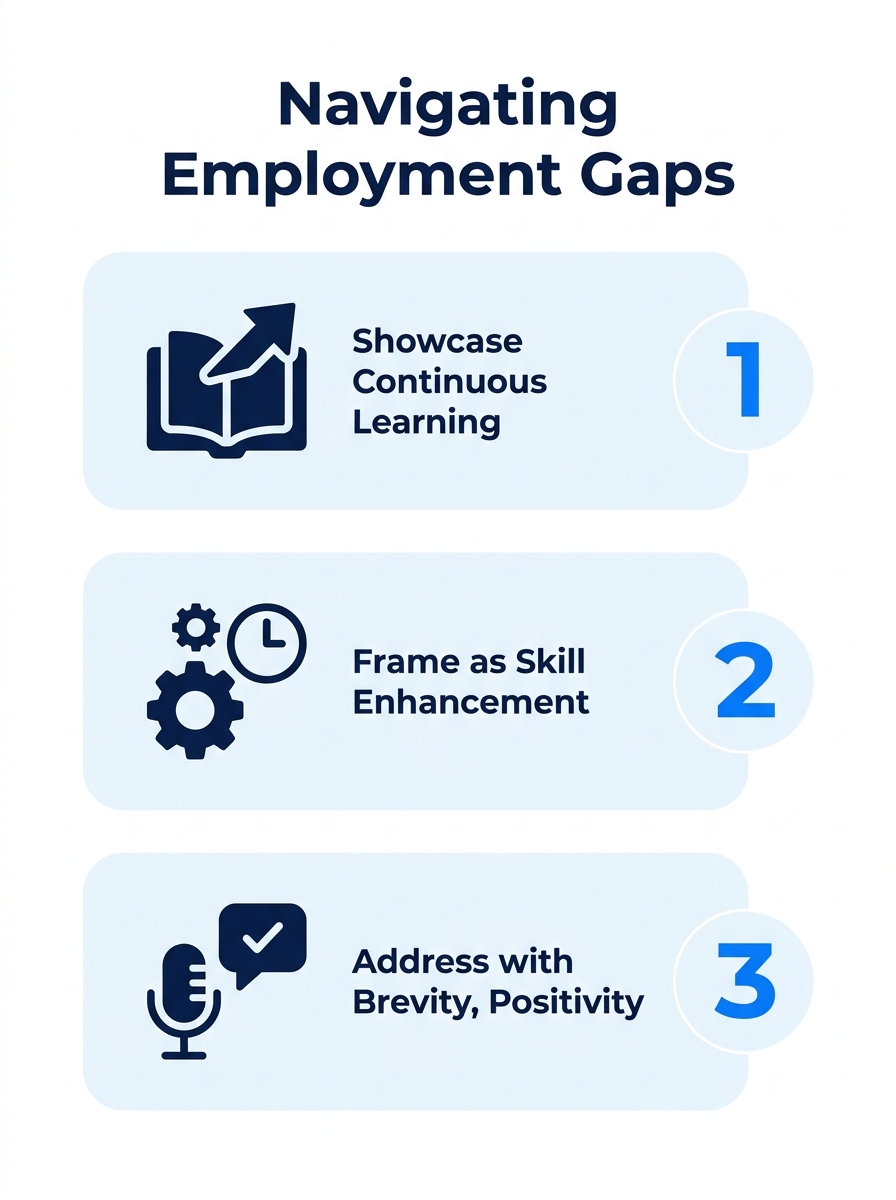
“You have to address it honestly and directly,” Decker said. “Make sure that you’ve included anything you did during that time. Did you get certifications? Did you volunteer?”
Employers focus more on skills and results than perfect career trajectories, according to the recruitment executive. Volunteering at nonprofit organizations during employment gaps keeps professional skills active and provides concrete talking points for interviews, he noted.
Job seekers should not volunteer layoff information on resumes but must respond honestly if interviewers ask why they left a previous position, Decker said. He recommended simple, factual responses: “I was one of 270 people caught up in this reduction of force,” or “Over two years we had five rounds of reductions in force, I made it through four, I was caught up in the fifth.”
Transferable Skills From Non-Traditional Experience
Monique Di Liberto, 57, faced a 17-year employment gap after leaving a career as a classically trained opera singer to raise children full-time while her husband built a chiropractic practice. When she decided to reenter the workforce, she had no traditional 9-to-5 job experience to feature on her resume.
Di Liberto reviewed activities beyond family life for skills that translated into work environments. Serving as PTA president required managing budgets and presenting project plans to the school board. She also handled budgeting, software rollouts, and hiring for her husband’s business.
Despite initial rejections for administrative support roles where employers said she wasn’t qualified, one interviewer was intrigued by her unconventional resume. Di Liberto proposed a monthlong trial run as an administrative assistant, telling the hiring manager: “I recognize that you probably are getting resumes of people who are far more qualified than me, but I would challenge that they are not as tenacious and driven as me.”
The company hired her. Over the next decade, she was promoted and recruited by other employers, eventually becoming head of client services at an artificial intelligence company. Interviewers asked about her employment gap at every new position, the Globe reported.
“I was fortunate enough to stay home for 17 years and raise amazing humans,” Di Liberto now tells potential employers. “And I worked from the ground up to be where I am today.”
Laura Sandvik, who left a marketing job to care for her mother and later her children, highlighted soft skills gained from those experiences in her LinkedIn profile. “I have no regrets about those choices,” Sandvik wrote. “They strengthened my patience, perspective, and sense of responsibility.”
Layoff Explanations: Own the Facts, Skip the Blame
Candidates should practice their gap explanations before interviews and avoid negativity such as blaming former employers, Decker said. “Own it, acknowledge it and move on,” he advised.
Baura Zia, 35, was laid off in 2022 shortly after returning from maternity leave. She spent the next three years raising two children full-time, labeling those years on her resume as a “parenting gap” that also included a cross-country move.
When Zia decided to find part-time work after her son’s first birthday, she explained during interviews that her previous organization eliminated her position because it lost the contract she was working on—not due to performance issues. “Having grace with yourself is really important,” Zia said. “It’s not a flaw to have a career gap.”
Zia’s job search proved easier than anticipated because she tapped into a professional network from a women’s public relations group she joined years earlier. Many cold-outreach messages to company employees went unanswered, but some responded, and her existing contacts provided critical leads.
The career coaches’ consensus on honest gap explanations aligns with Decker’s guidance—transparency paired with evidence of continued skill development carries more weight than attempts to hide or minimize career breaks.
The Takeaway
Resume gaps no longer carry the professional death sentence they once did, but interview preparation must include a practiced, factual explanation. The most effective approach pairs honest acknowledgment with concrete examples of what you accomplished during the break—whether that’s certifications, volunteer leadership, family business support, or caregiving that built transferable soft skills. Employers now accept that careers aren’t linear, but they still need to understand what you did with the time and why you’re ready to return. The candidates who land offers after extended gaps are the ones who can turn that history into a narrative about growth rather than an apology for absence.