
 4.9
4.9 4.5
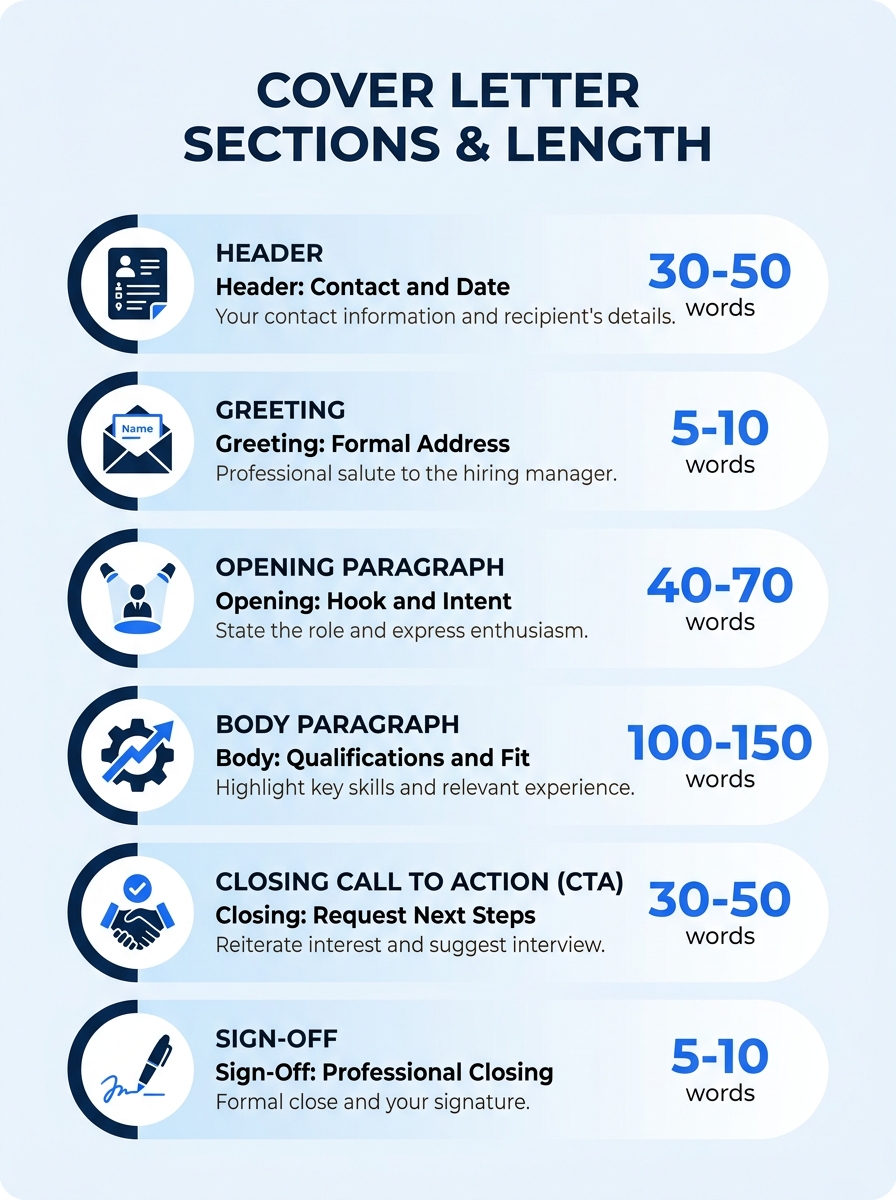
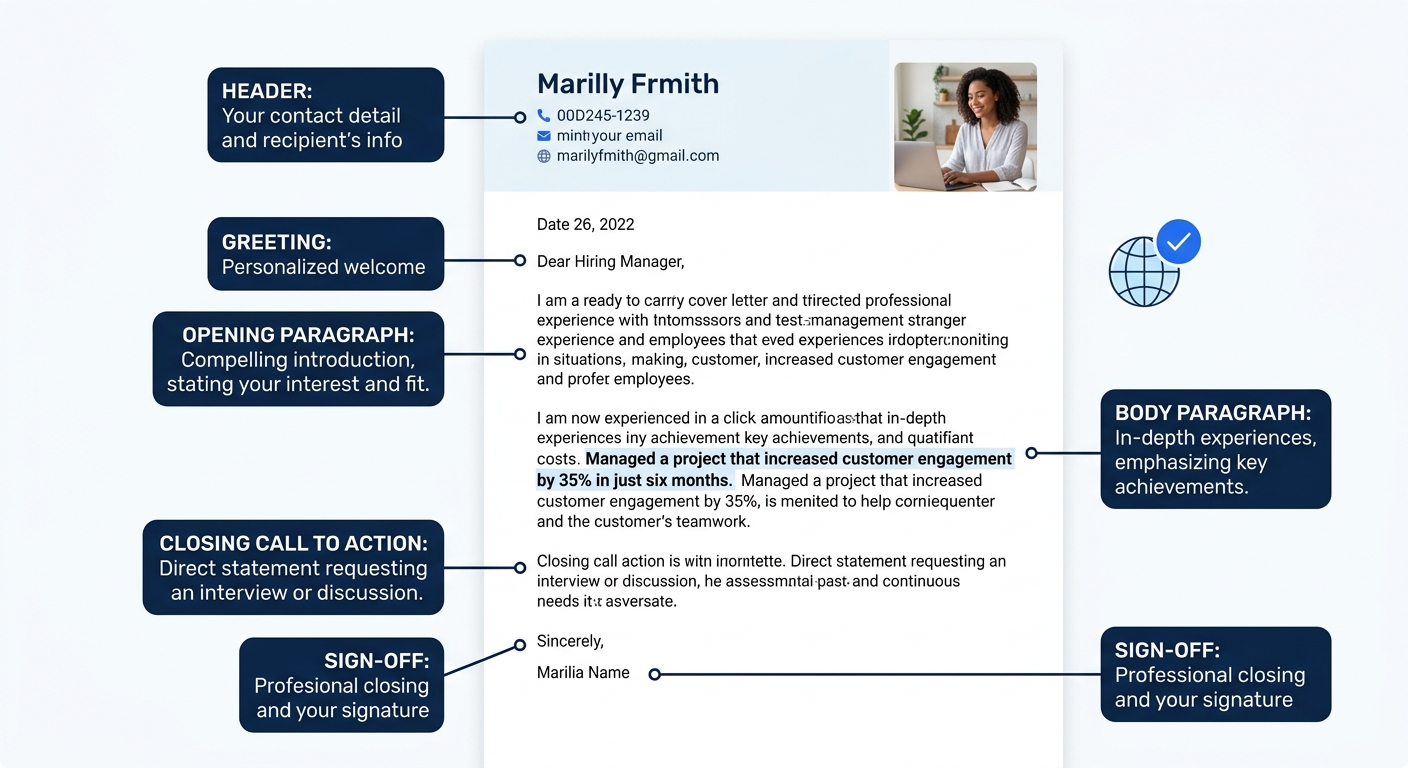
4.5Microsoft’s 2026 cover letter formatting guide and MIT’s career advising office agree on the same six-section structure: header, greeting, opening paragraph, body, closing call to action, and sign-off. This tutorial uses that structure to build a sample cover letter example you can adapt to any open position in about 30 minutes.
TL;DR: Every effective cover letter follows six sections in a fixed order. This guide walks you through writing each one, gives you a full sample you can copy and customize, and flags the three most common mistakes that get applications ignored.
Before You Start
Gather four things before you write a single word. Skipping this prep is the reason most cover letters come out generic and get tossed after a 60-second scan.
You’ll need:
- The job posting, open on your screen. You’ll pull exact phrases from it.
- Your resume, finalized. The cover letter complements your resume, it doesn’t repeat it.
- The hiring manager’s name. Check the job posting, the company’s team page, or LinkedIn. If you absolutely cannot find a name, “Dear Hiring Manager” works, but a real name is always stronger.
- Two or three of your achievements that match what the posting asks for. Think numbers: revenue generated, time saved, projects completed, customers served.
Time required: 30 minutes for your first letter. Subsequent letters adapted from this template take 10–15 minutes each.
Knowledge level: None beyond basic word processing. If you’ve written a professional email, you can write this.
Step 1: Set Up Your Header
The header sits at the top of your cover letter and mirrors the contact block on your resume. According to MIT’s career advising office, a cover letter should use a font size between 10 and 12 points and never exceed one page. Set those constraints now, before you start writing body text, so you don’t have to cut content later.
Your header includes:
- Your full name
- Phone number
- Professional email address
- City and state (full street address is optional and increasingly omitted)
- LinkedIn profile URL (if it’s current and complete)
Below your contact info, add the date, then the recipient’s name, their title, the company name, and the company address.
You’ll know this step worked when your header fills roughly 4–6 lines and looks identical in style to the header on your resume.
Tip: If you’re applying through an online portal that has separate fields for contact details, still include a header in your cover letter file. Hiring managers often print or forward the document, and a header-less letter looks incomplete.
Step 2: Write a Greeting That Uses a Real Name
“Dear Ms. Rodriguez,” beats “Dear Hiring Manager,” every time. A named greeting signals you did 45 seconds of research, which already separates you from the majority of applicants who skip this entirely.
Here’s how to find the name:
- Check the job posting for a listed contact.
- Search LinkedIn for the company name plus the department title (e.g., “Acme Corp Marketing Director”).
- Call the company’s front desk and ask who’s leading the search for that position.
If none of those work, “Dear Hiring Manager” or “Dear [Department] Team” is acceptable. Skip “To Whom It May Concern”, it reads like a form letter from 1998.
You’ll know this step worked when your greeting addresses a specific person or, at minimum, a specific team.
Step 3: Open With the Job Title and Your Strongest Credential
Your opening paragraph does exactly one thing: it tells the reader what job you want and gives a single reason to keep reading. Hiring managers spend roughly 60 seconds reviewing an application, according to hiring data cited by career advising centers, so your opener needs to justify the next 30 seconds immediately.
Here’s the formula:
Sentence 1: State the position you’re applying for and where you found it. Sentence 2: Name your strongest qualification, the one that maps most directly to the posting’s top requirement. Sentence 3 (optional): Express specific enthusiasm about the company, grounded in something real (a product, a mission statement, a recent initiative, anything that proves you looked them up).
Sample opening paragraph:
I’m writing to apply for the Marketing Coordinator position listed on your careers page. With three years of experience managing social media campaigns that grew audience engagement by 40% at a mid-size B2B firm, I’m confident I can contribute to Pinnacle Media’s content strategy. Your recent expansion into short-form video aligns directly with the campaign work I’ve led over the past two years.
That’s 65 words. Tight, specific, and it names a real number (40%) and a real company detail (short-form video expansion).
You’ll know this step worked when your opening paragraph contains the job title, one quantified credential, and one company-specific detail, all in under 75 words.
Step 4: Build the Body Around Matched Achievements
The body is where your sample cover letter example does the heavy lifting. You’re connecting dots between what the employer wants (pulled from the job posting) and what you’ve already accomplished (pulled from your resume, but told differently here).
Write one or two paragraphs. Each paragraph should contain a specific achievement that directly addresses a requirement in the posting. The Microsoft Word Blog’s 2026 formatting guide describes this section as the place where “clear sections guide readers through information,” and the guiding principle is simple: claim, evidence, connection.
- Claim: “I have experience managing cross-functional teams.”
- Evidence: “At Ridgeway Solutions, I led a 12-person team across engineering and design to ship a product redesign 3 weeks ahead of schedule.”
- Connection: “This experience maps directly to your posting’s requirement for a project lead who can coordinate between departments.”
You can also format two or three achievements as bullet points within the body if the prose version feels dense. Either format works as long as the content stays specific and each point ties back to the job posting.
Two rules for body paragraphs:
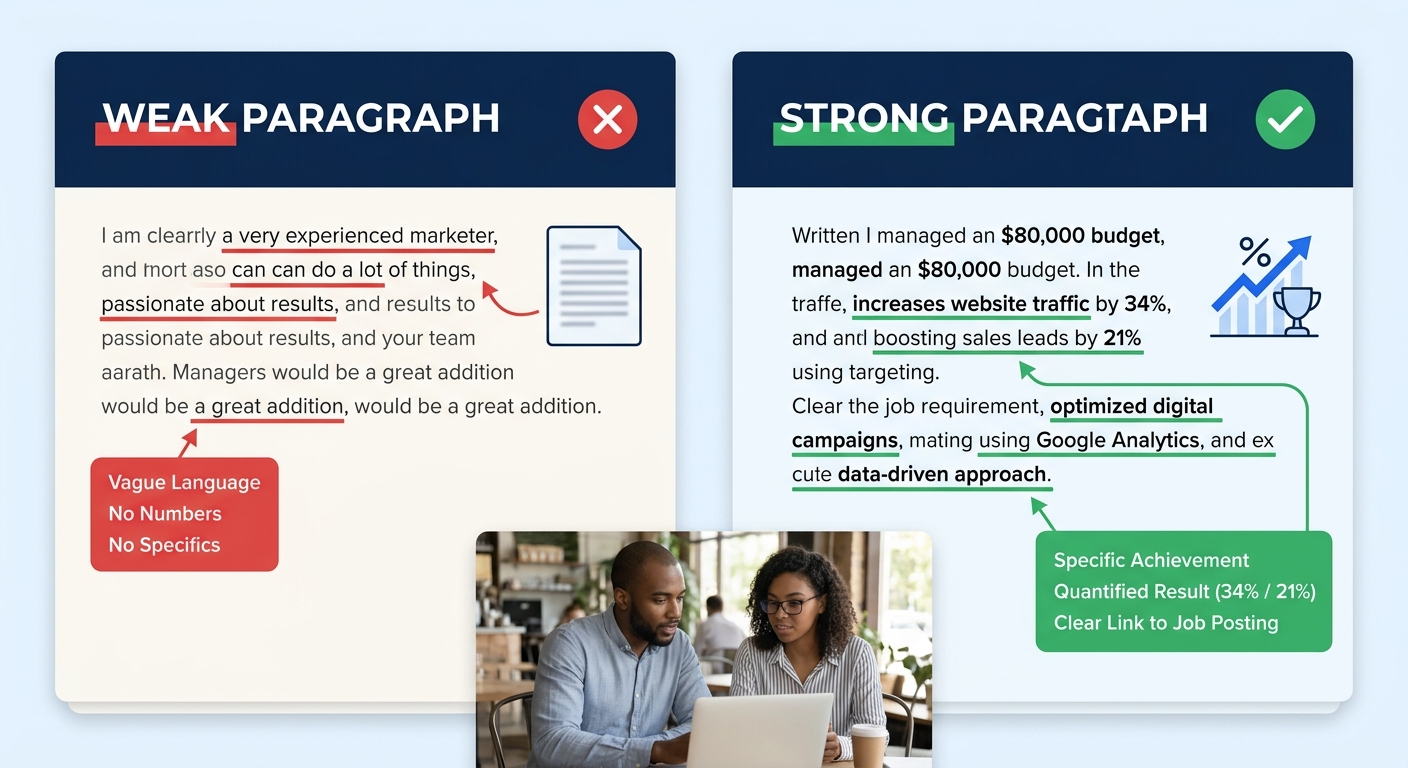
- Every achievement you mention must connect to something in the job posting. If it doesn’t, cut it regardless of how impressive it sounds.
- Quantify wherever possible. “Increased sales” is forgettable. “Increased regional sales by 18% over two quarters” sticks in a reader’s memory.
If you’re switching careers and your achievements don’t map in an obvious way, focus on identifying the transferable skills that translate across industries. A teacher applying for a corporate training role, for example, already has curriculum design, performance assessment, and group facilitation experience, all directly relevant to that new position.
You’ll know this step worked when every claim in your body paragraphs connects to a specific job posting requirement, and at least two achievements include hard numbers.
Step 5: Close With a Specific Call to Action
The closing paragraph does three things: it restates your interest, makes a clear ask, and thanks the reader. Most people write something vague here and lose momentum right when it counts.
A strong closing names a next step. Instead of “I hope to hear from you soon,” try something like this:
Sample closing paragraph:
I’m excited about the opportunity to bring my data analysis and team leadership experience to the Operations Analyst role at Greystone Partners. I’d welcome a conversation about how my background in process improvement, including the 22% efficiency gain I drove at my current company, can support your operations team. I’m available at your convenience and can be reached at (555) 987-6543 or [email protected].
That closing gives a reason for the meeting, names a concrete result, and provides a direct contact method. The hiring manager doesn’t have to hunt for your phone number or guess what you want from them.
End with a professional sign-off: “Best regards,” “Sincerely,” or “Thank you,” followed by your full name. Skip “Cheers,” “Warmly,” or anything overly casual unless the company’s culture clearly invites that tone.
You’ll know this step worked when your closing paragraph contains a specific reason to meet, a named availability, and a contact method, all in under 60 words.
If you remove the company name from your cover letter and everything still reads fine, the letter isn’t tailored enough. Go back to Steps 3 and 4.
Step 6: Format, Proofread, and Send
With all six sections written, you’re in the home stretch. Formatting errors and typos undermine even the strongest content, so spend the last five minutes here.
Formatting checklist:
- One page total. If you’re spilling onto page two, cut body content first.
- Font size between 10 and 12 points. Standard options: Arial, Calibri, Garamond, Times New Roman.
- 1-inch margins on all sides.
- Single-spaced text with a blank line between paragraphs.
- Save as PDF unless the posting specifically requests .docx. PDFs preserve your formatting across every device and operating system.
Proofreading process:
- Read the entire letter out loud. Your ear catches awkward phrasing your eyes skip over.
- Run spellcheck. It won’t catch context errors (“their” vs. “there”), but it catches the obvious ones.
- Have someone else read it. A second pair of eyes finds errors you’ve gone blind to after multiple drafts.
Warning: Double-check the company name and the hiring manager’s name before sending. Sending a letter addressed to “Dear Ms. Patel” when the hiring manager is Ms. Park is an instant rejection signal. The same goes for leaving another company’s name in a letter you adapted from a previous application. This mistake is more common than anyone admits.
You’ll know this step worked when your letter is one page, consistently formatted, typo-free, and saved as a PDF with a clear file name like “YourName-CoverLetter-CompanyName.pdf.”
For a look at how different industries shape these six sections differently, our collection of cover letter examples organized by job type shows the variations across fields.
The Complete Sample Cover Letter Example
Here’s the full letter, assembled from all six steps. Replace the bracketed content with your own details.
[Your Name] [Your Phone] | [Your Email] | [Your City, State] [Your LinkedIn URL]
[Date]
[Hiring Manager’s Name] [Their Title] [Company Name] [Company Address]
Dear [Ms./Mr. Last Name],
I’m writing to apply for the [Job Title] position listed on [where you found it]. With [X years] of experience in [relevant field/skill], including [one specific, quantified achievement], I’m confident I can contribute to [Company Name]’s [specific goal or initiative you researched].
In my current role at [Current Company], I [specific achievement #1 with numbers]. This experience directly supports your team’s need for [requirement from job posting]. I also [specific achievement #2 with numbers], which aligns with your posting’s emphasis on [second requirement from job posting].
I’d welcome the opportunity to discuss how my [key skill] experience can support [specific company goal]. I’m available for a conversation at your convenience and can be reached at [phone] or [email].
Best regards, [Your Full Name]
That whole letter takes a hiring manager under 60 seconds to read. They see a direct match between their requirements and your qualifications, and they know exactly how to reach you. For more fill-in structures built on this same framework, check out our complete cover letter template guide.
When the Letter Falls Flat
Three things go wrong most often. Here’s how to recognize and fix each one.
Problem 1: The letter exceeds one page. You’ll notice this when the PDF has a second page with just your closing orphaned at the top. The fix: remove one body achievement entirely. Two well-explained achievements beat three crammed ones. You can also reduce your header to two lines (name on one, phone/email/city on the second) to reclaim vertical space.
Problem 2: The body reads like a repeated resume. If your cover letter sentences start with the same verb phrases as your resume bullets (“Managed a team of…” / “Developed a process for…”), you’re duplicating rather than complementing. Rewrite each cover letter achievement as a mini-story: what was the situation, what did you do, what resulted? The resume gives the bullet; the letter gives the context behind it. If you want guidance on making your resume and cover letter work as a matched pair, browse our career guides on the blog.
Problem 3: The letter is generic. Test this by removing the company name. If everything still makes sense without it, you haven’t tailored enough. Go back to Steps 3 and 4 and add at least one detail specific to this employer: a product they launched, a value from their mission statement, a challenge their industry faces that you can address. ResumeWriting.net’s resources can help you research what to include for specific roles and industries.
Where to Go From Here
The sample cover letter example above gives you a reusable scaffold. Every new application means swapping out the achievements in Steps 3 and 4, updating the company-specific details, and re-running the proofread in Step 6. Your header, greeting format, and closing structure stay largely the same across applications.
Adaptation gets fast once you have a strong base letter. The first one takes 30 minutes; the fifth takes 10. And because each version is tailored to a specific posting with specific achievements and specific company research, you’re producing something a hiring manager can distinguish from the hundreds of generic submissions in their queue. If you want to see how other professionals have handled the same six-section structure across various career stages, our real cover letter templates collection shows finished examples you can study and borrow from.