

 4.9
4.9 4.5
4.5Applicant tracking systems filter out roughly 50% of applications before a human ever reads them. The 10 cover letter samples below are structured to clear that automated screen and hold a hiring manager’s attention across roles from entry-level through senior management, each customizable in under 30 minutes.
TL;DR: Pick the sample closest to your job target, replace the bracketed text with your own quantified achievements, and keep the whole thing under one page at 10–12 point font. Every example here follows the three-to-four paragraph format that [MIT’s career advising team recommends](https://capd.mit.edu/resources/how-to-write-an-effective-cover-letter/).
Before You Start
You need four things before you touch any sample for a cover letter: the job posting you’re targeting, your resume (updated), the name of the hiring manager if you can find it, and 2–3 achievements you can express with numbers. Without these, you’ll produce a generic letter that reads like every other applicant’s.
Here’s how to gather them:
- Job posting: Copy the full description into a document. Highlight the top 3–5 requirements.
- Resume: Have it open side by side. You’ll pull specific numbers from it.
- Hiring manager’s name: Check LinkedIn, the company’s team page, or the posting itself. Indeed’s formatting guide notes that if you can’t find a name, “Dear Hiring Manager” is acceptable.
- 2–3 measurable achievements: Revenue generated, costs reduced, percentage improvements, team sizes managed, customer satisfaction scores. If you’re entry-level, academic metrics, volunteer project outcomes, or coursework results work.
Tip: The University of Michigan’s Career Center advises candidates to “describe your qualifications for the type of position you seek using specific examples from academic, work, volunteer, and/or co-curricular experiences.” Even if you’re fresh out of school, you have quantifiable results somewhere.
Time required: 25–35 minutes once your materials are ready.
Step 1: Identify Your Scenario in the Table Below
Each of the 10 samples targets a different job situation. Scan this table, find your closest match, and scroll to that sample.
| Sample # | Scenario | Best For |
|---|---|---|
| 1 | Recent graduate, limited experience | First full-time role |
| 2 | Internship application | College students |
| 3 | Mid-career marketing professional | 4–8 years experience |
| 4 | Software developer | Technical roles |
| 5 | Career changer | Switching industries |
| 6 | Sales representative | Revenue-driven roles |
| 7 | Registered nurse | Healthcare |
| 8 | Administrative assistant | Support/operations |
| 9 | Project manager | Cross-functional leadership |
| 10 | Graphic designer | Creative portfolios |
Step 2: Copy Your Sample and Replace the Brackets
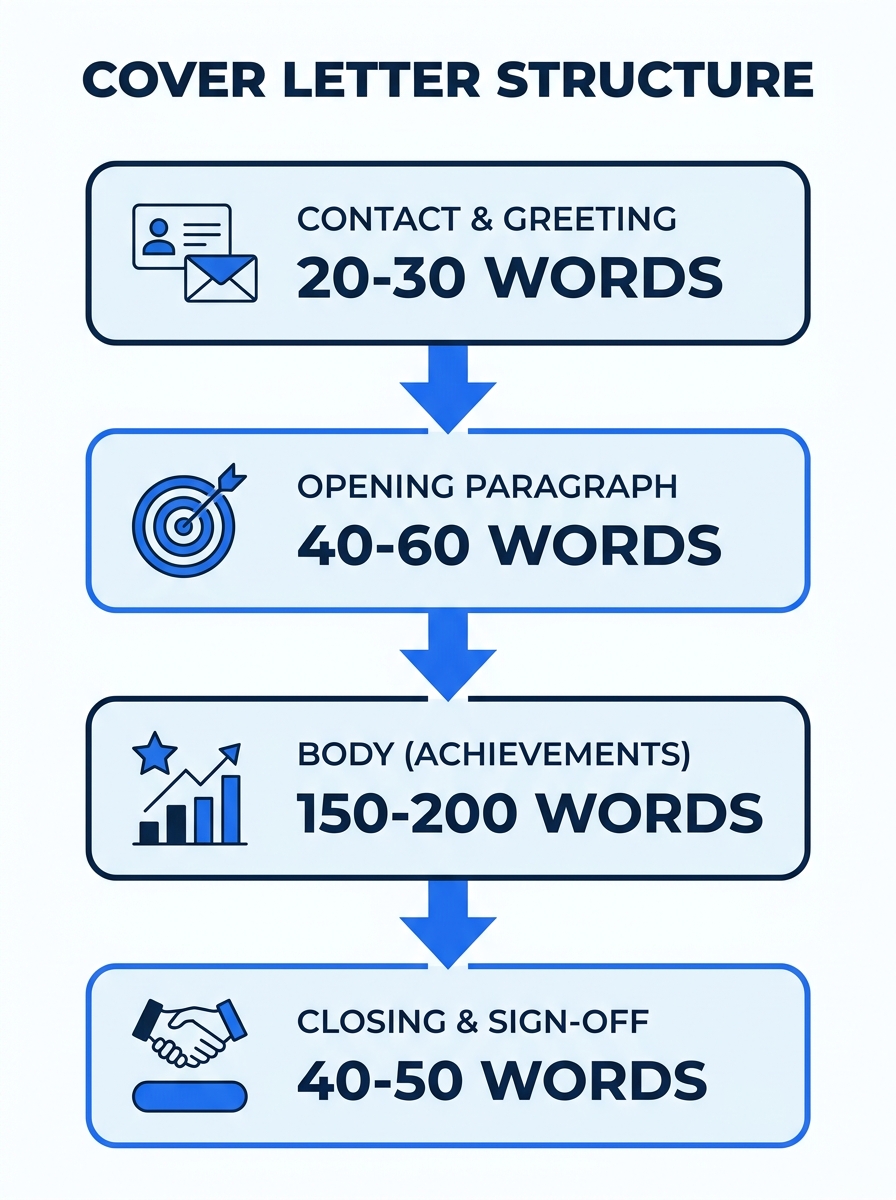
Below are the 10 samples grouped by experience level. Each sample shows the opening and body paragraphs, the sections that matter most. Replace everything in brackets with your own details. You’ll know this step worked when every bracket is gone and each paragraph contains at least one specific number.
Samples 1–2: Entry-Level and Internship
Sample 1, Recent Graduate
Dear [Hiring Manager Name],
Your posting for [Job Title] asks for someone who can [key requirement from posting]. During my senior capstone at [University], I led a four-person team that [specific project outcome, e.g., “increased the student org’s event attendance by 34% over one semester”]. That experience taught me [relevant skill], and I’m eager to apply it at [Company Name].
In my role as [part-time job/volunteer position] at [Organization], I [achievement with number, e.g., “processed 120+ customer transactions daily while maintaining a 98% accuracy rate”]. I’m drawn to [Company Name] because [specific detail about the company’s mission, product, or recent news].
Sample 2, Internship Application
Dear [Hiring Manager Name],
As a [Year, e.g., “junior”] studying [Major] at [University], I’ve built skills in [2–3 relevant skills] through coursework including [specific class]. My research project on [topic] required me to [action verb + measurable outcome, e.g., “analyze 2,000+ survey responses and present findings to a faculty panel of 12”].
I’m particularly interested in [Company]’s work on [specific project or product], and I believe my background in [skill] would contribute to [team/department]’s goals for [specific initiative if known].
For more entry-level approaches, we’ve compiled additional cover letter samples by job type with full templates.
Samples 3–5: Mid-Career and Career Changers
Sample 3, Marketing Manager (Mid-Career)
Dear [Hiring Manager Name],
At [Current Company], I manage a $[X] annual digital marketing budget and a team of [number]. Over the past [timeframe], my campaigns have driven [specific result, e.g., “a 28% increase in qualified leads and a 15% reduction in cost-per-acquisition”]. Your posting emphasizes [requirement], and that aligns directly with the demand-generation strategy I’ve built here.
One campaign I’m particularly proud of: [brief description, 1–2 sentences, e.g., “I redesigned our email nurture sequence, which lifted open rates from 19% to 37% and generated $420K in pipeline within 90 days”].
Sample 4, Software Developer
Dear [Hiring Manager Name],
Your team’s work on [specific product/feature] caught my attention because [genuine reason]. At [Current Company], I’ve spent [X years] building [type of systems, e.g., “RESTful APIs serving 50,000+ daily requests with 99.9% uptime”]. My most recent project involved [specific technical accomplishment with measurable result].
I write primarily in [languages], and I’ve contributed to [open-source project or internal tool] that [quantified impact, e.g., “reduced deployment time by 40% across three engineering teams”].
Sample 5, Career Changer (Teacher to Corporate Trainer)
Dear [Hiring Manager Name],
After [X years] teaching [subject] to classes of [number] students, I developed curriculum that raised standardized test scores by [X%] across [number] sections. The skills behind those results, needs assessment, content design, stakeholder communication, and measurable outcome tracking, are the same ones your Corporate Trainer posting requires.
At [School/District], I also [relevant transferable achievement, e.g., “onboarded 15 new teachers using a training program I designed, cutting their ramp-up time from 8 weeks to 5”].
If you’re navigating an industry switch, our piece on proven cover letter structures that lead to interviews walks through the transferable-skills framing in more depth.
Samples 6–8: Industry-Specific Roles
Sample 6, Sales Representative
Dear [Hiring Manager Name],
In my [X years] at [Current Company], I’ve consistently exceeded quota, most recently finishing Q[X] at [X%] of target, generating $[amount] in new business. Your posting mentions [specific sales methodology or market focus], which mirrors the approach I’ve used to [brief accomplishment, e.g., “grow my territory’s client base from 40 accounts to 73 in 18 months”].
Sample 7, Registered Nurse
Dear [Hiring Manager Name],
I hold a [BSN/MSN] from [University] and [X years] of clinical experience in [specialty]. At [Hospital/Facility], I manage patient loads of [number] per shift and have maintained a [X%] patient satisfaction rating over [timeframe]. I’m drawn to [Facility Name]’s reputation for [specific strength, e.g., “evidence-based cardiac care”].
Sample 8, Administrative Assistant
Dear [Hiring Manager Name],
At [Current Company], I support [number] executives, manage calendars across [number] time zones, and coordinate [specific process, e.g., “quarterly board meetings with 25+ attendees, including travel and logistics for 8 out-of-state directors”]. My approach to organization cut scheduling conflicts by [X%] last year.
The difference between a cover letter that gets read and one that gets skipped comes down to one thing: proof. Numbers, percentages, dollar figures. Proof that you’ve done the work.
Samples 9–10: Leadership and Creative Roles
Sample 9, Project Manager
Dear [Hiring Manager Name],
I’ve delivered [number] projects on time and under budget at [Current Company], managing cross-functional teams of [number] and budgets up to $[amount]. My most recent initiative, [brief description], came in [X%] under budget while hitting every milestone [X days/weeks] ahead of schedule.
What draws me to [Company Name] is [specific project, product, or company value]. I see an opportunity to bring the [methodology, e.g., “agile sprint structure”] I’ve refined here to your [department/team].
Sample 10, Graphic Designer
Dear [Hiring Manager Name],
My portfolio at [URL] includes [number] projects completed for clients including [2–3 notable names or industries]. At [Current Company/Agency], I redesigned [specific asset, e.g., “the product packaging line for a CPG brand”], which contributed to a [X%] increase in shelf-level sales over [timeframe].
I work in [software tools], and I’m particularly drawn to [Company Name]’s visual identity because [specific, genuine observation about their brand].
For designers specifically, our breakdown of graphic designer resume examples from entry to senior levels pairs well with this sample when you’re building a full application package.
Step 3: Rewrite Generic Lines with Quantified Proof
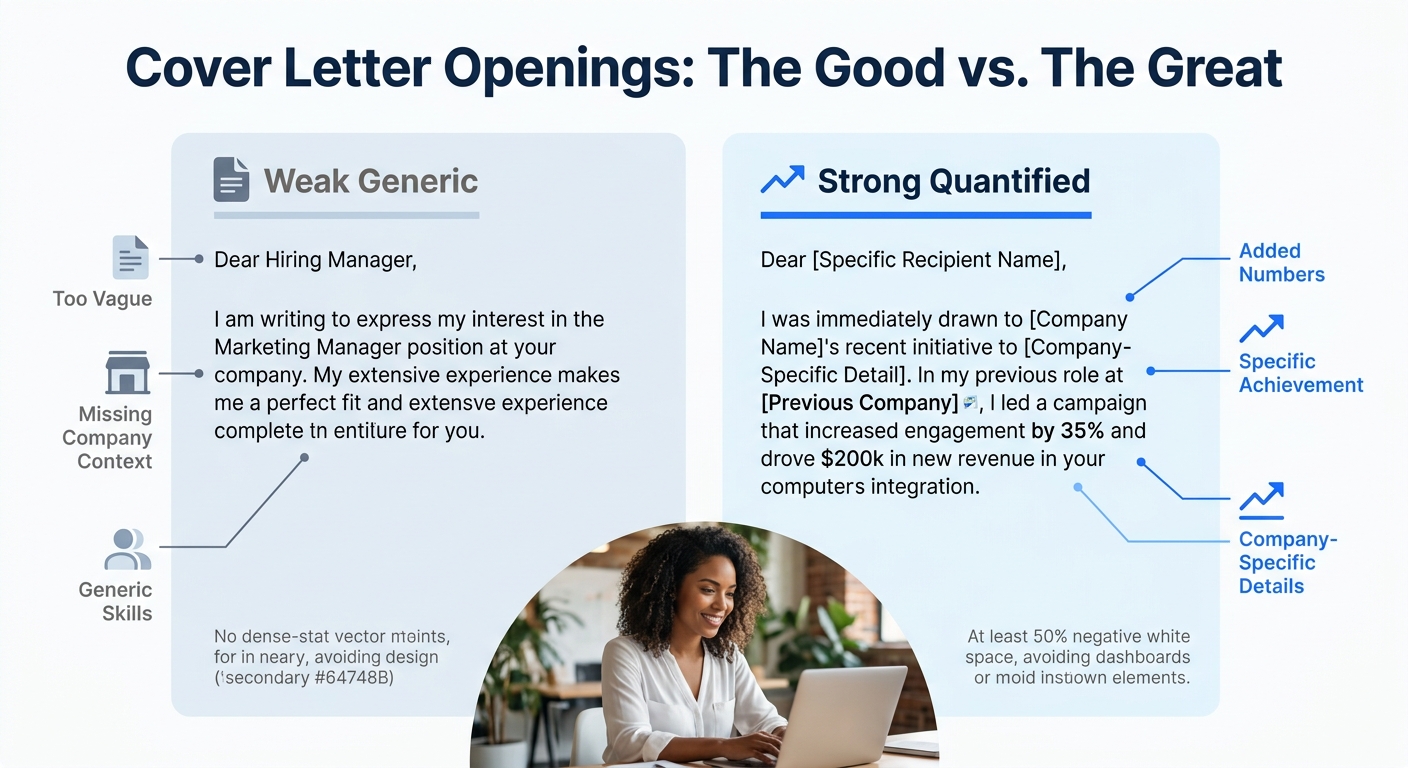
Go through your customized draft and hunt for any sentence that doesn’t include a number, a name, or a specific detail. As Indeed’s cover letter formatting guide notes, your cover letter should “showcase soft skills and personality” while differentiating you from identical applications. Vague claims like “I’m a hard worker” or “I have strong communication skills” do neither.
Here are before-and-after rewrites:
- Before: “I have extensive experience in customer service.”
- After: “I handled 85+ customer calls daily at [Company], maintaining a 4.8/5.0 satisfaction rating across 14 months.”
- Before: “I’m passionate about marketing.”
- After: “I grew our Instagram following from 2,100 to 11,400 in six months using a content calendar I built from scratch.”
- Before: “I’m a strong team player.”
- After: “I coordinated a 9-person volunteer crew that packed 3,000 meal kits in a single weekend.”
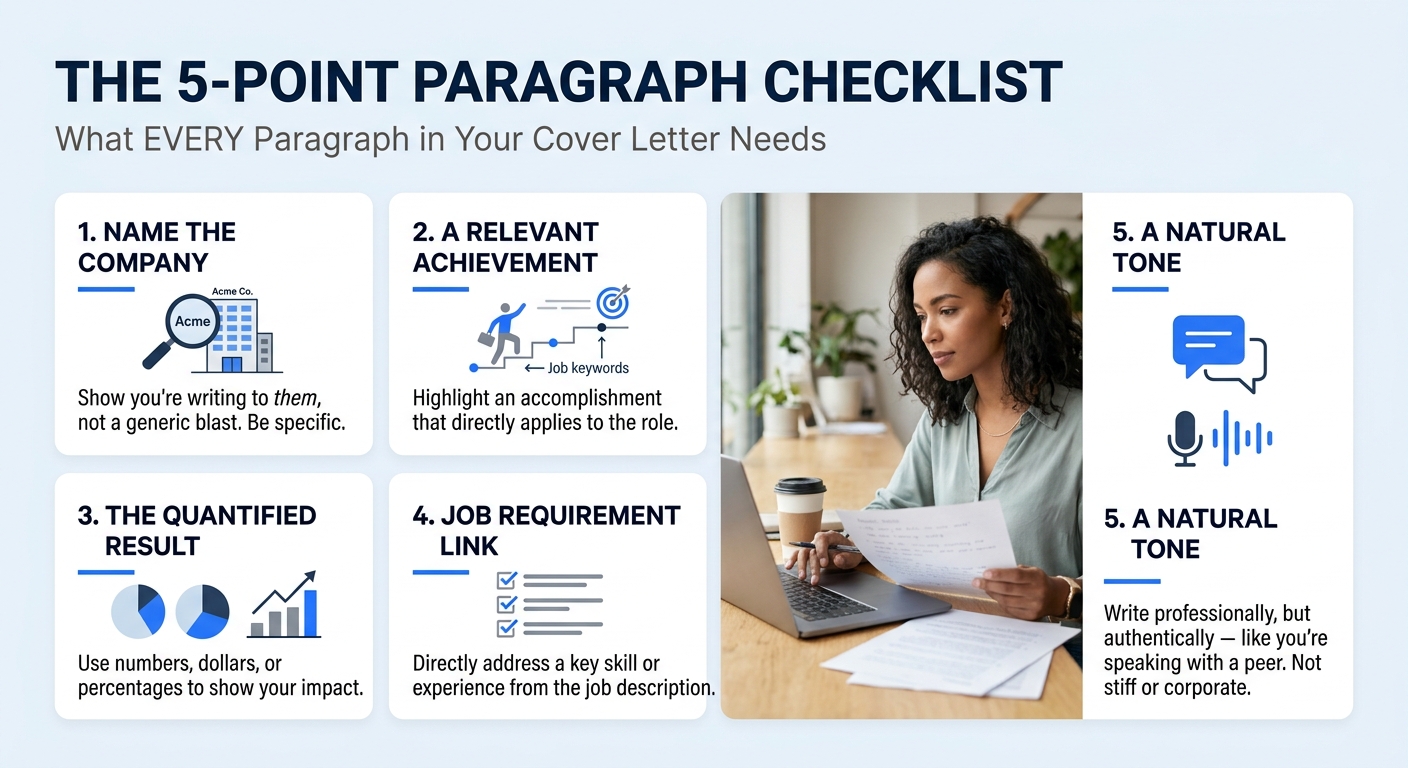
You’ll know this step worked when you read each paragraph and find at least one concrete metric.
Step 4: Format, Proofread, and Send
Set your font to 10–12 points, keep margins at 1 inch, and confirm everything fits on one page. MIT’s career advising team is direct on this: “A cover letter should be no longer than one page with a font size between 10-12 points.” If you’re over, cut the weakest paragraph.
Proofread by reading the letter out loud. Your ear catches awkward phrasing that your eyes skip. Save as PDF unless the posting specifically asks for a Word document, PDFs preserve your formatting across devices.
You’ll know this step worked when: the letter is one page, every bracket from the original sample is gone, and you’ve said the hiring manager’s name at least once.
Warning: Don’t skip the reference code. If the job posting includes a requisition number or reference code, put it in your opening line (“Re: Marketing Manager, Req #4582”). MIT’s guide specifically flags this: “be sure to include it in your letter so that human resources is able to accurately track your application.”
When Your Cover Letter Isn’t Getting Responses
Three common failure points and how to diagnose each:
- You’re getting filtered by ATS before a human reads you. Symptom: zero response on 20+ applications. Fix: Mirror the exact job title and 3–5 keyword phrases from the posting in your letter. If the posting says “project coordination,” don’t substitute “project management.” Read our guide on how proven cover letter templates handle keyword matching for specific examples.
- Your letter is too generic. Symptom: occasional responses, but only for roles where competition is low. Fix: Every cover letter should name the company at least twice and reference something specific, a product, a recent company announcement, a value from their mission statement. If you could swap in a different company name without changing anything else, the letter is too vague.
- Your achievements aren’t believable. Symptom: interviews where they seem skeptical of your claims. Fix: Add context to your numbers. “Grew revenue 200%” sounds inflated without context. “Grew territory revenue from $150K to $450K over 18 months by expanding into two adjacent verticals” tells a story someone can verify.
Where to Go From Here
These 10 samples cover the most common job-search scenarios, but your finished letter should sound like you wrote it, not like you filled in a template. After you’ve customized your sample, ask someone who knows your work to read it. Their feedback on tone and accuracy catches things self-editing misses. If you want to build the rest of your application materials to match, our sample cover letters with full walkthroughs show how to pair your letter with a resume that reinforces the same achievements, same numbers, same framing, consistent across every document the hiring manager sees.