
 4.9
4.9 4.5
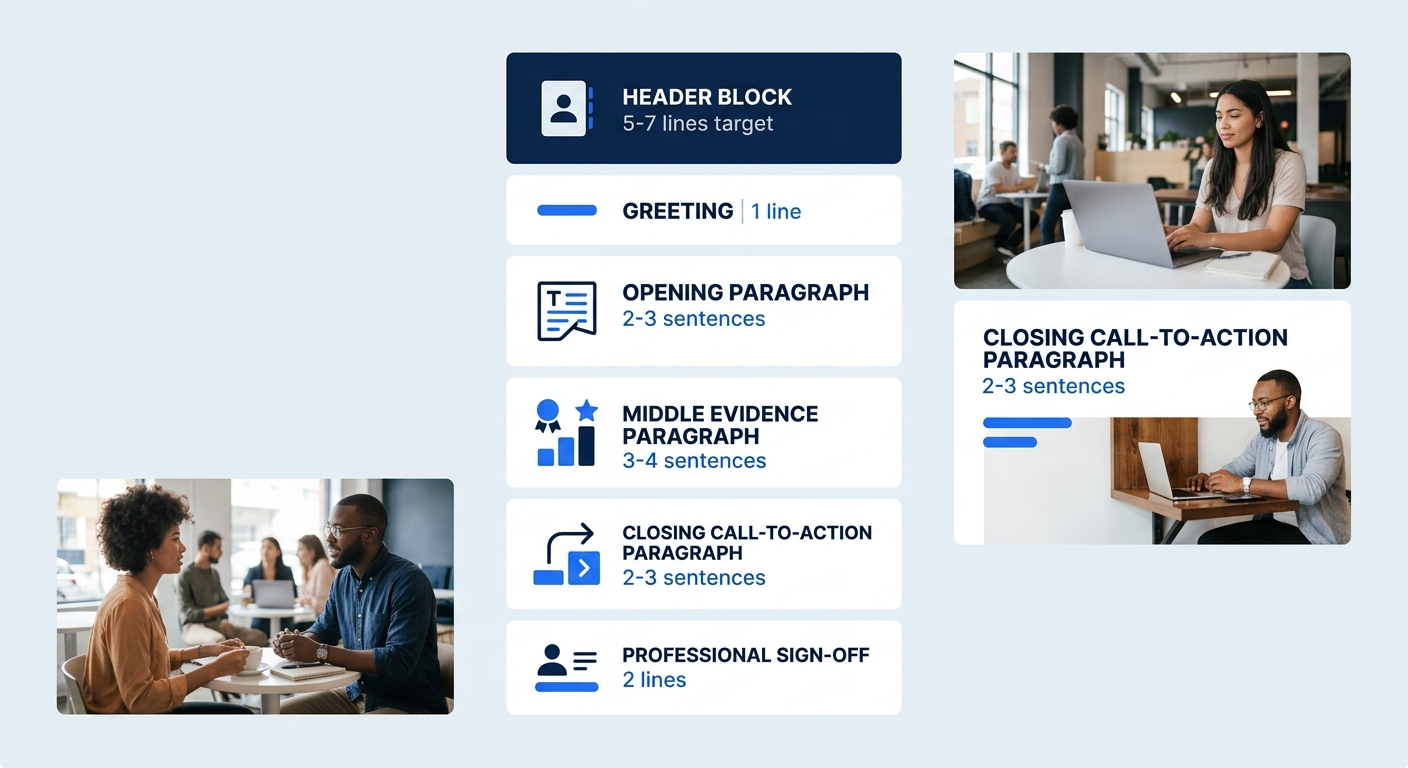
4.5Microsoft’s Word Blog specifies six sections for a properly formatted cover letter: header, greeting, opening paragraph, middle paragraph, closing call to action, and professional sign-off. The free sample for cover letter template below follows that exact structure, and you can customize it for any job posting in under 30 minutes.
TL;DR: Copy the template at the bottom of this article, fill in five blanks (company name, role title, one measurable result, one company-specific detail, your sign-off name), and send a single-page cover letter that matches what hiring managers scan for in their 6–7 seconds of reading time.
Before You Start
You need three things ready before touching the template. Skipping any of them leads to a generic letter that reads like every other submission in the pile.
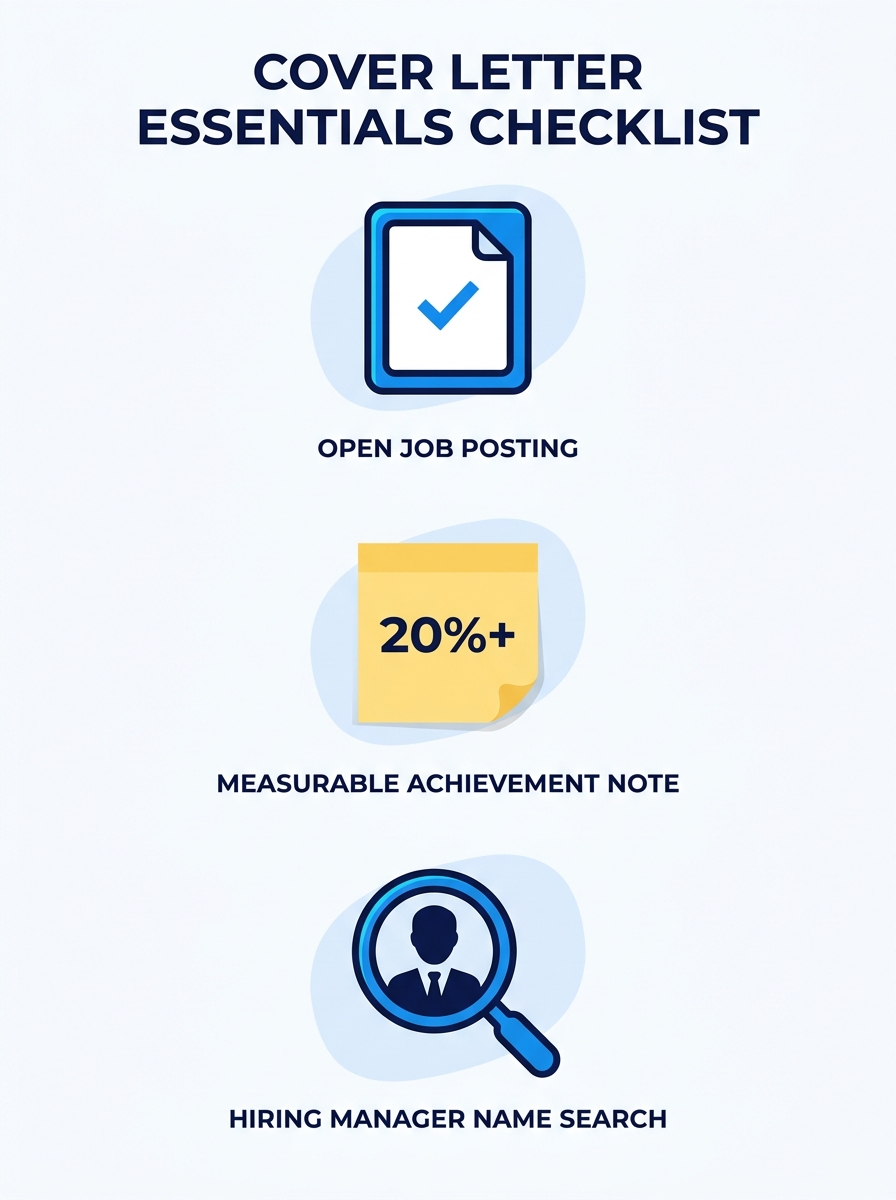
The job posting, open on your screen. You’ll pull the exact job title, the department name, and 2–3 key qualifications directly from the listing. If the role has a reference code, grab that too. MIT’s Career Advising office notes that you should include any reference number in your letter “so that human resources is able to accurately track your application,” per their published cover letter guidance.
One measurable achievement from your recent work. A percentage improvement, a dollar figure, a headcount you managed, a timeline you beat. The 2026 template trends tracked by career platforms show early-career candidates (2–5 years of experience) who include a specific metric like “improved efficiency by 15%” consistently outperform vague claims about being a “hard worker.” Have your number picked before you start writing.
The hiring manager’s name, if findable. Check the posting, the company’s team page, or LinkedIn. This takes 3–5 minutes and changes your greeting from generic to specific. If you can’t find a name after a reasonable search, “Dear Hiring Manager” works fine.
Step 1: Build Your Header and Contact Block
The header sits at the very top of your letter and mirrors the header on your resume. Include your full name, phone number, email address, and city/state (full street address is no longer expected in 2026). The University of Michigan Career Center specifies that the layout should be “left justified, beginning no more than 2 inches from the top” of the page, using “positive language, confident but not imposing, concise with supporting detail, written in active verb voice,” according to their cover letter resources page.
Below your contact info, add the date and then the company’s address block: hiring manager’s name (if known), their title, company name, company address. This formal structure signals professionalism before anyone reads a word of your pitch.
You’ll know it worked when your header occupies 5–7 lines and aligns left with the rest of your document. If it’s eating half the page, trim your address to one line and drop the company’s street address.
Step 2: Write a Greeting That Names a Real Person
“Dear Ms. Rodriguez,” beats “To Whom It May Concern” every time. But when you genuinely can’t identify the hiring manager, MIT’s career advising team recommends a clean fallback: “If you are not sure who to address the letter to, write ‘Dear Hiring Manager.'”
Don’t use “Dear Sir/Madam” (it sounds like 1997) or “Hey there” (too casual for 94% of industries). The greeting is one line. Spend your energy on the paragraphs that follow.
You’ll know it worked when your greeting contains either a specific person’s name with the correct honorific or the phrase “Dear Hiring Manager” followed by a comma.
Step 3: Open With Your Purpose and the Job Title
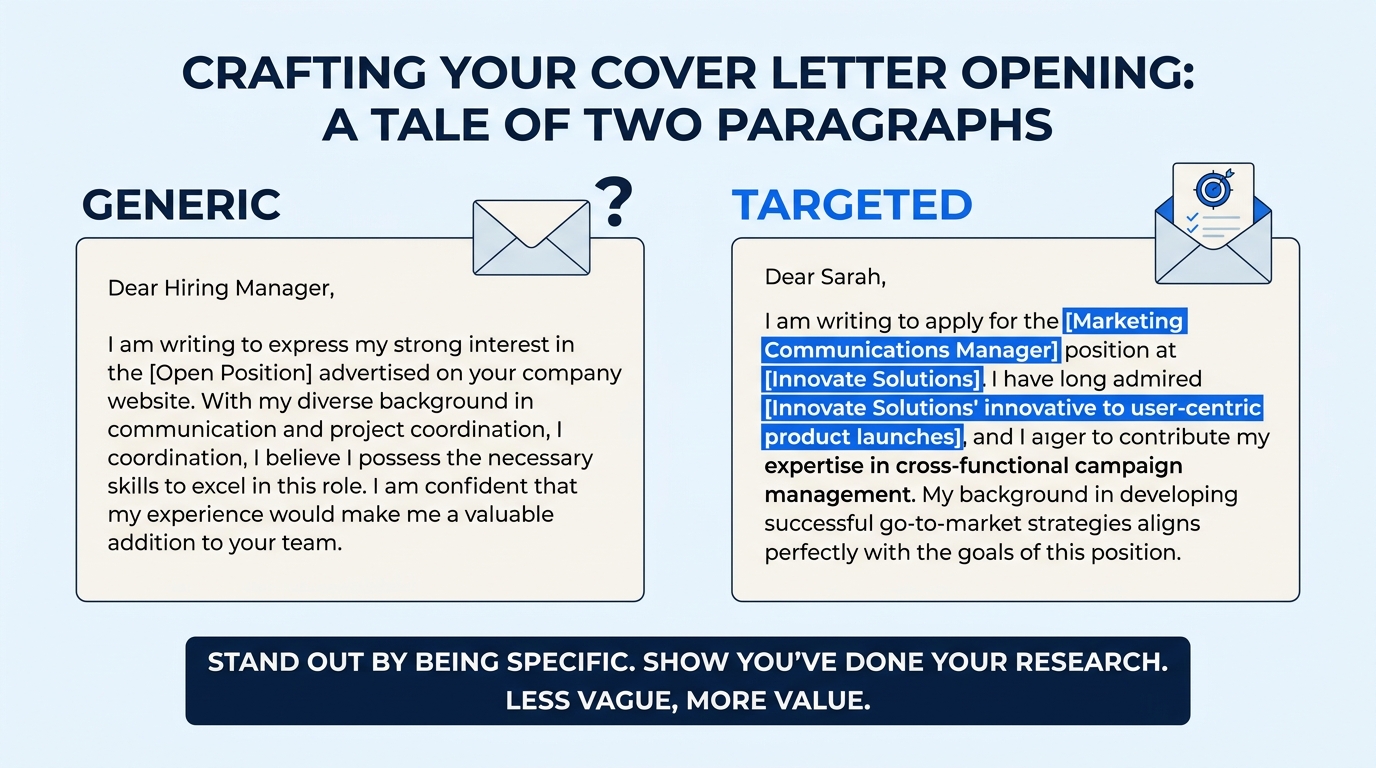
Your first paragraph does two things in 2–3 sentences: it names the role you’re applying for and gives one reason the company interests you. MIT’s career advising guidance says to “state clearly in your opening sentence the purpose for your letter and a brief professional introduction.” That’s the whole formula. Name the job title, state that you’re applying, and connect your background to it in one sentence.
This is where your pre-research pays off. If the company just launched a product, expanded to a new market, or announced a mission shift, mention it. Hiring teams in 2026 face larger requisition loads than ever, and templates designed to reveal how a candidate thinks about the company stand out from the 77% of applications that now read as AI-generated boilerplate.
You’ll know it worked when a stranger reading your opening paragraph can identify three facts: (1) your name, (2) the exact role title, and (3) one specific reason you want this job at this company. If any of those three are missing, revise.
Step 4: Build the Middle Around One Measurable Result
The middle paragraph is your proof section. Pick the single strongest example from your career that maps to what this job posting asks for, and build 3–4 sentences around it. Include the measurable result you identified before starting.
Indeed’s career advice team advises keeping the entire cover letter to one page using “a simple, professional” format, per their writing guide. That constraint matters here: you don’t have room for three examples. One detailed achievement with a real number (revenue increase of $40,000, customer retention improved by 22%, project delivered 3 weeks ahead of schedule) does more than three vague claims stacked together.
Tip: Match your evidence to your experience level. Entry-level candidates should focus on education, internships, and transferable skills. Mid-level professionals should show consistent results and cross-functional collaboration. Senior applicants need to highlight strategic decisions and their business impact. The sample for cover letter template below works for all levels, the difference is which achievement you slot in.
If you’ve written sample cover letter examples before, you already know this paragraph is where most people get stuck. They default to listing duties instead of outcomes. Write the outcome first, then explain what you did to produce it.
You’ll know it worked when your middle paragraph contains at least one specific number and directly references a qualification from the job posting.
Step 5: Close With a Confident Ask and Sign Off
Your closing paragraph is 2–3 sentences. Restate your interest, express enthusiasm for discussing the role, and suggest a next step. “I’d welcome the opportunity to discuss how my background in supply chain analytics aligns with your Q3 expansion goals” works. “I look forward to hearing from you” is fine but forgettable.
The Microsoft Word Blog’s formatting guide confirms that correct cover letter formatting includes “a closing call to action and professional sign off” as distinct elements. After your final sentence, skip a line and write “Sincerely,” followed by your full name. If you’re submitting via email, the University of Michigan Career Center recommends using “the body of the email as your cover letter, starting with a professional salutation”, no attachment needed unless the posting requests one.
You’ll know it worked when your sign-off uses one of these three closings: “Sincerely,” “Best regards,” or “Respectfully,” followed by a comma and your full name on the next line.
The Complete Template
Here’s the full sample for cover letter you can copy. Bracketed items are your fill-in-the-blank fields.
[Your Full Name] [Your City, State] | [Your Phone Number] | [Your Email Address]
[Today’s Date]
[Hiring Manager’s Name or “Hiring Manager”] [Their Title] [Company Name] [Company Address]
Dear [Mr./Ms. Last Name or “Hiring Manager”],
I’m writing to apply for the [Job Title] position at [Company Name]. Your [specific initiative, product launch, or mission detail] aligns with my background in [your relevant field], and I’m eager to contribute to [specific goal or team].
In my [current/most recent] role at [Previous Company], I [specific action verb: led, designed, reduced, increased] [what you did], resulting in [measurable outcome with a number, percentage, dollar amount, timeline, or headcount]. This experience directly prepared me for [key qualification from the job posting].
I’d welcome the chance to discuss how my [relevant skill] can support [Company Name]’s [specific objective mentioned in the posting]. I’m available at your convenience and can be reached at [phone number] or [email].
Sincerely, [Your Full Name]
If you’re building your resume alongside this letter, the best resume builders can generate a matching header style so both documents look consistent.
When Things Go Wrong
Three problems come up repeatedly when people use a sample for cover letter template like this one.
Problem 1: The letter runs longer than one page. You’ve probably included too many examples in the middle paragraph or repeated information from your resume. Cut to one achievement. If you’re still over a page, reduce your header to two lines (name on line one, city/phone/email on line two).
Problem 2: The opening paragraph sounds identical to the job posting. Parroting the listing’s language word-for-word looks lazy, and ATS systems don’t reward cover letter keyword stuffing the way some candidates assume. Use the posting’s terminology where natural, but reframe it through your own experience. If you want to see how different industries handle this, browse additional cover letter templates and tips for role-specific phrasing.
Problem 3: You can’t find a measurable result to include. Think beyond revenue and percentages. The number of clients you served per week (45 weekly client interactions), the size of a dataset you managed (12,000-row inventory spreadsheet), or a satisfaction score from feedback surveys (4.7 out of 5 average rating) all count. You have numbers in your work history, you’ve just never framed them as evidence before. Our cover letter examples by job type show how to pull metrics from roles that don’t obviously produce them.
Warning: If you’re applying via email, don’t attach the cover letter as a PDF unless the posting specifically requests it. Paste the full text into the email body with your resume attached. A separate cover letter file often goes unopened.
Where to Go From Here
The template above handles a standard job application. Once you’re comfortable with the six-section structure, you can adapt it for two situations that trip people up: career changes and internal transfers. Career changers need a middle paragraph that bridges old-role achievements to new-role requirements, our collection of sample cover letter formats walks through that pivot in detail. Internal transfers can skip the company research paragraph and replace it with a reference to a specific project or team you’ve already collaborated with.
Save your completed letter as both a Word document and a PDF. Review it aloud once before sending, you’ll catch awkward phrasing your eyes skip over. And keep a master copy with all the bracketed blanks intact so you can customize a fresh version in 15 minutes the next time a posting catches your attention.