
 4.9
4.9 4.5
4.5A complete sample of a cover letter takes six sections, header, greeting, hook, body, closing, and sign-off, and about 30 minutes to write from scratch when you follow a structured process. This guide walks through each section with a fill-in template and a finished example you can adapt for any role.
TL;DR: Every cover letter follows the same six-part structure. Write each section in order using the template below, swap in your own achievements with real numbers, and keep the whole thing to one page at 10-12 point font.
Before You Start
Gather these four items before you write anything. Skipping this step is why most cover letters end up vague and generic.
What you need:
- The job posting, open on your screen. You’ll pull exact phrases from it. Highlight the top three requirements the posting emphasizes most.
- Your resume, finalized. The cover letter should complement your resume by explaining the why behind key career moves, not repeat bullet points verbatim. If your resume still needs work, our cover letter examples and templates can help you see how the two documents work together.
- The hiring manager’s name. Check LinkedIn, the company’s team page, or the job posting itself. If you truly can’t find a name, “Dear Hiring Manager” works, but a real name is always stronger.
- 1-3 measurable achievements that directly match the job requirements you just highlighted. Specific numbers beat vague responsibilities every time (“cut meeting scheduling time by 20%” lands harder than “improved team efficiency”).
Time required: 25-40 minutes for your first letter. Subsequent letters using this template take closer to 15 minutes since you’ll only be swapping achievements and company-specific details.
Knowledge level: No prior cover letter experience needed. If you’ve written one before, you can jump straight to the full template section and use the phase-by-phase breakdowns as a checklist.
Phase 1: The Header and Greeting
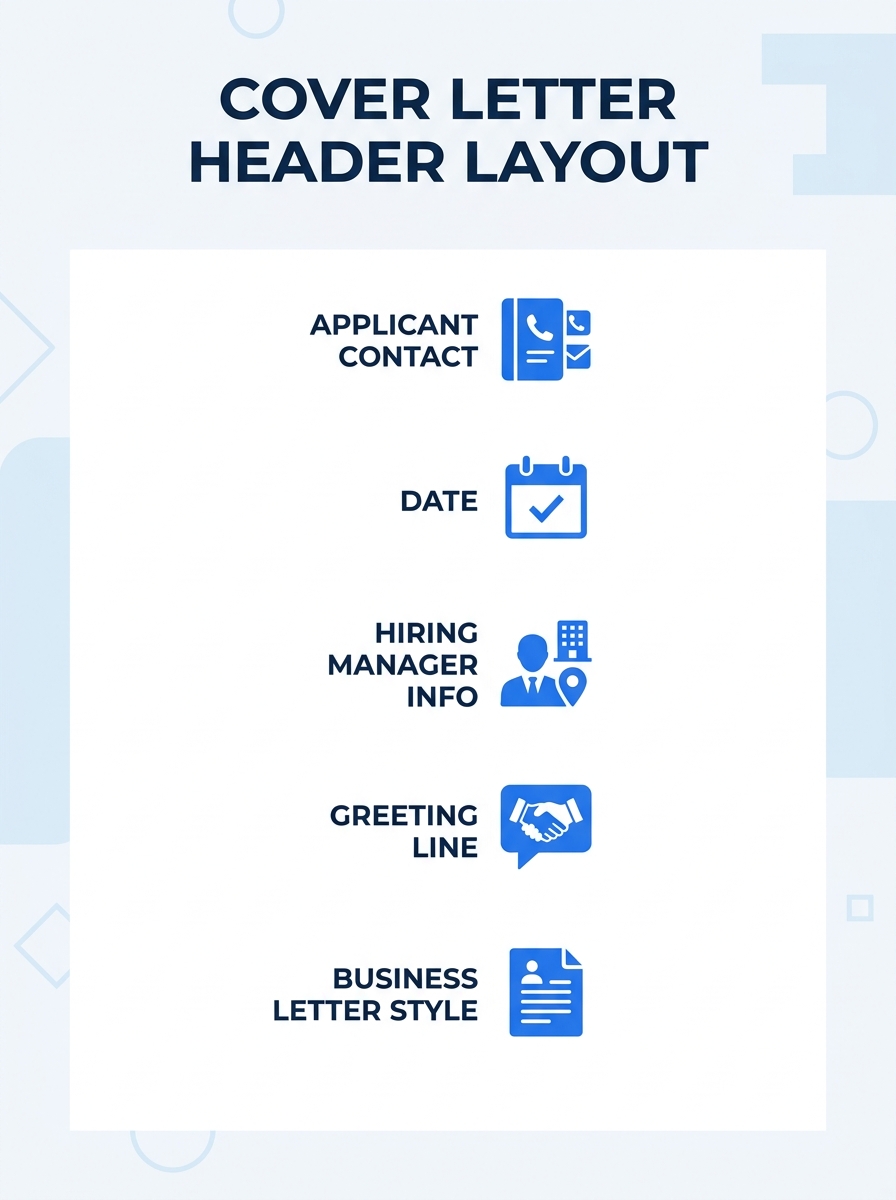
Your header mirrors the format of a business letter. According to MIT’s Career Advising & Professional Development office, a cover letter should use a font size between 10 and 12 points, and your contact information should appear at the top.
Here’s what the header includes, in order:
- Your full name
- Phone number
- Professional email address
- City and state (full street address is optional)
- Date
- Hiring manager’s name, title, company name, and company address
Then skip one line and write your greeting. Use “Dear [First Name] [Last Name]:” with a colon, not a comma. If you found the name on LinkedIn, double-check the spelling against the company website.
You’ll know this step is done when: your header fills roughly the top quarter of the page and includes a specific person’s name after “Dear.”
Phase 2: Draft Your Opening Paragraph
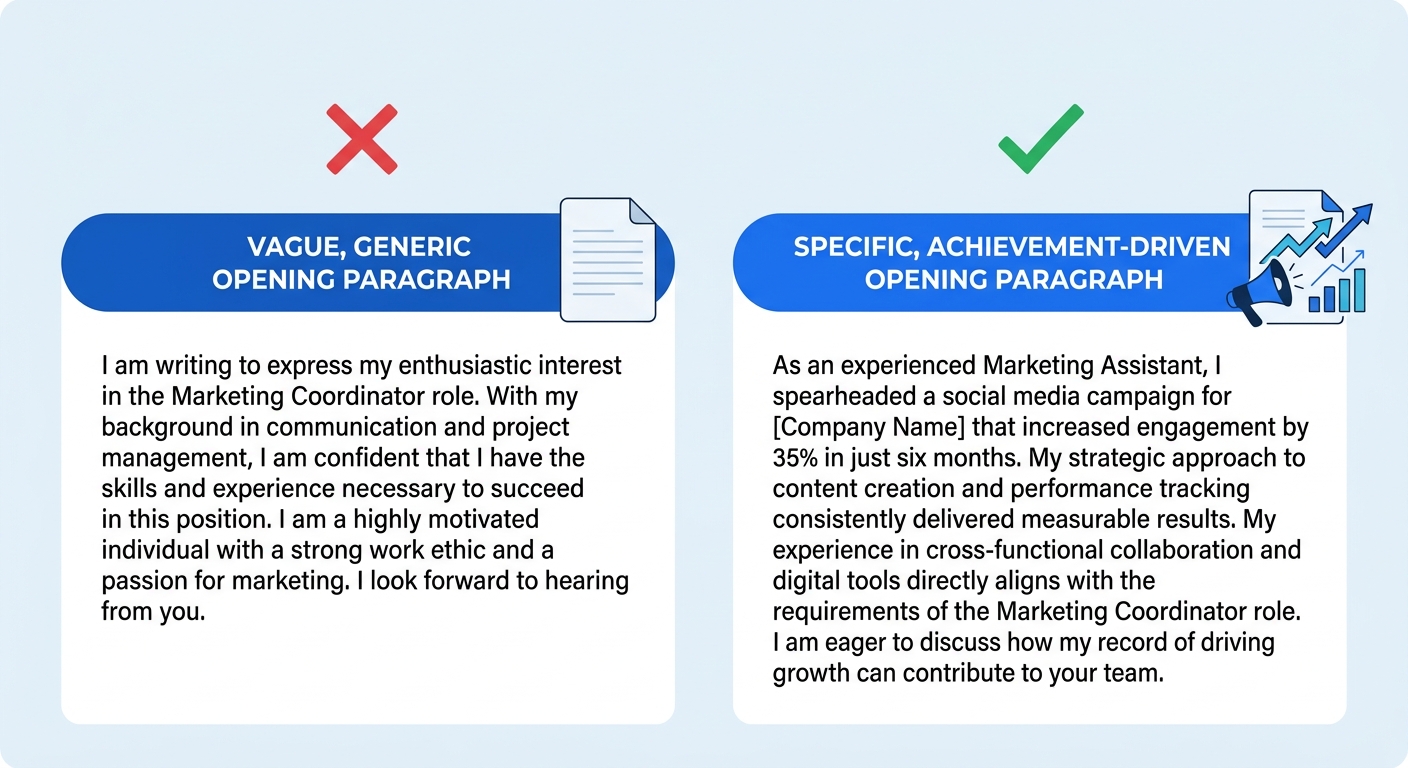
The opening paragraph is where most people stall. They write something broad about being “passionate about the industry” and hope enthusiasm carries the letter. It won’t. Recruiters in 2026 are looking for what hiring coaches call the “reason to talk”, the specific connection between you and this particular role.
Your opening paragraph should do exactly three things in three to four sentences:
- Name the position you’re applying for and where you found it.
- State one credential or achievement that immediately qualifies you.
- Connect that credential to the company’s specific need (pulled from the job posting you highlighted earlier).
Here’s the template for this paragraph:
Dear [Hiring Manager Name]:
I’m writing to apply for the [Job Title] position at [Company Name], posted on [Source]. With [X years/specific credential] in [relevant field], I’ve [one concrete achievement with a number]. [Company Name]’s focus on [something specific from their mission/posting] aligns directly with my work in [related area].
That’s 50-70 words. Keep it tight. The Microsoft Word Blog’s 2026 formatting guide describes the opening paragraph’s job as guiding readers into your specific qualifications immediately, and three sentences is plenty of space to do that.
Phase 3: Build the Body With Proof
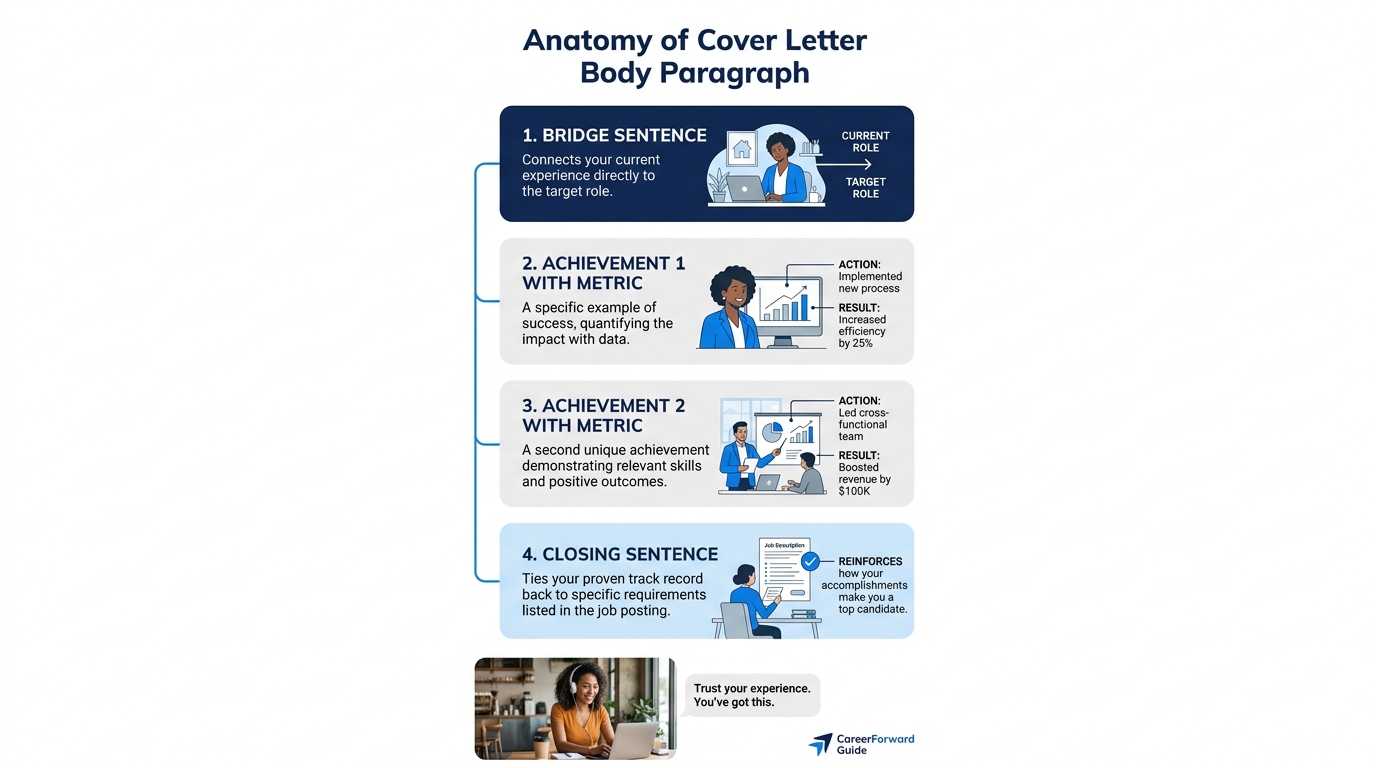
The body is where your sample of a cover letter earns its weight. This middle section, typically one to two paragraphs, takes the achievements from your resume and reframes them as evidence that you’ll succeed in this specific role.
The University of Michigan’s Career Center advises keeping the overall letter short and persuasive, with enthusiasm showing through concrete examples rather than adjective-heavy claims. That advice maps perfectly to the body paragraph structure:
Paragraph structure:
- Sentence 1: Bridge from your current or most recent role to the target role. (“In my current position as [title] at [company], I [action verb] [what you did].”)
- Sentences 2-3: Two specific achievements with numbers. Format these as regular sentences or as two short bullet points. Either works, but don’t use more than three bullets in the entire letter.
- Sentence 4: Connect those achievements to what the company needs. Reference the job posting language directly.
Tip: Pull two or three keywords from the job posting and use them naturally in your body paragraph. ATS systems scan cover letters too, and matching the employer’s own language shows you’ve read the posting carefully. If you’re unsure how ATS parsing works, our piece on [resume builders tested against real ATS platforms](/blog/resume-builders-ats-platforms-enhancv) covers the mechanics.
Template for the body:
In my [time period] as [current/previous title] at [Company], I [specific achievement #1 with a number, e.g., “reduced client onboarding time from 14 days to 6”]. I also [specific achievement #2 with a number, e.g., “managed a team of 8 across 3 time zones to deliver projects averaging 12% under budget”]. These experiences have prepared me to [specific responsibility from the job posting], which I understand is a priority for [Company Name]’s [team/department/initiative].
You’ll know this step is done when: your body paragraph contains at least two achievements with real numbers and references a specific requirement from the job posting.
Phase 4: Close and Sign Off
The closing paragraph is your call to action. You’re asking for the interview, not summarizing what you already said. Keep it to two or three sentences.
Template for the closing:
I’d welcome the opportunity to discuss how my experience in [relevant area] can support [Company Name]’s [goal/project/initiative]. I’m available for a conversation at your convenience and can be reached at [phone] or [email]. Thank you for your time and consideration.
Then sign off with one of these:
- Best regards,
- Sincerely,
- Thank you,
Follow the sign-off with your full name. If you’re submitting a PDF or printed letter, leave three to four lines of space between the sign-off and your typed name for a signature.
You’ll know this step is done when: your closing paragraph asks for a next step (the conversation), provides contact info, and ends with a professional sign-off. The entire letter should fit on one page with comfortable margins. MIT’s guidance is explicit on this: do not exceed one page.
The Full Sample, Assembled
Here’s what a finished cover letter looks like when all four phases come together. This sample of a cover letter is for a marketing coordinator role, but the structure works for any industry.
Jordan Rivera (555) 312-7890 | [email protected] | Chicago, IL
August 9, 2026
Lisa Brennan Marketing Director Greenfield Media Group 200 Michigan Ave, Suite 400 Chicago, IL 60601
Dear Lisa Brennan:
I’m writing to apply for the Marketing Coordinator position at Greenfield Media Group, posted on LinkedIn. With three years of experience in B2B content marketing and campaign management, I increased qualified lead volume by 34% year-over-year at my current company through targeted email sequences and landing page optimization. Greenfield’s focus on data-driven storytelling for mid-market clients aligns directly with my background in performance marketing.
In my current role as Marketing Specialist at Branch & Bower, I planned and executed 12 multi-channel campaigns per quarter, managing a $180,000 annual ad budget while maintaining a cost-per-lead 22% below the industry benchmark. I also built the company’s first A/B testing framework for email subject lines, which improved open rates from 18% to 27% over six months. These experiences prepare me to take on Greenfield’s campaign execution and analytics responsibilities, which I understand are central to this role.
I’d welcome the opportunity to discuss how my experience in performance marketing can support Greenfield Media Group’s growth goals. I’m available for a conversation at your convenience and can be reached at (555) 312-7890 or [email protected]. Thank you for your time and consideration.
Best regards, Jordan Rivera
The structure works for any industry. Swap the achievements, match the job posting language, keep it to one page, and you have a letter that reads like it was written for that specific role.
Notice what this letter doesn’t do: it doesn’t restate the resume line by line, it doesn’t open with “I am writing to express my interest” (a phrase so overused it’s become invisible), and it doesn’t run longer than 250 words in the body. For more finished examples across different industries, browse our collection of real cover letter samples.
When Things Go Wrong
Three problems come up consistently when people follow this template. Here’s how to spot and fix each one.
Problem 1: The letter runs longer than one page. This happens when the body paragraph includes too many achievements or too much context. Fix it by cutting to your two strongest, most relevant accomplishments. If an achievement doesn’t map to a specific line in the job posting, it doesn’t belong in this letter. Trim your body paragraph to four to five sentences maximum.
Problem 2: The letter sounds like your resume in paragraph form. Read your cover letter and your resume side by side. If you see the same phrases in both, rewrite the cover letter version to explain impact and context rather than duties. Your resume says “Managed $180K ad budget.” Your cover letter says “Managing a $180,000 annual ad budget taught me how to make hard allocation decisions under pressure, which is why I maintained a cost-per-lead 22% below the industry benchmark.” Same fact, different angle.
Problem 3: The greeting defaults to “To Whom It May Concern.” This signals that you didn’t research the company. Spend five minutes on LinkedIn searching for the hiring manager or department head. If you genuinely can’t find a name after checking the company website, the job posting, and LinkedIn, “Dear Hiring Manager” or “Dear [Department Name] Team” are acceptable alternatives. “To Whom It May Concern” is not. It reads as a form letter. For more strategies on tailoring letters to specific job applications, we’ve covered the personalization process in detail.
Where to Go From Here
You now have the template, the full sample, and the troubleshooting fixes for the three most common mistakes. The natural next step is to write your first draft using the phase-by-phase process above, then read it aloud. Reading aloud catches awkward phrasing and run-on sentences that your eyes skip over on screen.
Once your cover letter is solid, make sure your resume holds up to the same standard. If you’re considering AI-powered resume builders, know that they can produce a strong first draft, but the same rule applies as with cover letters: generic output loses to specific, role-tailored writing every time. Customize the achievements, match the job posting’s language, and keep both documents telling a consistent story about why you’re the right person for this specific role.