

 4.9
4.9 4.5
4.5Every sample of a cover letter in this guide includes quantified results, percentage gains, dollar figures, measurable outcomes, because hiring managers skim for proof, not promises. You’ll get five complete, customizable cover letters spanning entry-level through senior technical roles, each following the one-page format MIT’s career office recommends. Adaptation time per letter: about 20 minutes.
TL;DR: Five ready-to-use samples of a cover letter cover entry-level, career change, corporate, creative, and technical roles. Each includes specific metrics, a named hiring manager, and the header-opening-body-closing structure that matches standard recruiter expectations. Copy the one closest to your situation and swap in your own numbers.
Before You Start
You need three things before adapting any sample below. First, the job posting you’re targeting, open on your screen so you can pull exact phrases from it. Second, two to four measurable accomplishments from your work, academic, or volunteer history. Third, the hiring manager’s name. LinkedIn, the company’s team page, or a quick call to the front desk will get you this 90% of the time. A letter addressed to “Dear Hiring Manager” works if you genuinely can’t find a name, but addressed letters get read with more attention.
Your cover letter should be one page maximum, 10-12 point font, as MIT’s Career Advising and Professional Development office states: “A cover letter should be no longer than one page with a font size between 10-12 points.” Standard margins are 1 inch on all sides. Save and send as a PDF unless the application system requires .docx.
What Every Sample Below Has in Common
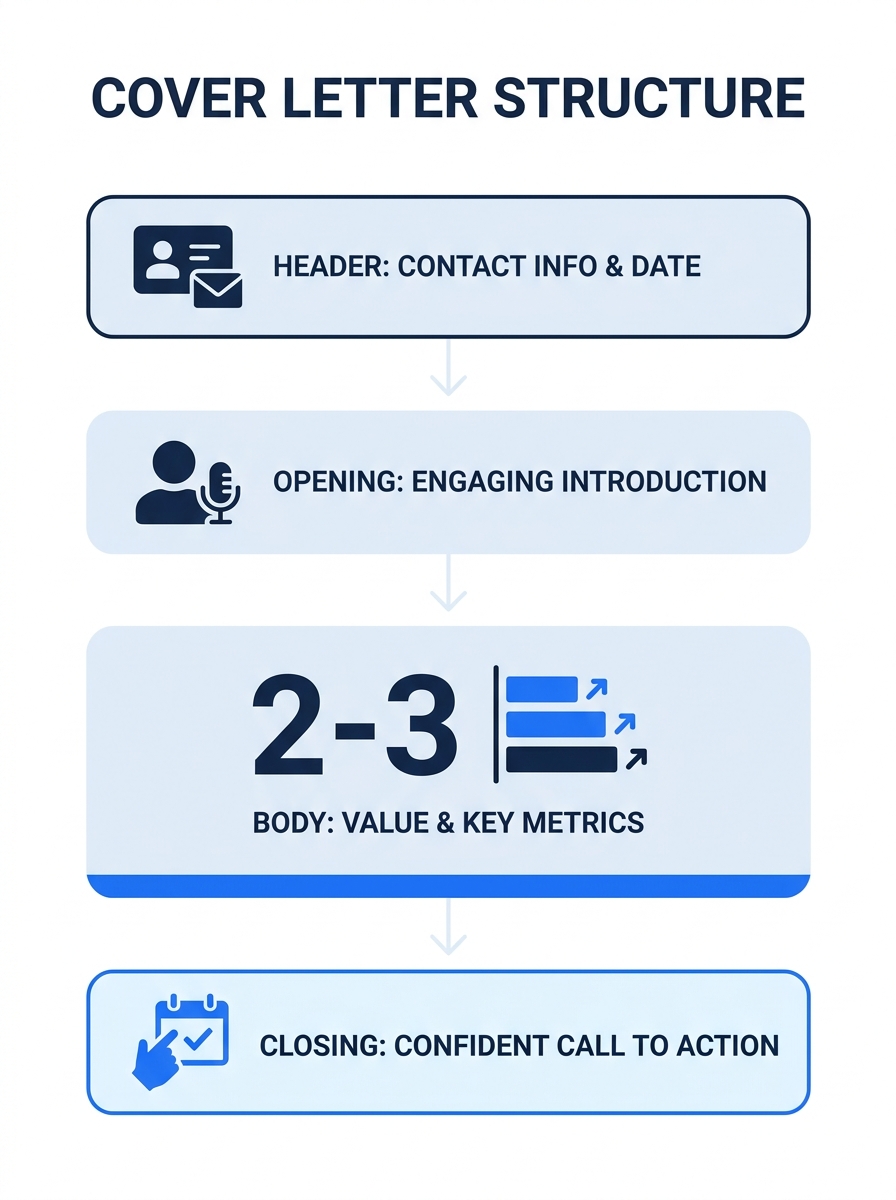
All five samples of a cover letter follow the same four-part skeleton: header, opening paragraph, body (one to two paragraphs), and closing paragraph. Columbia University’s career education office advises that a cover letter should “articulate your qualifications and motivation for the position” using specific examples drawn from real experience. That’s the function of the body section in every sample below. The opening hooks with a relevant achievement or connection to the company. The closing names a concrete next step.
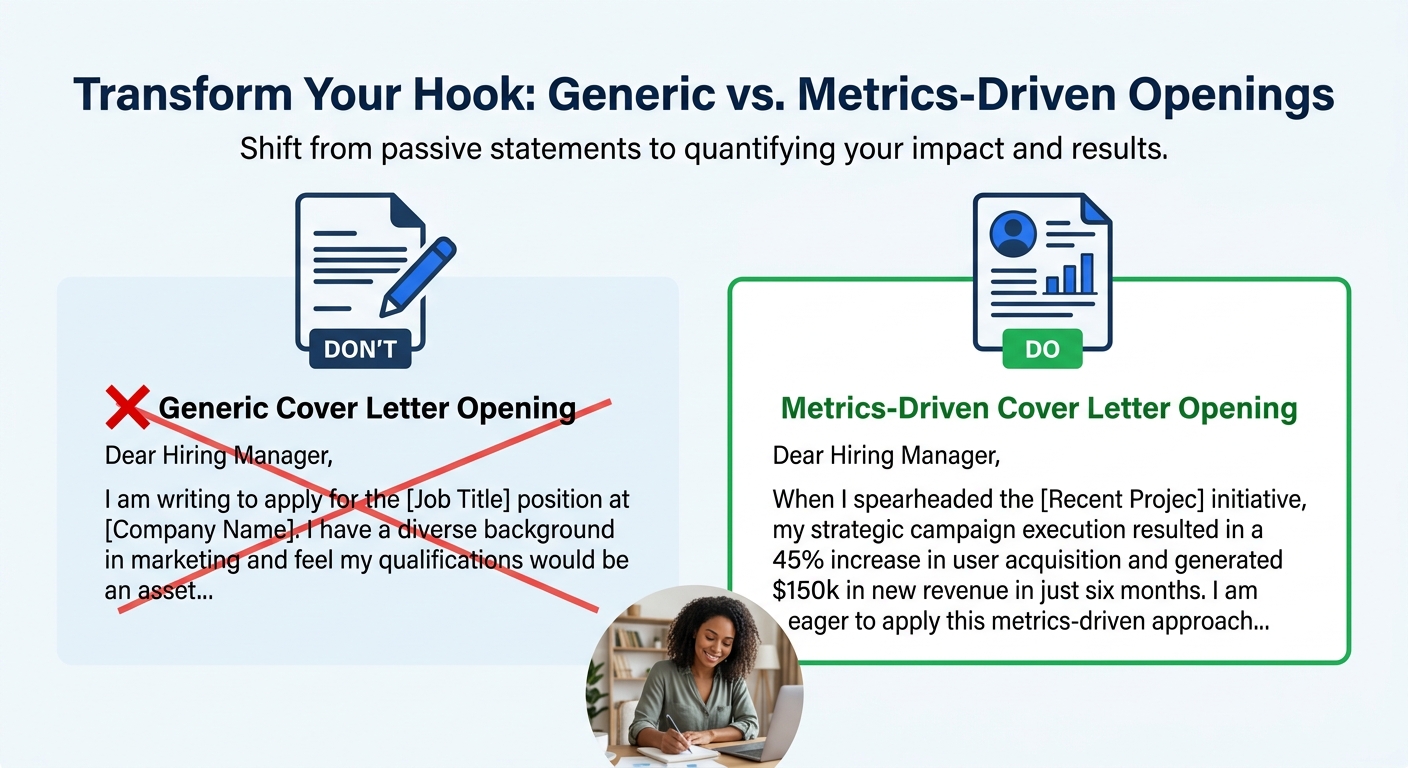
Data-driven cover letters that cite specific metrics, like 156% quota attainment or an 89% increase in qualified leads, outperform vague enthusiasm statements when evaluated by hiring managers. Each sample demonstrates this principle.
If you’ve already studied proven cover letter templates, you’ll recognize the underlying format. The difference here is that each sample is a finished, ready-to-edit letter rather than a blank framework.
Step 1. The Entry-Level Graduate
Goal: Produce a cover letter when you have limited or no professional experience.
The sample:
Dear Ms. Okafor,
Your posting for a Marketing Coordinator at Bellridge Foods caught my attention because of your team’s 2025 rebrand of the Harvest Gold product line. I led a similar rebrand project during my senior capstone at the University of Michigan, where our four-person team increased the client’s Instagram following from 800 to 6,200 followers over 14 weeks without any paid budget.
During that project, I managed the content calendar, wrote 42 posts, and coordinated with a graphic design student to maintain brand consistency across platforms. I also interned at a regional nonprofit where I drafted three press releases that earned local media coverage, resulting in a 23% uptick in event attendance. These experiences taught me how to translate audience data into content decisions on tight timelines.
I’d welcome the chance to discuss how my content and analytics skills fit your team’s goals. I’m available for a call or video interview at your convenience. Thank you for your time.
Sincerely, Jordan Acosta
Verification: Your adapted version names a specific school project, internship, or volunteer role with at least one number attached. The University of Michigan Career Center advises candidates to “describe your qualifications for the type of position you seek using specific examples from academic, work, volunteer, and/or co-curricular experiences.” If your letter does that, it’s working.
Step 2. The Career Changer
Goal: Show a hiring manager that skills from your previous industry transfer directly to the new one.
The sample:
Dear Mr. Tanaka,
After eight years managing restaurant operations for a 45-seat bistro, I’m applying for the Operations Analyst position at Meridian Logistics. Running a restaurant taught me supply chain management in compressed time frames: I reduced food waste by 31% over two years by building a forecasting spreadsheet that tracked 126 ingredient SKUs against daily sales data.
I also managed a team of 12, handled vendor negotiations that cut supply costs by $18,000 annually, and maintained a 4.6-star Google rating across 740+ reviews by implementing a customer feedback loop. I’ve since completed a certificate in data analytics from Coursera, where I built proficiency in SQL and Tableau. Your job description mentions “comfort with ambiguity and fast-moving data.” That’s a Tuesday night dinner rush.
I’d like to walk you through how these transferable skills apply to your open role. I’m available at your earliest convenience.
Best regards, Dana Whitfield
Verification: Your adapted version draws a clear line between an old-industry accomplishment and a new-industry requirement. If you’ve worked through how to adapt your resume language for a new industry, apply the same translation principle here. You’ll know it’s right when each body-paragraph sentence maps to a specific bullet from the job posting.
Step 3. The Corporate Professional
Goal: Write a polished letter for a mid-to-senior corporate role where tone and precision matter as much as content.
The sample:
Dear Ms. Langford,
I’m writing to express my interest in the Regional Sales Director position at Ashton Pharmaceuticals, listed on your careers page. In my current role as Senior Sales Manager at Graymont Health, I led a 14-person team that achieved 156% of our annual quota in 2025, generating $4.2M in new business across the Midwest territory.
Three initiatives drove those results. First, I restructured our lead qualification process, which increased the ratio of qualified leads by 89% within two quarters. Second, I introduced weekly pipeline reviews that shortened our average sales cycle from 68 days to 41 days. Third, I partnered with marketing to develop case studies that our reps used in 73% of finalist presentations. Ashton’s expansion into the Southwest market aligns with my experience opening two new territories at Graymont.
I look forward to discussing how these results can translate to your growth objectives. I’m available for a conversation this week or next.
Sincerely, Michael Torres
Verification: Your version includes at least three numbered results (dollar amounts, percentages, or timeframes) and references a specific company initiative or goal from the job posting. Harvard Business Review’s career guidance is direct: “Do the research, start off strong, and emphasize your value.” If you can delete your company-specific references and the letter still makes sense for a different employer, it’s too generic. Rewrite until removal breaks the letter.
Step 4. The Creative-Industry Applicant
Goal: Balance personality with professionalism in a field that values both.
The sample:
Dear Priya,
I spent the last three years as a senior copywriter at Flint & Birch, where I wrote campaign copy for six product launches that collectively drove $1.7M in first-quarter revenue. Your posting for a Creative Lead at Mosaic Studio mentions building “brand voices that feel human.” That’s exactly what I did for Flint & Birch’s B2B SaaS clients, brands that had been speaking in jargon for years.
My most recent project involved repositioning a cybersecurity startup’s messaging from technical spec sheets to outcome-focused storytelling. The result: a 37% increase in demo requests within 90 days of the new website launch. I also mentored two junior writers, one of whom was promoted within 10 months. Outside of client work, I’ve published essays in The Drift and Catapult.
I’d love to share my portfolio and talk about how Mosaic’s upcoming rebrand could benefit from this approach. Coffee, Zoom, or a carrier pigeon, I’m flexible.
Warmly, Sonia Reyes
Verification: Your version shows personality in the opening or closing line without sacrificing concrete numbers in the body. Creative-industry samples of a cover letter fail when they’re all voice and no evidence. Count your metrics: if you have fewer than two, add more.
Tip: The closing line is where creative-field applicants can show personality. Keep the body paragraph data-heavy, save the wit for the sign-off, where it won’t compete with your qualifications.
Step 5. The Technical Specialist
Goal: Demonstrate technical depth and business impact in the same letter.
The sample:
Dear Dr. Hassan,
I’m applying for the Senior Backend Engineer position at Veritas Data Systems. In my current role at Simplify Corp, I redesigned our API gateway, reducing average system latency by 60% (from 340ms to 136ms) and handling a 3x increase in concurrent users without additional infrastructure spend.
I’ve worked primarily in Python and Go for the past five years, and I contributed to an open-source monitoring tool (Palantir Beacon) that has 2,400 GitHub stars. At Simplify, I also led the migration of 14 microservices from a monolith architecture, which cut deployment time from 45 minutes to 8 minutes per service. Your job posting mentions scaling distributed systems for healthcare data, I’ve held HIPAA-compliant infrastructure responsibilities at Simplify since 2024.
I’d welcome a technical interview or system design session to walk through my approach. I’m available any day this week.
Best, Ravi Chandrasekaran
Verification: Your version names specific technologies, frameworks, or tools from the job posting and ties each one to a measurable outcome. If you mention a language or platform without attaching a result, add one. For more guidance on formatting your cover letter for specific job applications, we’ve covered the process step by step.
Common Problems and How to Fix Them
Three issues come up repeatedly when people adapt these samples of a cover letter.
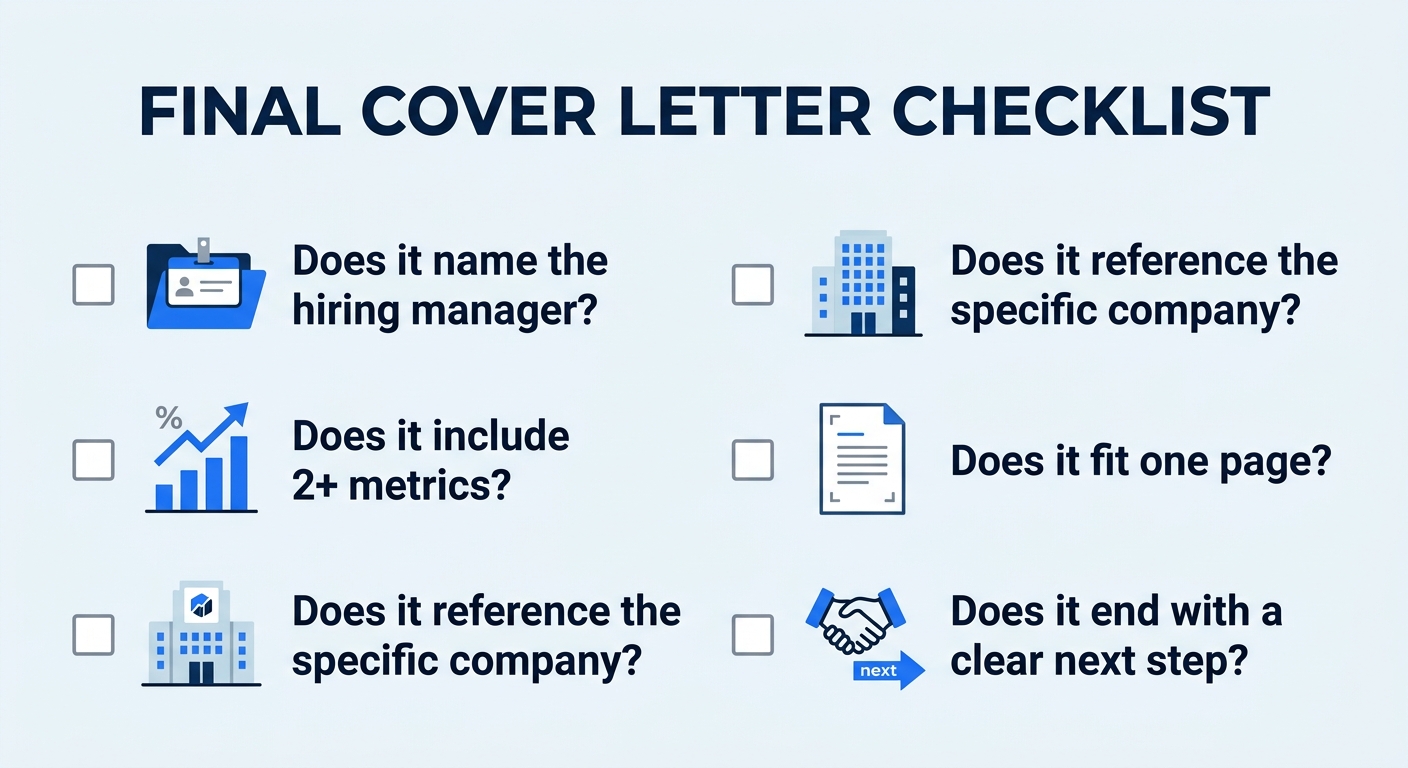
Problem 1: The letter sounds like a resume in paragraph form. You’ve listed responsibilities instead of results. Fix this by applying the “so what?” test to every sentence. “I managed a team of six” becomes “I managed a team of six that reduced client onboarding time from 12 days to 4 days.” The second version answers why the reader should care.
Problem 2: No connection to the specific company. If you can swap the company name for a competitor’s and the letter still reads the same, you haven’t done enough research. Mention a recent product launch, a company value from their website, or a detail from the job description that genuinely interests you. The entry-level format recommended by Indeed’s career advice team emphasizes that entry-level letters matter precisely because they help you stand out among candidates with similar academic backgrounds.
Problem 3: The closing paragraph is passive. “I hope to hear from you” puts the ball entirely in the reader’s court. Replace it with a specific call to action: “I’m available for a call Tuesday through Thursday this week” or “I’d welcome a 20-minute conversation about your Q3 hiring goals.” You’re making it easy for the reader to say yes.
If you can swap the company name for a competitor’s and the letter still reads the same, you haven’t done enough research.
If you’re struggling with the broader question of how to structure a cover letter from scratch, work through the formatting basics before adapting these samples.
Where to Go From Here
These five samples cover the most common scenarios, but every job application has its own texture. The career-change sample above won’t work identically for someone moving from finance to education versus restaurant management to logistics. Your job is to keep the skeleton, swap in your own numbers, and rewrite every sentence that doesn’t point directly at the role you want.
One useful next step: after you finish your cover letter, read it out loud. If any sentence sounds like something you’d never actually say to another person, cut it or rewrite it in your own voice. Cover letters that sound like real human beings outperform polished corporate-speak, and the data on quantified results backs up the same instinct. Specifics beat adjectives. Numbers beat buzzwords. And a letter that clearly connects your past work to the employer’s current problem will always outperform one that talks about passion in the abstract.