

 4.9
4.9 4.5
4.5Teal, Rezi, and Zety each produce ATS-friendly resumes, but they solve different problems. Teal bundles a job tracker and Chrome extension into a full search dashboard. Rezi focuses on AI-generated content and ATS scoring. Zety walks you through a guided builder with polished templates. Your bottleneck determines which one deserves your time.
TL;DR: Pick Teal if you want a centralized hub for tracking applications and tailoring resumes to each posting. Pick Rezi if you want the strongest AI writing assistance and ATS optimization. Pick Zety if you already have your content and need a fast, clean format.
How We’re Comparing These Three
The comparison focuses on four criteria: resume-building quality, AI writing features, pricing transparency, and how well each tool fits into a broader job search workflow. Template design and ATS compatibility matter, but every mainstream builder handles basic ATS parsing at this point. The real differentiator is what happens after you export the PDF, whether the tool also helps you manage the search itself, or whether you’re on your own.
We excluded enterprise-only platforms and builders with no free tier, since most job seekers need to test before committing money.
Teal Does Everything (and That’s the Tradeoff)
The Teal resume builder positions itself as a job-search operating system, and the description is accurate. The platform includes a resume builder, a CRM-style job tracker with notes and pipeline stages, a Chrome extension that captures listings from LinkedIn and Indeed, and a match-score tool that compares your resume against a job description’s keywords. The free tier is genuinely generous: unlimited job tracking, PDF exports, and basic resume editing without entering a credit card.
The resume builder itself offers strong customization. A recruiter reviewing the platform for Optim Careers wrote that Teal has “the best design tools I’ve used and the level of customization is second to none for building a professional resume.” Templates default to single-column, ATS-safe layouts, and the live preview updates as you type. If you’ve already spent time building a LinkedIn profile for your job search, the Chrome extension pulls in job descriptions so you can tailor each resume without toggling between tabs.
The friction starts with AI. Teal’s free tier caps AI bullet generation at roughly 10 credits per session, and the AI output requires significant editing. Multiple reviewers note that the tool sometimes inserts irrelevant keywords or hallucinates details, including fabricated work authorization information. You can’t trust a draft the AI generates without reading every line and revising.
Teal+ unlocks unlimited AI usage, additional templates, and advanced match scoring. Pricing sits at $9 per week, $29 per month, or $79 every three months. A Resume Genius review described these rates as “more expensive than many other resume builders.” That weekly plan is especially tricky: $9/week annualizes to $468, more than double what most competitors charge for a full year.
The platform also doesn’t auto-apply to jobs. If you’re hoping to submit hundreds of applications with minimal effort, Teal won’t do that for you. A 2026 review from Remote Job Assistant confirmed that Teal earns its 4.3/5 Trustpilot rating primarily for resume organization, but noted 11 one-star reviews out of 93 total, with complaints centering on billing confusion and AI quality.
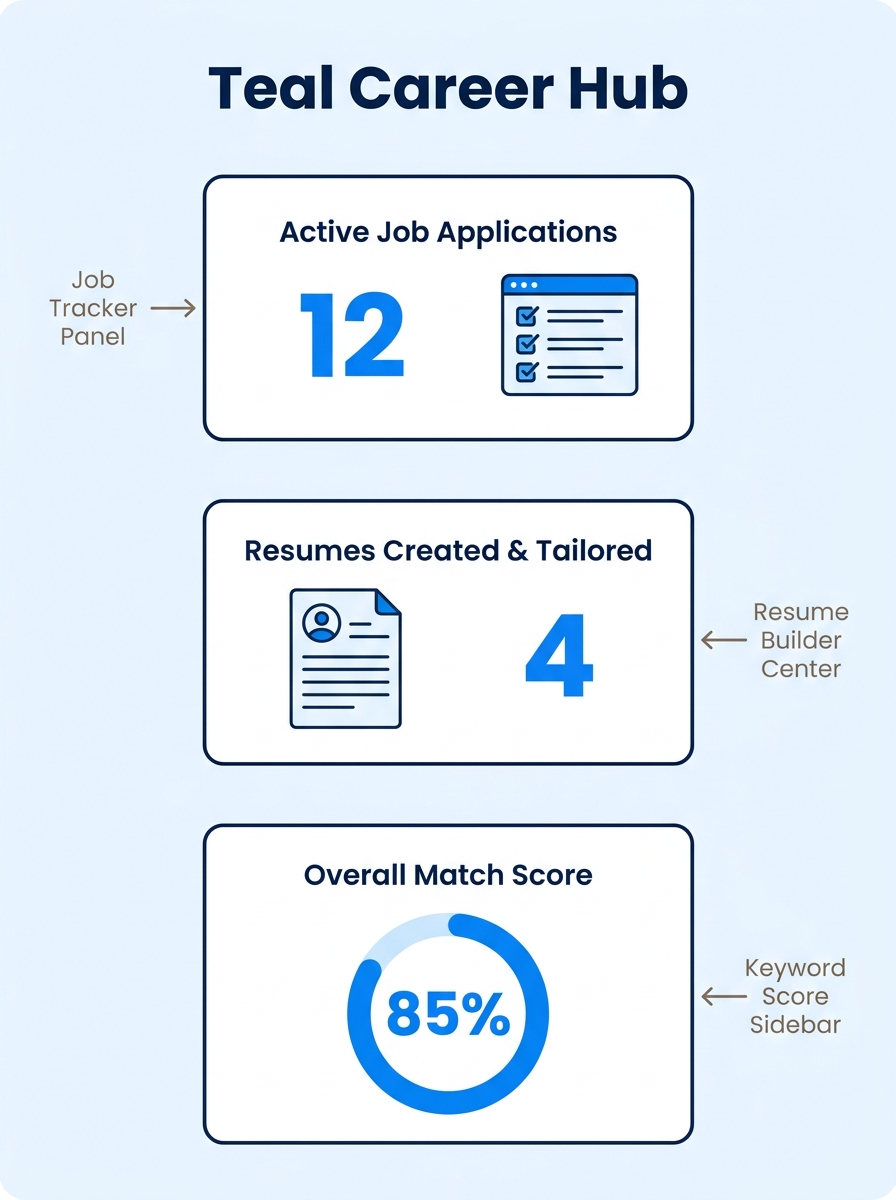
Warning: Teal’s $9/week plan looks affordable at first glance, but it costs $468/year if you forget to cancel. If you go paid, the $79 quarterly plan ($26.33/month) is the better deal.
Best for: Job seekers managing 20-50+ active applications who want one place to track stages, store resume versions, and tailor each submission to a specific posting.
Weakest at: Producing polished AI-written content without heavy manual editing. The all-in-one approach can feel overwhelming if you only need a resume.
Rezi Bets Hard on AI and ATS Scoring
Rezi takes a narrower approach: build the most ATS-optimized resume possible, and use AI to get there fast. The platform scored 5 out of 5 in a 2026 comparative test published on the Rezi blog, though that self-assessment deserves skepticism given the source. Independent reviewers consistently rank it among the top options for AI content generation and ATS compliance, and Forbes named it a top pick among AI resume builders.
Cache Merrill, founder of software firm Zibtek, told Forbes that “when it comes to AI-powered resume builders, one tool that I highly recommend for job seekers is Rezi,” citing its “actionable feedback, role-specific adjustments, and of course, the fact that it is ATS compliant.” That recommendation carries weight because Merrill has hired for technical roles and evaluated resume tools from both sides of the hiring desk.
Where Rezi pulls ahead of the Teal resume builder is AI output quality. The generated bullet points tend to be more role-specific and require less manual correction. Rezi also offers an ATS score that flags formatting issues, tables, headers, graphics, likely to break parsing in systems like Workday or Greenhouse. The interface is cleaner than Teal’s because it doesn’t try to be a job tracker, email tool, and interview prep platform all at once.
The tradeoff is scope. Rezi doesn’t include a job tracker, a Chrome extension for saving listings, or an application pipeline. You build your resume, export it, and manage the rest of your search elsewhere. If you’re someone who benefits from evaluating resume tools across multiple dimensions, Rezi’s focused approach might feel incomplete for a full job search campaign.
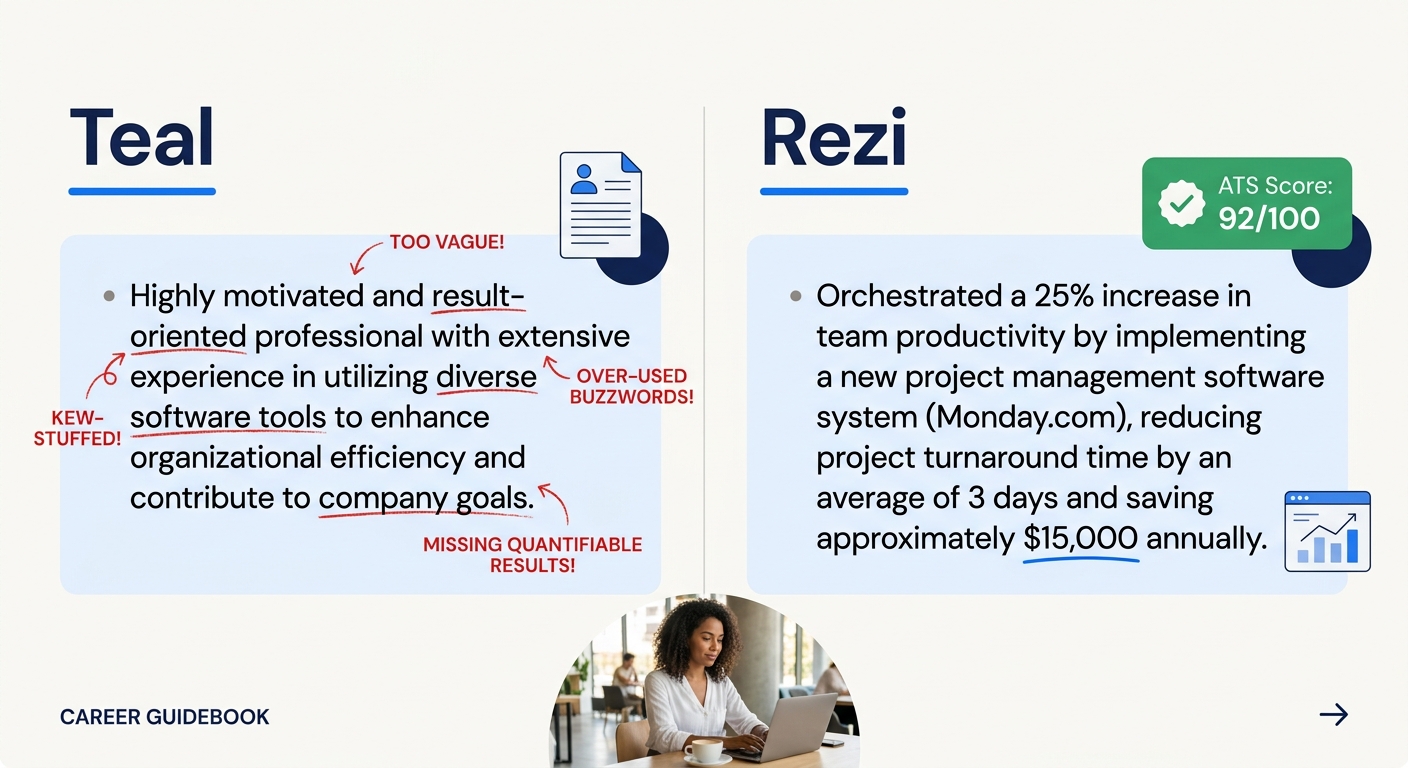
Best for: Job seekers who already have a system for tracking applications and want the strongest AI writing tool to craft each resume. Particularly useful for technical and specialized roles where keyword precision determines whether you pass automated screening.
Weakest at: Organizing a full job search. You’ll need a separate spreadsheet, Notion board, or other tracker to manage where you’ve applied and what stage each application is in.
Zety Gets the Job Done and Gets Out of the Way
Zety’s approach is the most traditional of the three. Forbes described it as a builder that “breaks down resume writing into easy-to-follow steps,” and that sums up the core experience: answer questions, pick a template, export a PDF. AI assistance exists but stays in the background, suggesting phrases rather than generating full sections from scratch.
The template library is larger and more visually varied than either Teal or Rezi. Zety offers two-column designs, color accents, and modern layouts that look polished on screen. The risk is that some of those designs break ATS parsing. If you’re applying through enterprise applicant tracking systems, stick to single-column options and skip the graphics-heavy templates entirely.
Zety’s pricing model has drawn criticism for lack of transparency. The platform often pushes users toward a subscription during the export step, and the cancellation process has generated complaints across review sites. The core builder is functional, but going in without reading billing terms closely is a mistake.
There’s no job tracking, no Chrome extension, no match scoring. Zety builds a resume and gets out of the way. For someone who already knows what they want to say and needs a formatting tool to say it professionally, that simplicity is an advantage. For someone facing the application fatigue that comes from customizing dozens of resumes, Zety won’t reduce your workload the way Teal or Rezi can. And if you’d rather hand the entire project to a professional, our roundup of best resume writing services covers that option.
Best for: Job seekers who have clear, written content and need a fast, polished format. Strong for career changers who want design flexibility and don’t need algorithmic keyword guidance.
Weakest at: AI-driven tailoring and keyword optimization. Zety won’t tell you which terms are missing from your resume relative to a job description.
Side-by-Side Comparison
| Feature | Teal | Rezi | Zety |
|---|---|---|---|
| Free tier | Yes, generous (unlimited tracking, PDF export, limited AI) | Yes, limited features | Limited, paywall at export |
| Paid pricing | $9/week, $29/month, or $79/3 months | Varies (check current site) | Subscription-based |
| AI writing quality | Functional but requires heavy editing | Strongest AI output, role-specific | Basic phrase suggestions |
| ATS optimization | Good (single-column defaults, keyword matching) | Best-in-class ATS scoring and flagging | Template-dependent |
| Job tracking | Built-in pipeline with notes and stages | None | None |
| Chrome extension | Yes, captures listings from job boards | No | No |
| Template variety | Moderate, ATS-focused | Moderate, ATS-focused | Large, design-forward |
| JD match scoring | Keyword comparison against job descriptions | ATS compliance score | None |
| Review reputation | 4.3/5 Trustpilot (93 reviews) | Forbes top pick, 4.5M+ users | Mixed (billing complaints) |
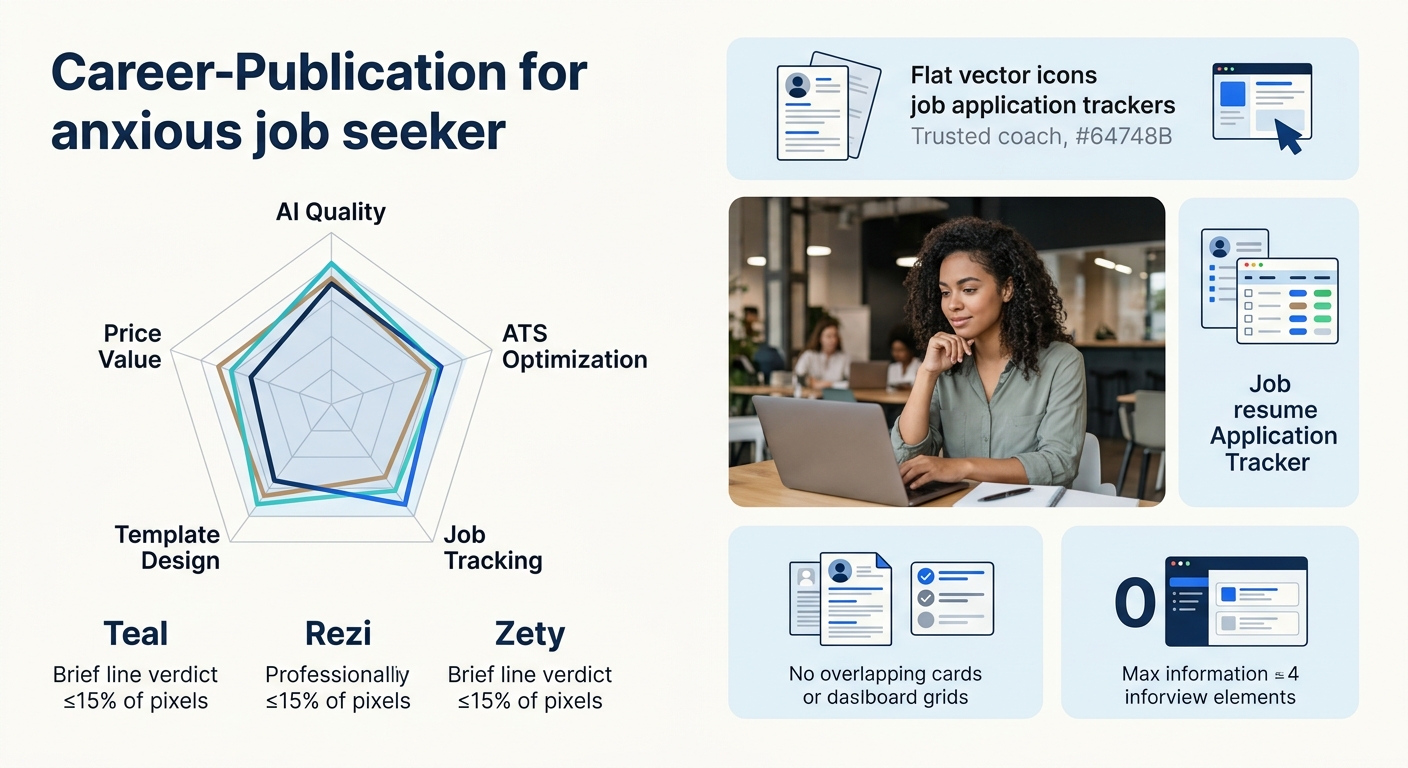
Every builder handles basic ATS parsing. The real differentiator is whether the tool helps you manage the search itself, or leaves you on your own after export.
For a broader look at builder platforms beyond these three, our top resume builder reviews cover additional options across different price points and feature sets.
Who Should Pick Which
Teal wins for the organized multi-application searcher. If you’re running 30+ active applications and need one dashboard to track stages, save job descriptions, and tailor resumes with keyword matching, Teal’s free tier delivers real value without spending a dollar. Upgrade to Teal+ only if you’re generating AI bullets daily and the 10-credit free cap is genuinely slowing you down. Avoid the weekly plan. Commit monthly or quarterly if you go paid.
Rezi wins for the resume perfectionist. If your priority is the strongest AI-written content and the tightest ATS scoring, and you’ll handle job tracking with your own system, Rezi produces better first-draft bullets than Teal and gives you a clearer picture of how your resume will perform in automated screening. It’s the right choice when content quality, rather than search organization, is your bottleneck.
Zety wins for the fast finisher. If you’ve already written your content, know your target role, and want a sharp-looking PDF in under 20 minutes, Zety’s guided builder and template library will get you there. Read the billing terms carefully, export your document, and move on. The tool does one thing and does it at a reasonable speed.
No single builder is the universal best pick. The right one depends on whether your bottleneck is organization, content quality, or formatting speed. Identify which problem is actually costing you interviews, and put your time into the tool that fixes that specific gap, rather than the one with the longest feature list.