


 4.9
4.9 4.5
4.5Panel interviews evaluate career changers on decision quality, relevance, and demonstrated learning rather than on prior job titles or industry tenure. The STAR method, which most candidates default to, lacks a built-in step for articulating lessons learned or obstacles navigated, and that gap costs career changers the exact credibility they need to build.
TL;DR: Career changers need a behavioral interview framework that goes beyond STAR by explicitly surfacing obstacles and lessons learned. Prepare 5–7 adaptable stories, name your transferable skill before each story, quantify every result with specific numbers, and address your career pivot proactively rather than waiting for the panel to question it.
SHRM confirms that behavioral interviews remain the dominant hiring format across industries, and MIT Career Advising recommends candidates spend 60% of their response time on the Action portion and roughly 10% on Results. For someone switching careers, those proportions matter because the Action is where transferable skills live. Every rule below is built for that reality.
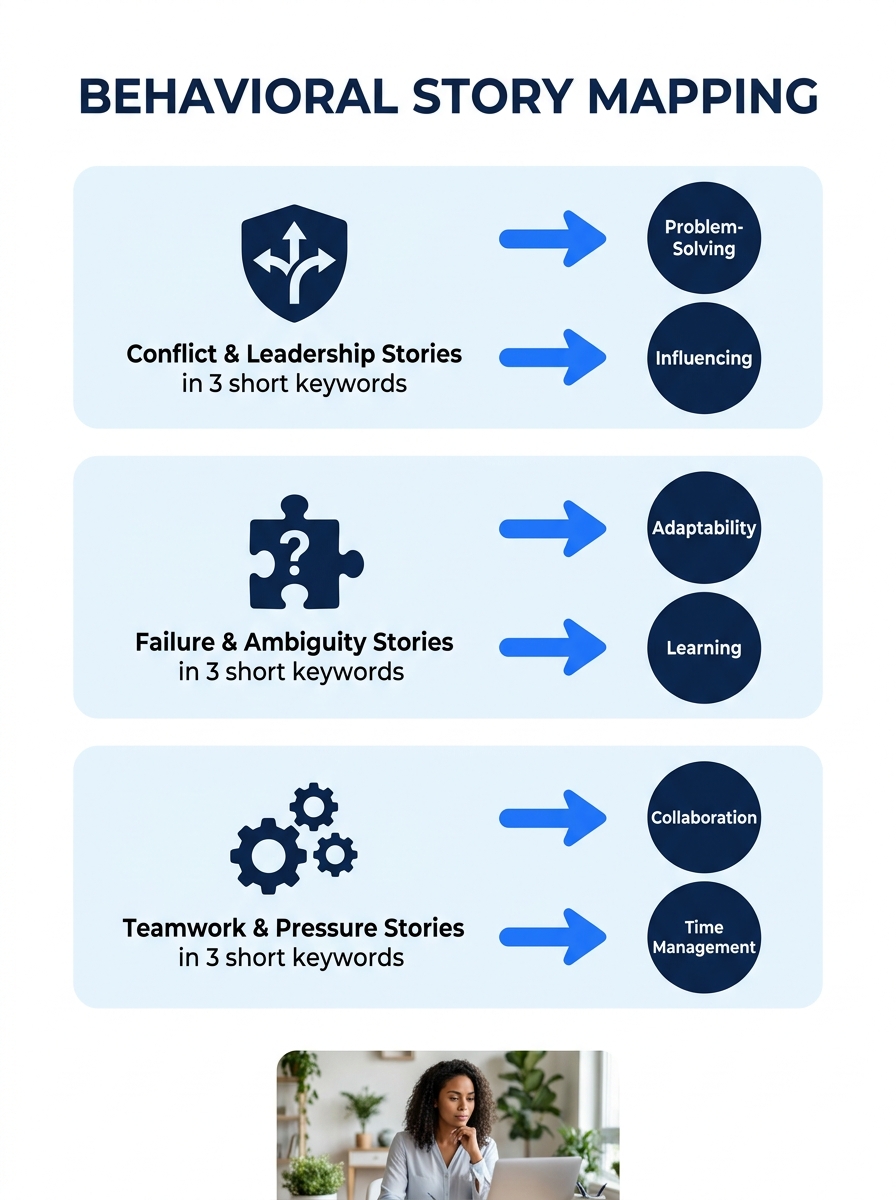
Prepare 5–7 adaptable stories, not 50 scripted answers
Yale University’s Office of Career Strategy advises structuring complete stories that connect personal strengths to the new role’s needs. Five to seven well-chosen stories can cover the full range of behavioral interview questions you’ll face in a panel setting: conflict resolution, working under pressure, leadership, failure, and ambiguity.
The math works in your favor. According to Gartner’s careers team, recruiters evaluate your past behavior based on “the level of relevant detail you share.” A deeply detailed story you’ve rehearsed 10 times beats a vaguely remembered one you’re assembling for the first time. Career changers who prepare 5–7 stories and practice mapping each one to 3–4 different prompts can walk into a panel of 4 interviewers and handle 12 or more questions without repeating themselves.
Pick stories that cross industry lines. A supply chain manager moving into product management doesn’t need a “product launch” story. They need a story about coordinating 6 vendors across 3 time zones to hit a deadline, because that narrative demonstrates stakeholder management, prioritization, and communication in a single answer. If you’ve already reverse-engineered the job description during resume prep, you know which competencies the panel is scoring. Match your 5–7 stories against those competencies before you walk in.
Drop pure STAR and add the obstacle and the lesson
STAR (Situation, Task, Action, Result) has been the default behavioral answer framework since the 1980s. It works well enough for candidates whose experience maps directly to the role. For career changers, it leaves out the two things hiring panels care about most: what got in your way, and what you took away from the experience.
Mark Murphy, writing in Forbes, advocates for the SHER Method, which “offers candidates a more nuanced and reflective approach to interview responses” by focusing on challenges faced and lessons learned alongside actions taken. Other STAR method alternatives include SOAR (Situation, Obstacle, Action, Result), CAR (Challenge, Action, Result), PAR (Problem, Action, Result), CCAR, BAR, and SPSIL (Situation, Problem, Solution, Impact, Lesson). The framework landscape is crowded, and each variation solves a slightly different problem.
Which acronym you memorize matters less than including two elements STAR omits: the obstacle and the reflection. A career changer answering “Tell me about a time you managed competing priorities” needs to name what made the situation hard (maybe it was an unfamiliar system, a resistant team, or a 72-hour deadline) and close with what they’d do differently next time. Panels assign higher marks to answers showing self-awareness because self-awareness signals coachability. And coachability is exactly what a hiring manager wants when taking a risk on someone from outside the industry.
Tip: Practice the obstacle-and-lesson additions as a 15-second closing to each of your 5–7 stories. Time yourself. If your reflection runs longer than 20 seconds, you’re over-explaining.
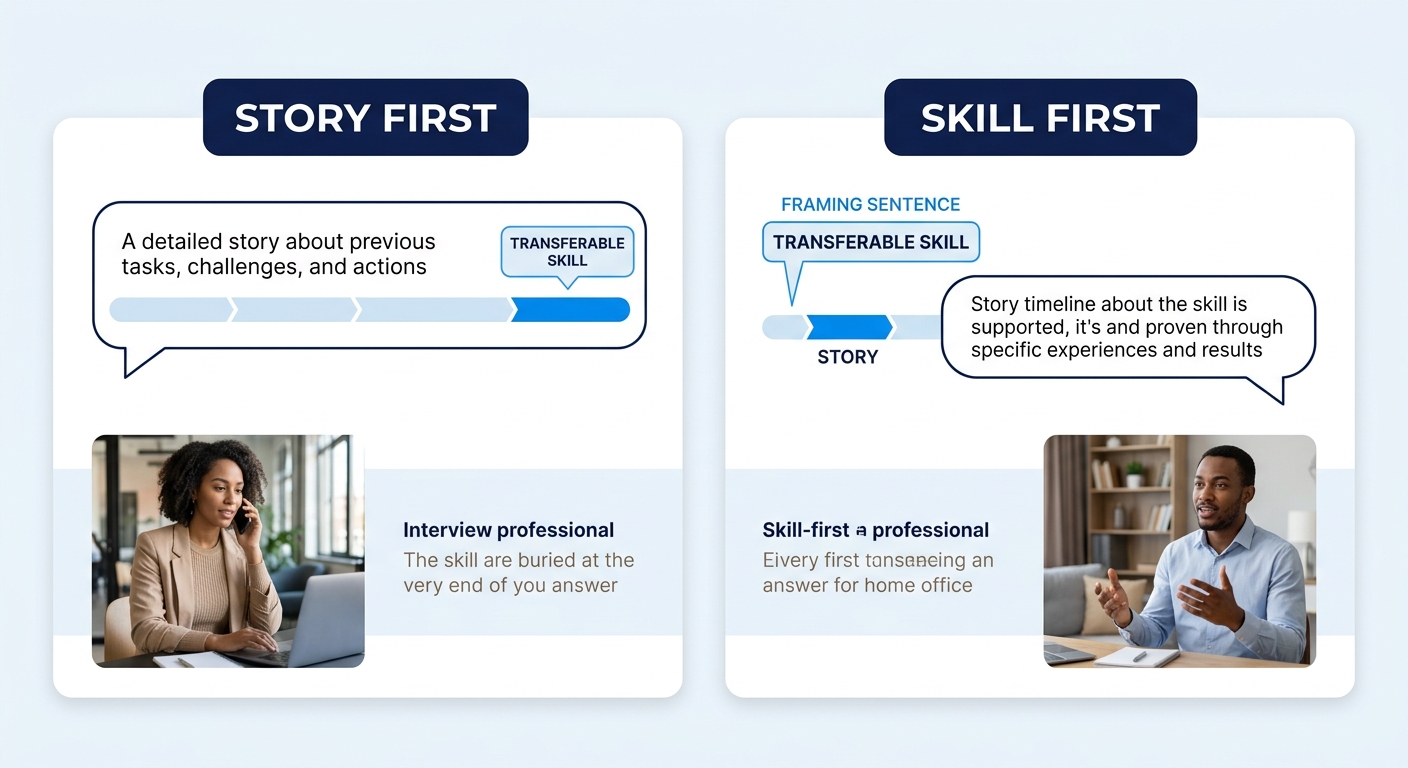
Always name the transferable skill before you tell the story
TopUniversities research states it directly: “Never mention a transferable skill without giving some evidence that you actually do possess it and without referencing it back to the role you’re interviewing for.” But most career changers do this backward. They tell the story and hope the interviewer connects the dots. In a panel with 3–5 evaluators, each using a different scorecard column, that connection gets lost.
Name the skill in a single sentence at the top. Say, “This is an example of how I’ve managed cross-functional stakeholder alignment,” then tell the story. The panel now knows what to listen for. They can check their box. Your answer gets scored correctly instead of being filed under “interesting but not sure how it’s relevant.”
This technique takes about 4 seconds of speaking time. It changes how every subsequent detail in your answer gets interpreted. When you’re in a career change interview, that framing sentence does work you can’t accomplish retroactively. If the panel doesn’t understand why your teaching experience matters for a project management role, your carefully structured 90-second answer scores a 2 out of 5 on their rubric.
Use the exact phrases from the job posting in your skill-naming sentence. “Cross-functional collaboration” if that’s what they wrote. “Data-driven decision-making” if that’s in their requirements. Mirror their language before you launch into your story. This is the same principle behind building a targeted resume: match the employer’s vocabulary, then prove the match with evidence.
Say “I” instead of “we” in every single answer
MIT Career Advising’s guidance here is unambiguous: use “I” to clarify individual contribution. This matters more for career changers than for anyone else sitting in that room. When a panel hears “we launched a new onboarding system,” they have no idea what you personally did. And since your background is already unfamiliar to them, they’ll default to assuming you were along for the ride.
When a panel hears “we launched a new onboarding system,” they have no idea what you personally did — and since your background is already unfamiliar to them, they’ll default to assuming you were along for the ride.
“I” statements accomplish three things at once during panel interview preparation and delivery. They prove you did the work. They let evaluators score you individually (structured panel interviews use rubrics, and “we” answers are functionally unscorable against an individual competency). And they prevent the follow-up question “What was your specific role in that?” which eats 20–30 seconds of your answer time and signals that your original response lacked specificity.
There’s a natural objection here: “But I really did work on a team.” Good. Say so in one sentence, then spend the remaining 80% of your answer on what you specifically contributed. “Our team of 8 rebuilt the client intake process. I owned the workflow mapping, interviewed 14 end users to identify bottlenecks, and redesigned the intake form that reduced processing time by 35%.” You credited the team and made yourself scorable in the same breath. That’s the balance to hit.
Quantify results even when the numbers feel small
Career changers routinely undersell their outcomes because the numbers come from a different context. A teacher who improved student pass rates by 12% worries that sounds trivial compared to a revenue figure. It doesn’t. Hiring panels evaluate the direction of impact and the rigor of your measurement, not the absolute magnitude. An answer with “12% improvement” scores higher than an answer with “significant improvement” on every structured rubric.
The 60/10 split MIT recommends (60% of answer time on Action, 10% on Result) assumes that 10% is loaded with a concrete number. If your Result section is “and it went really well,” you’ve wasted the most evaluative 8 seconds of your answer. According to behavioral interviewing research from Becker, interviewers assess “how the candidate works under pressure, reacts to conflict, previous career wins and losses.” The word “losses” implies they expect you to measure outcomes. You should oblige.
Numbers to pull from your own history: percentage improvements (even 5% counts), time saved (hours per week, days per quarter), error reduction rates, number of people trained or managed, dollar values of budgets or projects, headcount of teams, customer or client counts. If you’ve built your resume around quantifying impact for non-technical roles, you already have these numbers documented somewhere. Print that list and bring it to your panel interview preparation session. The same 14 metrics that power your resume bullets should power your spoken answers.

Address your career change before they ask about it
Indeed.com lists “Tell me about your change in careers” as one of the most common career change interview questions. And professional interview coaching will tell you the same thing: don’t wait for the question to surface organically. Volunteer the narrative early, ideally woven into your response to the very first behavioral question the panel asks.
In a panel interview, each evaluator brings a different assumption about your pivot. One thinks you’re fleeing a bad situation. Another wonders if you’ll stay longer than 18 months. A third is genuinely curious but won’t ask directly because their scorecard doesn’t have a “career change motivation” line. By embedding your transition rationale into your first answer (“When I moved from financial analysis to UX research, I was drawn to the qualitative side of decision-making, and this project is a good example of that”), you neutralize all three assumptions simultaneously and free up the rest of the interview for competency-focused questions.
Your LinkedIn profile and resume should already tell this story consistently. The panel interview is where you add the genuine reasoning: what you saw in the new field, what skills you realized were transferable, what specific gap in your professional development the new career fills. Panels respond to coherence across your written materials and your verbal answers. Inconsistency between your resume narrative and your spoken answers is one of the fastest ways to lose credibility with a group of evaluators who’ve already reviewed your application before you walked in.
When These Rules Break Down
These six rules assume a structured behavioral panel where evaluators use scorecards and competency rubrics. That format covers roughly 70% of panel interviews at mid-to-large companies. The remaining 30% includes unstructured panels (common at startups with fewer than 200 employees), case-based panels (consulting and strategy roles), and technical panels where behavioral questions are mixed with live problem-solving.
In unstructured panels, the “name the skill first” rule can feel overly formal. Read the energy in the room. If the panel is conversational, interrupting and riffing and asking follow-ups before you’ve finished, shorten your stories to 60 seconds and let the dialogue carry the detail. Your transferable skills interview answers still need specificity, but the explicit labeling can be lighter.
In case-based panels, behavioral questions often appear as 5-minute warm-ups before a 40-minute live case. Don’t over-invest in the warm-up at the expense of the case. Give a tight 60-second answer using the obstacle-and-lesson framework, demonstrate that you’re structured and self-aware, then shift your energy.
And if you freeze, if a question catches you off-guard and none of your 5–7 stories fit, say so honestly. “I don’t have a direct example from my previous work, but here’s the closest parallel and what I’d do differently in this context.” Panels score honesty and adaptability higher than a fabricated answer that falls apart under follow-up questioning. Your career change already proves you can navigate uncertainty. Let that fact work in your favor.