
 4.9
4.9 4.5
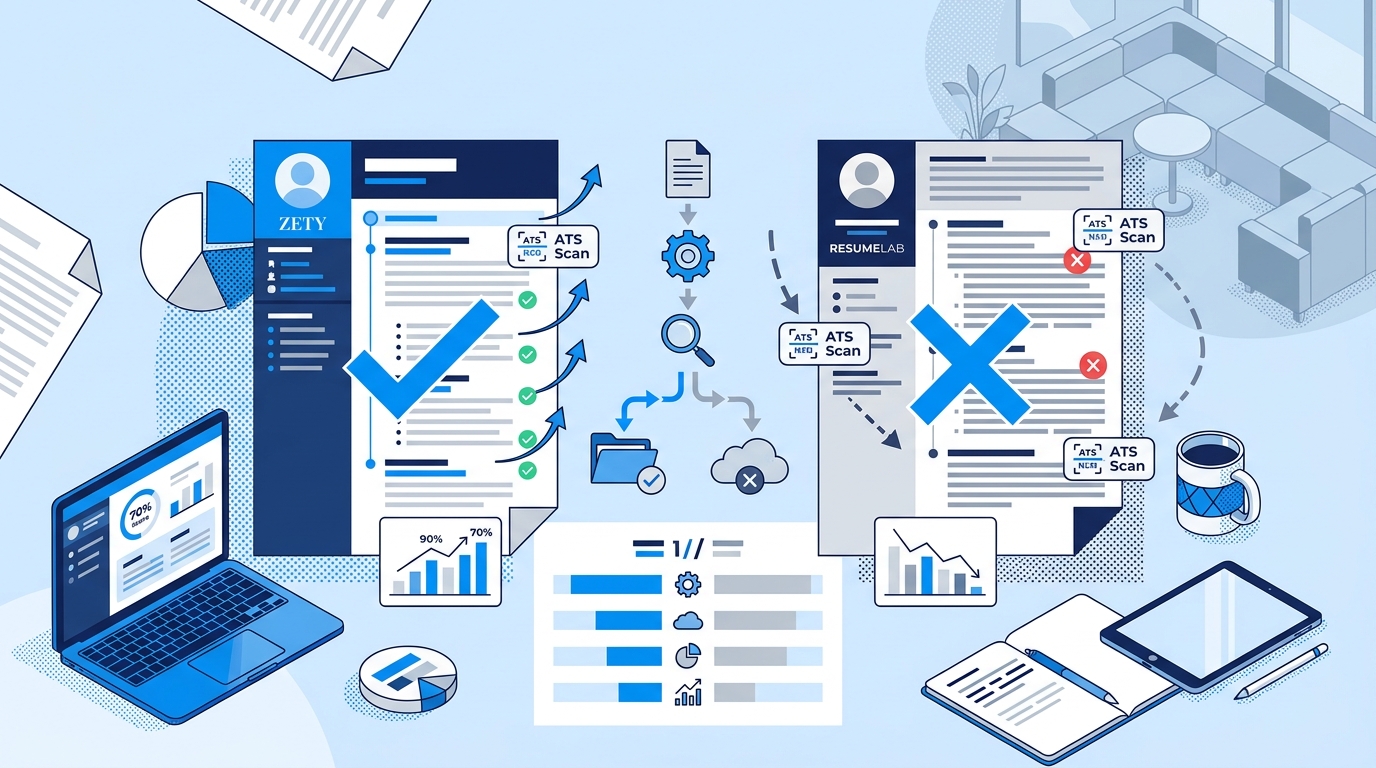
4.5Zety and ResumeLab run on the same template engine, built by the same parent company, Talent Inc. (formerly Bold LLC). In cross-platform ATS testing published by Resume Optimizer Pro, Zety produced a 98% parse rate but only a 74% pass rate once keyword thresholds kicked in. ResumeLab, which shares that identical formatting backbone, inherits the same structural ceiling and the same critical weakness: zero job-specific keyword optimization.
The Corporate Family Tree Behind Two “Competing” Builders
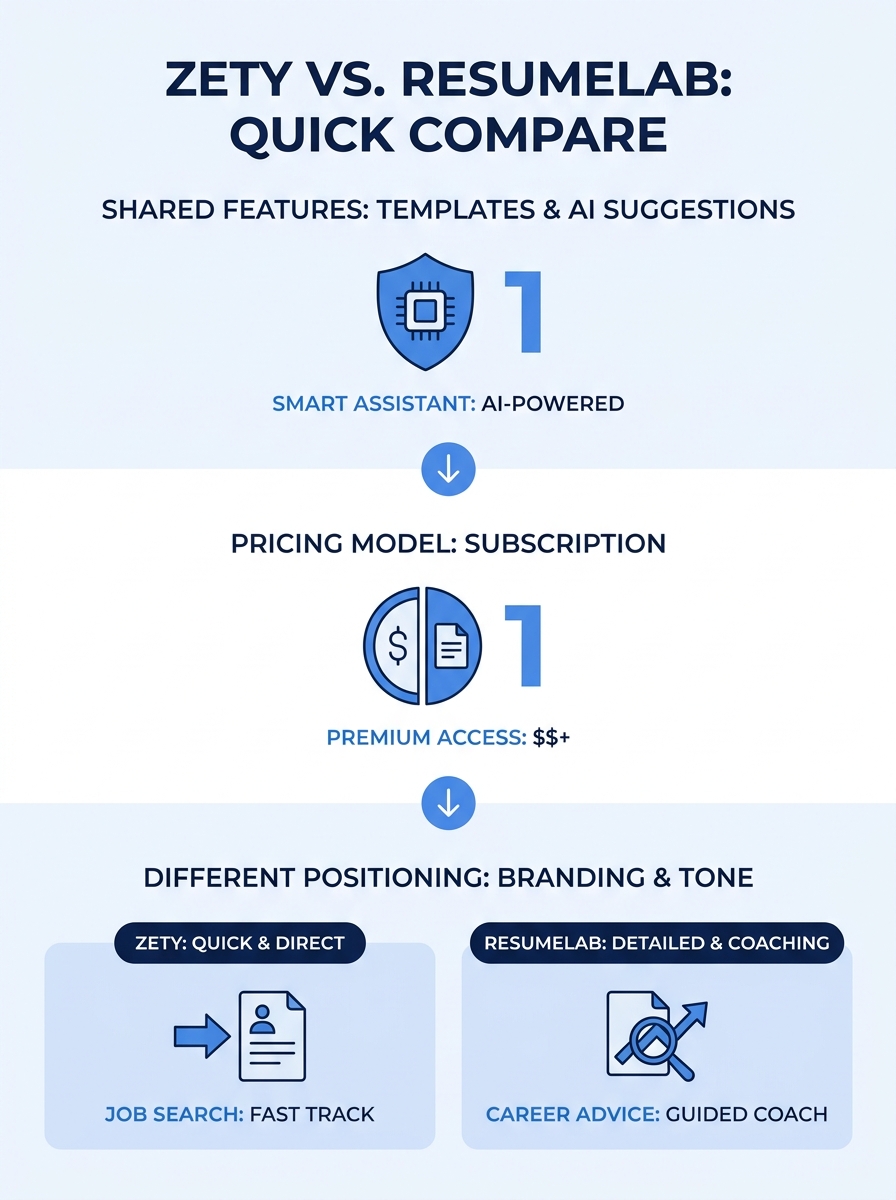
Talent Inc. operates both Zety and ResumeLab, along with several other resume-adjacent brands. The two products share underlying template architecture, similar AI suggestion engines powered by OpenAI integrations, and nearly identical editorial databases of pre-written bullet points organized by job title and seniority level. The visual skins differ. The fonts and color palettes diverge. But the document structure the ATS actually reads? Functionally identical.
This matters because the entire Zety vs. ResumeLab debate, which surfaces constantly in Reddit threads and career forums, frames these as meaningfully different products competing on merit. They aren’t. The resume builder comparison most non-technical job seekers need to make is between this shared Talent Inc. engine and genuinely distinct alternatives like Kickresume, Teal, or Resume Optimizer Pro, each of which approaches ATS optimization from a different angle.
Both Zety and ResumeLab use what Zety’s marketing calls “Smart Apply” technology. Resume Optimizer Pro’s 2026 review characterized this feature bluntly: “Zety’s resume checker provides a proprietary score, but it does not score your resume against a specific job description using actual ATS matching standards.” That limitation applies equally to ResumeLab, because the scoring engine is the same codebase wearing a different hat.
For anyone evaluating the best resume builder 2026 options for administrative, HR, marketing, project management, or other non-technical roles, this shared DNA is the first and most important fact to absorb. You’re choosing between one product sold under two brand names and an ecosystem of genuinely differentiated competitors.
The 98% Parse Rate and the 26-Point Drop
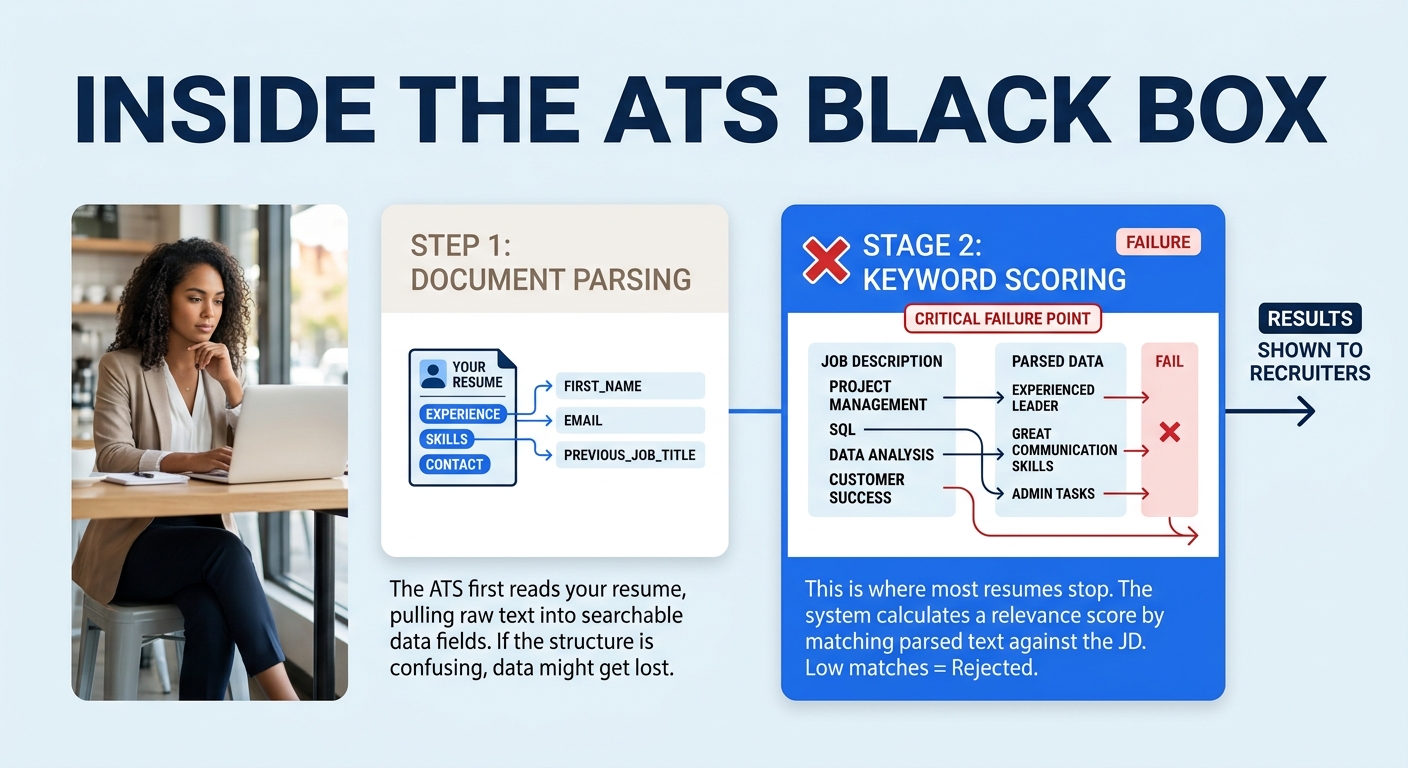
Resume Optimizer Pro’s 2026 cross-platform ATS test ran resumes built with five popular builders through Workday, Greenhouse, Lever, iCIMS, and Taleo. Zety’s templates achieved a 98% parse rate across all five systems, meaning the ATS could correctly read and extract contact information, work history, education, and section headers from Zety-formatted documents almost every time. That 98% figure sounds excellent in isolation.
The trouble starts at the keyword layer. Zety’s average keyword match score landed at 71%, and its overall ATS pass rate (using a 60% keyword threshold, which is standard for most enterprise ATS configurations) dropped to 74%. The gap between 98% parsing and 74% passing represents the difference between a document the machine can read and a document the machine thinks is worth flagging for a recruiter.
As the Resume Optimizer Pro testing team wrote in their ATS builder comparison: “A builder with a high parse rate but poor keyword integration scores lower overall than one with strong performance on both metrics.” This two-dimensional scoring framework captures exactly where the Talent Inc. engine falls short for non-technical applicants.
Why does keyword integration hit non-technical roles harder? Technical resumes carry built-in keyword density. A software engineer’s resume naturally contains programming languages, framework names, and certification acronyms that map directly to ATS keyword filters. A marketing coordinator’s resume, a human resources generalist’s resume, or a project manager’s resume relies on softer, more context-dependent language. Phrases like “stakeholder engagement,” “cross-functional collaboration,” and “budget oversight” need to be matched precisely to the phrasing each employer uses in their job description. An ATS resume builder that doesn’t analyze the target job posting can’t perform that matching, and neither Zety nor ResumeLab does.
If you’ve ever wondered why standard resume layouts still fail modern screening systems, this is the mechanism. Clean formatting solves half the equation. Keyword alignment solves the other half, and the Talent Inc. builders leave that half entirely to you.
Non-Technical Bullet Points and the Suggestion Engine Gap
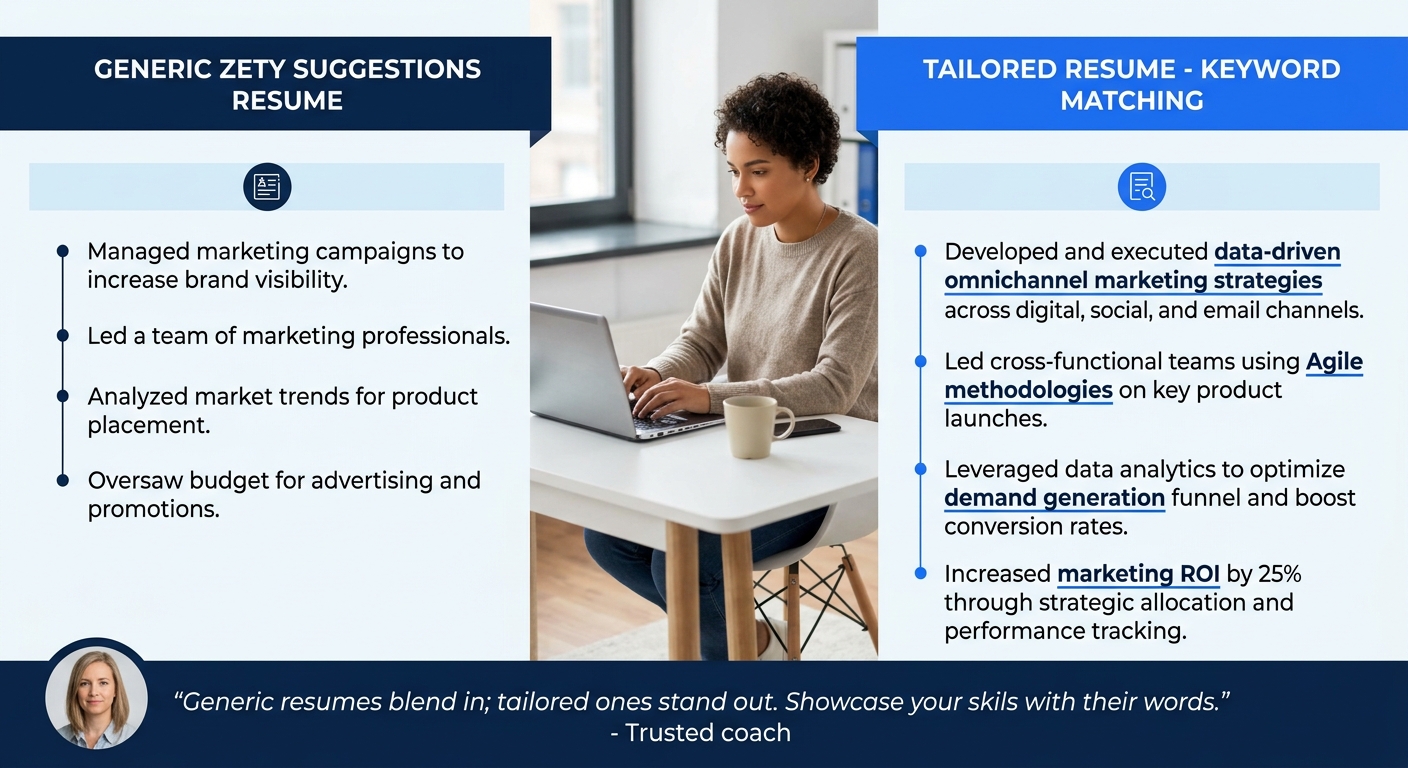
Both Zety and ResumeLab offer pre-written bullet point suggestions drawn from a database of over 300 job titles. When you select “Marketing Manager” or “Executive Assistant,” the builder surfaces 8-15 suggested bullet points you can click to add to your resume. These suggestions reflect general best practices for the role. They don’t reflect the specific job you’re applying for.
A DEV Community author who applied to 50 jobs using five different resume builders reported a telling finding: “The prettiest resumes weren’t always the most effective.” That observation tracks with the Zety/ResumeLab experience for non-technical applicants. The templates produce visually polished documents that parse beautifully. But the content suggestions are generic enough that they dilute keyword relevance for any specific posting.
Consider a real-world scenario. A nonprofit program director applies for a grants management role. The Zety/ResumeLab suggestion engine offers bullets about “program development,” “team leadership,” and “budget management.” The job description, though, calls for “federal grant compliance,” “OMB Uniform Guidance,” and “sub-recipient monitoring.” The ATS is scanning for those exact terms. The suggested bullets miss every one of them.
This is where the resume metrics framework for non-technical roles becomes essential. Non-technical professionals need to quantify impact using the employer’s own vocabulary, drawn directly from the job posting. No ATS resume builder in the Talent Inc. family automates that process. You get a formatting scaffold and generic starting content. The actual tailoring, the work that moves you from 71% keyword match to 85% or higher, happens manually.
Warning: Zety’s proprietary “resume score” is an internal quality metric, not an ATS simulation. A resume that scores 90/100 in Zety’s checker can still score below passing thresholds in Workday or Taleo if the keywords don’t match the target job description. Don’t confuse builder confidence scores with ATS compatibility scores.
And that raises a question about value. If you’re paying for a builder that handles formatting but leaves keyword optimization to you, are you paying for enough? The analysis of how free resume builders grade format but miss job-specific fit found this exact gap across multiple platforms, but it stings most when you’re paying $23.95 per month for the privilege.
The $337-Per-Year Pricing Structure
Zety’s pricing model has drawn consistent criticism throughout 2026. The builder itself is free to use. You can enter your information, select a template, arrange your sections, and preview the final document without paying. But downloading that document as a PDF or Word file requires a paid subscription. The entry point is a $1.95 to $2.95 trial that auto-renews into a recurring charge of approximately $23.95 to $25.95 every four weeks, billed 13 times per year. That adds up to roughly $337 annually, according to Scale.jobs’ comparative analysis.
ResumeLab’s pricing follows a nearly identical structure, which makes sense given the shared corporate parent. The trial-to-subscription pipeline is the same. Trustpilot reviews of both brands hover around 4.2 out of 5 stars, but recent reviews increasingly highlight billing frustration. Users report that the cancellation process feels unresponsive, and unexpected charges after the trial period generate a disproportionate share of negative reviews.
For context, here’s how the Talent Inc. builders stack up against alternatives on the dimensions that matter most for non-technical applicants:
| Feature | Zety / ResumeLab | Kickresume | Teal | Resume Optimizer Pro |
|---|---|---|---|---|
| ATS Parse Rate | 98% | 10/10 ATS friendliness rating | Not independently tested | 98% |
| ATS Pass Rate (60% threshold) | 74% | Not independently tested | 82% | 94% |
| Job-Specific Keyword Matching | No | AI tailoring available | Real-time keyword matching | Aggressive keyword injection |
| Annual Cost (full subscription) | ~$337 | ~$84 (Premium) | Free tier + paid plans | ~$108 |
| Non-Technical Bullet Suggestions | Generic by job title | Generic by job title | Tailored to job posting | Tailored to job posting |
| Onboarding Time | 25-30 minutes | 10-15 minutes | 10-15 minutes | 15-20 minutes |
The Zety/ResumeLab onboarding process takes 25-30 minutes because it walks you through each section sequentially, offering suggestions at every step. That guided approach helps absolute beginners who might otherwise face blank-page paralysis, and a 2026 Reddit review described Zety as “best for absolute beginners” precisely because of this hand-holding. But experienced professionals, especially those applying to multiple non-technical roles that each require keyword tailoring, find the process slow and repetitive.
If you’re weighing whether a builder alone is sufficient or whether you need human expertise, professional resume writing services handle both formatting and keyword strategy in a single engagement, which can be more cost-effective than a $337 annual builder subscription plus the time you spend doing manual keyword work.
The Sibling Rivalry That Never Was
The Zety vs. ResumeLab decision, stripped to its core, is a branding choice. Same templates. Same AI engine. Same keyword gap. Same pricing trap. For non-technical roles where keyword alignment determines whether your resume surfaces in recruiter searches, both builders leave the hardest part of the job to you.
A 98% parse rate means the machine can read your resume. A 74% pass rate means the machine often decides not to show it to anyone.
That 24-point gap between parsing and passing is where non-technical applications go to die. If you’re a program manager, a fundraiser, an account executive, or an HR business partner, your resume’s keywords carry the entire weight of ATS scoring because your job titles and skills don’t contain the self-evident technical markers that inflate keyword matches automatically.
The path forward for non-technical applicants involves either choosing an ATS resume builder that performs real-time keyword matching against your target job description (Teal’s 82% pass rate and Resume Optimizer Pro’s 94% pass rate both reflect this capability) or supplementing any template builder’s output with manual keyword tailoring. Reverse-engineering a job description into a targeted resume is the skill that closes the gap between a clean document and one that actually reaches a human reviewer.
And once your resume passes the ATS, the work isn’t over. Auditing your builder’s AI suggestions for authenticity ensures that the bullets you kept from the suggestion engine still sound like you said them, not like a database generated them. Recruiters who review the 74% of Zety-built resumes that do pass screening are reading dozens of documents with suspiciously similar phrasing. The ones that stand out are the ones where the applicant rewrote those suggestions in their own voice, with their own numbers, telling their own story.
Choosing between Zety and ResumeLab is choosing between identical twins. The more consequential decision is whether a formatting-first builder is enough for the role you’re targeting, or whether you need a tool — or a human — that solves the keyword problem the Talent Inc. engine was never designed to address.