


 4.9
4.9 4.5
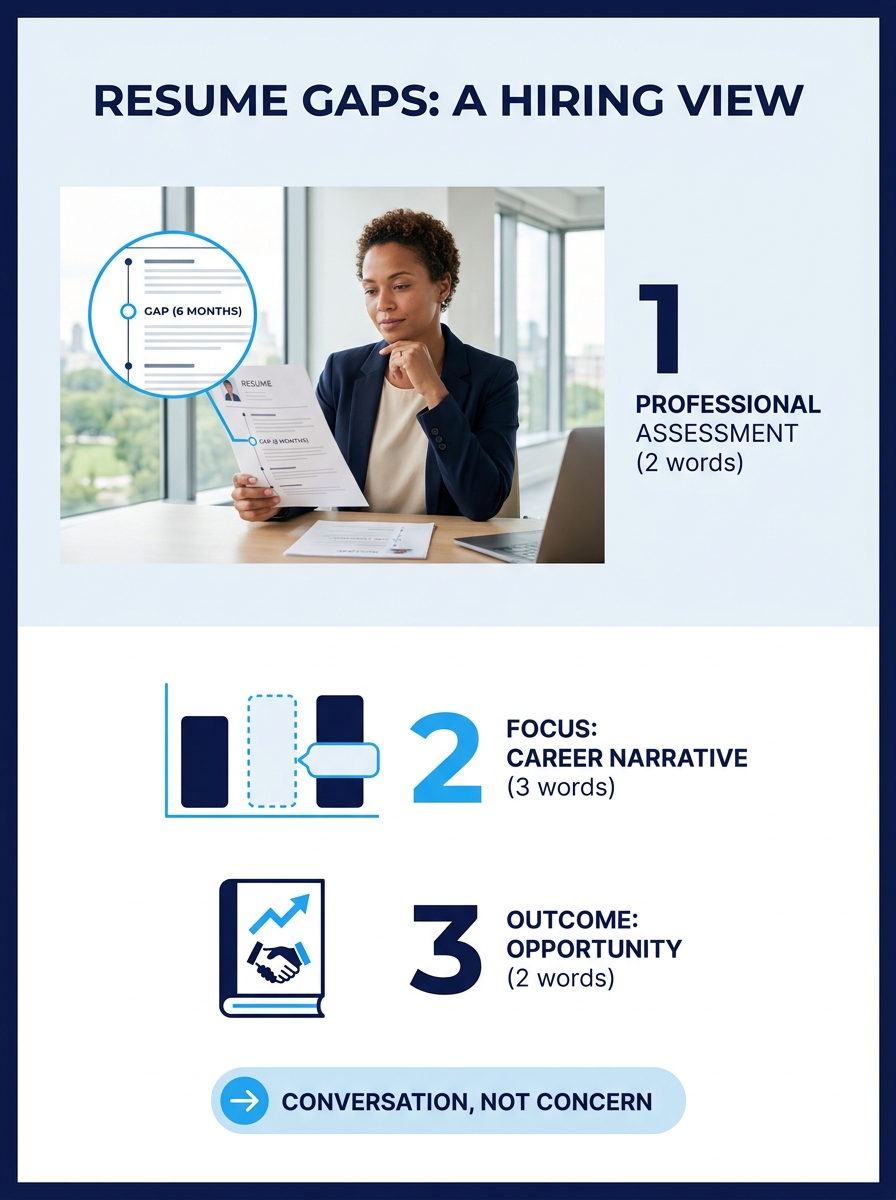
4.5The resume employment gap you’re trying to disguise is the first thing an experienced recruiter notices. Seventy-nine percent of hiring managers say they’ll hire a candidate with a gap when it’s explained properly, according to LinkedIn hiring data. The concealment, not the gap, is what kills your candidacy.
TL;DR: Hiding a career gap on your resume backfires because it signals dishonesty or poor judgment. Each of the five most common gaps (layoffs, caregiving, health, sabbaticals, terminations) has a specific framing strategy that satisfies hiring managers. A confident, direct career gap explanation outperforms every formatting trick or date-manipulation tactic.
The Psychology of the Hidden Gap
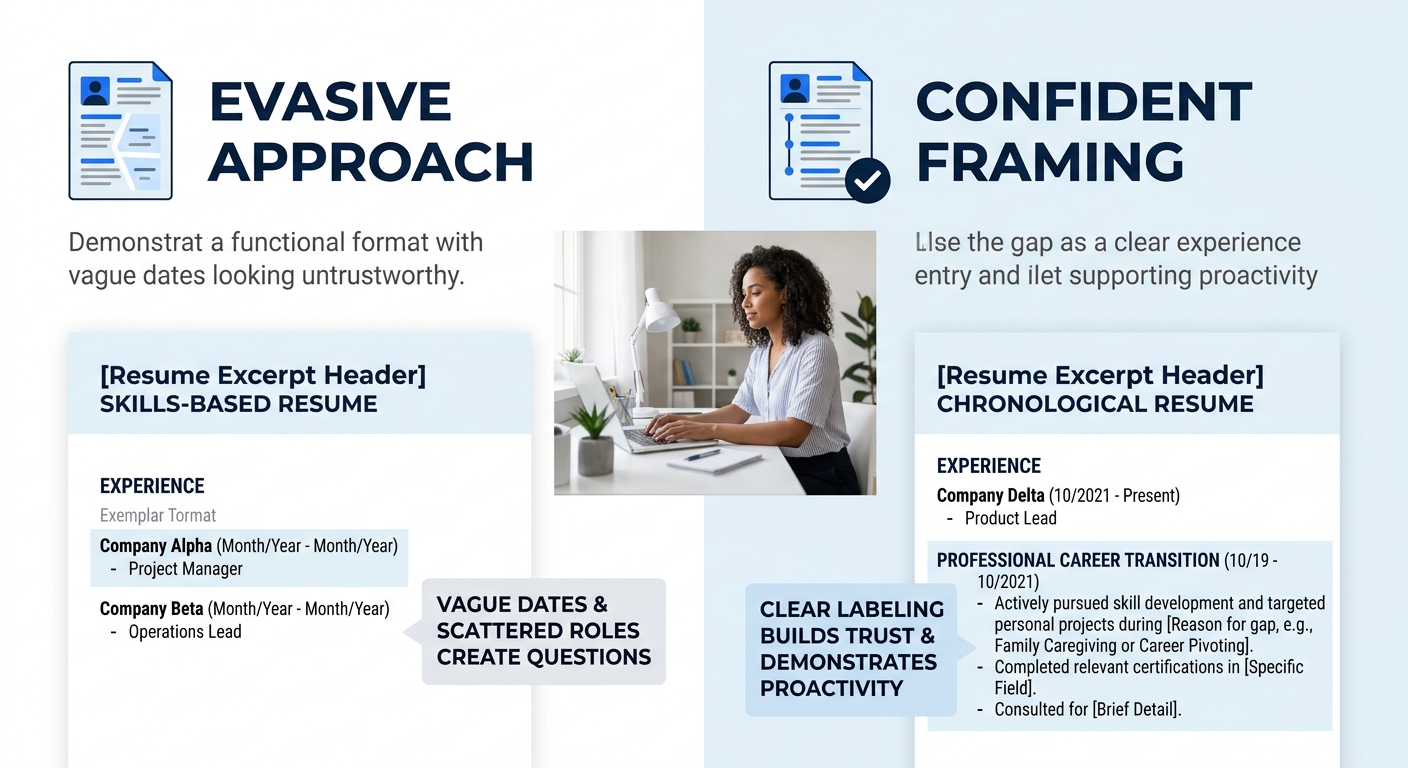
Why does hiding a resume employment gap backfire so reliably? Because hiring managers have seen every trick in circulation. Functional resumes that strip dates entirely. Year-only formatting designed to obscure six-month holes. Vague “consulting” entries that nobody can verify. Recruiters don’t miss these patterns. They flag them.
One hiring manager on Reddit’s r/askmanagers put it plainly: “I don’t care about gaps, but I ask in case there is a red flag. Chronic employment issues, legal issues. There are thousands of reasons to take a gap, that I would simply ignore and move on to the interview and rest of your resume,” according to a thread on employment gap concerns.
That quote reveals the real dynamic at play. Hiring managers aren’t scanning for unbroken employment histories. They’re screening for red flags. When you hide a gap, you manufacture ambiguity, and ambiguity reads as a flag. A LinkedIn survey of 23,000 global workers found that nearly two-thirds had taken a career break at some point in their careers, which prompted LinkedIn to add a dedicated “Career Breaks” profile feature. Gaps are normal. Concealing them is what’s unusual.
The fear that drives concealment is understandable. LinkedIn’s hiring data indicates that 61% of corporate managers initially view gaps with some skepticism, citing concerns about motivation and skill decay. But that skepticism dissolves when candidates provide a clear, confident career gap explanation. The 79% willingness figure tells you the majority will move forward with a gapped resume if the explanation holds up.
So the thesis holds: the gap itself does far less damage than the silence around it.
Five Gaps and the Framing That Survives Scrutiny
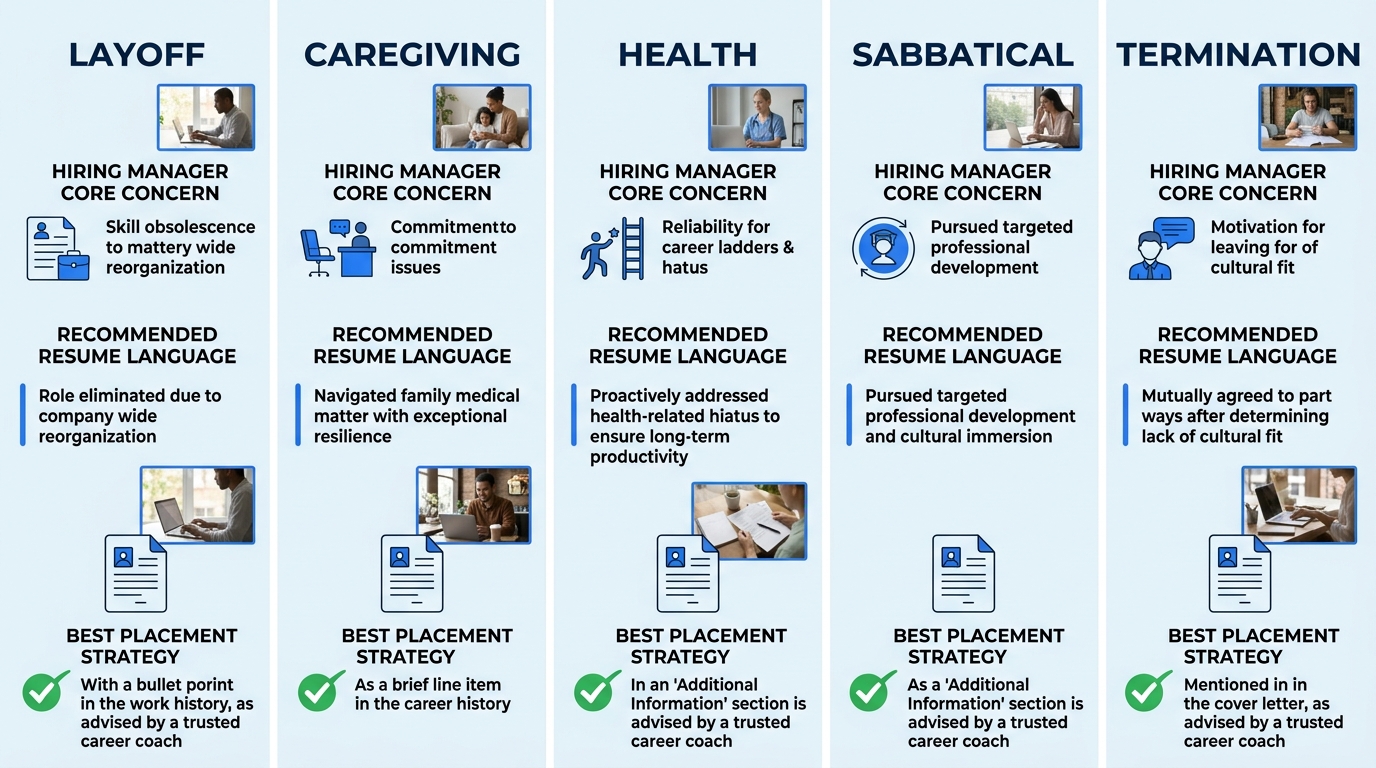
Each type of resume gap triggers a different concern in the hiring manager’s mind. The resume gap framing that works addresses that specific concern, not a generic one. Here’s what each gap looks like from across the desk, and the language that neutralizes it.
Gap #1: Layoffs
The concern: “Were they let go for performance, or was this genuinely a reduction in force?”
Layoffs carry less stigma now than at any point in the last two decades. BestColleges career research notes that “indicating that you were laid off in an application or during an interview should not negatively impact your chances of getting hired.” The wave of tech layoffs that displaced over 100,000 engineers in recent years normalized this experience across every industry, from financial services to healthcare IT.
The frame: State it directly on your resume: “Position eliminated in company-wide restructuring (division closed).” Add one line about what you did during the gap, whether that was completing a certification, taking on freelance projects, or volunteering. If you’re navigating this situation right now, the strategies used by displaced engineers rebuilding their resumes around outcomes rather than titles apply across the board.
Gap #2: Caregiving
The concern: “Will they need to leave again? Are they fully available now?”
Caregiving gaps affect roughly 1 in 5 workers who report gaps longer than a year, whether they stepped away for children, aging parents, or ill family members. Career coach Kathy Caprino has advised candidates to “lead with facts, finish with the skills you gained,” treating the caregiving period as evidence of project management, crisis response, and daily prioritization under pressure.
The frame: Indeed’s career break resume guidance recommends listing your career break as if it were a job in your experience section. Write “Family Caregiving (2022–2024)” as the entry, then add two bullet points: one about any professional development you maintained (industry reading, certifications, part-time consulting), and one about your current readiness and availability.
Gap #3: Health-Related Breaks
The concern: “Is the health issue resolved? Will attendance be reliable?”
This is the gap people agonize over most, and the one that requires the least amount of detail on paper. You’re under no legal obligation to disclose a medical condition. Hire Heroes USA recommends you “provide a broad explanation while highlighting achievements and professional development that may be detailed elsewhere in your resume.”
The frame: Write “Personal Sabbatical (2023–2024)” or “Medical Leave (Resolved)” on the resume. That covers it. Save any additional context for the interview if asked directly, and even then, keep it to one sentence: “I dealt with a health situation that’s fully resolved, and I used part of that time to [specific professional activity].” The cover letter is often the better venue for health-related gaps, as Indeed’s returning-to-workforce guidance notes: use your cover letter, rather than your resume, to briefly explain the break and emphasize your availability. If you’re writing that letter, the approach in our cover letter personalization playbook will help you calibrate the right level of detail.
Gap #4: Gap Year, Travel, or Sabbatical
The concern: “Are they serious about working, or will they bail when wanderlust hits again?”
The gap year resume challenge is real because hiring managers worry about flight risk. Reddit’s r/resumes community frequently advises framing deliberate sabbaticals as consulting or self-employment. “It’s perfectly acceptable to fill the gap with consulting work as self-employment,” one experienced project manager noted in a recent thread.
The frame: If you did any work during the gap (freelance projects, language study, volunteer coordination abroad), list it as an experience entry. “Independent Consultant / Professional Development (2023–2024)” with bullets about specific projects or skills acquired reads as intentional and productive. If the gap was purely personal, own it: “Professional Sabbatical (2023–2024)” followed by one bullet about how you stayed current in your field. The key is demonstrating intentionality, showing you made a deliberate choice and used the time with some structure.
Hiring managers aren’t screening for unbroken employment histories. They’re screening for red flags. When you hide a gap, you manufacture ambiguity, and ambiguity reads as a flag.
Gap #5: Termination
The concern: “What went wrong, and will it happen here?”
This is the gap that genuinely benefits from strategic framing on a returning to workforce resume. Being fired carries real stigma, and your approach needs to acknowledge the departure without inviting follow-up questions on paper. The resume itself should never say “terminated” or “fired.”
The frame: List the job with its dates normally. The gap after it gets treated like any other: fill it with what you did next. If the gap was short (under six months), year-only date formatting (2023–2024 instead of March 2023–September 2023) can minimize the visual footprint without dishonesty. The actual explanation belongs in the interview, where tone and body language carry weight. Prepare a two-sentence script: “The role wasn’t the right fit for either side. Here’s what I learned from it and how I’ve applied that lesson since.” If you want to prepare for that conversation in depth, a solid behavioral interview answer framework helps you practice pivoting from difficult questions toward forward-looking answers.
Format Choices That Signal Confidence vs. Concealment
The structural decisions on your returning to workforce resume communicate as much as the words themselves. Here’s where format intersects with gap strategy, and where the wrong choice amplifies the problem you’re trying to solve.
| Format Choice | When It Helps | When It Hurts |
|---|---|---|
| Year-only dates (2022–2024) | Gaps under 6 months; multiple short roles | Gaps over 12 months (creates more suspicion) |
| Hybrid resume (skills + chronology) | Career changers; gaps filled with transferable skills | Technical roles where chronological progression matters |
| Functional resume (skills only, no timeline) | Almost never | Recruiters and ATS systems both penalize missing dates |
| Gap listed as experience entry | Gaps over 6 months; caregiving or sabbatical | Very short gaps where a line item looks disproportionate |
| Cover letter explanation only | Health gaps; terminations; sensitive circumstances | Long gaps that leave a visible hole on the resume itself |
The functional resume deserves special attention because it’s the format job seekers most often reach for when they have a gap, and it’s almost always the wrong move. When you optimize your resume for the human who reads it after the ATS screening pass, remember that recruiters are trained to read chronologically. A functional format doesn’t hide your gap. It announces that you have something worth hiding.
The hybrid format works better for most gap situations because it leads with a skills summary (addressing any concern about skill decay during your gap) while still providing a chronological work history below. You can reverse-engineer a job description to identify which skills belong in that top section, ensuring the competencies you highlight directly match what the role requires. That skills section does double duty: it reassures the hiring manager about your current abilities and pulls their attention toward what you can do now rather than where you weren’t working then.
Tip: For gaps under six months, listing only years (not months) is a widely accepted practice that most recruiters consider standard formatting rather than evasion. For anything longer than a year, you need an actual entry on your resume with a label and at least one bullet point.
Why Transparency Beats Cleverness, Even When It Feels Reckless
The conventional wisdom says to minimize, obscure, and redirect attention away from a career gap. And for a long time, that advice made sense in a labor market where unbroken tenure signaled loyalty and competence. The data now tells a different story.
LinkedIn’s introduction of a Career Breaks profile feature, based on their survey of 23,000 workers across industries, formalized what hiring managers were already adjusting to: career gaps are a standard part of professional life. The 79% of hiring managers who say they’ll hire gapped candidates represent the new baseline, not a generous exception. And the 61% who express initial skepticism aren’t rejecting candidates with gaps. They’re rejecting candidates who can’t explain them.
The framing strategies above share a common architecture. They name the gap directly. They provide one concrete detail about what happened during it. And they pivot forward to availability, skills, and readiness. That three-part structure (name it, fill it, move forward) works because it addresses the hiring manager’s actual concern while simultaneously demonstrating the communication skills and self-awareness that make someone a strong hire in any role.
Your gap happened. The resume that acknowledges it with confidence and context will outperform the resume that pretends it didn’t. The hiring managers reviewing your application aren’t demanding perfection from your timeline. They’re looking for honesty they can trust and competence they can verify, and a well-framed gap gives them both.