

 4.9
4.9 4.5
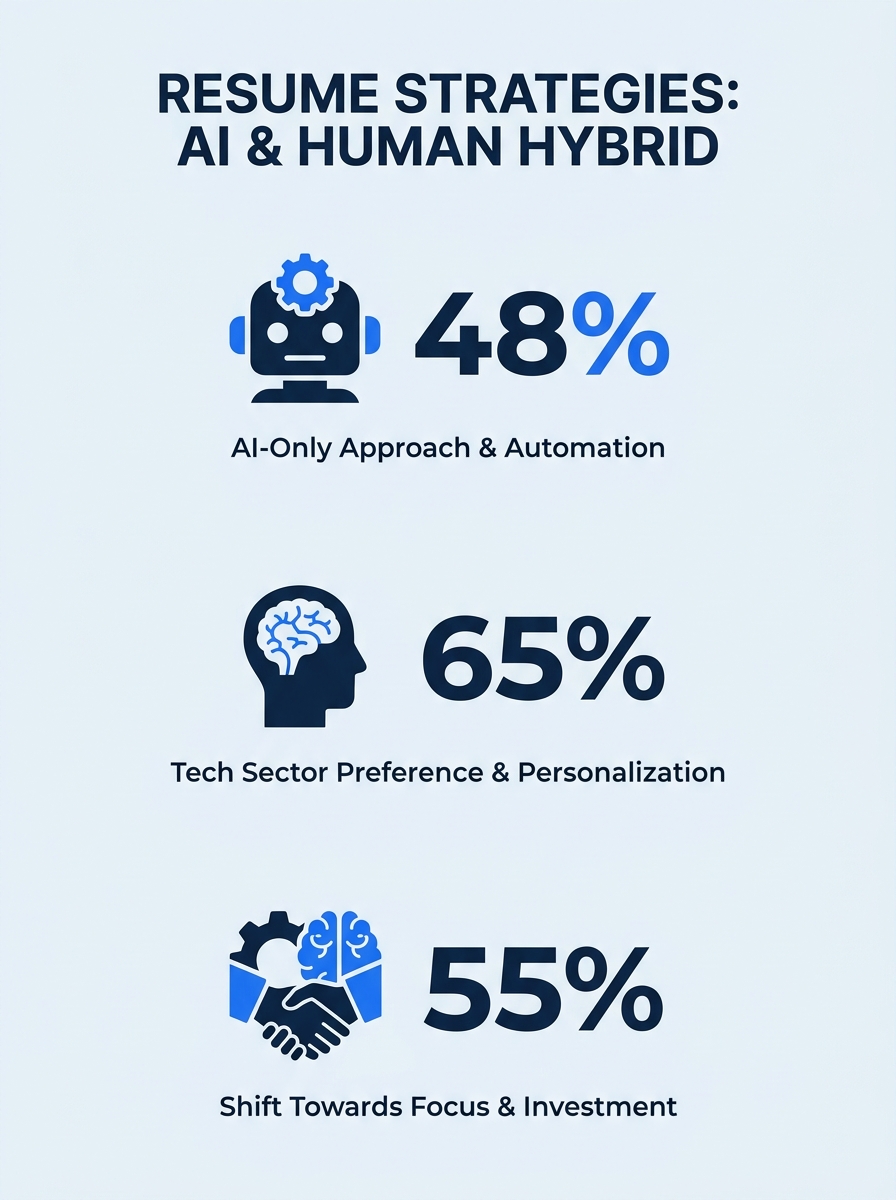
4.5Forty-eight percent of U.S. hiring managers now prefer investing in AI tools over hiring and training a recent college graduate, according to a ResumeTemplates.com survey of 1,000 hiring managers published June 3, 2026. That finding forces entry-level candidates into a choice between three distinct resume positioning strategies: lead with AI tool proficiency, double down on human-only strengths, or demonstrate AI-augmented results.
TL;DR: Nearly half of hiring managers prefer AI tools to entry-level hires. Your resume should respond to one of three realities: proving you can run AI tools, proving you do what AI can’t, or proving you make AI outputs better. The right choice depends on your target industry and what you can actually document.
The survey numbers get harsher the deeper you look. Fifty-five percent of companies have already shifted entry-level hiring budgets toward AI tools. Forty-five percent have restructured roles so one senior employee using AI replaces multiple junior hires. The preference peaks in technology at 65% and finance at 56%, while government sits at 20%. Hiring managers cite faster onboarding (61%), reliable output (55%), and lower cost (48%) as the primary reasons they’d pick a subscription over a person.
And the broader labor data compounds the pressure. As of June 4, 2026, AI has become the leading reason cited for layoffs, with tech alone losing 123,000 jobs this year. Entry-level hiring at companies adopting AI is down 80%, per Forbes reporting from late May. Generative AI is particularly effective at codified, checkable tasks, the kind learned from textbooks and training data rather than accumulated on the job. The tasks that define early careers fall squarely into that category.
So which resume strategy gives you a real edge in this entry-level job market? That depends on the kind of role you’re targeting and how deep AI adoption runs at the companies on your list.
Leading With AI Tool Proficiency
The instinct many candidates have is to add a “Skills: Prompt Engineering, ChatGPT, Claude, RAG” line to their resume. As The AI Career Lab observed in their 2026 resume guide, this works at the most surface level but doesn’t differentiate. There are now millions of resumes carrying that exact line. Both Harvard’s Mignone Center for Career Success and the University of Miami’s Toppel Career Center recommend including terms like “data analysis,” “Python scripting,” and “AI tool proficiency” in your skills section. But listing skills without context puts you in the same pile as everyone who completed a weekend certification.
A stronger version of this strategy names specific tools and ties each one to a measurable output. Instead of “Proficient in Claude,” you write “Used Claude to draft client communications, reducing turnaround from 4 hours to 45 minutes.” If you’re working on making your resume speak to both ATS systems and the human who reads it second, that kind of specificity does double duty: it matches keyword scans and it convinces a real person you’ve done real work.
The AI-fluency resume works best in sectors where AI adoption is highest and hiring managers are explicitly looking for candidates who can hit the ground running with their existing tool stack. In the technology sector, where 65% of managers prefer AI tools over new hires, demonstrating you already know the tools removes the onboarding cost argument that drives the preference. If a hiring manager’s main objection to hiring you is that training costs more than subscribing to a $200/month AI service, your resume needs to make the cost argument disappear.
Where this strategy weakens: when you’re applying to government roles (only 20% prefer AI over grads) or healthcare, where tasks require judgment calls AI can’t reliably make. There’s also a shelf-life problem. Entry-level AI jobs that exist in 2026 require attention to detail, basic computer skills, and the ability to follow detailed instructions consistently. These are genuine requirements, but they’re also skills AI itself is getting better at, which means the tools you’re listing today may not need a human operator in 18 months.
Tip: When listing AI tools on your resume, pair each one with a quantified result. “Used Midjourney to produce 40 social assets per week, up from 8 with manual design” beats “Proficient in Midjourney” in every screening context. If you need help structuring that kind of specificity, [reverse-engineering a job description into a targeted resume](/blog/reverse-engineer-job-description-resume) is a reliable method.
The Human-Edge Resume
Why would a company hire you when a tool can do the same work faster? The answer is that many tasks can’t be reduced to a prompt. Srinivasan, a researcher featured in Harvard Business School’s Working Knowledge series, concluded: “Rather than solely eliminating jobs, generative AI creates new demand in augmentation-prone roles, suggesting that human-AI collaboration is a key driver of labor market transformation.” The phrase worth circling is “augmentation-prone.” Certain roles are expanding because AI makes the human in the seat more productive, and those roles reward skills that resist automation.
Generative AI excels at codified, checkable tasks. The work that defines early careers falls into that category, which is why entry-level hiring is collapsing in AI-heavy sectors. But the flip side: uncoded, ambiguous, relationship-dependent work resists automation. Client management, cross-functional coordination, physical troubleshooting, and persuasive communication under real-time pressure all sit outside what current AI handles well.
AT&T’s decision to invest $38 billion over the next five years hiring and training blue-collar front-line workers illustrates this divide. The majority of those hires are skilled technicians expanding fiber networks. No AI tool climbs a utility pole or troubleshoots a live installation. This pattern repeats across industries where physical presence, regulatory judgment, or interpersonal trust matters.
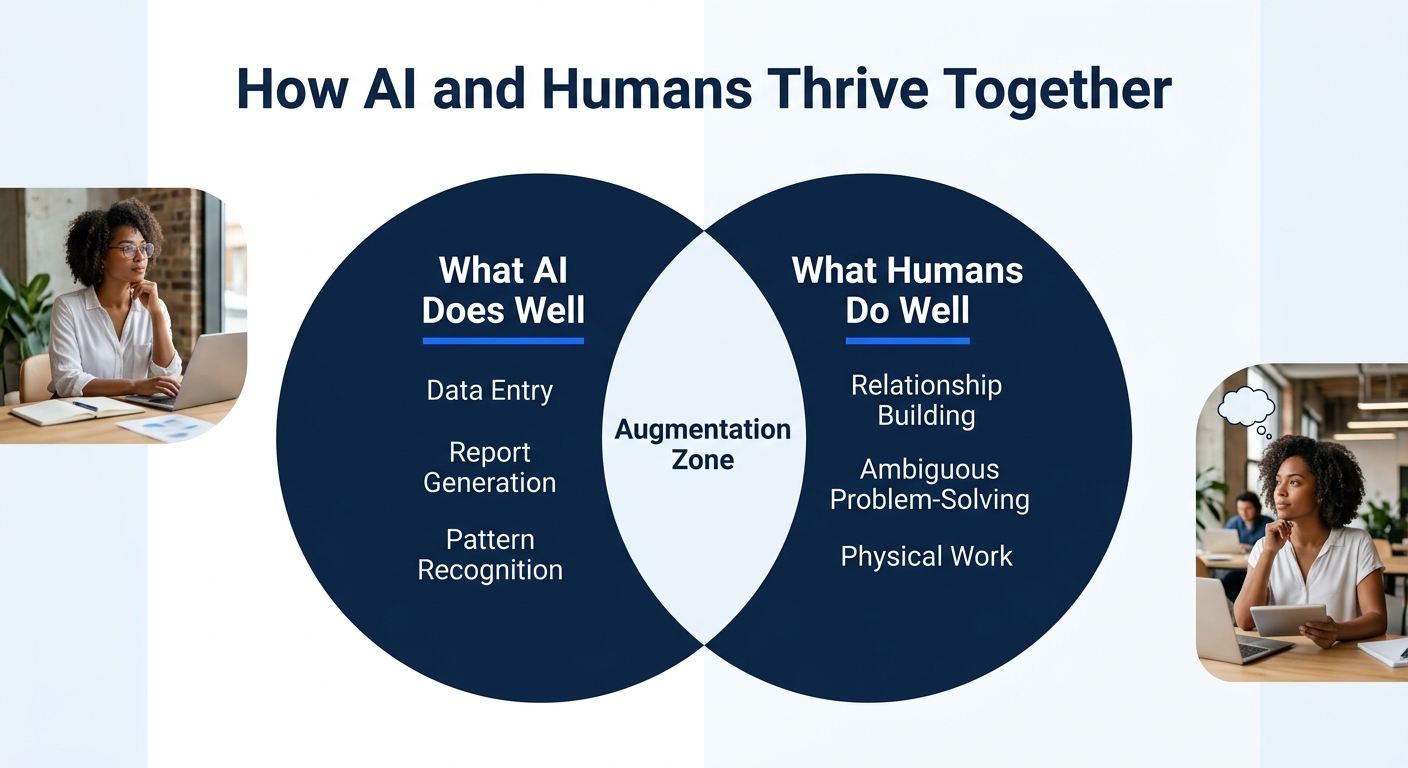
The human-edge resume strategy means you build your entire positioning around adaptability skills and work that requires presence, nuance, or trust. If you’ve done client-facing internships, managed real conflicts, navigated ambiguous projects, or solved problems without a textbook answer, those experiences belong at the top of your page. You’re framing unconventional experience as a strength by demonstrating your value lives precisely where AI’s value doesn’t.
Where this strategy weakens: it can sound defensive. If your resume reads like you’re avoiding AI rather than complementing it, hiring managers in tech and finance may see you as behind the curve. Forbes reported in March 2026 that 67% of hiring managers believe AI-generated resumes are sabotaging the hiring process, so they’re already scrutinizing every document for authenticity signals. A human-edge resume that reads too polished or formulaic will trigger the same suspicion as an obviously AI-generated one. Your adaptability skills need to come through in specific stories, not vague assertions.
Showing AI-Augmented Outcomes
The third strategy borrows from the first two but shifts the emphasis away from what tools you know or what AI can’t do. Instead, it centers on what you’ve actually produced by working alongside AI tools. This resume positioning strategy maps directly onto how companies are restructuring roles right now. Remember: 45% of surveyed companies have rebuilt positions so that one senior person with AI replaces multiple junior people. The job you’re applying for probably expects you to do what two or three people used to do.
If a hiring manager’s main objection to hiring you is that training costs more than subscribing to a $200/month AI service, your resume needs to make the cost argument disappear.
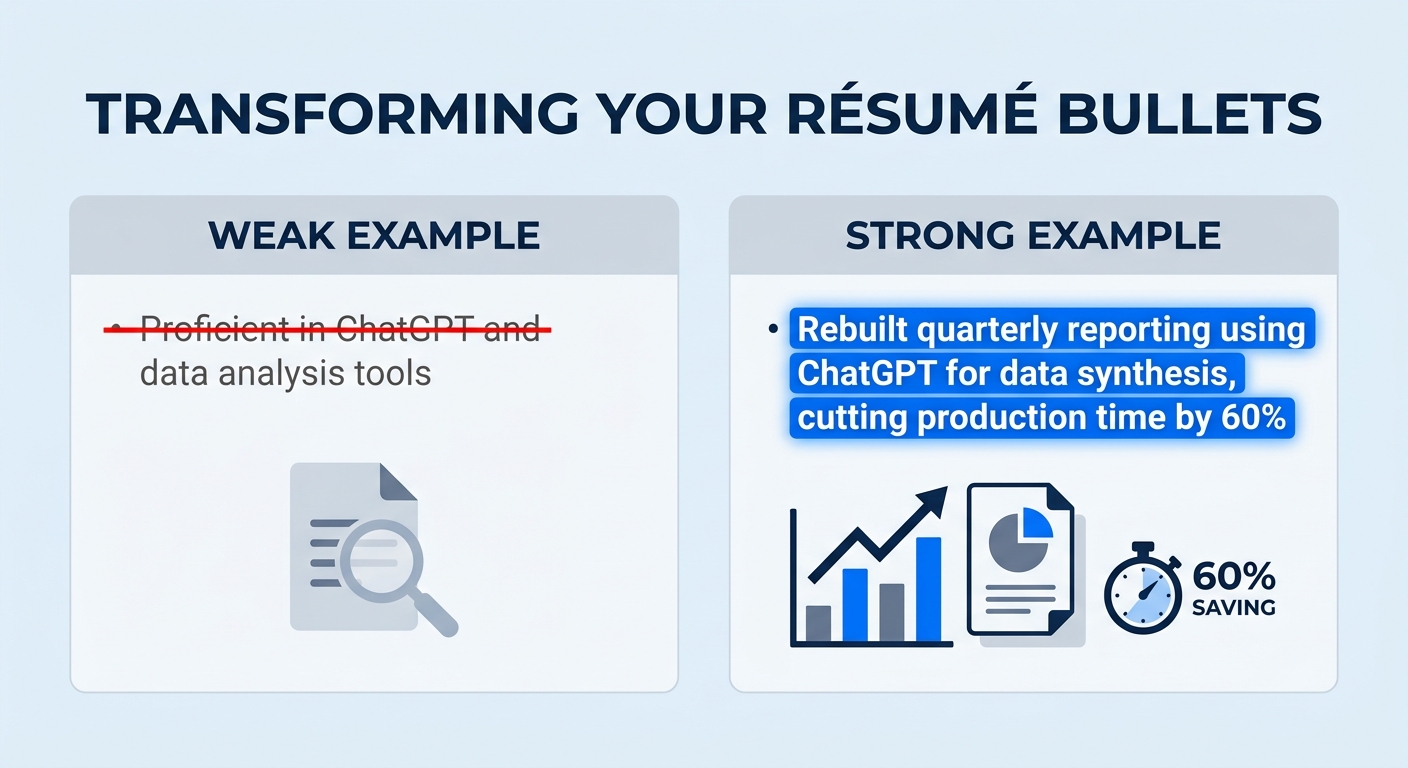
An AI-augmented outcomes resume leads with results and attributes the improvement to your combined human-plus-AI workflow. Instead of “Proficient in ChatGPT,” you write “Rebuilt the quarterly reporting process using ChatGPT for data synthesis and manual validation, cutting production time by 60% while maintaining 99.2% accuracy.” The hiring manager reading that line sees someone who’s already operating the way their restructured team works. That’s the difference between listing a tool and showing a workflow.
This approach works particularly well because it addresses all three of the concerns hiring managers cited in the ResumeTemplates.com survey. You onboard fast because you already use the tools (61% cited onboarding speed). Your output is reliable because you show verified results (55% cited output reliability). And you’re cost-effective because you multiply your own productivity (48% cited lower cost). One resume bullet, three objections answered.
When chatbots are conducting screening interviews at 30% of U.S. employers, vague claims about AI proficiency get probed immediately. Both AI screeners and human interviewers will ask follow-up questions about your workflow, your error-checking process, and the specific numbers you’re claiming. The augmented-outcomes resume only works if every claim is specific and defensible. For recent graduates who used AI tools in coursework or capstone projects, those experiences count, but the claim has to include a real metric tied to a real deliverable.
Where this strategy weakens: you need actual experience to pull it off. You can’t fabricate a workflow you never ran. And fabrication risk is high right now. With 80% of hiring managers claiming they can spot AI-generated resume content at a glance, stretching a minor class project into a major productivity story is likely to backfire during the interview.
Side-by-Side Comparison
| Factor | AI-Fluency Resume | Human-Edge Resume | AI-Augmented Outcomes Resume |
|---|---|---|---|
| Strongest industries | Tech (65% AI preference), finance (56%) | Government (20%), healthcare, trades | Any sector with restructured hybrid roles |
| Core message to hiring managers | “I already know your tools” | “I do what AI can’t” | “I produce more with AI than without it” |
| Primary risk | Skills commoditize quickly as tools simplify | Can read as AI-avoidant in tech-heavy sectors | Requires real, verifiable project experience |
| Addresses which hiring concern | Faster onboarding (61%) | Judgment in ambiguous, high-stakes situations | All three: speed (61%), reliability (55%), cost (48%) |
| Best fit for | Candidates with certifications and technical depth | Career changers, liberal arts grads, hands-on roles | Candidates with project-based proof of AI-augmented work |
| Shelf life of positioning | 12-18 months before tools evolve | Durable, but limits you to slower-adoption sectors | Long, because outcomes transfer across tool changes |
The Verdict
There’s no single resume trick that reverses a structural shift where 55% of companies are redirecting entry-level hiring budgets to AI. But the candidates getting interviews right now are the ones who’ve picked a strategy that matches their actual evidence and their target industry, then built every bullet around it.
If you’re aiming at tech or finance, the augmented-outcomes resume is your strongest play because it addresses all three concerns from the ResumeTemplates.com data in a single document. If you’re targeting government, education, or trades, a human-edge resume still carries weight because AI adoption in those sectors lags 30 to 45 percentage points behind tech. And if your primary asset is certified technical fluency with specific AI platforms, the AI-fluency resume works as long as every tool name sits next to a result.
The referral and outreach ecosystem that fills 70% of roles still matters, too. A warm introduction from a trusted employee makes hiring managers less likely to default to “we’ll just use AI for that task.” Your resume gets you through the screen, but the relationship gets you into the conversation where hiring manager expectations can shift in your favor.
The AI hiring trends of 2026 haven’t closed the door on entry-level careers. They’ve changed which doors are open and what the person on the other side wants to see when they read your resume. Pick the strategy that matches your proof, build your resume around it, and apply to the sectors where that proof still matters more than a software license.