

 4.9
4.9 4.5
4.5Screening data shows recruiters spend fewer than 30 seconds on a resume before deciding to keep or reject it. For entry-level candidates, ResumeLab confirms the right length is one page. The most reliable path to filling that single page with content that survives both ATS filters and human review: reverse-engineer the job description you’re targeting instead of opening a template.
TL;DR: Templates give you a layout but no content direction. The Reverse-Assembly Method starts from 3-5 real job postings instead: extract their keywords, map those keywords to your actual experience, then build five standard resume sections in priority order. Every decision about what to include comes from the posting, not from guessing.
Templates Solve the Wrong Problem
The reason so many people freeze in front of a blank document is that they treat resume writing as a design problem. Pick a layout. Choose a font. Arrange the boxes. Then figure out what goes inside them.
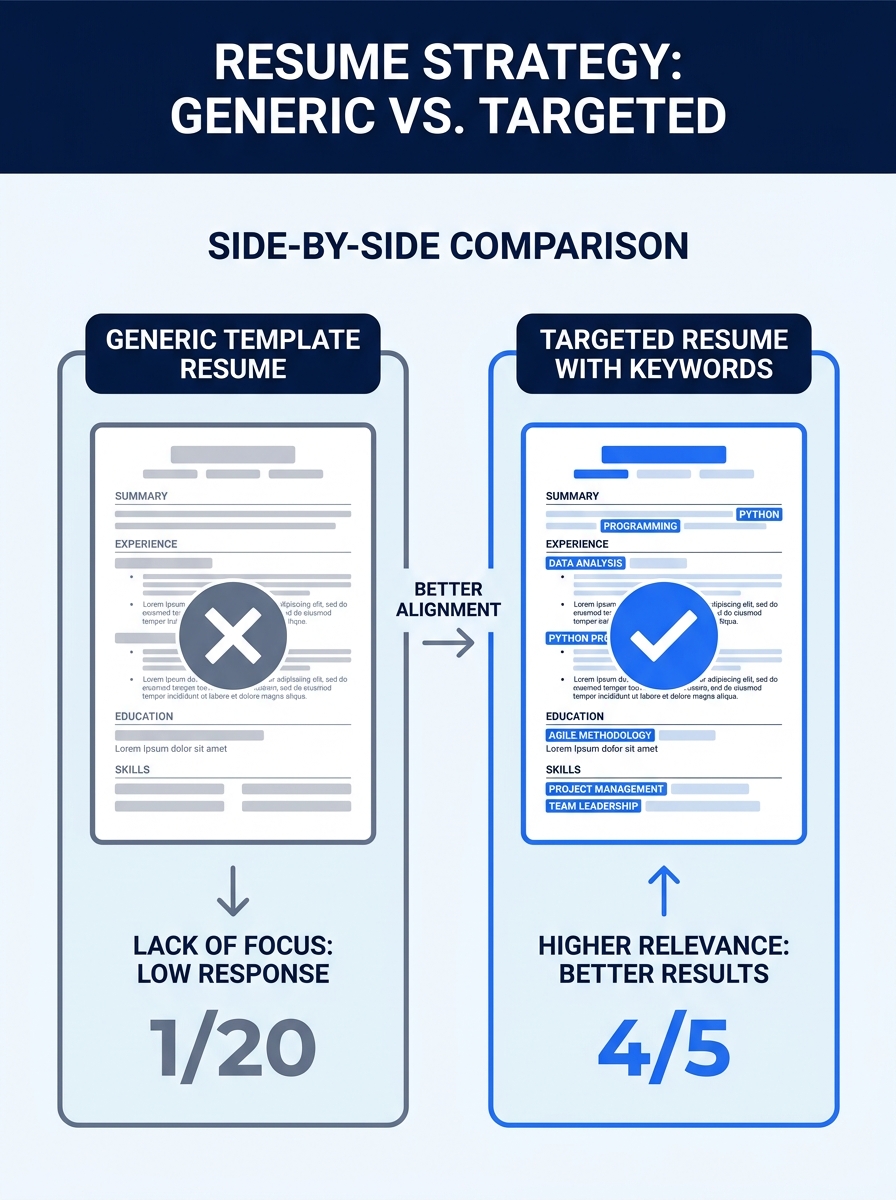
This gets the order backwards. The Muse’s entry-level resume advice frames it clearly: “Your resume is a single page that is supposed to convince the person who reads it to call you for an interview. So it has to be relevant to the job they’re hiring for.” Sending out the same generic version to every employer is the fastest route to silence.
Templates encourage exactly that behavior. They hand you placeholder text (“Results-oriented professional seeking a challenging opportunity…”) and suggest you swap in your details. The structure stays identical across applications. But ATS software at over 97% of large employers compares your resume against the specific job description, scanning for keyword alignment. A template built for a generic “marketing associate” role won’t match the particular skills a given company listed for their marketing associate opening.
So the real question for a resume for beginners is: where should your content come from? The answer is the job posting itself.
The Reverse-Assembly Method
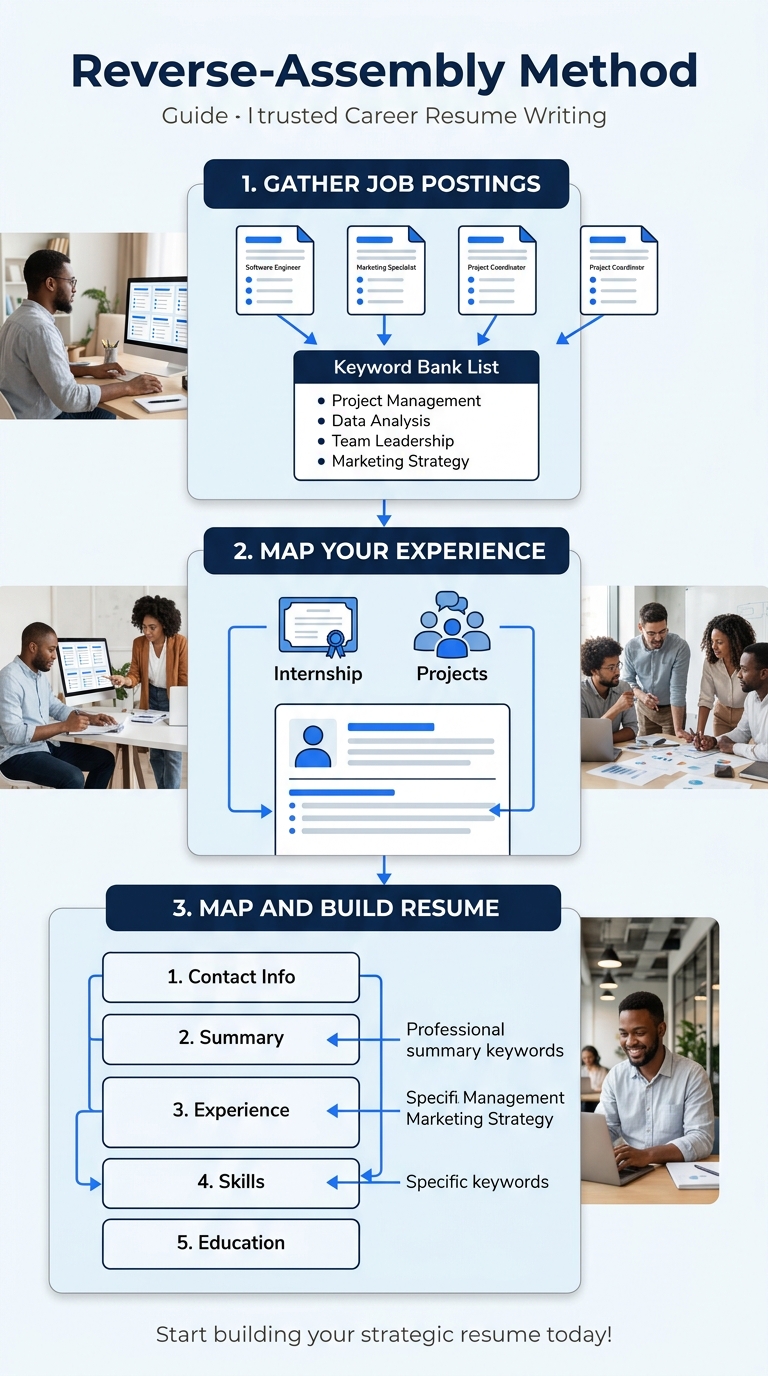
Here’s a framework for how to start a resume from scratch that removes guesswork from every section. It has three stages, and the first one doesn’t involve your resume at all.
Stage 1: Build a Keyword Bank From Real Postings
Teal’s keyword analysis research recommends examining multiple job descriptions for similar roles to get a full picture of what an industry actually wants. Pull up 3-5 job postings for the type of role you’re targeting. They don’t need to be at the same company.
Read each posting line by line. Write down every skill, tool, qualification, and responsibility that appears. Pay attention to what shows up repeatedly across postings. If 4 out of 5 “administrative assistant” listings mention “calendar management,” “Microsoft Excel,” and “travel coordination,” those aren’t optional skills. They’re the baseline the industry expects.
This keyword bank becomes your content source. Every line on your finished resume will trace back to something employers asked for in real postings.
Stage 2: Map Keywords to Your Actual Experience
Go through your keyword bank and mark which items you can honestly claim. Be literal. If the postings ask for “Salesforce” and you’ve never opened Salesforce, that keyword doesn’t go on your resume. But if they ask for “data entry” and you’ve maintained spreadsheets for a campus organization, that’s a match.
For entry-level candidates, experience comes from more places than you might expect: part-time jobs, internships, volunteer work, class projects, club leadership, freelance gigs. Indeed’s entry-level resume guide specifically advises including internships related to your target role and listing primary duties that connect to the position you’re seeking.
Stage 3: Build Sections in Priority Order
With your mapped keyword bank in hand, you’re now assembling a resume where every piece of content has a documented reason for being there. This is the core of job description reverse-engineering: the posting tells you what to write, and your experience tells you what’s true.
We’ve covered the mechanics of turning a job posting into a targeted resume in a full walkthrough, but the section-by-section breakdown below is designed specifically for beginners writing their first resume.
Five Sections That Make Up an Entry-Level Resume Structure
Every resume for beginners needs five sections, arranged in a specific order. The chronological format is preferred by most employers and works best for candidates with any work history at all, including part-time or seasonal jobs. Functional (skills-based) resumes omit employment dates and are sometimes used by career changers, but they raise red flags for entry-level applicants because recruiters assume you’re hiding a lack of experience.
| Section | What Goes Here | Length |
|---|---|---|
| Header | Full name, phone, email, city/state, LinkedIn URL | 2-3 lines |
| Summary/Objective | 2-3 sentences connecting your background to the specific role | 30-50 words |
| Skills | Hard and soft skills pulled from your keyword bank | 8-12 skills |
| Experience | Jobs, internships, projects, volunteer work with bullet points | 3-6 bullets per entry |
| Education | Degree, school, graduation date, relevant coursework or honors | 2-4 lines |
A few things to note about this structure. The summary goes at the top because, as resume screening research confirms, recruiters follow a fixed visual path starting from the top of the page and spending the most time on whatever they see first. The skills section comes before experience because entry-level candidates often have stronger skill keywords than work history. And education goes last unless you’re a current student with no work experience at all, in which case it moves up to slot three.
Tip: BeamJobs’ 2026 analysis of entry-level resumes that landed interviews found a consistent pattern: successful candidates included relevant skills in a dedicated skills section **and** showed the context in which those skills were used elsewhere on the resume. Listing “Python” in your skills section is good; showing you used Python to build a class project dashboard is what makes the keyword stick.
Writing Bullets That Show Impact Without Years of Experience
The bullet points under each experience entry are where most beginners stall out. You feel like you haven’t done anything worth describing. But the problem is usually framing, not a lack of material.
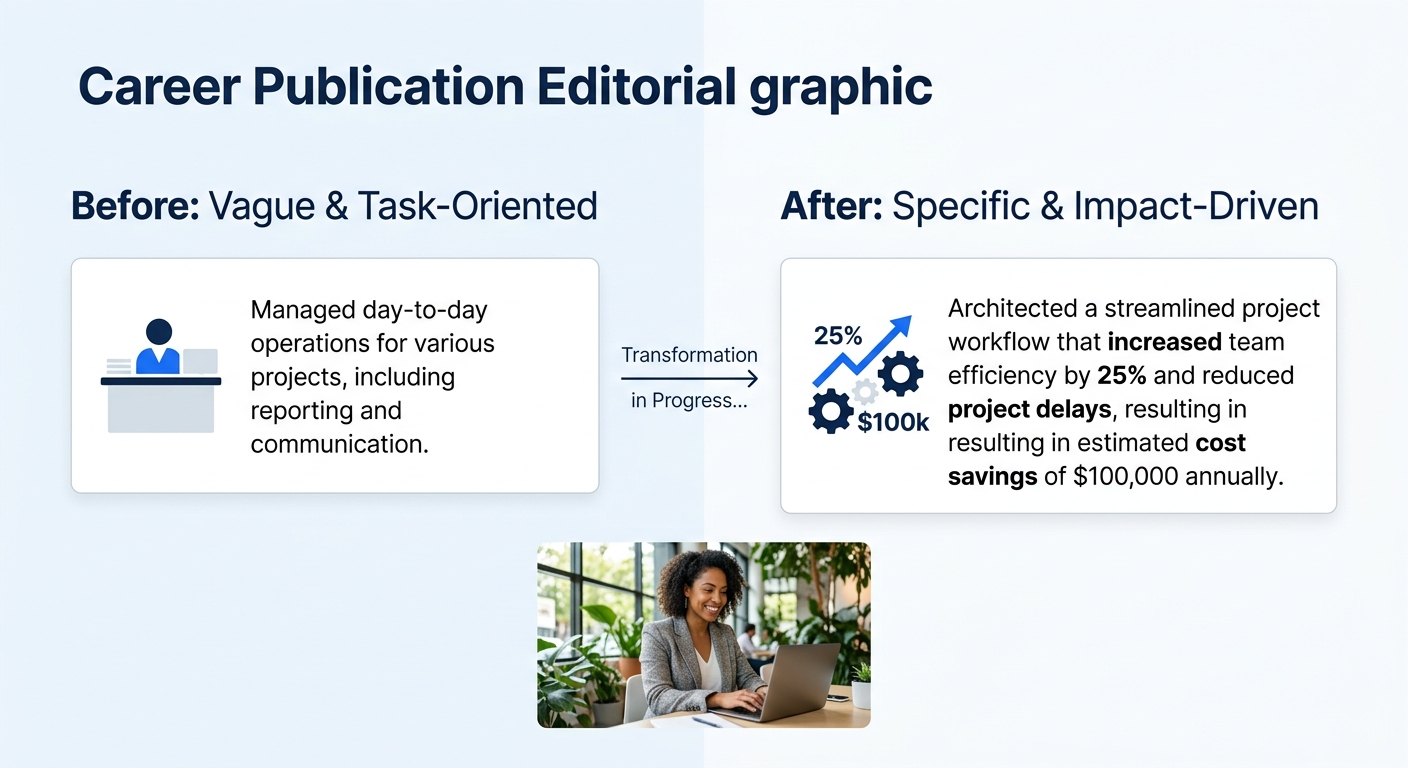
Avoid bullets that describe what you were supposed to do (“Responsible for answering phones”). Write bullets that describe what happened when you did it. The Impact-What structure works well here: lead with the result, then explain the action.
Weak bullet: “Helped organize campus career fair logistics.”
Stronger bullet: “Coordinated venue setup and vendor schedules for a 200-attendee campus career fair, reducing setup time by 45 minutes compared to the prior year’s event.”
The second version has three things the first one lacks: a number (200 attendees), a measurable outcome (45 minutes saved), and a comparison point (prior year). You don’t need Fortune 500 achievements to write effective bullets. You need specifics.
You don’t need Fortune 500 achievements to write effective bullets. You need specifics.
Even without formal work experience, you can write impact-driven bullets about class projects, volunteer roles, and personal initiatives. ResumeGenius recommends highlighting “your most relevant skills and your enthusiasm for the position” in your summary paragraph, and letting your bullet points demonstrate those skills through concrete examples rather than abstract claims.
For candidates who have gaps in their work timeline, the same principle applies. Frame what you did during the gap with the same specificity you’d use for a paid role.
ATS Compatibility Without Overthinking It
Writing for both ATS algorithms and human readers sounds complicated, but the basics for entry-level candidates are straightforward.
Submit as PDF. This prevents formatting from breaking when the file opens on someone else’s computer. Use standard section headers (“Work Experience,” “Skills,” “Education”) because ATS software is trained to recognize those exact labels. Avoid tables, text boxes, columns, and headers/footers for critical content, since many ATS parsers skip anything outside the main document body.
Don’t try to game the system with white-text keywords or invisible formatting tricks. Modern ATS platforms flag that behavior, and it can get your application auto-rejected. Instead, use the keywords from your keyword bank naturally within your bullet points and skills section. If the posting says “customer relationship management” and you have CRM experience, write both the full phrase and the abbreviation somewhere on the page.
Warning: No two jobs are exactly the same, even when they share a title. ResumeWorded’s targeted resume tool works by comparing your resume against a specific job description and finding keywords you missed. Treat each application as a separate alignment exercise. A single “master resume” sent to 50 employers will underperform 50 tailored versions sent to one employer each.
The 87% abandonment rate among job seekers during the resume writing process often stems from this exact friction. Customizing feels tedious. But the Reverse-Assembly Method reduces the effort because your keyword bank already contains the terms each posting cares about. You’re rearranging and emphasizing, not starting from zero every time.
What the Numbers Leave Out
The data points above tell you how to structure an entry-level resume, where to find your keywords, and how long to make each section. They don’t tell you something equally important: what happens after the resume leaves your hands.
Screening data measures averages. The 30-second figure is a mean across thousands of resume reviews. Some recruiters spend 10 seconds. Others spend 2 minutes on a candidate who catches their attention in the first line. The one-page recommendation assumes typical entry-level experience. If you’ve completed 3 internships and published undergraduate research, a tightly edited 1.5-page resume won’t disqualify you.
The numbers also can’t account for how a resume interacts with the rest of your application. A strong cover letter (and there’s a full personalization system for writing tailored letters without rewriting from scratch each time) can compensate for a thinner experience section. A warm referral from someone inside the company can move your resume past the ATS filter entirely.
What the Reverse-Assembly Method gives you is a repeatable process for the part of job searching that paralyzes the most people: the blank page. It turns “I don’t know what to write” into “I know exactly what this employer wants, and here’s where my experience matches.” The gap between those two states is where the interview lives.