


 4.9
4.9 4.5
4.5Swapping “managed” for “orchestrated” on a production floor resume changes your callback rate by approximately zero percent. The verb itself carries almost no weight with hiring managers. What actually moves the needle is the number attached to it: the yield percentage, the downtime reduction, the units-per-shift figure that tells a plant manager you understand output. Resumes with quantified results receive 40% more callbacks than those listing duties alone, and 78% of hiring managers identify metrics as the single most persuasive element on a resume, according to LinkedIn Talent Solutions data.
TL;DR: A resume verb replacement audit for production and operations roles should spend 80% of its energy identifying the right manufacturing resume metrics and 20% choosing the right verb. Pairing strong action verbs with measurable outcomes can increase interview callbacks by up to 140%. The verb without the number is decoration; the number without the verb is a spreadsheet. You need both, but the number matters more.
Why Verb Swaps Alone Don’t Move the Needle
The resume advice industry has spent years telling production professionals to replace “responsible for” with stronger verbs like “directed,” “executed,” or “coordinated.” That advice is correct but incomplete, and following it in isolation creates a specific kind of failure: a resume full of energetic-sounding verbs that still describes duties rather than outcomes.
Consider these two bullets from a real production supervisor resume:
Before audit: “Responsible for managing production line output and ensuring quality standards were met.”
After verb swap only: “Directed production line output and enforced quality standards.”
The second version sounds more active. But a hiring manager reading 75 resumes for one opening still has no idea whether you managed a line of 4 people or 40, whether “quality standards” means 2% defect rates or 12%, or whether output went up or down during your tenure. The verb swap made the sentence grammatically stronger without making the candidate more hirable.
After full audit: “Directed 3 high-speed packaging lines across 2 shifts (32 operators), reducing defect rate from 4.1% to 1.8% over 14 months while increasing throughput by 12%.”
That third version contains 6 specific numbers. Each one answers a question a plant manager or operations director would otherwise need to ask in an interview. The production resume action verbs here (“directed,” “reducing,” “increasing”) do their job, but the metrics are doing the heavy lifting.
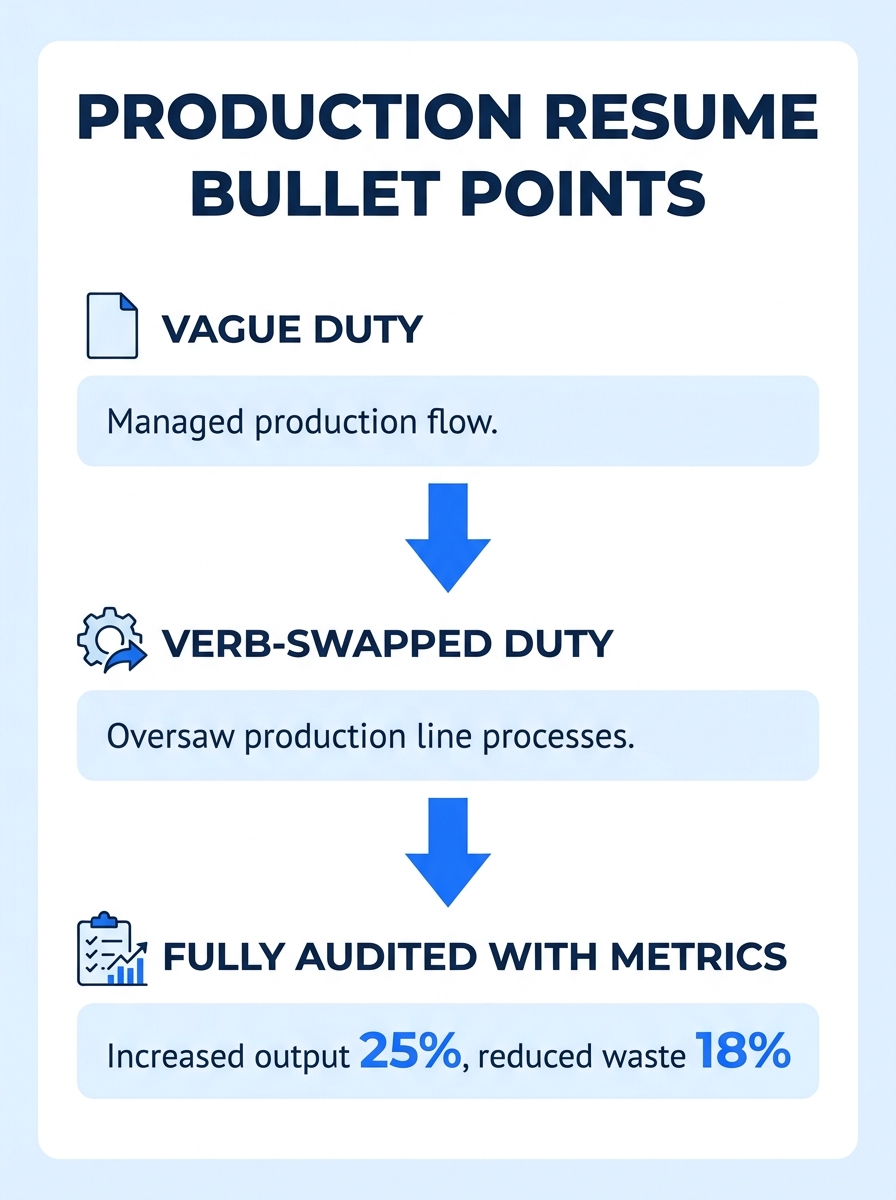
Research from Scale.jobs confirms the scale of this gap: pairing action verbs with measurable outcomes, such as “Managed a cross-functional team of 12 engineers, achieving a 20% productivity boost,” can increase interview callbacks by 140%. Resumes with percentages or dollar amounts are 2.5 times more likely to pass ATS screening compared to those with verb-heavy but number-light bullets. The formula that consistently beats both ATS and human screeners follows a specific structure: strong action verb, plus specific task, plus measurable result. The verb is the chassis. The result is the engine.
The Five-Category Metric Scan for Production Roles
The hardest part of a resume verb replacement audit isn’t choosing between “supervised” and “oversaw.” It’s figuring out which numbers to include when your daily work involves dozens of measurable outputs. Production environments generate more trackable data than almost any other work setting, which creates a paradox: you have too many potential metrics, and most candidates either pick the wrong ones or give up and list none.
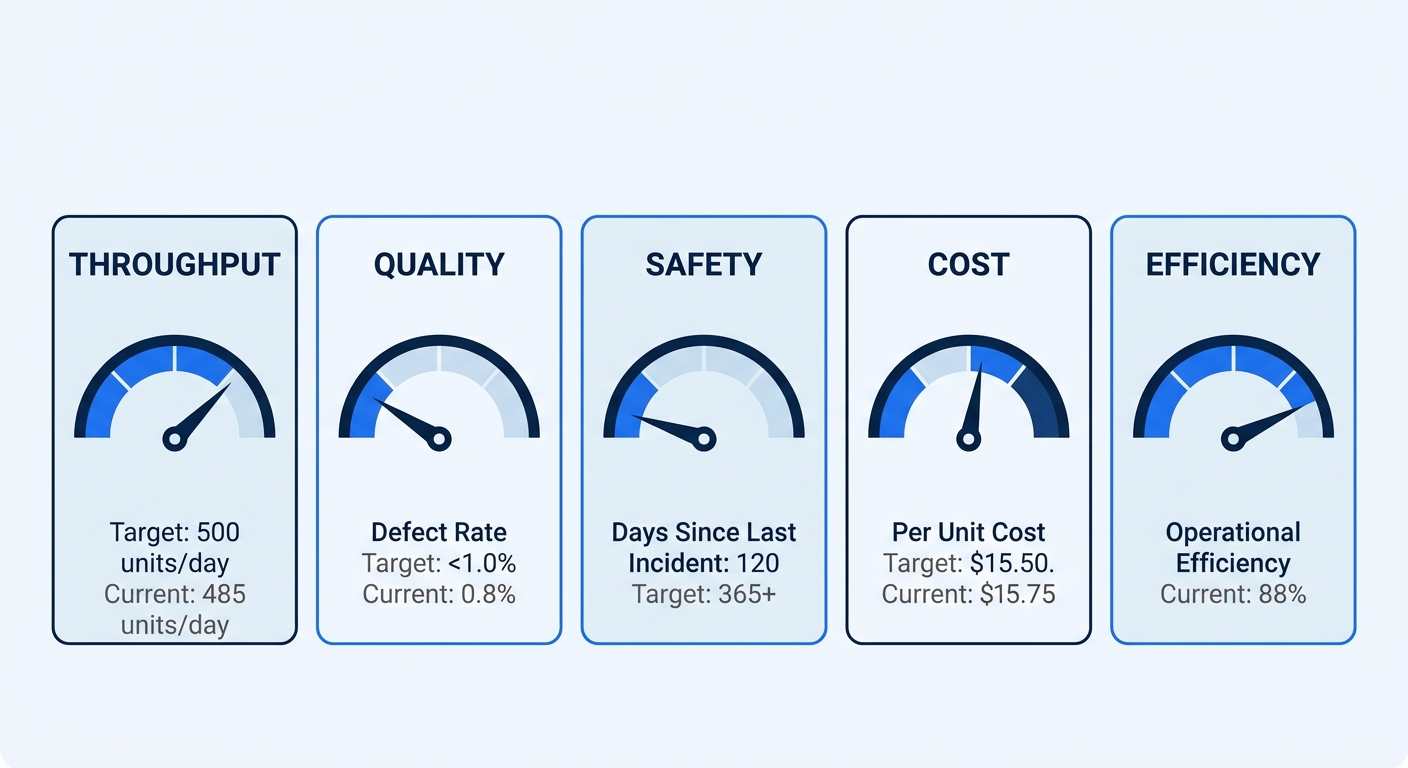
As Indeed’s career guidance puts it, quantifying a resume means reading through it to identify areas where more precise numbers offer a clearer representation of the value you provide. For manufacturing and production roles specifically, those numbers fall into 5 categories that map directly to what operations hiring managers care about.
| Metric Category | What to Measure | Example Bullet |
|---|---|---|
| Throughput | Units per shift, cycle time, line speed | Increased line speed from 340 to 410 units/hour across 2 shifts |
| Quality | Defect rate, scrap %, first-pass yield | Reduced scrap rate by 37% ($180K annual savings) through SPC implementation |
| Safety | Incident rate, days without LSTI, OSHA findings | Maintained 0 lost-time incidents across 22 months and 48 direct reports |
| Cost | Cost per unit, waste reduction, overtime spend | Cut overtime spending by $94K annually by redesigning shift rotation schedule |
| Efficiency | OEE, uptime %, changeover time | Improved OEE from 62% to 79% by reducing average changeover time from 45 to 18 minutes |
When building your own manufacturing resume metrics, go through each of those 5 categories for every role you’ve held and write down whatever numbers you can recall or estimate. You don’t need all 5 for every position. Two or three strong metrics per role will outperform six vague duty statements every time. If you’ve been working on quantifying achievements for non-technical roles, the same principle applies with production-specific vocabulary.
Tip: If exact figures are confidential, Enhancv recommends replacing your success metrics with X placeholders and including a key (e.g., “$XM to represent $1-9 million”) so recruiters can understand the magnitude of your achievement without disclosing proprietary data.
The Audit in Practice: A Before-and-After Walk-Through
Knowing you need metrics and actually extracting them from your work history are two different problems. Here’s how a resume verb replacement audit works when applied to a real operations resume, bullet by bullet.
The process has three steps. First, identify every bullet that describes a duty rather than an outcome. Duties use language like “responsible for,” “assisted with,” “helped to,” “involved in,” or any construction where the verb describes what you were supposed to do rather than what happened because you did it. Second, for each duty bullet, ask: “What changed because I was there?” The answer to that question contains your metric. Third, rewrite the bullet using the verb-task-result structure, front-loading the action verb and ending with the number.
Here are 4 production bullets run through this process:
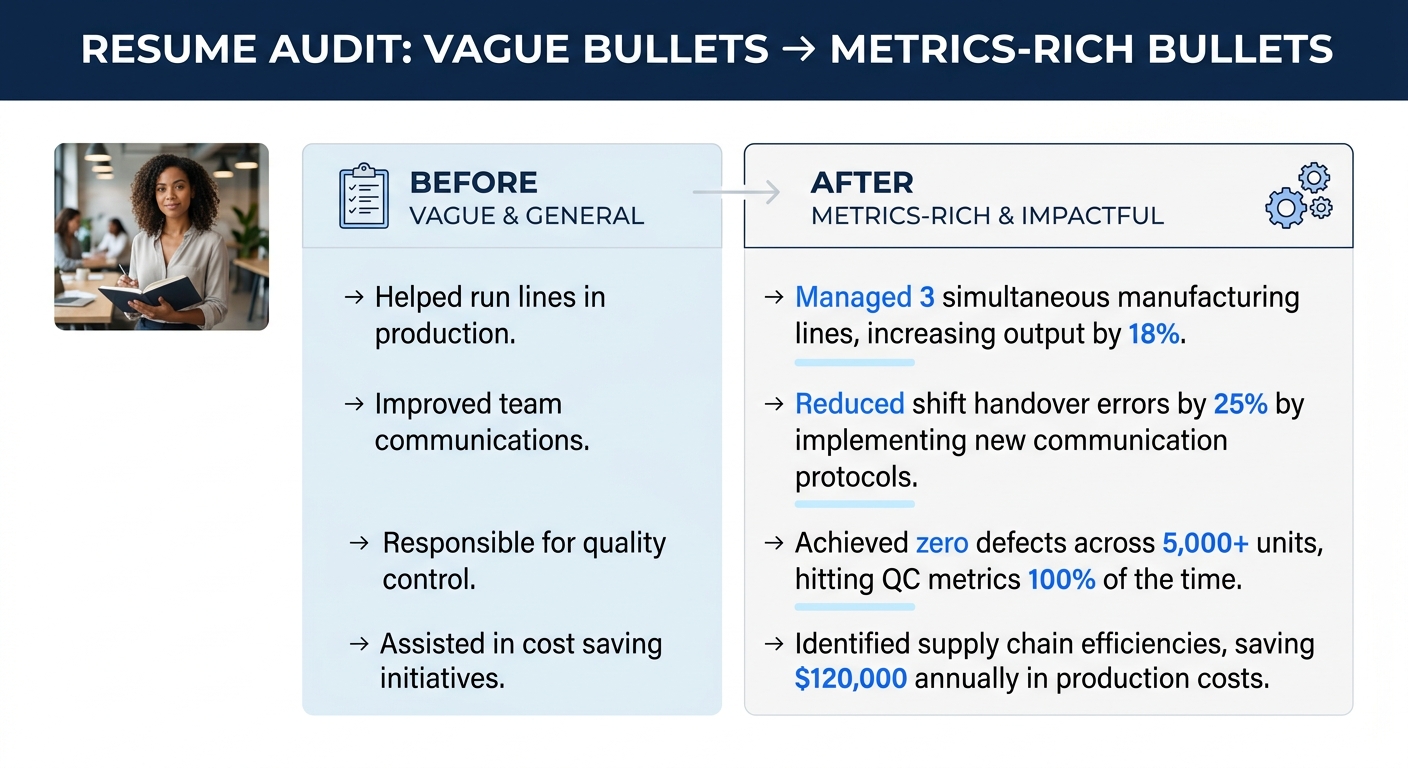
Original: “Responsible for training new hires on equipment operation.” Audited: “Trained 45+ new operators on CNC and injection molding equipment over 2 years, reducing average ramp-to-competency time from 6 weeks to 3.5 weeks.”
Original: “Oversaw inventory management for the warehouse.” Audited: “Managed $2.4M raw materials inventory across 3 warehouse zones, cutting carrying costs by 18% through ABC classification and reorder point optimization.”
Original: “Assisted with lean manufacturing initiatives.” Audited: “Led 8 kaizen events targeting changeover reduction, eliminating 22 hours of weekly downtime and generating $310K in annual capacity gains.”
Original: “Ensured compliance with safety regulations.” Audited: “Implemented daily safety audit protocol for 4 production cells (52 employees), achieving 14 consecutive months with 0 recordable incidents.”
The verb is the chassis. The result is the engine. A resume full of strong verbs and zero numbers is a car with no motor.
Notice what happened in each rewrite. The verbs got slightly more specific (“trained” instead of “responsible for training”), but the transformation came from adding between 3 and 6 concrete numbers per bullet. Volume (45+ operators, $2.4M inventory), frequency (8 kaizen events, daily audits), timeframes (2 years, 14 months), and percentage changes (18% reduction, 22 hours eliminated) all appear naturally because production work generates these figures constantly.
Monster’s resume guidance reinforces this pattern: action verbs are most effective when paired with specific outcomes, and even simple metrics like volume, frequency, accuracy, or percentage changes help employers understand the scale and impact of your work.
If you’re struggling to remember exact numbers from previous roles, that’s normal. One practical approach is to reverse-engineer the job description you’re targeting: look at what the employer says they need, then work backward through your experience to find the closest matching metric. You ran a team? Count the people. You improved a process? Estimate the before-and-after. You managed a budget? State the dollar figure, even as a range.
For operations resume outcomes specifically, the metrics that resonate most with hiring managers track improvement over a baseline. “Managed a team of 20” is useful context. “Managed a team of 20 and reduced turnover from 34% to 12% by restructuring the onboarding program” is a story with a clear conclusion. If you’ve seen how one operations manager rebuilt her resume around process outcomes, the pattern is consistent: baseline, action, result.
Where This Leaves the Action Verb
The contrarian claim at the top of this article — that verb choice barely matters — deserves some qualification now that the evidence is laid out. Verbs do matter in one specific way: they signal to ATS systems and human readers that a bullet describes an accomplishment rather than a passive state. “Reduced defect rate by 37%” will always outperform “Was part of the team that saw defect rates go down” because the active construction front-loads agency and clarity. Writing for both ATS algorithms and human readers requires that active construction as a baseline.
But the verb is the easiest part of the sentence to get right, and it’s where most production professionals stop. The audit that actually changes callback rates is the metric audit: going bullet by bullet through your resume and asking whether each line would still make sense if the verb were removed. If “Directed production operations” and “Managed production operations” are interchangeable without losing information, neither version is finished. The number is missing.
So when you sit down to audit your production resume, spend 5 minutes on your verb choices and 55 minutes on your numbers. Dig through old performance reviews, pull up KPI dashboards you contributed to, check project folders for the before-and-after figures you reported to your manager. For anyone building a resume from scratch, this same principle applies from the first draft: write the metric first, then choose the verb that best introduces it.
The 140% callback increase that research associates with verb-plus-metric pairings doesn’t come from finding the perfect synonym for “managed.” It comes from giving a hiring manager something to react to. A number. A dollar figure. A percentage. A timeline. The verb gets your bullet started. The metric gets you the interview.