


 4.9
4.9 4.5
4.5“Responsible for managing a team of 12” and “Led 12-person cross-functional team to 140% of quarterly revenue target” describe the same job. The passive version gets skimmed past in the 6–7 seconds recruiters typically spend scanning a resume. The active version with resume impact metrics earns a second look. Three methods bridge that gap, and they produce dramatically different results.
TL;DR: Fixing passive voice resume mistakes ranges from a quick verb swap (fastest, weakest) to the action-verb-plus-metric formula (best balance for most people) to a full outcome-first rewrite (strongest, most time-intensive). Your seniority and available data determine which method to use where.
The distance between these three approaches is wider than most people realize. A verb swap moves a bullet from failing to adequate. The formula method pushes it to strong. A full reframe turns it into a story a hiring manager remembers during the post-screening meeting. Which one you need depends on your role level, the data you have access to, and how many minutes per bullet you’re willing to invest.
Here’s how each one works, where each one breaks down, and when to use which.
Swapping the Verb and Nothing Else
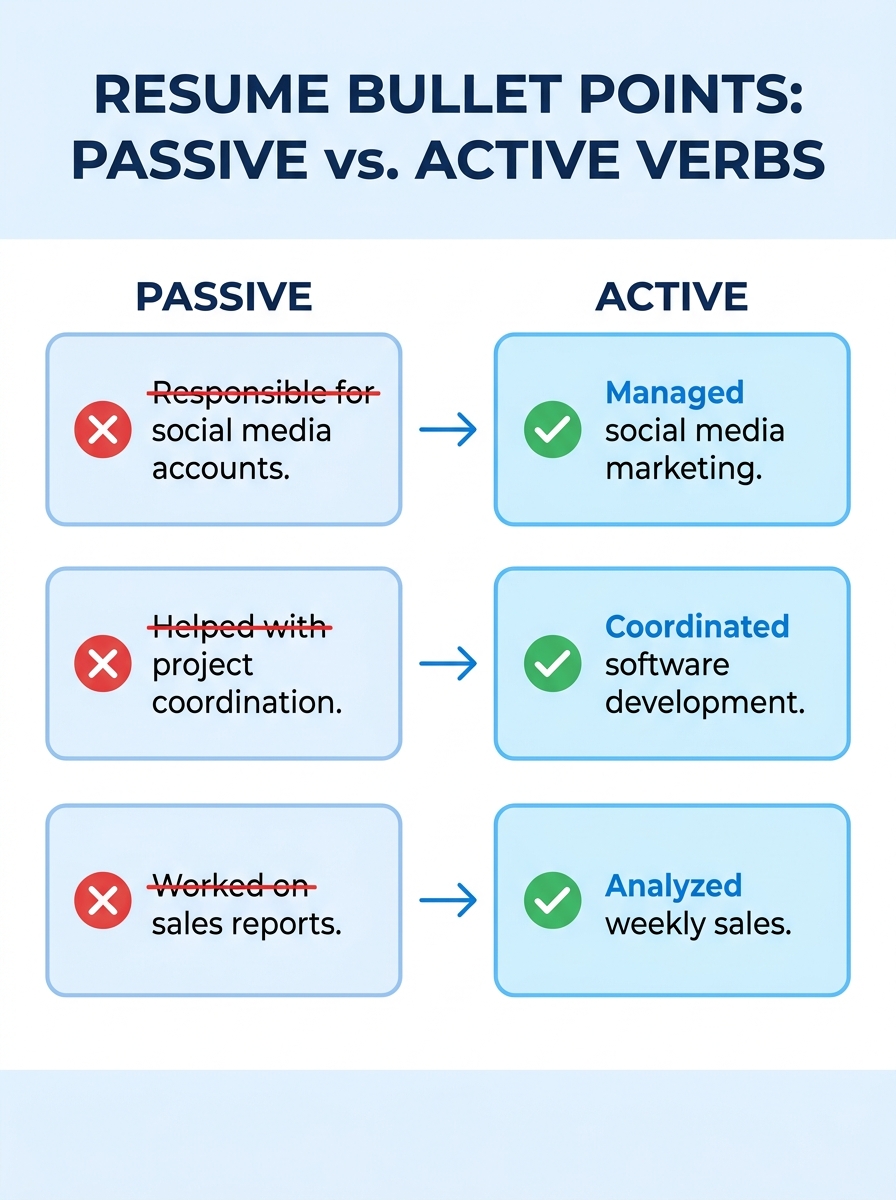
The fastest fix for weak resume language patterns is a direct verb replacement. You find every instance of “was responsible for,” “assisted with,” “helped to,” or “duties included,” and you swap in a stronger action verb. The sentence structure stays the same. The content stays the same. Only the verb changes.
This is the method MIT’s Career Advising & Professional Development office recommends as a starting point: “Action verbs help bring your resume to life by painting a picture for the reviewer, and affirming your skills. Begin each bullet point statement or phrase with an action verb.”
Here’s what a verb swap looks like in practice:
- Before: “Was responsible for overseeing daily operations”
- After: “Oversaw daily operations”
- Before: “Assisted with the development of marketing campaigns”
- After: “Co-developed marketing campaigns”
- Before: “Helped to onboard new team members”
- After: “Onboarded new team members”
The improvement is real. You’ve eliminated the passive construction, cut 3–5 filler words per bullet, and placed yourself as the actor. Monster’s career guidance puts it plainly: “Generic phrases like ‘responsible for’ or ‘worked on’ do little to highlight your impact. That’s where action verbs make all the difference.” Harvard’s Mignone Center for Career Success catalogued 45 rare action verbs specifically because the common ones (“managed,” “led,” “created”) appear on roughly 70% of resumes in competitive fields.
But here’s the limitation: verb swaps don’t add information. “Oversaw daily operations” is tighter than “Was responsible for overseeing daily operations,” but a hiring manager still doesn’t know the scale, the outcome, or why it mattered. You’ve fixed the grammar. You haven’t built a resume power statement.
When the verb swap is enough: Entry-level roles where you genuinely don’t have metrics yet, or bullets describing routine duties that don’t need quantification. If you’re building a resume from scratch, our guide on assembling your first resume without templates covers how to structure those early bullets.
The Action-Verb-Plus-Metric Formula
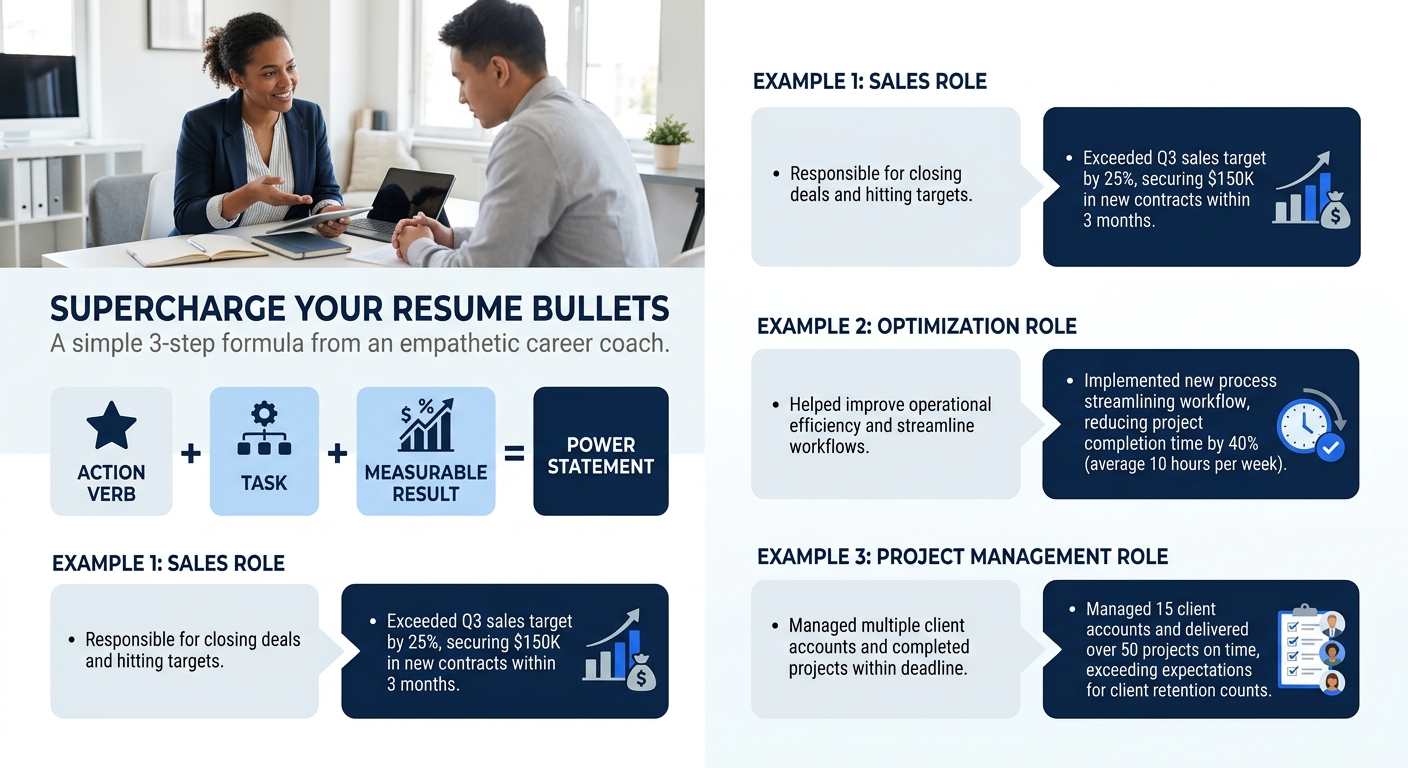
This is the method career coaches recommend most frequently, and for good reason. It adds the one element verb swaps lack: quantified proof. The formula is straightforward. Start with an action verb, state what you did, and close with a measurable result.
Teal’s resume guidance frames it this way: “Start with an action verb, clearly state your accomplishment, and end with the quantified impact.” That three-part structure gives hiring managers the verb-task-result pattern their eyes have been trained to scan for.
The transformations are substantial:
- Before: “Responsible for customer service” → After: “Resolved 40+ customer inquiries per day, reducing average response time by 83%”
- Before: “Managed social media accounts” → After: “Grew social media following by 10,000 in 3 months, exceeding acquisition targets by 30%”
- Before: “Was tasked with reducing churn” → After: “Reduced subscription cancellations by 5% quarter-over-quarter through proactive outreach program”
- Before: “Helped improve customer satisfaction” → After: “Achieved 85% customer satisfaction rating, 15% higher than the company average”
Those examples come directly from resume impact metrics documented by Resume Genius and Forbes contributor Andrew Fennell, and they illustrate why this method works as well as it does. Each bullet carries 2–3 specific numbers. Each number anchors a claim that a recruiter can evaluate in under 4 seconds.
A bullet with zero metrics forces the hiring manager to guess at your impact. A bullet with 2–3 specific numbers lets them evaluate you in under 4 seconds.
The action verb resume optimization here is doing double duty. The verb establishes agency (“Resolved,” “Grew,” “Reduced,” “Achieved”), and the metric establishes scale. Together, they answer the two questions every hiring manager brings to a resume: “What did this person actually do?” and “How well did they do it?”
If you’ve already audited your resume for vague action verbs, the formula method is your natural next step. Swap the verb, then backfill the metric.
Tip: Don’t have exact numbers? Estimate responsibly. “Managed approximately $2M annual budget” is far stronger than “Managed departmental budget.” Ranges work too: “Trained 15–20 new hires per quarter.” The specificity signals competence even when the figure is approximate.
Where this method breaks down: It assumes your achievements fit neatly into a single line. For senior or strategic roles where a bullet needs to convey organizational context, the formula can feel reductive. “Reduced operational costs by 18%” doesn’t tell the reader you did it across 4 distribution centers during a supply chain crisis.
Rewriting the Bullet From the Outcome Backward
The third method starts from a completely different place. Instead of editing an existing bullet, you throw it out and rebuild from the result.
Karpiak Consulting documented a pattern they see repeatedly in resume reviews: clients with “a resume that relied too heavily on broad summaries instead of helping hiring teams visualize the actual work. The experience sounded polished and professional, but much of it was communicated through vague leadership language, generalized management phrasing, and high-level business summaries.” The fix wasn’t better verbs or tacked-on percentages. The fix was rethinking what each bullet was trying to communicate.
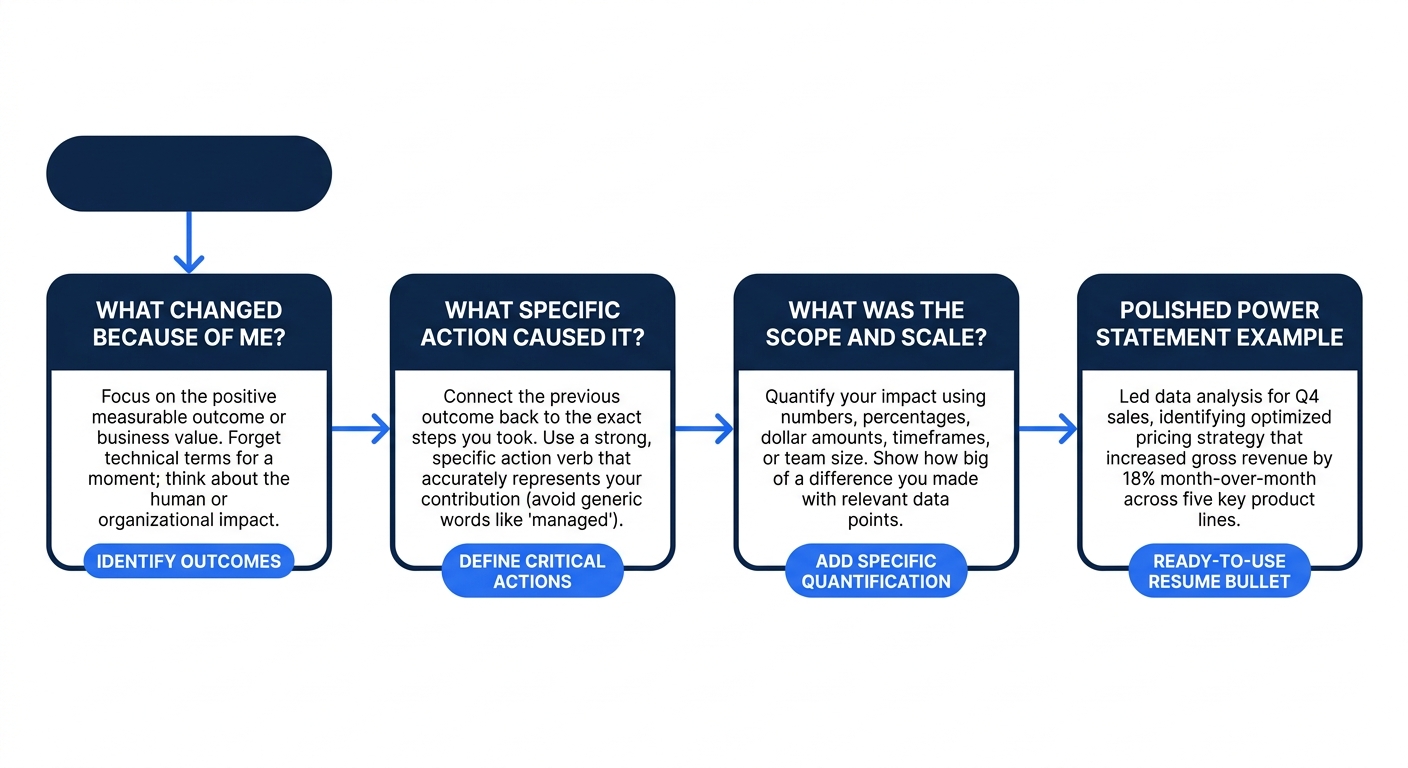
The outcome-backward method works like this:
- Identify your biggest result in that role. Revenue generated, costs cut, process time reduced, team retention improved, deals closed, errors eliminated.
- Trace backward to the specific action that produced that result.
- Write the bullet starting with the outcome, then layer in the method and scope.
An operations manager who wrote “Responsible for warehouse logistics and inventory management” doesn’t need a verb swap. That person needs to ask: what was the measurable outcome of my logistics work? If the answer is “reduced order fulfillment time from 72 hours to 24 hours across 3 warehouses,” the bullet writes itself. We covered a version of this exact scenario in our piece on how an operations manager rebuilt her resume around process outcomes.
Novorésumé’s 2026 analysis of 79 resume buzzwords to avoid flags “was responsible for” and “helped with” as the two most common weak action verbs on resumes. The outcome-backward method eliminates both automatically, because you’re no longer describing duties at all. You’re describing what changed because you were there.
The cost: This method takes 10–15 minutes per bullet, compared to 30 seconds for a verb swap and 2–3 minutes for the formula method. For a resume with 18–25 bullet points, that’s 3–6 hours of focused rewriting. It’s an investment that pays off most clearly for mid-career and senior candidates, where recruiters expect depth alongside brevity.
How the Three Methods Compare
| Verb Swap | Formula Method | Outcome-Backward Rewrite | |
|---|---|---|---|
| Time per bullet | 30 seconds | 2–3 minutes | 10–15 minutes |
| Eliminates passive voice | Yes | Yes | Yes |
| Adds quantified results | No | Yes | Yes |
| Conveys strategic context | No | Sometimes | Yes |
| Best for | Entry-level, routine duties | Mid-level, metric-rich roles | Senior roles, career pivots |
| Risk | Bullets stay thin | Can feel formulaic if every bullet uses identical structure | Time-intensive, risk of over-writing |
| Impact on screening | Moderate improvement | Strong improvement | Strongest, when done well |
Most resumes benefit from a mix. Your 3–4 most important bullets (the ones describing your biggest wins) deserve the outcome-backward treatment. The remaining 12–20 bullets work well with the formula method. And a handful of minor duties can get by with a clean verb swap. The goal is eliminating every passive construction while matching your revision intensity to each bullet’s importance.
If you’re targeting a specific role, reverse-engineering the job description will tell you which bullets deserve the deepest rewrite. The keywords and qualifications the employer emphasizes most should map to your strongest, most fully rewritten bullets.
How To Choose Between These Three
The honest answer is that you’ll use all three in a single resume. The choice isn’t which method to adopt globally. The choice is which method to apply to which bullet.
Apply the outcome-backward rewrite to your top 3–5 accomplishments. These are the bullets that justify your candidacy for the specific role. They need context, scale, and measurable results. Apply the formula method to your next 10–15 bullets, where a strong verb plus 1–2 metrics gives the hiring manager enough to work with. Apply the verb swap to the remaining 3–5 bullets covering routine responsibilities that don’t warrant detailed metrics.
The progression from passive voice resume mistakes to genuine resume power statements happens in layers. Fix the worst offenders first (anything starting with “was responsible for” or “duties included”), then work your way up. A resume where every single bullet follows the formula method reads almost as mechanically as one full of passive constructions. Variety in your bullet structure mirrors variety in your actual skill set: some wins are huge and quantifiable, some are solid and metric-backed, and some are foundational duties you handled cleanly.
The real trap with passive voice was never the grammar itself. The trap was that passive constructions let you avoid the harder question: what did you actually accomplish, and can you prove it? Each of these three methods forces that question back to the surface, with increasing pressure. Pick the intensity that matches the bullet’s importance, and your resume will read the way hiring managers want it to: clear about what you did, specific about how well you did it, and impossible to skim past.