


 4.9
4.9 4.5
4.5LinkedIn’s career advice database documents a bullet-point rewrite that captures the full gap between a technical troubleshooting resume that gets filtered and one that gets read: “Troubleshot network issues” becomes “Resolved 95% of network issues within 24 hours by troubleshooting routers, switches, and firewalls.” Same work, entirely different career signal.
This article walks through that single transformation in detail: what broke in the original bullet, where the missing numbers were hiding, how the verb selection changed the framing, and what happens when you apply the same technique across an entire experience section. By the end, you’ll have a repeatable method for rewriting every technical problem-solving resume bullet point you own.
The Bullet Before Surgery
“Troubleshot network issues” reads like a line item from an incident management system, not a professional accomplishment. It tells a hiring manager exactly three things: you existed, a network had issues, and someone (presumably you) did something about them. It communicates zero information about scope, severity, timeline, success rate, or what happened to the business as a result.
This matters because 90% of employers explicitly screen for evidence of problem-solving abilities during resume review, according to hiring survey data compiled across technical recruiting firms. And the average recruiter spends 6 to 7 seconds on an initial scan. In that window, a generic troubleshooting bullet blends into the background noise of every other candidate who also fixed things at work.
The problem runs deeper than word choice. “Troubleshot network issues” is structurally passive. It describes a task category rather than a specific action with a measurable result. You could paste it into any IT resume from any decade and it would fit, which means it differentiates you from absolutely nobody. If you’ve fallen into the passive voice trap on your resume, this kind of bullet is the most common symptom.
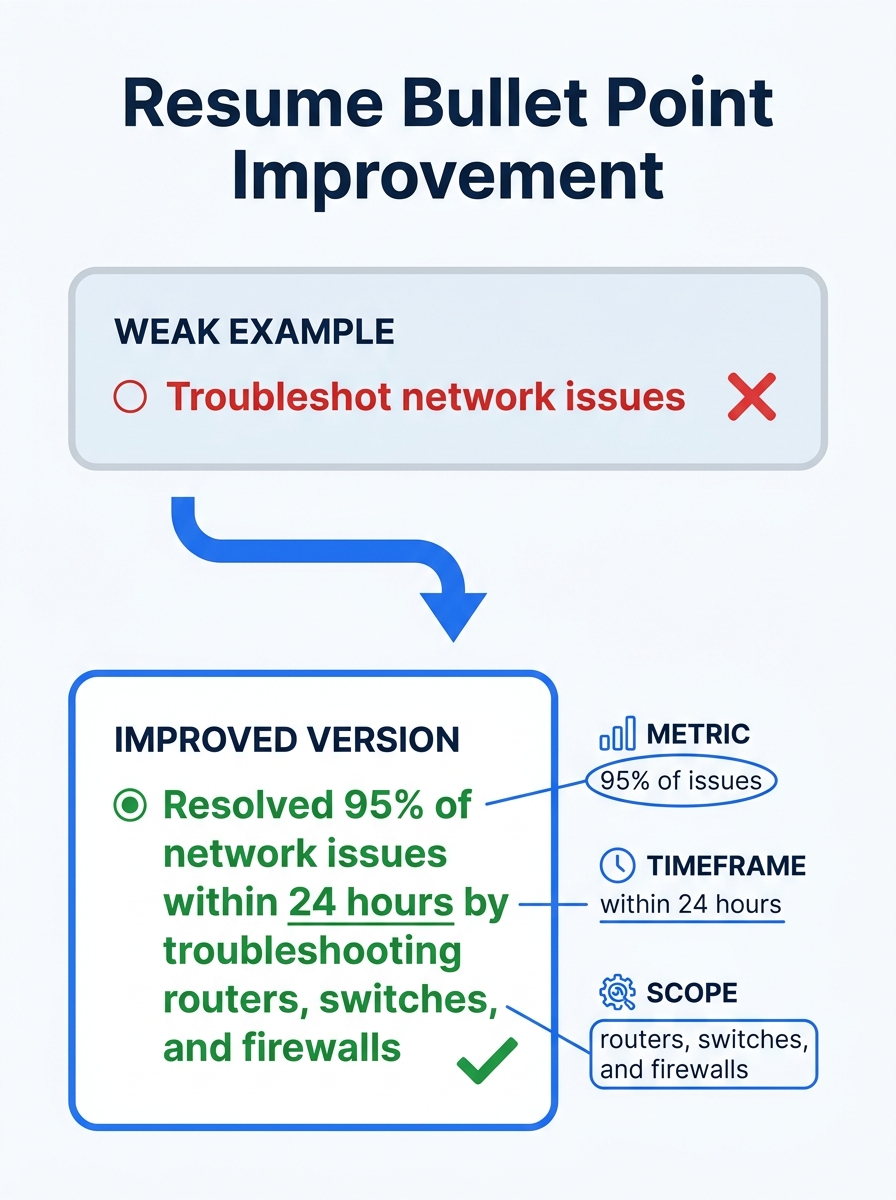
Three specific failures make this bullet invisible to both automated screening and human readers:
- No metric. No percentage, count, dollar figure, or time measurement. Software developer resume metrics are the single fastest way to move from “did stuff” to “achieved results.”
- No scope. How many issues? Across how many users, endpoints, or systems? A 5-person office and a 50,000-node enterprise both have “network issues.”
- No timeframe. Resolved within minutes? Hours? Days? The speed of resolution is itself a performance indicator, and leaving it out forfeits one of the easiest numbers to claim.
Where the Numbers Were Buried
The most common objection engineers raise when asked to quantify troubleshooting work is “I don’t have metrics for that.” They almost always do. The numbers live in ticketing systems, monitoring dashboards, post-incident reviews, SLA reports, and sprint retrospectives. You’ve been generating data about your own performance for years without thinking of it as resume material.
Consider what a systems engineer already knows from daily work: average resolution time (pulled from Jira or ServiceNow), ticket volume per week or month, uptime percentages (from monitoring tools like Datadog or PagerDuty), the number of systems or users affected by an outage, and the business cost of downtime if anyone in the company has ever calculated it. VisualCV’s troubleshooting skills guide recommends providing practical case studies of problems solved and results achieved, and the raw material for those case studies is already sitting in your team’s tooling.
The rewritten bullet—”Resolved 95% of network issues within 24 hours by troubleshooting routers, switches, and firewalls”—drew its 95% and 24-hour figures from exactly this kind of operational data. The engineer who wrote it didn’t run a special analysis. They checked their ticket closure rate and their average time-to-resolution, two numbers any IT professional can pull in under ten minutes.
Tip: Open your ticketing system right now and run a report on your closed tickets from the past 12 months. Look for: total volume, average resolution time, percentage resolved within SLA, and any P1/P2 incidents where you were the primary responder. These four data points can populate 3 to 5 resume bullets on their own.
Here’s a practical framework for extracting metrics from troubleshooting work. Think of it as the Scope-Speed-Stakes audit:
- Scope: How many systems, users, endpoints, or transactions were affected? (“Across 14,000 daily transactions” or “serving 2,300 internal users”)
- Speed: How fast did you resolve it relative to a benchmark? (“Within 24 hours” or “40% faster than team average SLA”)
- Stakes: What was the business consequence of the fix? (“Preventing an estimated $12K/hour in lost revenue” or “Restoring service for 3 client accounts worth $1.2M ARR”)
Every troubleshooting bullet on your resume should include at least two of these three elements. If you’re working on quantifying achievements across your entire resume, this audit gives you a specific lens for the debugging and incident-response sections.
Three Verbs That Changed the Frame
The original bullet used “troubleshot” as both the action and the identity. Teal’s resume synonym analysis flags “debugged” as one of the weakest verbs on developer resumes and suggests alternatives like “rectified,” “diagnosed,” and “resolved.” But debugging action verbs carry different connotations depending on what story you’re trying to tell, and choosing the right one is a framing decision, not a vocabulary exercise.
Look at how three different verbs reshape the same work:
- “Diagnosed intermittent packet loss across 12 branch office VPN tunnels, identifying a firmware incompatibility that had evaded two previous escalation teams.” This verb emphasizes analytical thinking and root-cause investigation. It positions you as someone who finds the reason things break.
- “Resolved 95% of network issues within 24 hours by troubleshooting routers, switches, and firewalls.” This verb emphasizes completion and reliability. It positions you as someone who closes tickets and meets SLAs.
- “Eliminated recurring database timeout errors affecting 8,000 daily API calls by refactoring connection pooling logic, reducing P1 incidents from 6/month to 0 over the following quarter.” This verb emphasizes permanent fixes. It positions you as someone who prevents recurrence.
Each verb tells a hiring manager something different about your approach. “Diagnosed” says analytical. “Resolved” says reliable. “Eliminated” says proactive. The right choice depends on the role you’re targeting.
If a job description emphasizes incident response and SLA adherence, “resolved” and “restored” are your primary verbs. If it emphasizes system reliability and architecture, “eliminated,” “redesigned,” and “prevented” carry more weight. This is where reverse-engineering a job description directly feeds your verb selection for technical problem-solving resume bullet points.
The verb you choose for a troubleshooting bullet decides whether you sound like someone who cleans up messes or someone who prevents them from happening again.
Expanding the Fix to a Full Experience Section
One strong bullet surrounded by four weak ones creates an uneven reading experience that can actually hurt you. Recruiters notice the inconsistency. So the reframing technique needs to extend across every line in your experience section.
Here’s what a typical mid-level systems engineer’s experience section looks like before the rewrite, based on common patterns documented across resume skills databases:
- Troubleshot network issues
- Debugged production code
- Managed server infrastructure
- Resolved user tickets
- Maintained system stability
And here’s what that same section looks like after applying the Scope-Speed-Stakes audit and selecting verbs that match a target role focused on reliability engineering:
- Resolved 95% of network incidents within 24 hours across a 200-node enterprise environment, exceeding the 48-hour SLA by 50%
- Diagnosed and eliminated a recurring memory leak in the payment processing microservice, reducing crash incidents by 72% across 14,000 daily transactions
- Maintained 99.97% uptime for 18 production servers supporting 2,300 internal users and 4 client-facing applications
- Reduced average ticket resolution time from 4.2 hours to 1.8 hours by implementing a tiered triage protocol for the 6-person support team
- Authored 23 runbook entries for common failure modes, cutting onboarding time for new engineers from 3 weeks to 8 days
Every bullet now carries at least two elements from the Scope-Speed-Stakes framework. Every verb was chosen to match a reliability engineering job description. And every number came from data the engineer already had access to through existing tools.
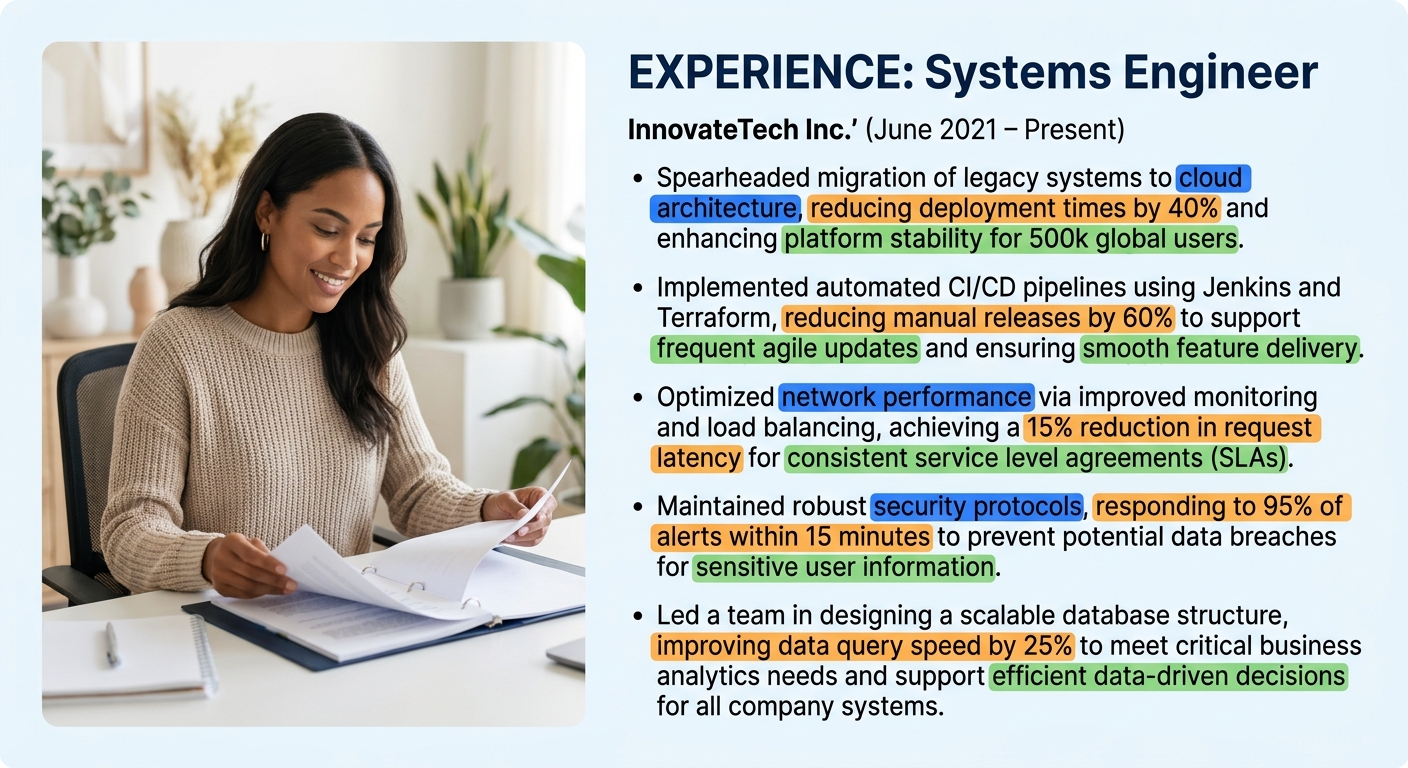
Notice that the fifth bullet doesn’t describe troubleshooting at all. It describes documentation. But because it’s framed as a measurable outcome (23 entries, onboarding time cut by 62%), it reinforces the problem-solver identity rather than breaking it. Technical candidates often forget that preventing future problems counts as problem-solving, and the documentation, training, and process improvements you’ve built around incident response are some of the strongest material you can put on a resume.
If you’re building a resume from scratch and want a structure that supports this kind of detailed experience section, the beginner’s assembly framework on our blog walks through the full process step by step.
The Résumé After the Reframe
The before version of this experience section would scan as a maintenance technician’s task log. The after version reads as a reliability-focused engineer who thinks in systems, measures outcomes, and prevents recurrence. Same person. Same job history. The difference is entirely in how the work was framed.
The rewriting process that produced this result followed a consistent sequence: pull numbers from existing operational tools, apply the Scope-Speed-Stakes audit to identify which data points belong in each bullet, select a verb that matches the target role’s priorities, and structure the bullet as action-plus-metric rather than task-plus-tool. That sequence works for network troubleshooting, application debugging, infrastructure management, database optimization, and security incident response. The technical domain changes, but the framing logic stays the same.
One thing the rewrite did not do: inflate numbers or claim credit for team-wide results. The 95% resolution rate was the engineer’s actual closure rate. The 72% reduction in crash incidents was measured in production monitoring after their specific code change shipped. When hiring managers at technical companies see software developer resume metrics, they expect to discuss those numbers in an interview. Any figure you put on your resume should survive a “walk me through how you got that number” question without hesitation.
Ninety percent of employers screen for problem-solving evidence during hiring. The candidates who clear that screen aren’t the ones with the most impressive technical vocabularies. They’re the ones who translated their debugging work into business language, attached real numbers to it, and chose verbs that told a specific story about how they approach problems. You already have the experience. The resume just needs to show it. For more guidance on turning technical work into interview-ready documents, browse our career guides on the ResumeWriting.net blog.