

 4.9
4.9 4.5
4.5Three resume strategies compete for career changers’ attention: mirror the target job description keyword-for-keyword, lead with a transferable skills summary, or systematically reframe past achievements in the new industry’s language with quantified evidence. The first two reliably produce rejection. The third works, but only with disciplined skill mapping for career switchers.
TL;DR: Career changers typically choose between direct-matching a job description, listing generic transferable skills, or reframing past accomplishments with measurable outcomes in the target industry’s language. Direct matching gets caught by hiring managers. Skills lists get ignored. Evidence-based reframing—anchored in specific results—is the strategy that survives both ATS filters and human scrutiny.
Direct-Matching the Job Description
The instinct makes sense on the surface: read the job posting, identify every keyword, and reshape your career change resume until it reads like you’ve been doing that exact job for years. A Hudson RPO survey of 803 recruiters found that nearly 60% believe strengths and skills matter more than education or work experience, so loading your resume with the “right” words feels logical.
The problem is that direct-matching collapses once a hiring manager spends more than ten seconds with your resume. Your bullet points borrow the vocabulary, but the underlying evidence doesn’t hold up. If a product management role asks for “cross-functional stakeholder alignment” and you copy that phrase into your summary, a hiring manager will look for concrete examples in your experience section. When they find retail scheduling and inventory management instead, the disconnect registers immediately as resume padding.
ATS systems compound the issue in unexpected ways. Default keyword filters often reject candidates who have relevant capabilities because they lack the exact job title. A candidate with “team lead” experience gets screened out when the system demands “manager.” So even if you’ve loaded the right verbs and noun phrases from the posting, the title mismatch can kill your application before any human sees it.
Charlotte Melkert, co-founder of Equalture, has noted that shrinking labor forces and technological changes require hiring for transferable skills rather than job-specific ones to address talent shortages. The irony is that direct-matching does the opposite: it forces you into someone else’s career shape instead of presenting your actual capabilities in relevant terms.
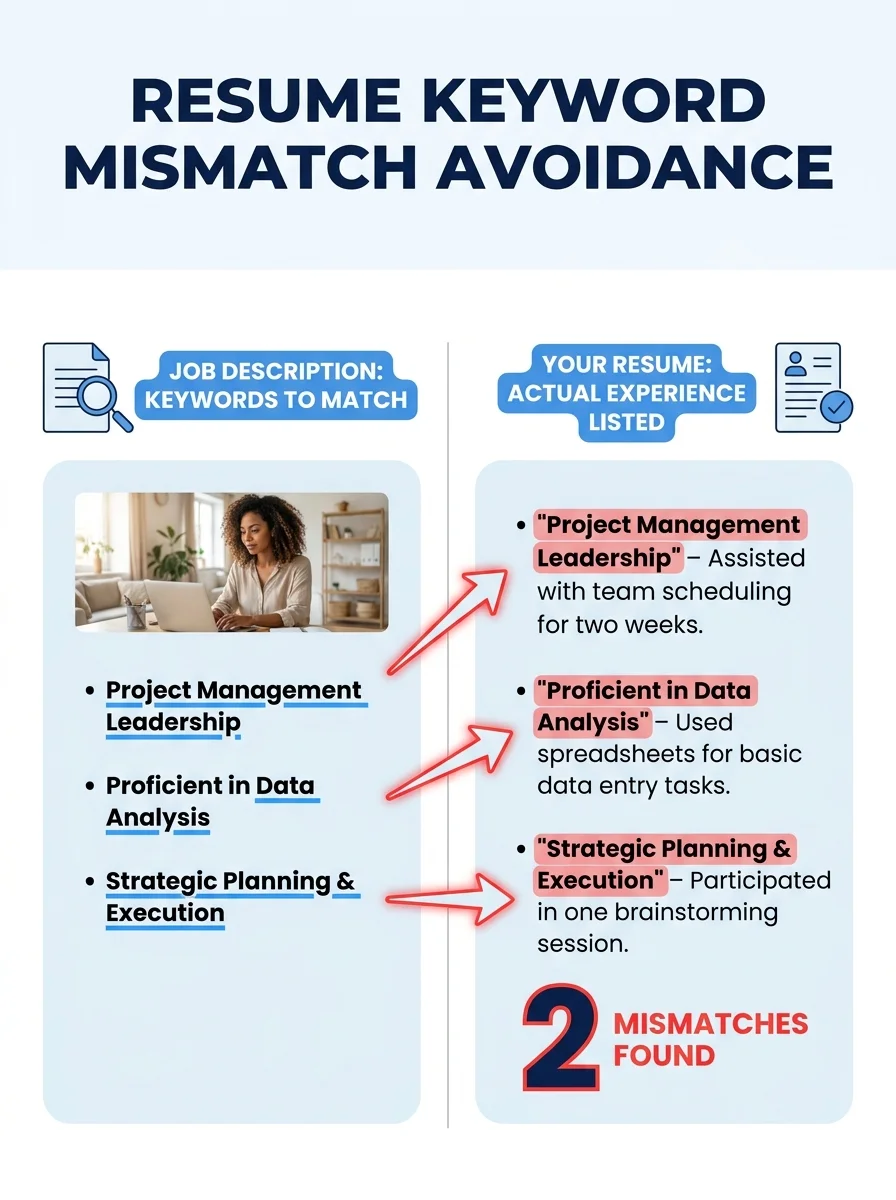
The tradeoff with direct matching is speed versus credibility. You can produce a relevant experience resume in 20 minutes by copying phrases from a job posting. But you’re betting that no one will look closely. For roles receiving 250+ applications, that bet sometimes pays off at the ATS stage. It almost never survives the human review that follows, especially when interviewers ask you to walk through your experience. If you need help converting vague duties into measurable outcomes, that’s a prerequisite before any matching strategy becomes viable.
The Transferable Skills List (and Its Ceiling)
The transferable skills resume takes the opposite approach: instead of borrowing industry-specific language, you lead with broad capabilities. Leadership. Communication. Problem-solving. Project management. You build a summary section packed with these terms and hope they signal your adaptability.
This is the strategy that career advice columns have recommended for decades, and it contains a kernel of truth. As SkillsYouNeed’s career change guide puts it, “You must completely reframe your resume or CV to highlight your transferable skills front and centre.” But the advice stops too early. It tells you what to feature without addressing how to make those skills believable.
Here’s where the ceiling appears: 79% of employers now value skills assessments as much as other hiring criteria, and problem-solving and critical thinking consistently rank among the top valued skills. Every career changer knows this. Every career changer lists the same five to eight skills. When a hiring manager reads “strong communication skills” on the fourteenth resume of the morning, the phrase carries zero informational value.
When a hiring manager reads “strong communication skills” on the fourteenth resume of the morning, the phrase carries zero informational value.
The deeper problem, as career coach research from Your Career Homecoming points out, is that “your skills alone are not the cornerstone to choosing a career.” Listing transferable skills won’t save you from the fundamental question hiring managers ask: can you prove these skills produced results in contexts that matter to us?
Skills mapping for career switchers, as defined by AIHR’s implementation guide, involves identifying and outlining the specific skills required for a role through a structured, visual process. The transferable skills resume skips this mapping step entirely. It presents skills in isolation, without connecting them to the target role’s actual requirements or demonstrating them through evidence. A McKinsey Quarterly report found that nearly 90% of companies predict a major skills gap, which means employers are hungry for proof of capability. Generic lists don’t qualify as proof.
The tradeoff here is safety versus impact. The transferable skills resume feels comfortable because you don’t have to commit to one target role. You can send the same resume to marketing managers, operations directors, and program coordinators. But that flexibility is the weakness: a resume that fits everywhere fits nowhere precisely enough to generate callbacks. If you’ve been making common career pivot mistakes, a generic skills list is often the root cause.
Reframing With Evidence
The third approach treats your career change resume as a translation project. You take each accomplishment from your previous role, identify the underlying skill, and rewrite it in the language your target industry uses, with quantified outcomes attached.
A Deloitte study found that skills-based hiring increases candidate pool size by up to 10x for hard-to-fill roles. Reframing with evidence is how you position yourself inside that expanded pool without fabricating experience. As Resume Worded’s career change guide warns, one of the most frequent mistakes career changers make is highlighting achievements or skills that aren’t relevant to the industry they’re trying to break into. The reframing approach forces you to filter ruthlessly.
Here’s what this looks like in practice. A visual designer pivoting to front-end development doesn’t list “Adobe Creative Suite proficiency” and “strong design thinking.” Instead, they reframe: “Led cross-functional projects with engineering teams, using user behavior data to inform interface decisions that reduced support tickets by 34%.” The skills underneath—collaboration, data-informed decision-making, user empathy—are identical. The language and evidence match what a hiring manager in engineering actually values.
Tanya Forrest of Lancaster University has stressed that advancing technical skills is essential for job security because the half-life of job-specific skills shrinks rapidly. This makes learning agility a critical transferable competency. A reframed evidence resume demonstrates that agility through concrete examples of adaptation, rather than claiming it in a summary line.
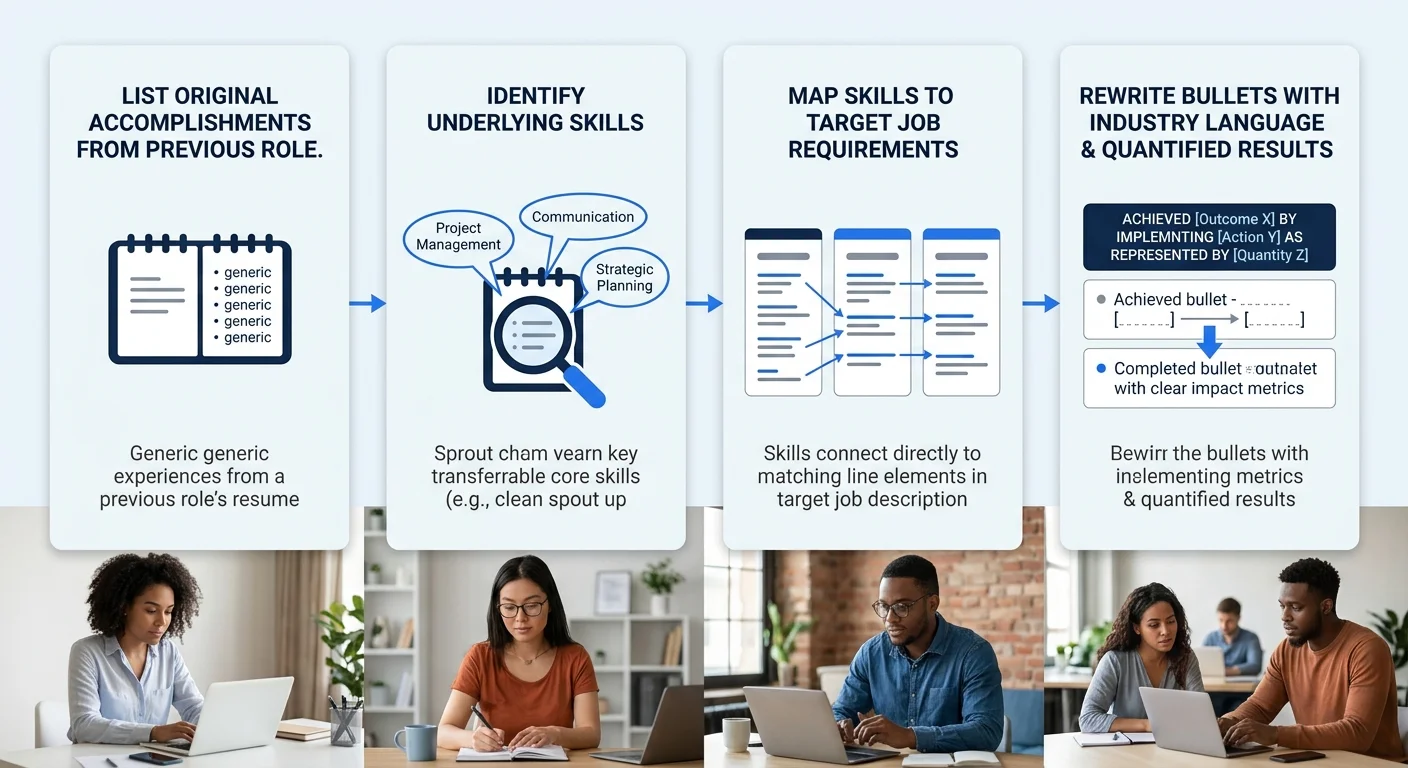
The process follows a structured skill mapping approach. Reverse-engineering a job description gives you the target vocabulary. Then you audit your own experience for moments where you demonstrated those capabilities, even if the context was entirely different. “Managed retail inventory across 3 locations” becomes “Optimized resource allocation across distributed operations, reducing waste by 18%.” The achievement is real. The framing is new.
Tip: When reframing, keep a two-column document: left column holds your original bullet points, right column holds the rewritten versions using target industry language. This makes it easy to verify you’re translating real accomplishments, not inventing new ones.
The tradeoff is effort versus precision. Reframing takes 3-5x longer than either of the other approaches. You need to research target role language, map your skills systematically, quantify outcomes you may not have tracked, and tailor each resume to specific positions. But the conversion from passive descriptions to power statements is where career changers separate themselves from the stack of generic applicants. Jake Zabkowicz, CEO of Hudson RPO, has emphasized that hiring for transferable skills like communication and adaptability builds stronger, more inclusive teams compared to traditional credential-first screening. Your resume needs to make those skills visible and credible.
How the Three Strategies Compare
| Factor | Direct Match | Transferable Skills List | Reframed Evidence |
|---|---|---|---|
| Time to prepare | 20-30 minutes | 30-60 minutes | 2-4 hours per role |
| ATS pass rate | Moderate (title mismatch risk) | Low (generic terms under-weighted) | High (targeted keywords + context) |
| Hiring manager credibility | Low (claims don’t match experience) | Low (no proof behind skills) | High (quantified, translated results) |
| Tailoring required per application | High (must match each posting) | None (same resume everywhere) | High (must map to each role) |
| Interview readiness | Poor (can’t back up borrowed language) | Moderate (can discuss skills generally) | Strong (stories match resume claims) |
| Best for gap size | Small pivots (adjacent roles) | Exploratory applications | Committed career changes |
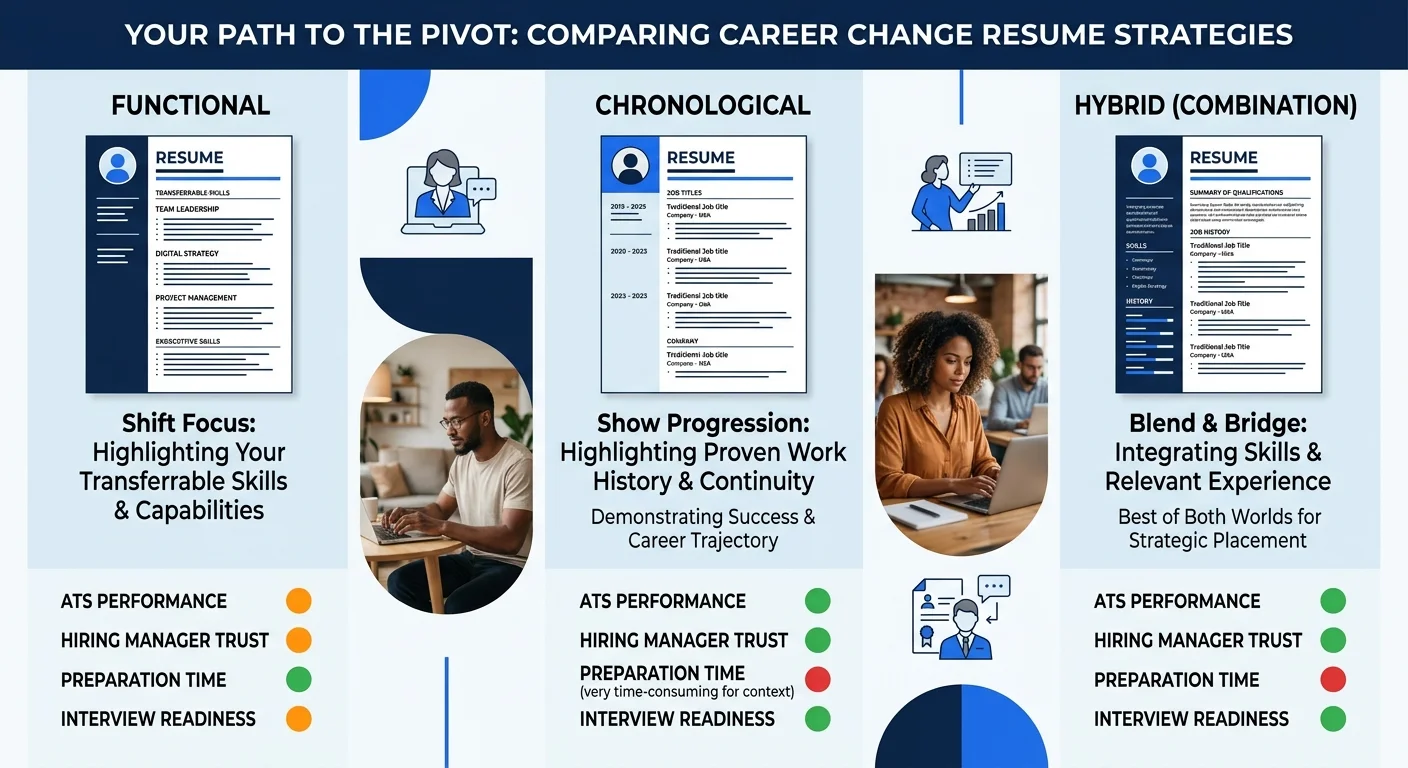
The data pattern is clear. The Deloitte finding that skills-based hiring expands candidate pools by 10x only benefits you if your resume makes those skills legible to both algorithms and humans. The direct match strategy games the algorithm but fails the human. The transferable skills list satisfies neither. The reframed evidence approach handles both, which is why it consistently produces better callback rates for career changers despite requiring significantly more preparation.
Career changers who’ve struggled with formatting decisions that cost interviews often discover that structure problems compound the strategy problem. A well-formatted transferable skills resume still underperforms a poorly formatted evidence-based one, but combining strong formatting with reframed evidence is the clear winner.
The Verdict
If you’re making a small lateral move—say, from marketing coordinator at a SaaS company to marketing coordinator at a healthcare company—direct matching works adequately because your title, tools, and metrics already align. The translation gap is narrow enough that keyword matching covers it.
If you’re genuinely exploring and haven’t committed to a target role yet, a transferable skills resume serves as a placeholder while you research. But treat it as a draft, not a finished product. Send it to informational interviews, not job applications.
For committed career changers who’ve identified a specific target role or industry, the reframed evidence resume is the only approach with a strong track record. The 87% of companies reporting skill shortages are actively looking for candidates with proven capabilities from non-traditional backgrounds. Your job is to make those capabilities legible. That means sitting down with the job description, mapping your accomplishments to its requirements, and rewriting every bullet point with the target industry’s vocabulary and your real, quantified results.
The work feels tedious. It requires you to audit achievements you took for granted and translate them into unfamiliar language. But the behavioral interview preparation process becomes dramatically easier when your resume already tells the right stories in the right words. You walk into the interview with proof pre-loaded, instead of scrambling to connect your old job to their open role in real time. The career changers who land interviews aren’t the ones with the longest skills lists. They’re the ones who did the translation work before hitting submit.