


 4.9
4.9 4.5
4.5Naming your company’s proprietary CRM by its internal acronym, citing the Q3 retention initiative you co-led, referencing the exact KPI dashboard your team built: these details are impossible for any external applicant to replicate, and they form the foundation of every successful internal position resume.
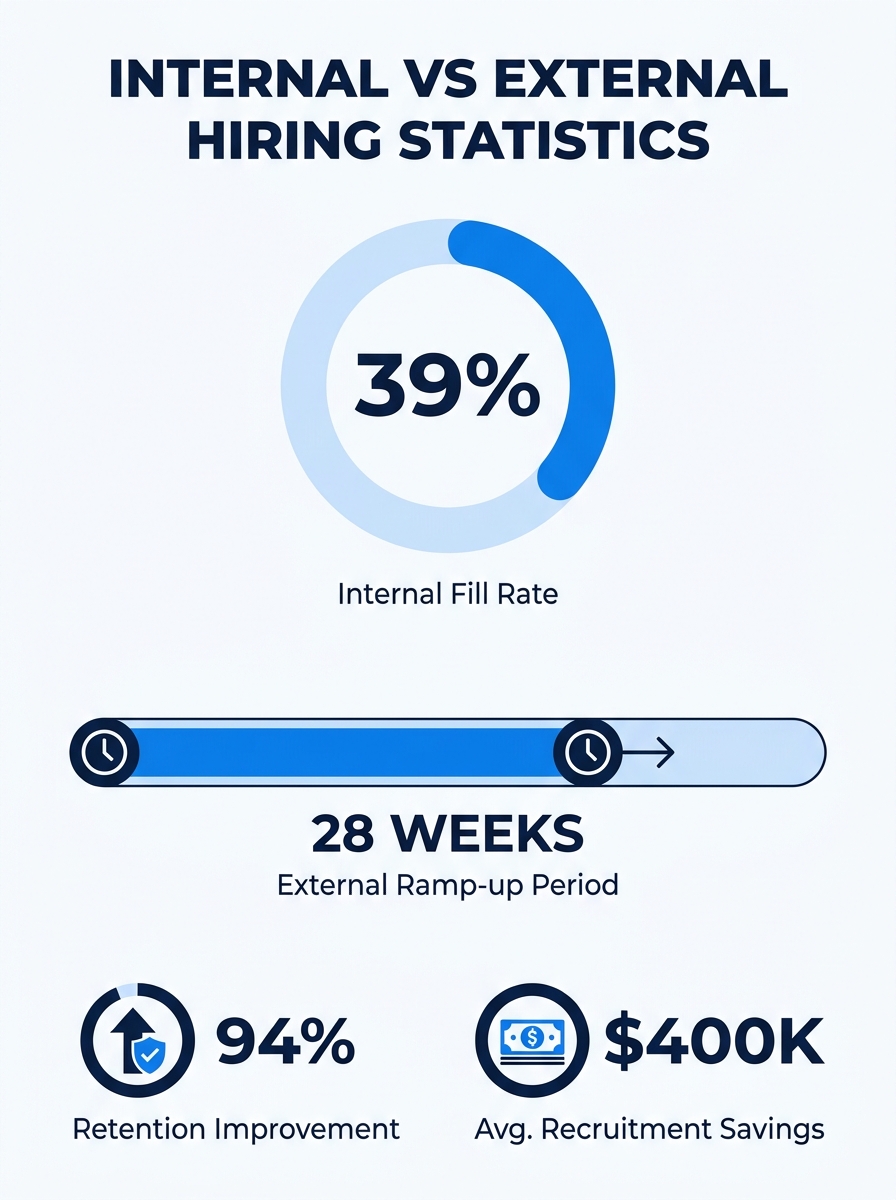
The Shift from 32% to 39%
Internal candidates filled 39% of open roles in 2025, up from 32% in 2023, according to aggregate talent acquisition data compiled across major enterprise platforms. That 7-percentage-point jump happened during a period when external job openings decreased by 27% and new hires dropped by 15%. Companies got tighter, budgets shrank, and hiring managers increasingly preferred candidates who already understood the business.
The financial math reinforced that preference. Internal mobility improves retention by 94% through demonstrated career investment, while reducing recruitment costs that average $400,000 annually at the enterprise level, according to Gloat’s internal mobility research. External hires carry 18–20% higher salary expectations than internal promotions for equivalent roles. And the ramp-up difference is dramatic: external mid-level hires need an average of 28 weeks to reach full productivity, while internal transfers already know the systems, the stakeholders, and the unwritten rules.
Nearly 70% of Talent Acquisition leaders report increasing investment in internal mobility programs. But here’s the uncomfortable detail buried in that optimism: roughly half of employees don’t know internal openings exist at their own company. Your internal mobility career strategy starts with watching job boards you’ve probably never checked — your company’s intranet postings, Slack channels for internal opportunities, or talent marketplace platforms.
If you’re staring at one of those postings right now, your resume needs to look fundamentally different from the one you’d send to a competitor.
Proprietary Language as Resume Currency
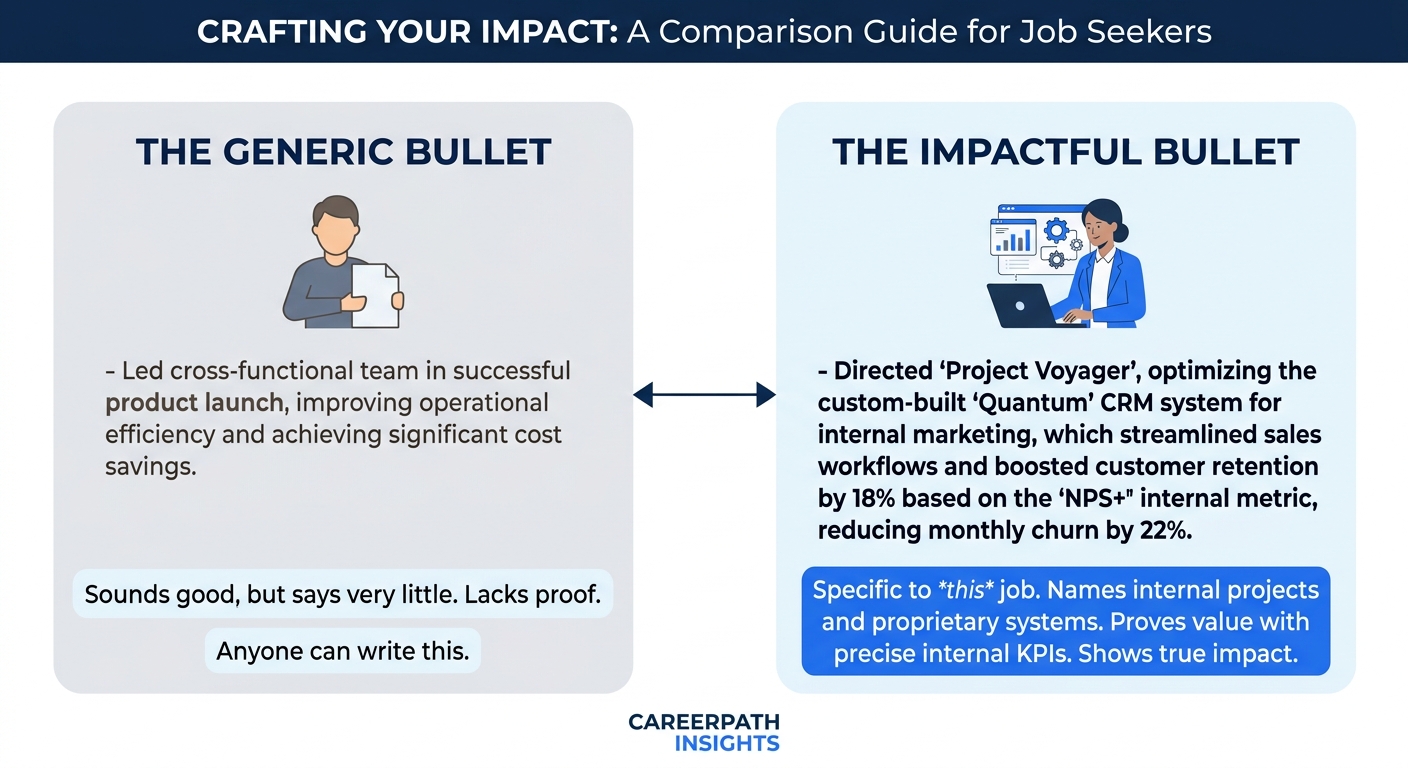
The single biggest structural advantage of an internal position resume is vocabulary. VM Solutions’ 2026 guide to internal job resumes states, according to their internal resume preparation resource: “You can reference proprietary systems by name, cite internal KPIs, mention specific projects and initiatives, and use the company’s own language — things no outside applicant could do.”
That observation deserves more attention than most internal candidates give it. They default to the same generic resume language they’d use for an outside application. “Managed CRM database” instead of “administered Salesforce Lightning instance serving 340 reps across EMEA and APAC regions.” “Improved customer satisfaction” instead of “raised Net Promoter Score from 42 to 61 within the Northeast territory during the FY25 Q2–Q4 retention push.”
Company knowledge resume positioning works because hiring managers reading internal applications already share context with you. They know what “Project Meridian” was. They understand what it means to hit a 97.2% SLA compliance rate on the Tier 2 support queue. They recognize the names of the cross-functional steering committees. When you write with that shared vocabulary, you signal belonging at the table in a way no outsider can replicate.
This is where the quantification principles from converting vague duties into measurable impact bullets become even more powerful. External candidates have to explain what a metric means. You can skip straight to what you did with it.
A practical test: read each bullet point on your internal resume and ask whether an outside applicant could have written it. If the answer is yes, you’re underusing your biggest advantage.
Two Resume Types, One Company
Promotion resume writing and lateral transfer resume writing serve different arguments, even within the same organization. Conflating them is one of the most common mistakes internal candidates make.
A promotion resume argues upward readiness. YES Writing’s guide to internal promotion resumes frames it this way: the internal resume should function as “making the case for promotion in resume form: show scope, outcomes, and readiness for the next level.” That means your bullet points need to demonstrate increasing responsibility, leadership over progressively larger initiatives, and outcomes that stretch beyond your current job description. You’re proving you’ve already been operating at the next level before anyone gave you the title.
An internal transfer resume strategy, on the other hand, argues lateral fit. You’re moving from marketing to product, or from operations to business development. The argument here is “my existing skills solve problems in your department that you haven’t been able to solve with your current team.” Transferable skills take center stage, but framed through the lens of company-specific context that only an insider can provide.
If you’ve been considering a career pivot within your own company, the principles we’ve covered for how career changers should reframe their experience apply doubly here, except you don’t need to explain away a gap between industries. You’re already inside the building.
| Resume Element | Promotion Resume | Lateral Transfer Resume |
|---|---|---|
| Summary focus | Expanding scope and readiness for next level | Cross-functional skills that map to new department |
| Bullet emphasis | Increasing responsibility, team leadership, budget ownership | Transferable projects, shared stakeholders, relevant tools |
| Skills section | Leadership competencies, strategic planning | Grouped by category: tools, processes, domain knowledge |
| Company language | Reference internal KPIs, initiative names, org-wide goals | Reference cross-departmental projects, shared systems |
| Key proof point | “I’ve already been doing parts of this job” | “I’ve solved similar problems in a different context here” |
The ADP SPARK blog documented a contributor’s career transition experience that illustrates the lateral transfer path well. According to their published account, “The key factor was my employer’s dedication to expanding the skills and knowledge I wanted and needed to hone while I technically remained within my role. Rather than having to ladder up or lattice elsewhere to seek those job advancements, this gave me leverage for a new career path forged by opportunity.”
That phrase, “a new career path forged by opportunity,” captures what your lateral transfer resume needs to communicate. You aren’t fleeing your current role. You’re moving toward a role where your accumulated company knowledge creates disproportionate value.
The Cross-Functional Evidence Stack
For both promotions and lateral moves, the strongest internal resumes share one structural feature: evidence of cross-functional work. Enhancv’s 2026 functional manager resume guide recommends, per their published examples, placing “a focused skills section near the top of your resume, grouping competencies by category” such as team coordination, process improvement, and stakeholder communication, and including project-based experience alongside cross-functional task force participation.
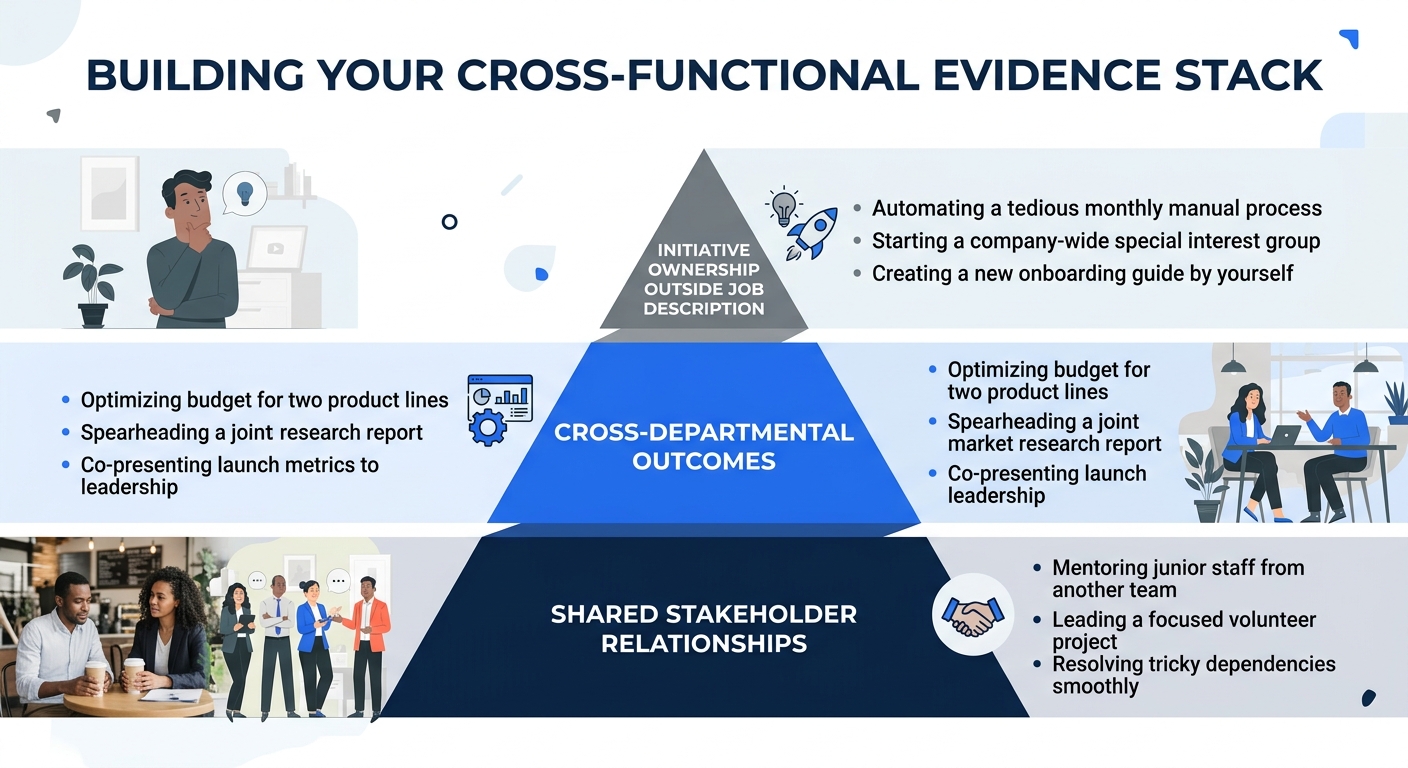
Here’s how to build what I’d call a Cross-Functional Evidence Stack, three layers of proof that demonstrate your ability to operate beyond your department’s walls:
Layer 1: Shared stakeholder relationships. Name the departments you’ve worked with. “Partnered with Product, Engineering, and Legal on the FY25 compliance remediation initiative” tells the hiring manager you’re already trusted across the org chart.
Layer 2: Cross-departmental outcomes. Quantify results that affected teams beyond your own. “Reduced ticket escalation rate by 34%, eliminating an estimated 12 hours per week of engineering triage time” shows impact that ripples beyond your silo.
Layer 3: Initiative ownership outside your job description. Did you volunteer for the company hackathon committee? Lead an employee resource group? Sit on a product advisory board? These aren’t filler. They’re direct evidence that you operate at a scope wider than your title suggests.
An external candidate can match your skills. They can’t match your 18 months of Slack history with the team they’d be joining.
The combination of these three layers gives hiring managers the confidence to picture you in a new seat. You’ve already proven you can work with their team. That evidence simply doesn’t exist on an external candidate’s resume, no matter how polished their formatting or how targeted their keywords.
This approach aligns with what we’ve covered about reframing troubleshooting experience for broader resume impact. Your day-to-day problem-solving work likely involved stakeholders outside your immediate team. Surface that cross-functional dimension explicitly on the page.
Where the 28-Week Ramp-Up Vanishes
The 28-week productivity ramp-up for external hires represents the strongest implicit argument your internal resume can make. Every line that references a system you already know, a relationship you’ve already built, or a process you’ve already improved tells the hiring manager: this person skips the learning curve and produces value from week one.
This matters more than ever in a job market where external searches now take an average of 108 days to reach a first offer. While colleagues blast applications into the external void, you can be interviewing for internal roles within your own company’s accelerated timeline. Many internal mobility programs skip redundant recruiter screening entirely, sending internal applicants straight to hiring manager conversations.
Your internal resume doesn’t need to be longer than an external one. It needs to be denser with insider evidence. Use the company’s own language. Reference projects by their internal names. Cite KPIs that the hiring manager tracks on their own dashboard. Group your cross-functional experience into a visible stack at the top of the document, using the three-layer structure above to organize it.
And if you’re updating your broader LinkedIn presence alongside your internal application, be strategic about it. Internal hiring managers will check your public profile, but they’ll weight your internal resume more heavily because it speaks their language in ways no public profile can.
The 39% internal fill rate tells you that more than a third of roles go to people already in the building. Your resume is the document that determines whether you’re one of them. Build it around what you know that no outside candidate could possibly know, and you’ve already closed a gap that no amount of keyword optimization or generic bullet-writing can close from the outside.