
 4.9
4.9 4.5
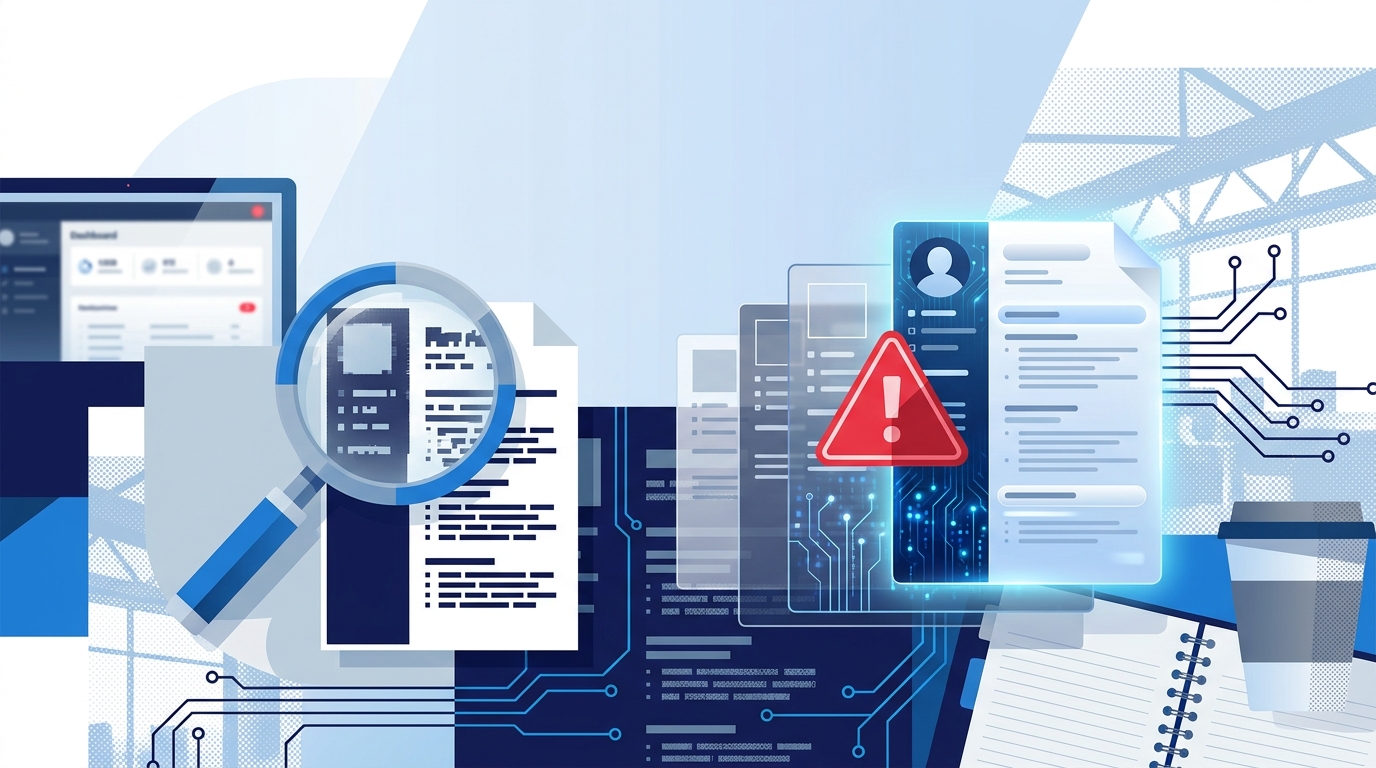
4.5Screening audits of 10,000 applications between December 2025 and January 2026 found that 72% contained identical ChatGPT-generated phrasing, yet separate research shows AI-written resumes are up to 82% more likely to pass automated filters than human-written ones. The resume that survives the bot often alarms the human who reads it next.
TL;DR: Three resume strategies exist right now: fully AI-generated, hybrid AI-plus-human, and fully human-written. Each carries specific tradeoffs in ATS pass rates, hiring manager suspicion, and interview conversion. The hybrid approach outperforms the other two for most job seekers, but only when you understand exactly where AI helps and where it hurts.
That 82%-versus-72% tension shapes every decision you make about how to write your resume in the current market. You’re choosing between three paths, and each one has a documented cost. With nearly 90% of employers now using AI to screen applications, the stakes on this choice affect every application you send.
Letting ChatGPT Write the Whole Thing
The fully AI-generated resume gets through ATS gates at the highest rate of any approach. That 82% advantage over human-written resumes in automated screening is real and significant. But the advantage collapses the moment a human reads the document.
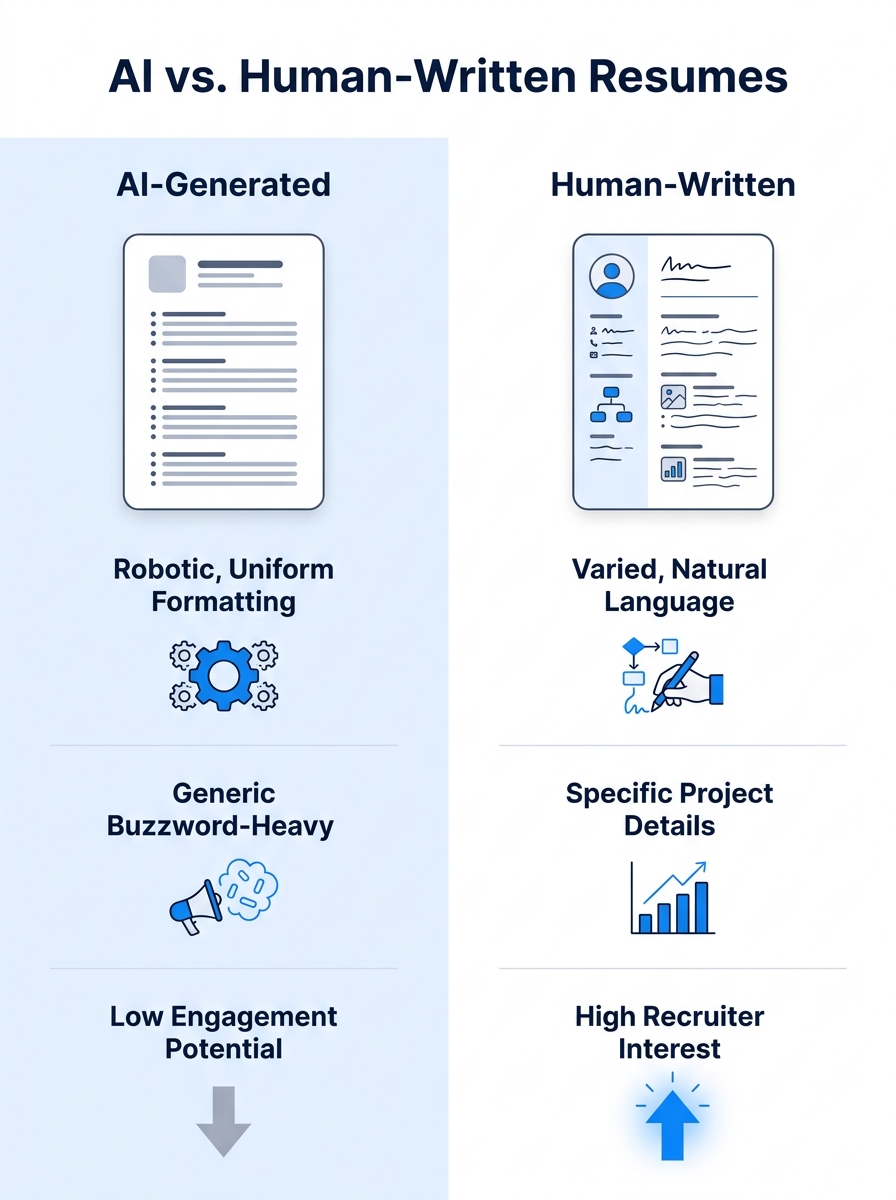
Here’s why. Of the roughly 7,200 AI-generated resumes flagged in the late-2025 screening audit, recruiters identified them through three consistent tells: identical phrasing across different candidates, keyword density that felt unnatural, and a polished uniformity that erased any sense of a real person behind the words. The Willo Blog’s analysis of AI-generated resume detection documented that applicants with limited proficiency in their field “may not recognize what reads as ‘off,’ their AI-assisted resumes often end up over-polished and keyword-stuffed,” raising immediate red flags for recruiters.
The over-polished resume red flags are specific and learnable. Recruiters report spotting discrepancies between LinkedIn connection counts and claimed career length. They notice when a 3-year professional has the vocabulary and framing of a 15-year executive. They flag resumes where every single bullet point follows the exact same “Achieved X by implementing Y, resulting in Z% improvement” template. One hiring manager pattern-match is all it takes: once a recruiter suspects AI resume detection is warranted, they dig harder.
Hilke Schellmann, author of “The Algorithm” and a journalism professor investigating AI hiring tools, told Business Insider: “We’ve seen innocent looking or innocuous proxies that actually turn out to be very biased, and you only know that because somebody checked, and unfortunately often nobody checks.” Her research into AI screening tools revealed that she scored 73% qualified for an English-language job while speaking only German in a video interview, according to her NPR investigation. The system rating nonsense answers highly tells you something important: AI screening tools reward format and keywords over substance. A fully AI-generated resume exploits this perfectly on the way in and fails spectacularly on the way out.
The authenticity gap hits hardest during the phone screen. Treegarden’s 2026 analysis found that a 15-minute phone screen with targeted questions is the single most effective tool for detecting AI-fabricated experience. When you can’t speak naturally about the “cross-functional stakeholder alignment” you supposedly led, the call ends your candidacy faster than a typo would have.
And there’s a compounding problem if you’re applying to many positions. One job seeker documented a 2.3% interview rate from 87 applications before switching strategies. Sending the same AI-generated resume everywhere produces exactly that kind of return: high ATS pass rates, abysmal human conversion.
AI for Structure, Your Voice for Everything Else
The hybrid approach uses AI as a drafting tool while keeping your specific experiences, your actual numbers, and your natural phrasing in the final document. This is the AI vs human resume writing middle ground, and the data supports it more strongly than either extreme.
Why does this work? Because hiring manager resume screening operates on two levels simultaneously. The ATS needs keyword alignment, proper formatting, and section headers that match expected patterns. The human needs evidence that a real person with real experience wrote this document. A hybrid resume satisfies both by letting AI handle the structural scaffolding while you fill in the substance.
A practical framework for evaluating where AI adds value in your resume breaks down into three categories. Call it the Structure-Substance-Voice test:
- Structure: AI excels here. Section ordering, header formatting, keyword integration with job descriptions, and ATS compatibility checks. Let the tool handle these.
- Substance: This is yours alone. Specific project names, actual metrics you achieved, real team sizes, genuine challenges you overcame. If you’re converting vague duties into quantifiable impact bullets, the raw material must come from your memory, not a language model.
- Voice: This is where most candidates go wrong. AI-polished language strips out the conversational texture that makes a resume feel written by a person. Your natural word choices, your industry-specific shorthand, your way of describing problems—these are the signals hiring managers read as authentic.
Tip: Run the “could anyone else have written this bullet?” test. If a bullet point on your resume could appear unchanged on 500 other resumes in your field, it’s too generic. Replace it with a detail only you would know: a specific client name (if appropriate), a dollar figure you personally influenced, a tool version you actually used.
The hybrid approach also protects you during interviews. When you’ve genuinely written or heavily edited every line on your resume, you can speak to any bullet point without hesitation. That 15-minute phone screen that catches fully AI-generated candidates cold becomes a comfortable conversation instead. As career coaching experts have noted, self-awareness and authentic communication remain the most reliable differentiators in competitive hiring processes.
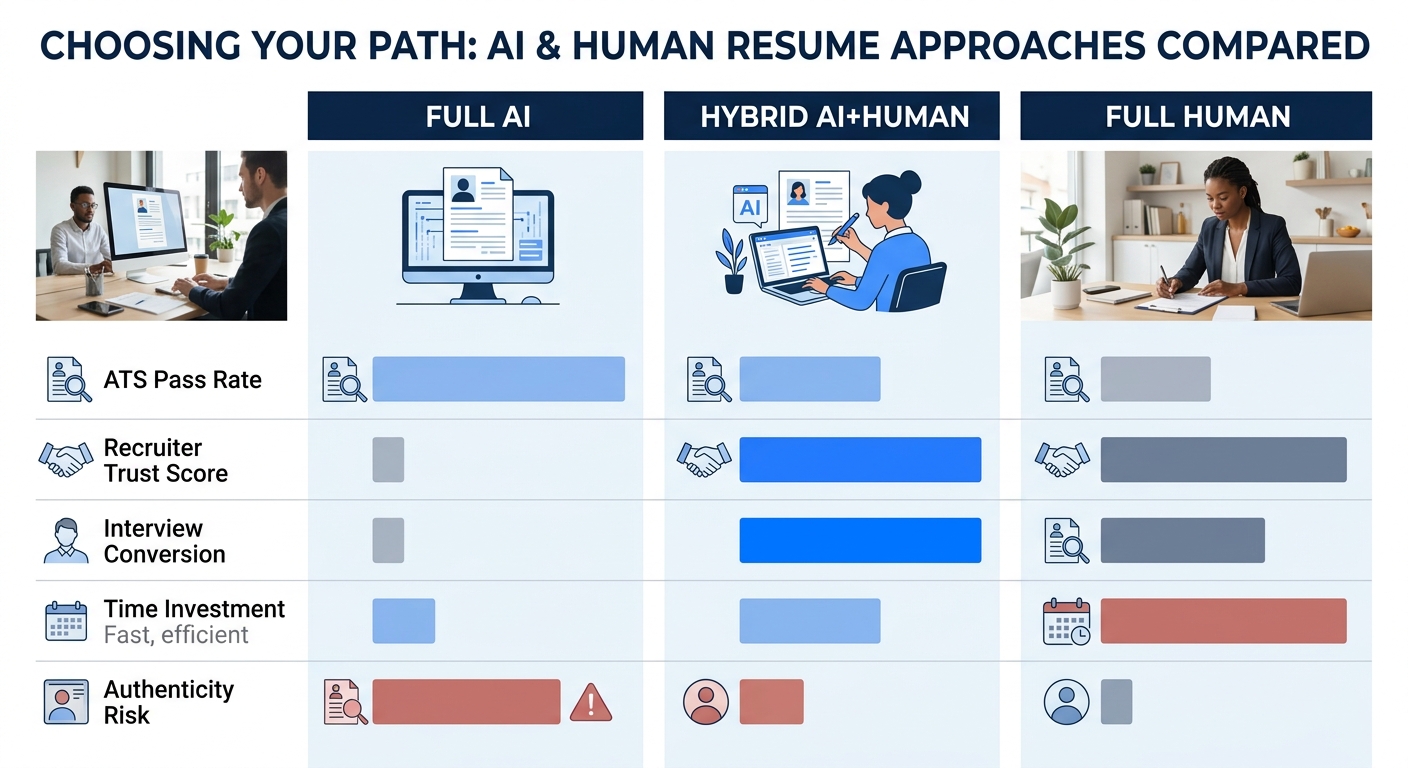
| Metric | Full AI | Hybrid (AI + Human) | Full Human |
|---|---|---|---|
| ATS pass rate | Highest (82% advantage over human-only) | High (keyword-optimized structure) | Lowest (often misses keyword patterns) |
| Recruiter suspicion | High (72% flagged in audits) | Low (natural voice masks AI structure) | Very low |
| Interview conversion | Poor (phone screens expose gaps) | Strong (candidates can speak to every bullet) | Strong |
| Time investment | 10-20 minutes | 1-3 hours | 3-8 hours |
| Authenticity risk | Severe (identical phrasing across candidates) | Minimal (unique substance preserved) | None |
Going Fully Human in an AI-Screened Market
The fully human-written resume carries the highest authenticity in resumes but faces a structural disadvantage that’s gotten worse every quarter. When AI-written resumes pass automated screening at 82% higher rates, your carefully crafted, genuinely personal resume can get filtered out before any human sees it.
This isn’t a theoretical concern. Brookings Institution research on AI resume screening found that racial bias compounds the problem: resumes with white-associated names were preferred in 85.1% of test cases, while resumes with Black-associated names led in just 8.6%. Equal selection rates appeared in only 6.3% of tests. The AI systems doing this screening aren’t reading for authenticity. They’re pattern-matching against training data that encodes existing biases. A purely human-written resume that doesn’t hit the right keyword patterns faces both algorithmic disadvantage and potential bias amplification.
Professional resume writers understand this tension. As one career strategy expert explained on CareerVillage, “a resume writer understands industry trends, hiring language, and strategy—things AI often misses. They know how to highlight your achievements in a way that connects with recruiters and passes ATS checks naturally.” The key word there is “naturally.” A skilled human writer produces something that reads as authentic because it is, while still incorporating the structural awareness that ATS systems require.
The fully human approach makes the most sense in three specific situations: when you’re applying to fewer than 10 carefully selected positions, when you’re in a field where personal voice and writing quality are themselves job qualifications (journalism, marketing, executive leadership), or when you’re working with a professional resume writer who understands how ATS parsing and human reading work together.
The resume that survives every automated filter but sounds like it was written by the same AI as 7,200 other applications isn’t a competitive advantage. It’s a uniform.
But for most job seekers sending 20, 40, or 80+ applications during a market where job searches average 108 days to first offer, the time investment of writing each resume entirely by hand becomes unsustainable. That 3-to-8-hour-per-application cost means either fewer applications or declining quality as fatigue sets in—neither of which improves your odds.

The Honest Answer
The hybrid approach wins for the majority of job seekers. The data points converge on a clear pattern: AI structure gets you past the 82% ATS advantage threshold, while human substance and voice keep you from triggering the over-polished resume red flags that flagged 72% of fully AI-generated applications in recent audits.
Your field, your application volume, and your interview skills should determine how far toward either extreme you lean. A software developer applying to 50 positions benefits heavily from AI-assisted keyword optimization across different job descriptions. A creative director applying to 3 agencies should write every word personally. A mid-career professional navigating a career change needs the hybrid approach most acutely, because translating transferable skills into ATS-friendly language requires both structural awareness and genuine self-knowledge.
The hiring manager resume screening process in 2026 has become an AI-reads-AI loop: candidates generate resumes with AI, employers screen them with AI, and the humans at both ends struggle to maintain meaningful signal. Breaking that loop requires you to be strategic about where you accept AI’s help and where you insist on your own voice. The resume that performs best through the entire hiring pipeline—ATS gate, recruiter skim, hiring manager deep read, phone screen, panel interview—is the one where AI handled the architecture and you filled every room with something only you could have put there.